Exclusive Interview with an Ethereum Foundation Researcher: Rollups, Social, and Gaming Sectors Will Ultimately Benefit from Danksharding
TechFlow Selected TechFlow Selected
Exclusive Interview with an Ethereum Foundation Researcher: Rollups, Social, and Gaming Sectors Will Ultimately Benefit from Danksharding
Danksharding's next steps, its value, and the new use cases enabled by Proto-Danksharding.
 Navigating Web3 tides with focused insights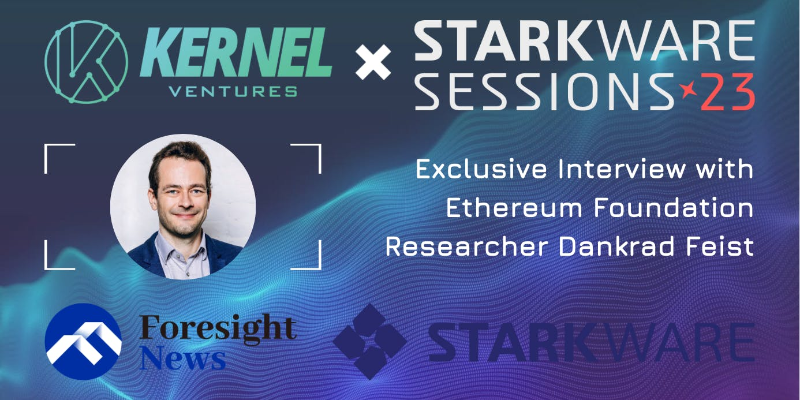
Author: Rose
Translation: TechFlow
This episode of Kernel Talk features an interview with Dankrad Feist, researcher at the Ethereum Foundation. As the person who proposed the new sharding design and the concept of Danksharding, Dankrad shares insights on the next steps, value proposition, and new use cases enabled by Proto-Danksharding. Kernel Ventures, a cryptocurrency venture fund focused on supporting developer communities and the world’s most creative innovators, is highly optimistic about the future development of Ethereum and Danksharding.
1. What comes after Proto-Danksharding in the roadmap for Danksharding?
Proto-Danksharding was designed to make upgrades extremely smooth, so it already incorporates essentially all the cryptography and fundamental components we need for sharding. This means we can gradually upgrade without requiring another hard fork of Ethereum. Therefore, all upcoming developments will be things we can implement at the network layer. And some of these improvements could come quite soon.
For example, we can optimize how blobs are transmitted across the network, enabling modest scaling—potentially doubling or quadrupling the number of commitments allowed. These enhancements could be realized within six months to a year after the initial rollout.
2. What is the biggest added value brought by Danksharding? Does its implementation enable entirely new types of applications, and what else can we expect?
The greatest value of Danksharding lies in providing a scalable data availability layer. For rollups, this enables processing massive volumes of transactions, which translates into significantly cheaper fees. To me, this means we are finally ready to unlock the full potential of cryptocurrency—the kind of vision people had when designing and building Ethereum in 2014 and 2015. Not only can this vision now be realized, but it can also be used by large numbers of users. I believe the possibilities are endless. We’ll see many innovations—even basic applications like payments become transformative once they’re cheap and scalable enough.
3. Do Optimistic Rollups and zk-Rollups benefit equally from Proto-Danksharding and Danksharding?
Broadly speaking, yes. Both Optimistic Rollups and zk-Rollups require a data availability layer to achieve low-cost and scalable transactions. This provides them with far more data than currently available through Ethereum's main chain. They can benefit in similar ways, although there might be slight differences in implementation details depending on the specific blockchain architecture.
4. What are your thoughts on storage after Ethereum sharding? Are you aware of any projects working on this?
Essentially, Ethereum will not be responsible for storing rollup states. While Ethereum ensures the publication of all data needed to update state, the state itself must be maintained—and potentially incentivized—by the rollups. That part is largely up to them. I think some ideas and solutions are already emerging. However, given the size of current rollups, I don't see this as a major issue yet because their states remain small enough that they won’t get lost even without special incentives. But if someone wants to build rollups with much larger states—which I believe should definitely happen—then incentive mechanisms become worth serious consideration.
5. Do you see any new use cases enabled by Proto-Danksharding, such as in social or gaming? What new or exciting applications are you looking forward to?
Absolutely. As you mentioned, both social and gaming applications will ultimately benefit from cheaper transactions. I find social applications particularly interesting because they aren’t necessarily tied to real-world bridges like financial apps are. Financial applications face regulatory complexities when leveraging Ethereum’s security. But in social and gaming contexts, we can do a lot without needing those connections. So I’m very excited to see what emerges. I believe all of this becomes possible thanks to having a scalable base layer.
Join TechFlow official community to stay tuned
Telegram:https://t.me/TechFlowDaily
X (Twitter):https://x.com/TechFlowPost
X (Twitter) EN:https://x.com/BlockFlow_News
 Kernel Ventures