ABCDE: Why We Invested in Polyhedra Network?
TechFlow Selected TechFlow Selected
ABCDE: Why We Invested in Polyhedra Network?
PolyHedra Network is a ZK full-stack project that has developed two advanced ZKP protocols, deVirgo and paraPlonk, enabling full-stack ZK interoperability and scalability.
 Navigating Web3 tides with focused insights
Polyhedra Network is a full-stack ZK project with a core team from UC Berkeley, Tsinghua University, and Stanford University. It has developed two advanced ZKP protocols—deVirgo and paraPlonk—enabling full-stack ZK interoperability and scalability.
Polyhedra Network has secured $10 million in strategic funding from top global VCs (see CoinDesk's coverage). ABCDE is also an investor in Polyhedra Network.
1. ZK Scalability vs. ZK Interoperability
We know the internet, blockchain, and Metaverse all require connectivity. Yet today’s multi-chain world remains fragmented into isolated islands, with liquidity and data availability becoming increasingly siloed. Most cutting-edge ZK projects—including zkRollups, zkEVMs, and zkVMs—focus primarily on scalability, while ZK interoperability has been overlooked. In contrast to Starkware, Zksync, and others that focus solely on ZK scalability, Polyhedra Network is a full-stack ZK “hexagonal warrior,” designing and implementing zkBridge—a ZK-based interoperability system—while its proprietary ZKP protocols also enhance the efficiency of existing zkRollup systems, achieving both ZK interoperability and scalability.
In ZK interoperability, Polyhedra Network has implemented deVirgo, an industry-leading distributed ZK protocol, which powers zkBridge and ZKDID, providing trustless and efficient interoperability infrastructure for Web3. The zkBridge testnet is already live, enabling cross-chain interoperability between networks such as Ethereum, BNB Chain, and Cosmos.
Virgo is a GKR protocol based on error-correcting codes and hash functions—the same cryptographic assumptions used by Starkware and Polygon Zero. Virgo does not require trusted setup, allowing ordinary users with just a laptop or smartphone to become Provers without downloading massive data from servers (a well-known industry challenge). At the same time, Virgo is one of the fastest ZKP protocols available today.
deVirgo is a highly efficient distributed ZKP protocol built on Virgo. It achieves near-perfect linear scalability, meaning that in a distributed computing network with M machines, proof generation time can be reduced by nearly M times. Moreover, communication across the distributed network in deVirgo is minimized during the main computation phase (the GKR part). Using deVirgo, zkBridge’s proof generation speed can be further accelerated—up to 100 times faster than single-threaded Virgo.
So what exactly are zkBridge and zkDID powered by distributed deVirgo?
1.1 zkBridge
Polyhedra Network has engineered the deVirgo protocol and designed and implemented zkBridge based on it. The zkBridge testnet is now live, supporting cross-chain asset and data interoperability across various Layer-1 and Layer-2 blockchains including Ethereum, BNB Chain, Cosmos, and Polygon—providing trustless and efficient infrastructure for Web3 interoperability. For integration with DeFi, GameFi, and other Web3 applications, Polyhedra Network offers developer-friendly APIs to simplify building cross-chain and multi-chain applications.
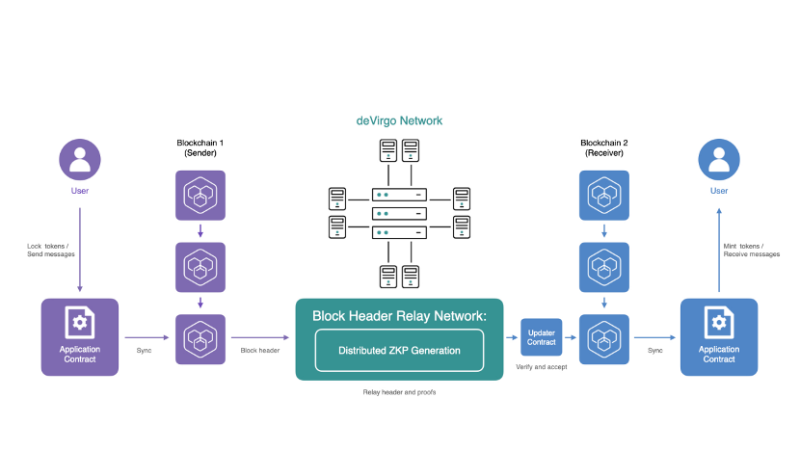
For blockchains with light client protocols, Polyhedra Network compiles these protocols into zk-SNARK circuits and proves their correct execution. The receiving chain can then efficiently verify the execution. With a modular architecture, zkBridge supports multiple use cases such as cross-chain asset transfers and swaps, message passing, and state synchronization across multiple blockchain networks.
1.2 zkDID
zkDID is a scalable and interoperable DID solution based on SBTs and verifiable credentials using ZKPs, with a testnet already launched. zkDID aims to support millions of verifiable credentials per second, empowering billions of users to access Web3 infrastructure and applications. Additionally, zkDID leverages ZKP to implement a privacy solution based on Vitalik’s proposed stealth addresses, enabling fine-grained control over personal information. zkDID infrastructure is compatible with W3C standards and any verifiable credential data type, and achieves cross-interoperability across Web3 and Web2 systems via zkBridge, significantly simplifying communication among stakeholders in Web3 DID ecosystems.
2. ZK Scalability via paraPlonk
Beyond ZK interoperability, Polyhedra Network has also designed and implemented paraPlonk, which experimentally accelerates existing zkRollup systems.
paraPlonk is a suite of next-generation ZKP protocols based on segregation-friendly and succinct proof techniques. With paraPlonk, nodes in a cluster can jointly generate ZKP proofs similarly to mining pools. Nodes only need to broadcast minimal data during proof generation. paraPlonk is Plonk-compatible and serves as a generalized version of Plonk, drastically reducing communication overhead among distributed Plonk nodes while preserving all of Plonk’s advantages. Thus, any Plonk-based proof system can migrate to paraPlonk with minimal modifications. paraPlonk’s design is also compatible with other ZK systems like Marlin and Gemini—protocols co-invented by founding members of Polyhedra Network, with Marlin already deployed in Aleo.
3. ZK Full-Stack
Polyhedra Network’s vision is to become a true full-stack ZK project that unifies ZK interoperability and ZK scalability, enabling seamless connectivity between Web2 and Web3 through ZK components like zkBridge and zkDID.
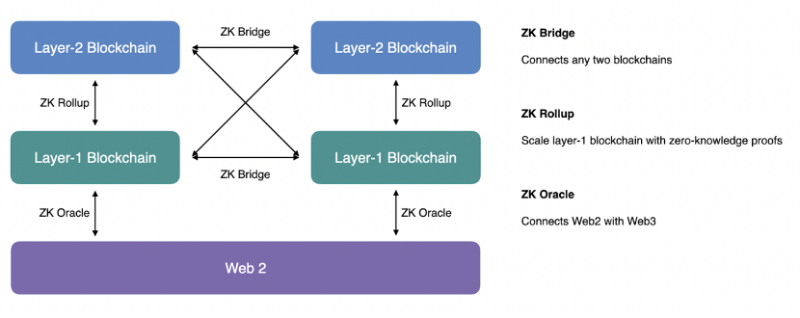
At the infrastructure layer, Polyhedra Network implements zkBridge via advanced ZKP protocols, connecting any two blockchains. paraPlonk accelerates existing zk-Rollups and enhances scalability for Layer-1 blockchains.
At the middleware and application layer, Polyhedra Network enables zkDID and zkOracle through interoperability technologies, bridging Web2 and Web3 worlds.
Just like its name “Polyhedra”—meaning “many-faced”—Polyhedra Network truly embodies a full-stack hexagonal warrior, combining both ZK interoperability and ZK scalability.
About ABCDE
ABCDE is a venture capital firm focused on leading investments in top-tier crypto builders, co-founded by Du Jun, co-founder of Huobi with over 10 years of experience in the crypto industry, and BMAN, a former internet and crypto entrepreneur. The co-founders of ABCDE have built billion-dollar market cap companies from the ground up in the crypto space. Being founders ourselves, we deeply understand the needs of builders. We’ve already established a comprehensive ecosystem for our portfolio builders—including a publicly listed company (1611.HK), an exchange (Huobi), a SaaS provider (ChainUP), a media platform (CoinTime.com), and a developer platform (BeWater.xyz). If you’re a builder with a vision to change the world, join us in building the next-generation crypto network.
Twitter: https://twitter.com/ABCDECapital
Website: www.ABCDE.com
Join TechFlow official community to stay tuned
Telegram:https://t.me/TechFlowDaily
X (Twitter):https://x.com/TechFlowPost
X (Twitter) EN:https://x.com/BlockFlow_News
 ABCDE
ABCDE