








DeFund Protocol: A decentralized on-chain fund and a Web3-native capital management protocol
TechFlow Selected TechFlow Selected
DeFund Protocol: A decentralized on-chain fund and a Web3-native capital management protocol
In decentralized blockchain finance, users also need professional blockchain fund managers.
 Navigating Web3 tides with focused insights
By Jaleel
After the collapses of CeFi platforms such as Celsius and Voyager, centralized fund management has become a negative term in the crypto space, prompting users to seek new alternatives within DeFi. With market sentiment improving this year, innovation in the DeFi sector has drawn increasing attention, particularly in two high-interest areas: derivatives and decentralized fund management.
-
In traditional finance, funds are among the highest-volume instruments, where experienced fund managers help lower investment barriers, reduce risks, and improve asset returns for investors.
-
Similarly, in decentralized blockchain finance, users also require professional blockchain fund managers. DeFund Protocol was born out of this very need.
What exactly is the DeFund Protocol? How does it work, and how can one participate? BlockBeats provides a brief overview.
A Web3-Native Fund Management Protocol
DeFund Protocol is a blockchain-based decentralized fund investment protocol that allows anyone to manage fund assets via smart contracts to generate higher returns. Fund managers do not require large capital reserves or institutional backing—performance is entirely data-driven. Built on Ethereum smart contracts, DeFund enables fully decentralized fund management, allowing users to interact directly with the protocol at any time without third-party authorization or permission for fund operations.
While maintaining decentralization, DeFund aims to integrate with major DeFi protocols like Uniswap for trading and liquidity provision, leveraging permissionless liquidity to ensure the protocol's perpetual operation. Currently built atop Uniswap, DeFund selects supported Pools and Tokens from Uniswap, with future plans to enhance composability with additional DeFi protocols, offering greater flexibility in investment strategies for decentralized funds.
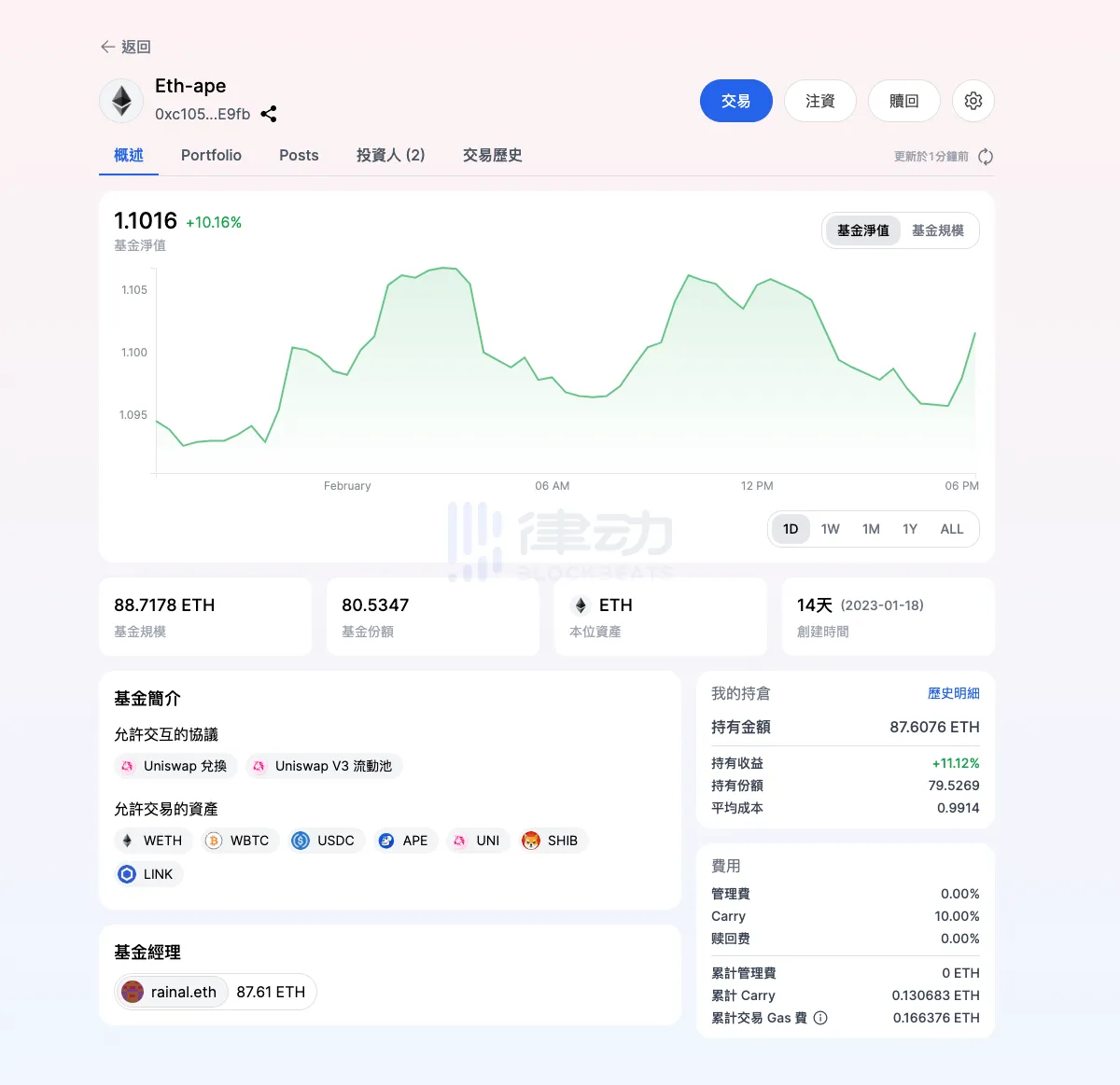
To protect the interests of LPs (Limited Partners/investors) and GPs (General Partners/fund managers), DeFund sets criteria for eligible Pools and Tokens. Initial selection rules include: Uniswap Pools with TVL exceeding $5M; more than 100 Positions; and independent Owners exceeding 70% of total Positions. These parameters may be adjusted later through DAO governance.
LPs can monitor fund performance in real-time, subscribe to or redeem from funds instantly, and set stop-loss triggers that automatically redeem their entire investment when activated.
GPs hold management rights, enabling them to create funds, define investment caps, management fees, carry rates, select underlying protocols and tokens, and specify eligible LP addresses and minimum investment thresholds. Within defined operational boundaries, GPs can execute investment activities on Uniswap (swaps and liquidity pools). Additionally, a GP may appoint up to five traders to assist in fund operations.
Like traditional funds, DeFund supports both public and private funds. Public funds are open to all investors unless subscription limits are reached. Private funds require investors to be on a whitelist—only whitelisted addresses may invest.
Mechanism Overview
Currently, DeFund allows one-to-many open-ended fund management via smart contracts, supporting Uniswap swaps and liquidity pools. Support for additional DeFi protocols will be added in the future.
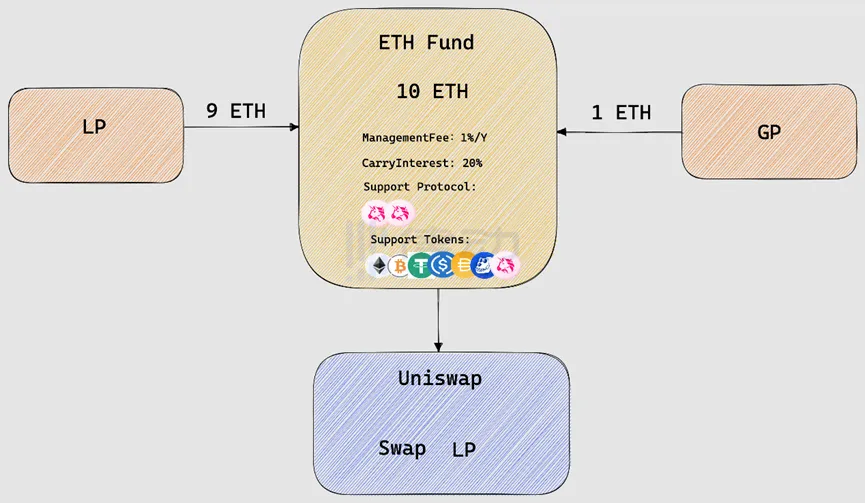
The fund contract is initiated by the GP and can be either public or private. Anyone can invest in public funds, while only whitelisted addresses can join private funds. The initial investment from an LP must meet or exceed the minimum subscription amount set in the contract. For example, in the illustration above, the GP and LP contribute 1 ETH and 9 ETH respectively, forming an initial fund value of 10 ETH. The GP then operates the fund according to predefined terms—such as a 20% carry and 1% annual management fee—and conducts daily operations based on selected protocols and tokens to generate returns.
The DeFund economic model involves three key parties: LPs (note: GPs act as LPs when making subscriptions), GPs, and the platform. The GP centrally manages the fund’s capital to generate profits, which are shared between LPs and GPs. LPs provide capital for the GP to deploy, and upon redemption, performance-based carry fees are distributed to the GP. GPs earn two types of annual income: management fees and carry fees, and may also set custom redemption fees.
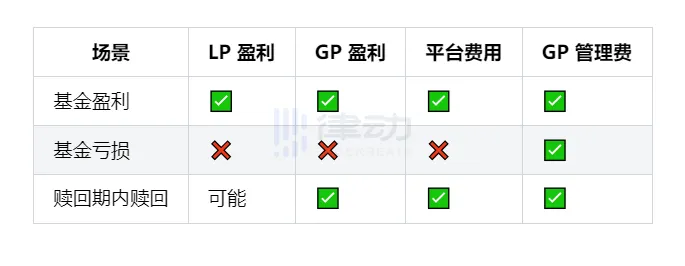
Management fees are paid by LPs to cover the GP’s ongoing operational costs. These fees accrue annually (365 days) from the moment the fund is established (after both GP and LP have funded the contract), calculated in seconds. GPs can withdraw accrued management fees at any time during fund operation. Even if full liquidation is triggered by either party, any remaining unclaimed management fees will still be calculated and transferred to the GP.
Carry fees represent the GP’s primary incentive for strong performance. Each time an LP initiates a redemption, the system calculates realized profits. If profitable, the carry is distributed based on the current split ratio—currently 5% of net profits goes to the protocol, though this parameter is adjustable via DAO governance, with the remainder sent to the GP. The specific carry calculation logic is as follows:
To support sustainable fund operations, GPs may set redemption fees and lock-up periods. LPs redeeming within this period are charged accordingly. During the redemption window, fees are split—20% goes to the DAO treasury and 80% to the GP.
Development Progress
Currently in V1, DeFund Protocol supports ERC20 token-based fund management on Ethereum, offering features such as limit orders, insurance pools, and protocol fees. In Q2 2023, DeFund plans to launch V2, enabling cross-chain fund management across platforms including BSC, Polygon, and Solana, along with expanded investment strategies and tools. Additionally, according to DeFund founder Jason, the team is developing an investment strategy API that will allow GPs to quickly build automated on-chain trading strategies, further reducing the cost and complexity of fund operations.
How to Create Your Own Fund on DeFund?
1. Visit the DeFund Protocol homepage, connect your wallet, and switch to the testnet. Click "Enter APP" in the top-right corner to access the application. Click the "Create Fund" button, proceed to the fund creation page, and click "Get Started".
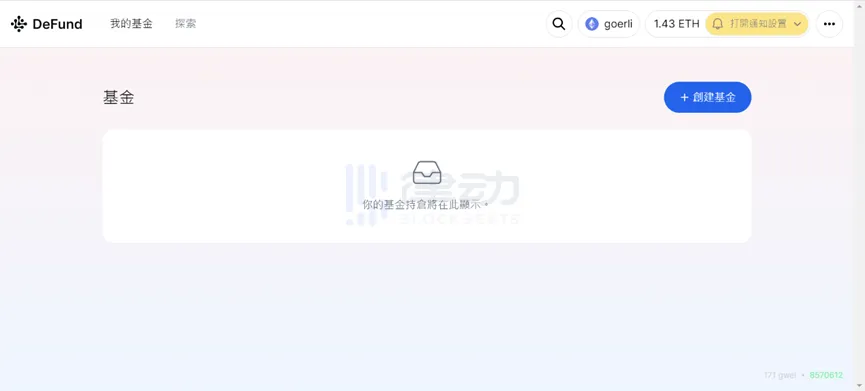
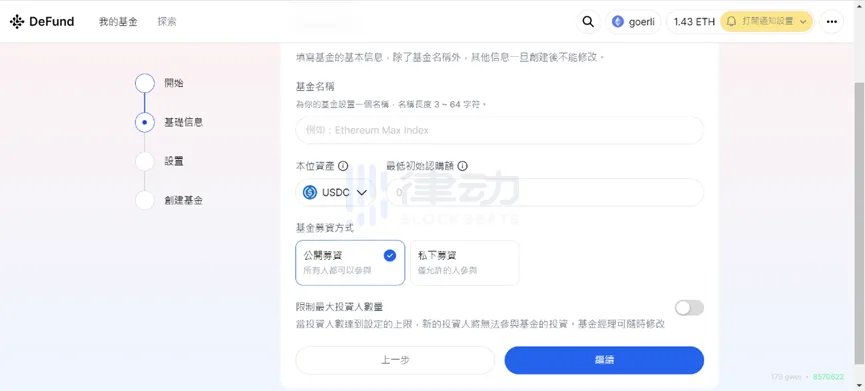
2. Fill in basic fund details according to your needs, including fund name, base asset, minimum subscription amount, fundraising method, and maximum number of investors (optional). After reviewing, scroll down and click "Continue".
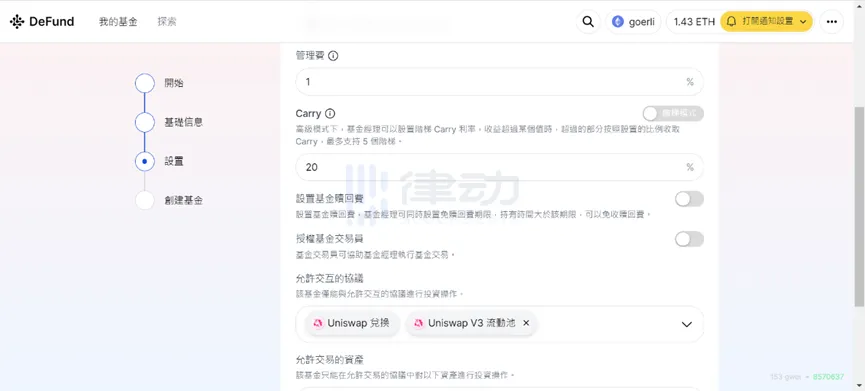
3. Proceed to the fund configuration page, where you can set the manager address, management fee rate, carry fee rate, redemption fee, assistant traders (optional), allowed protocols, and permitted tradable assets. After confirmation, scroll down and click "Continue".
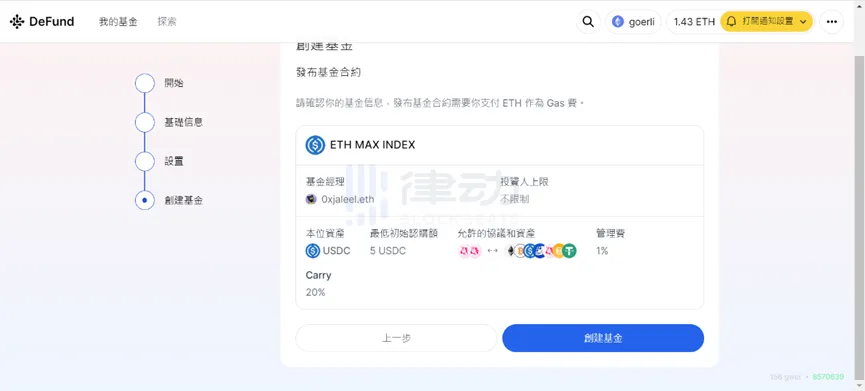
4. Review all settings on the final contract deployment screen. Once confirmed, click "Deploy Contract" to publish the fund. After blockchain confirmation, your decentralized fund is live. Issued funds can be viewed under "My Managed Funds".
How to Invest in and Redeem Funds on DeFund?
1. Access a fund page via its link to view details such as description, fees, and fund manager information. If satisfied, click the "Deposit" button in the top-right corner to subscribe.
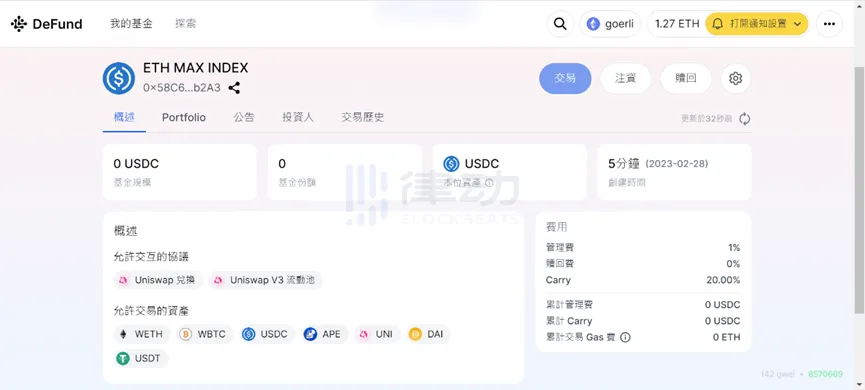
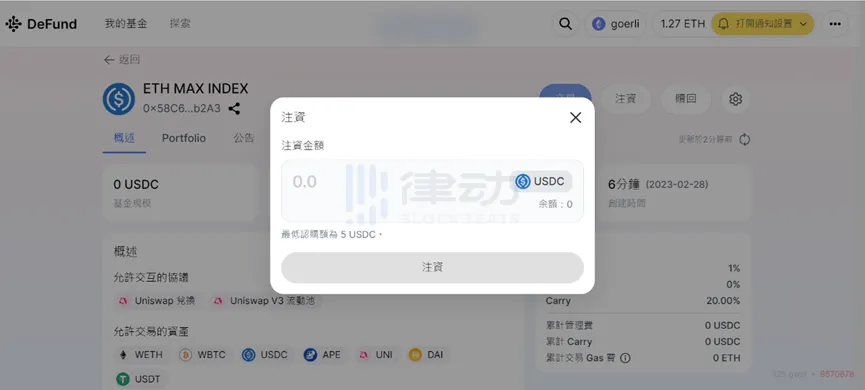
2. Select the deposit amount and confirm by clicking "Deposit". After blockchain confirmation, your investment is complete. View investment details under "Investors" or "My Funds".
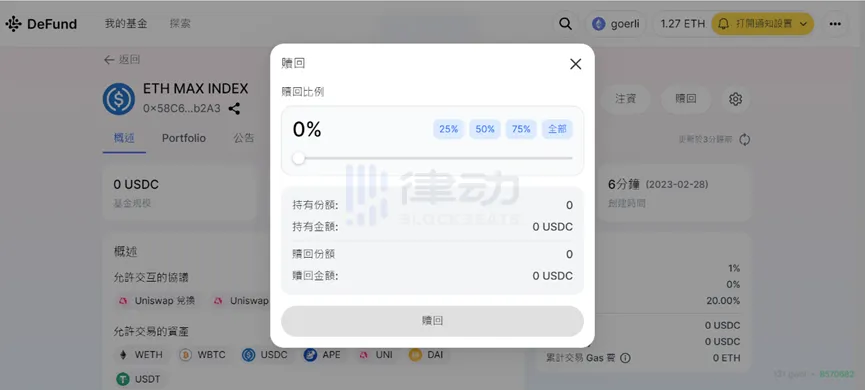
3. To redeem your investment, navigate to the fund’s detail page. Click "Redeem", select the redemption percentage, confirm, and submit. After blockchain confirmation, redeemed assets will be automatically returned to your wallet.
BlockBeats reminds readers that while DeFund Protocol aims to solve fund management challenges in crypto, it also faces risks and hurdles such as market competition, technological innovation, and regulatory uncertainty. Users should exercise caution, conduct thorough research, and carefully select trusted fund managers before committing real funds on mainnet.
Join TechFlow official community to stay tuned
Telegram:https://t.me/TechFlowDaily
X (Twitter):https://x.com/TechFlowPost
X (Twitter) EN:https://x.com/BlockFlow_News
 BlockBeats






