








LSD Matryoshka War Escalates: It's Not Just About Liquidity Anymore—High Yields Are the New Frontier
TechFlow Selected TechFlow Selected
LSD Matryoshka War Escalates: It's Not Just About Liquidity Anymore—High Yields Are the New Frontier
LSD (Liquid Staking Derivatives) was the dominant narrative in the crypto market during the first half of 2023, and even throughout the entire year.
 Navigating Web3 tides with focused insights
By: Yu Zhong Kuang Shui
LSD (Liquid Staking Derivatives) was the dominant narrative in the crypto market during the first half of 2023—and arguably for the entire year. Since January 10th, tokens related to LSD have led the market rally. The original purpose of LSD is to unlock liquidity—issuing liquid tokens against staked assets. For example, Lido Finance issues stETH as a liquid token when users stake their ETH.
Why do we consistently focus on and remain bullish about the LSD ecosystem?
Put simply, if ETH is considered the "US dollar" of the crypto world, then stETH acts like a rigidly redeemable "US Treasury bond" with built-in yield. Whether it's Lido Finance, Rocket Pool, or SSV.Network, these protocols aim to solve pain points associated with Ethereum staking—such as difficulty setting up validator nodes, high minimum staking thresholds, and low capital efficiency. However, it wasn't until Frax Finance introduced new LSD products that yield became a major focal point.
frxETH aims to boost user returns through DeFi: users can either provide liquidity in Curve’s frxETH-ETH pool or stake frxETH to receive sfrxETH and earn staking rewards. Its high yields come from two sources: Frax Finance shares all ETH staking rewards from the underlying frxETH assets with sfrxETH stakers, while also using Convex-based vote bribes to offer enhanced returns to frxETH-ETH LPs (note: frxETH holders themselves do not receive staking yield distributions).
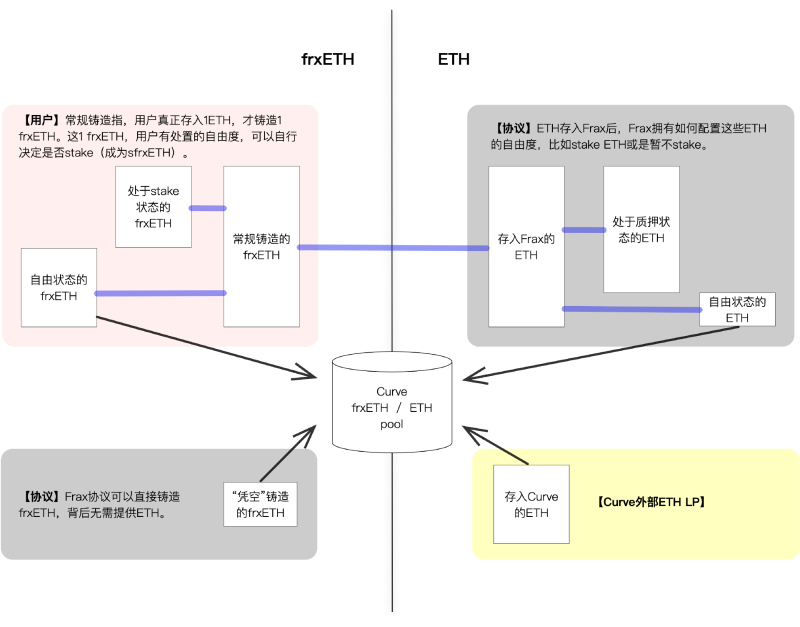
Following Frax Finance, this trend of DeFi “matryoshka” stacking has intensified. LSD protocols now must not only offer liquidity but also compete fiercely on yield to attract users and capital.
We will now focus on three key protocols: Yearn ($YFI), Pendle Finance ($PENDLE), and Aura Finance ($AURA).
Yearn
Yearn, launched by Andre Cronje in early 2020, is an Ethereum-based DeFi yield aggregator designed to maximize returns for ETH, stablecoins, and other tokens.
On February 22nd, Yearn officially announced it would soon launch a new product called «yETH», which aims to represent a diversified basket of LSD assets, enhancing yield while spreading risk.
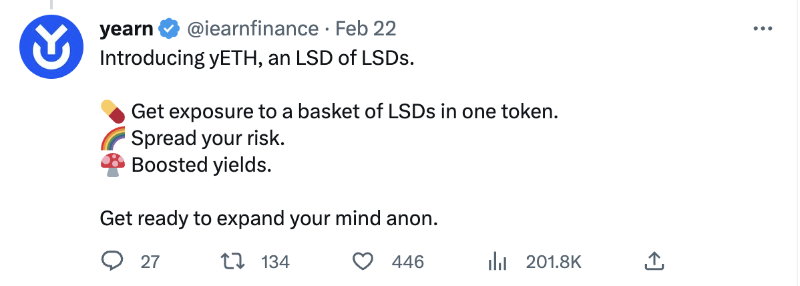
According to community speculation, yETH will be built atop first-layer LSD assets such as stETH and frxETH, and will benefit from preferential governance allocations via Yearn’s holdings of veCRV. To compare yields, Twitter user @MStiive created the following yield comparison chart.
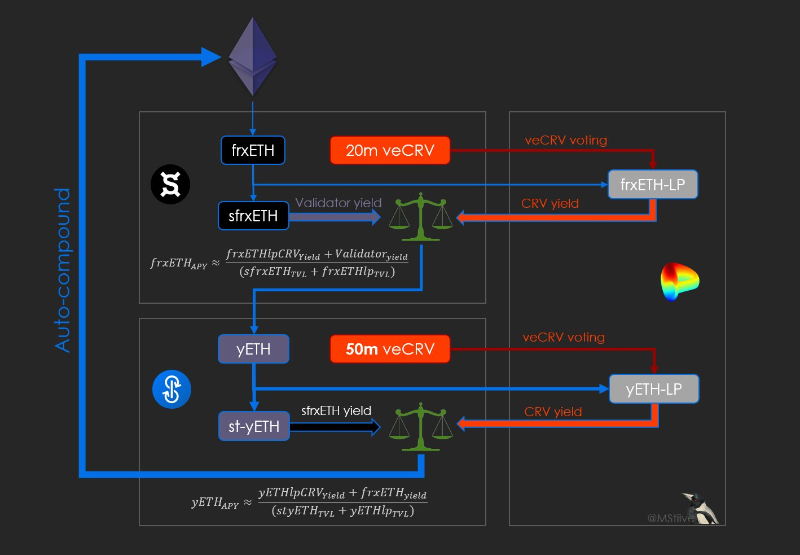
As shown in the model above, Yearn and Frax Finance aren’t direct competitors since yETH’s underlying collateral consists not of ETH, but of LSD assets like stETH and frxETH. Instead, yETH offers higher yields to holders of those assets, potentially triggering a powerful flywheel effect for Ethereum staking—or perhaps a new wave of matryoshka-like composability.
Of course, all of this remains speculative until official confirmation.
Pendle Finance
Pendle Finance is a DeFi protocol built on Ethereum, Arbitrum, and Avalanche that enables tokenization of future yield. It allows users to tokenize and sell the expected future earnings from certain assets.
How does it work?
Pendle wraps interest-bearing assets into SY (Standardized Yield) tokens, which are then split into PT (Principal Tokens) and YT (Yield Tokens). Because yield accrual depends on time, Pendle essentially packages SY over time, separating principal from yield.
YT represents the accrued yield over a specific period, while PT can be redeemed 1:1 for SY at maturity. Users can trade PT and YT on Pendle’s v2 AMM, which incorporates a time-decay factor into traditional AMM mechanics, enabling trading of yield tokens (YT).
How does this structure unlock maximum yield potential?
With Pendle, users can execute advanced yield strategies—such as purchasing interest-bearing assets at a discount, e.g., buying $ETH at a 6.59% discount or $APE at a 20.85% discount.
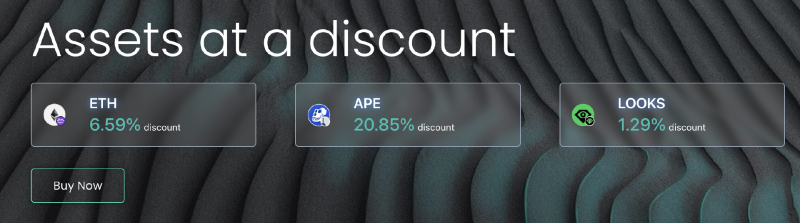
Alternatively, users can lock in yield-generating assets—like staking ETH on Lido—to receive PT stETH and YT stETH tokens upfront, then immediately sell the YT stETH tokens via the v2 AMM to realize future yield today.
In short, LSD protocols help users stake ETH and maximize yield, while Pendle enables the monetization of those future yields today.
Currently, Pendle supports LSD assets from Lido Finance, Rocket Pool, and Aura Finance.
Aura Finance
Currently, stETH and cbETH dominate most of the LSD market share. Smaller players aiming to catch up have one clear strategy: offer greater incentives:
1. Higher yields
2. Increased liquidity
3. DeFi integration with stronger composability
Aura Finance delivers exactly that. It is a yield and governance incentive platform built on Balancer, much like how Convex relates to Curve.
According to Dune analytics, Aura holds 26.2% of all $veBAL. By leveraging veBAL-based vote bribes, liquidity providers (LPs) can earn significantly higher yields. The advantage of Balancer’s liquidity mining wars lies in its superior capital efficiency compared to Convex, which ultimately benefits Aura as well.
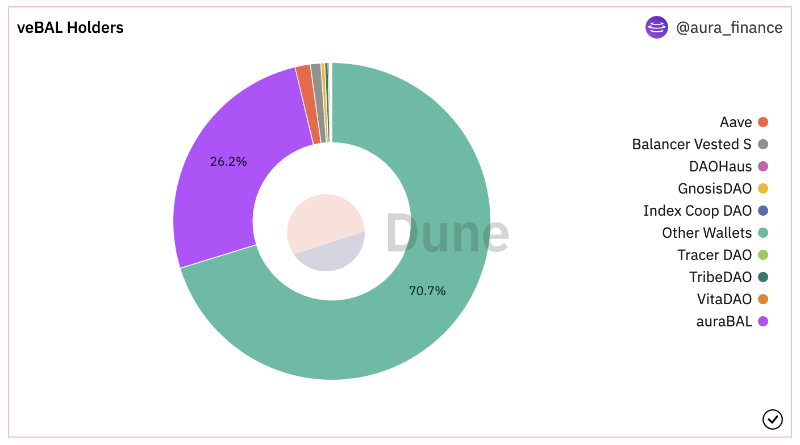
Earlier, we discussed Frax Finance and Yearn’s success in Curve’s liquidity wars—Frax owns 20 million $veCRV, while Yearn holds 50 million. Over time, both Lido Finance and Rocket Pool have begun competing for Balancer’s liquidity. As a veteran DeFi protocol, Balancer boasts $1.1 billion in TVL (Total Value Locked), making it a prime battleground. Aura Finance is positioned to be the primary beneficiary of this LSD-driven liquidity war on Balancer.
As stated in Aura’s tweets, LSD protocols aiming to increase the utility of LSD assets will start within DeFi—such as becoming popular collateral types in CDPs and money markets. ETH is widely accepted as collateral due to its strong liquidity, allowing protocols to quickly liquidate positions and avoid bad debt.
To ensure robust liquidity for LSD assets, a liquidity war becomes inevitable—and Aura Finance is set to lead this battle on Balancer.
Through Aura Finance, LSD protocols gain the opportunity to kickstart liquidity flywheels for USD and altcoin trading pairs. Once activated, these liquidity networks could create powerful network effects, establishing LSD assets as default mainstream trading pairs.
Currently, Aura Finance has partnered with nearly every major LSD protocol, including Lido Finance, Rocket Pool, Swell Network, Stakewise, Stader, Ankr, and StaFi. It’s foreseeable that these LSD protocols will engage in governance wars over AURA voting power to protect and grow their market share.
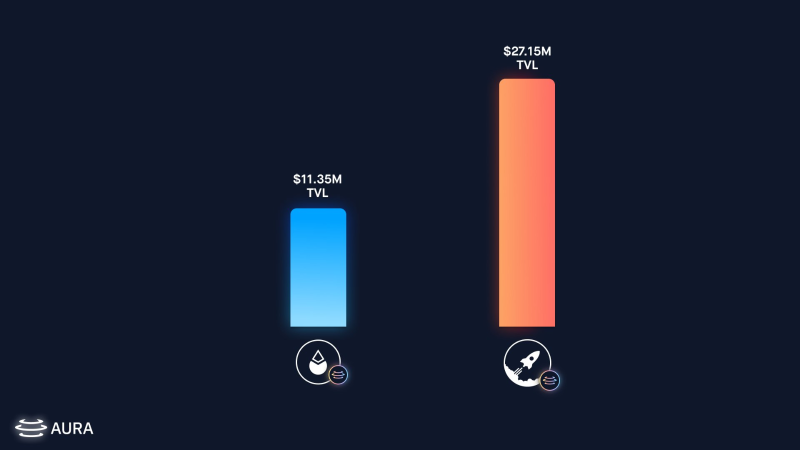
Rocket Pool was the first LSD protocol to participate in Aura Finance’s liquidity incentives. Official data shows that although Lido’s stETH altcoin liquidity pools have surpassed $11 million in TVL, rETH—with its first-mover advantage—has already achieved over $27 million in TVL for its altcoin trading pairs.
Moreover, Frax Finance CEO Sam Kazemian has hinted in the community that he plans to accumulate AURA positions.

At its core, the competition surrounding Aura Finance and Balancer reflects a broader battle among LSD protocols for liquidity dominance.
In Conclusion
Looking at this evolving LSD war, we can analyze this emerging sector from two perspectives:
From the user perspective: LSD protocols eliminate minimum staking requirements and deliver higher yields—the leading examples being Lido Finance and Frax Finance.
From the LSD protocol perspective: survival and growth are paramount. Protocols must expand market share to thrive. Yearn and Pendle act more like catalysts in the LSD market—their support can accelerate a given protocol’s growth. Meanwhile, Aura may emerge as the central protocol in the LSD market share race, with its governance rights becoming a key prize contested by all major LSD players.
Join TechFlow official community to stay tuned
Telegram:https://t.me/TechFlowDaily
X (Twitter):https://x.com/TechFlowPost
X (Twitter) EN:https://x.com/BlockFlow_News






