Bankless: How Can Blur Beat Opensea?
TechFlow Selected TechFlow Selected
Bankless: How Can Blur Beat Opensea?
To become the next NFT marketplace champion, what challenges does Blur need to overcome?
 Navigating Web3 tides with focused insights
Written by: William Peaster
Compiled by: TechFlow
$BLUR is finally here. This is the new governance token for NFT marketplace Blur, airdropped upfront to users of the platform.
Expectations around this airdrop were built through three gamified phases that rewarded traders, listers, and bidders—greatly increasing Blur’s visibility and helping it emerge as a genuine competitor to OpenSea, the long-standing NFT market leader.
However, an airdrop alone isn’t enough to challenge OpenSea. The buzz and momentum generated by such incentives are temporary and will only carry so far.
Take NFT marketplaces LooksRare and X2Y2 as examples—they both launched token incentive programs with LOOKS and X2Y2 tokens at the beginning of last year. As you can see in the price comparison chart below, there was initial excitement for both tokens upon launch, followed by significant price declines. Over time, neither managed to capture substantial market share from OpenSea. Of course, their stories continue, but clearly, they’re no longer as exciting or compelling as they once were.
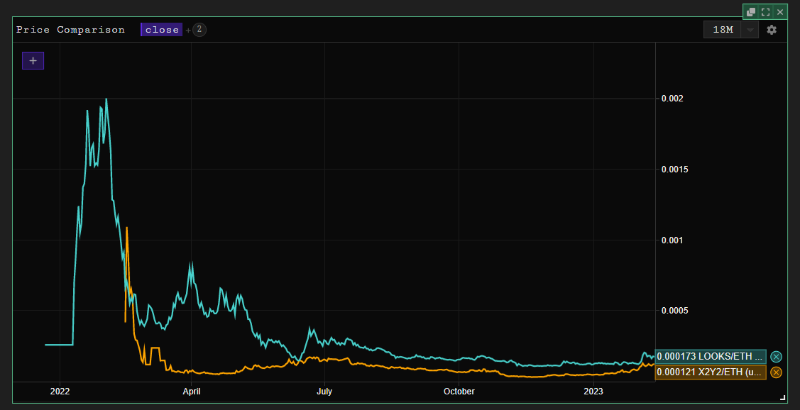
So launching $BLUR is part of Blur's strategy for decentralized governance coordination and capturing market share from OpenSea and other competitors. However, much of the impact of this latter tactic may be temporary—already priced into the market before and after the $BLUR launch.
So what’s the good news about Blur? It genuinely has an appealing UX, making it a legitimate challenger to OpenSea beyond just tokenomics.
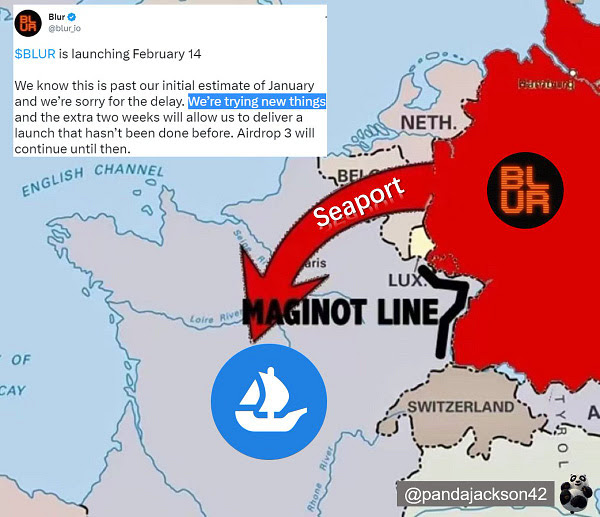
For example, Blur aggregates listings from all major NFT marketplaces—including OpenSea’s Seaport Protocol—so it is not restricted by OpenSea’s marketplace blocklists. In contrast, currently OpenSea only aggregates projects built on top of Seaport, such as ENS, Vision, and Sound.
Moreover, Blur boasts extremely fast listing refresh speeds, distinguishing itself with real-time listings and instant NFT metadata display. According to Blur, its marketplace is 10 times faster than Gem and nearly 20% more gas-efficient—Gem being OpenSea’s NFT aggregator designed for professional traders.
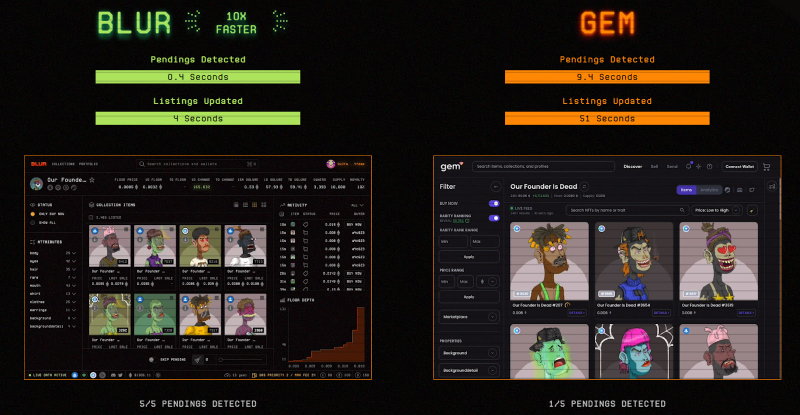
Rich selection, impressive speed, and smooth user experience—these are the pillars Blur aims to stand on and grow its market share. But the question remains: over time, will these pillars combined with the $BLUR launch be enough to truly surpass OpenSea?
Certainly, if Blur hopes to overtake OpenSea—a platform already dominant—it still has much work ahead.
OpenSea launched in December 2017 and has led the space for years, becoming the dominant force in the NFT ecosystem and accumulating unparalleled depth of experience and resources along the way.
Currently, Blur is running neck-and-neck with OpenSea in terms of NFT trading volume levels—a position it has maintained alongside the reigning giant for several weeks.
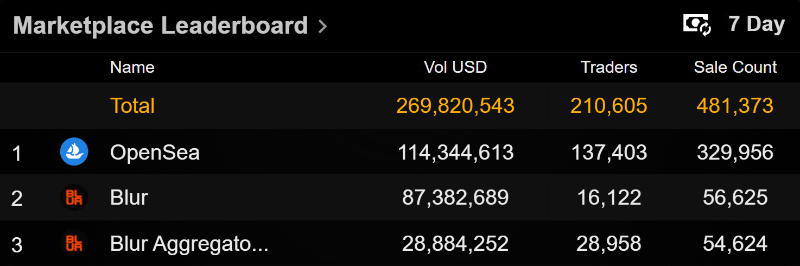
This phenomenon is highly impressive—but it is also largely influenced by anticipation surrounding the $BLUR launch, whose tactical effects we’ve noted are ultimately temporary.
If Blur is to truly win the war for the NFT market, it will need to continue meaningfully advancing and building upon its user experience foundations and the $BLUR launch. Easier said than done, right? So how should this upstart proceed?
In my view, to become the next NFT marketplace champion, Blur needs to achieve the following five things.
1. Protect the Moat
Blur’s speed advantage is real. Its gas efficiency is high. Its bid system is highly flexible. These are currently unique moats for Blur.
These moats remain effective only as long as they stay exclusive to Blur. If competitors catch up—which is possible—then these advantages could evaporate.
To win, Blur must remain faster, more efficient, and more flexible. Of course, easier said than done, and there may not be immediate solutions—but regardless: the moat must be defended.
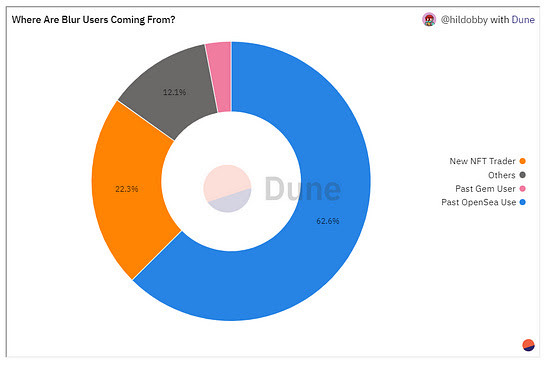
That said, 65% of Blur’s early users came from OpenSea and Gem, so if Blur can solidify its moat, these users might permanently switch over.
As a fan of Gem, I can say that right now I find the user experiences of Blur and Gem to be quite comparable.There are aspects I prefer in Blur, aspects I prefer in Gem, and overall I appreciate both platforms.
2. Keep Rewarding
Blur’s gamified airdrop was an impactful strategy that helped the marketplace match OpenSea’s NFT trading volume levels—up until now.
This counts as a tactical victory—but Blur needs to string together more such victories to succeed, even if each effect is temporary. It appears Blur has already taken this lesson to heart.
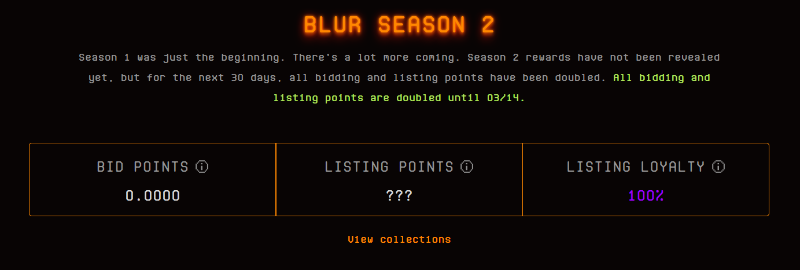
Since the airdrop, they’ve launched “Season Two” $BLUR rewards, where all bids and listing points on the marketplace will be doubled over the next month. A seasonal approach makes great sense here.
3. Push Forward the Plan
For Blur to keep moving forward, it must continuously evolve and innovate.
Stagnation against champion OpenSea, for whatever reason, would undoubtedly cause Blur to miss its window of opportunity.
For instance, perhaps Blur might eventually try to beat OpenSea by optimizing its professional trading UX and focusing on all top L2 chains.
We’ll have to wait and see. Ultimately, it comes down to how well the Blur team determines their highest priorities and skillfully executes and innovates around them.
4. Maintain Fighting Spirit
Without a doubt, Blur is the underdog in this battle. OpenSea’s capabilities, resources, and active user base are immense.
If the Blur team allows these disadvantages to affect their mindset, they won’t be able to defeat OpenSea. Sometimes underdogs win—not because of odds, but because of relentless fighting spirit and the burning desire to win, which over time creates a gap with complacent incumbents.
5. Pray There’s No $SEA Token
I mean, half of any battle is what the opponent does. In other words, Blur can maintain liquidity for its $BLUR rewards and keep rolling out cool features one after another, but it's hard to guarantee it won’t get beaten by OpenSea.
Indeed, many assume it’s settled that OpenSea will never launch its own token. That may very well be true. But imagine if they did airdrop a $SEA token to users? That would be a landmark move, potentially further cementing OpenSea’s dominance for years to come.
After all, wouldn’t OpenSea simply beat Blur by attacking the same four points above? Eroding Blur’s UX moat, launching its own rewards, advancing its own roadmap, and maintaining fighting spirit? Indeed, OpenSea might not even need a $SEA token to beat Blur for some time.
Accordingly, for the Blur team, success may not just be about doing everything perfectly. It might also be like chess—executing their plan skillfully while hoping OpenSea makes a misstep!
Join TechFlow official community to stay tuned
Telegram:https://t.me/TechFlowDaily
X (Twitter):https://x.com/TechFlowPost
X (Twitter) EN:https://x.com/BlockFlow_News