Interview with Bankless Co-Founder David: The Story of Bankless, Network Nations, and Ethereum
TechFlow Selected TechFlow Selected
Interview with Bankless Co-Founder David: The Story of Bankless, Network Nations, and Ethereum
There is a博弈 relationship between Bankless and its premium subscribers and sponsors, with mutual checks and balances between them.
 Navigating Web3 tides with focused insights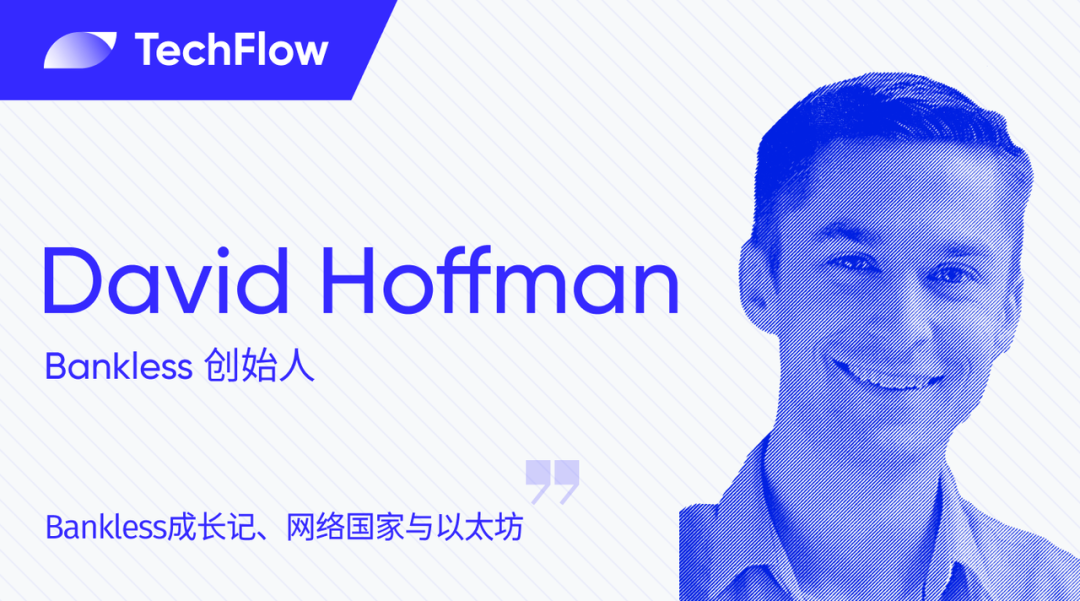
Interviewer: Sunny
Editor: Min
If you're immersed in the crypto world, you've surely heard of Bankless!
It started as a podcast and a Substack newsletter. Today, there's also a DAO and Ventures under the Bankless name.
As one of the most influential media brands in crypto, how did Bankless grow and evolve from zero to where it is today?
At a restaurant in Zuzalu, Montenegro, TechFlow reporter sat down with David Hoffman, co-founder of Bankless and founder of BanklessDAO. Oh, and he now has a new title—General Partner at Bankless Ventures.
The conversation covered his journey founding Bankless, investment strategies, thoughts on network states versus nation-states, Ethereum Foundation’s current research focus, and even his personal guide to a healthier lifestyle.
The Journey to Bankless
TechFlow: Today, we’re thrilled to welcome David, who will share his journey in the crypto space and the story behind launching Bankless with Ryan. David, we can’t wait to hear your story and learn about the origins of Bankless.
David:
I first picked up this idea while studying psychology—through positive psychology, people can achieve significant improvements at very low cost! Also, to make people feel better mentally, you need to get them exercising. And since you're already addressing those two areas, you might as well include good nutrition and diet.
Before fully diving into crypto, I stumbled upon Ethereum and learned about money and finance.
I realized that if I truly cared about improving people's lives at minimal cost, I had to talk about money, finance, and social structures.
Finance is just as critical a north star as individual health. If you want people to take control of their lives, they must first have financial resources. So rather than focusing narrowly on psychology or physical therapy, I wanted to tackle deeper systemic issues.
-
My first company was an ICO consulting firm, born during the ICO boom. But it didn't go far—it folded after seven or eight months.
-
My second venture was Bunker Capital—not a real VC firm. It replaced ICOs by focusing on security tokenization. That one didn’t last either and eventually shut down.
-
My third company focused on real estate tokenization—again, security tokenization but with a narrower use case. That company still exists today.
In 2018, I met Ryan on Twitter. We began discussing similar ideas and gradually grew closer.
Between 2018 and 2020, before Bankless, I launched my first podcast called Pod Crypto, co-hosted with a college friend. That’s when I learned how to produce podcasts.
Ryan started publishing the Bankless newsletter, and I thought—why don’t we merge the podcast and newsletter?
By the end of September 2020, I was ready to go all-in on Bankless full-time, so I quit my COO role at the real estate tokenization startup.
From then on, Ryan and I officially partnered up and launched Bankless.
TechFlow: What’s the relationship between Bankless and BanklessDAO? As a founder, what reflections do you have on operating a DAO?
David:
Here’s how BanklessDAO originated.
Many people reached out to me and Ryan saying they loved what we were doing with Bankless and wanted to help.
We didn’t know how to bring them into a traditional company—we weren’t interested in building a massive corporation. But we wanted to give everyone passionate about advancing the movement a way to contribute and participate.
That’s where the DAO comes in. We identified individuals who had proven themselves on-chain—people already part of our community.
So if you’re a premium member, you get access to voting tools. For example, we issued tokenized T-shirts—on-chain footprints we could verify, like saying, “Oh, you’re part of our tribe.”
So we issued a token and distributed it to everyone willing to contribute—that became BanklessDAO.
As for leadership, we didn’t insert ourselves into DAO governance. We let the community figure it out on their own. The development of BanklessDAO has been entirely self-directed by its members.
TechFlow: Within BanklessDAO, is there a structure for resource and power distribution?
David:
Yes—for example, $BANK token allocations—but mainly through various mechanisms tied to different sub-DAOs.
Each sub-DAO has its own revenue model and operates relatively independently. Most sub-DAOs function as sovereign entities within the larger DAO.
They each have a central resource pool—more decentralized and focused on specific domains. One might focus on content creation, another on consulting, etc. There are many ways to get involved.
They earn money independently, but when combined, each part functions as its own sovereign system.
TechFlow: On financial sustainability, do you think Bankless’ current premium subscription model is sustainable?
David:
We maintain a balancing act between premium subscribers and sponsors—each constraining the other. Bankless has always operated this way.
We aren’t swayed by mass appeal because we owe loyalty to our paying subscribers. The public doesn’t control us.
Likewise, sponsors can’t control us—if they behave in ways we dislike, we can drop them and rely on our community.
So it’s an interactive process. The key is Bankless’ unownability—this preserves our integrity. No single revenue stream dominates, which keeps us pure.
Sponsorships provide fuel to scale the business, but our foundation is the premium subscription strategy.
When power shifts between stakeholders, we know which side needs more attention.
TechFlow: How has Web3 changed or enhanced monetization models at Bankless?
David:
Business models don’t fundamentally differ between Web3 and Web2.
Regardless of industry, the core model remains the same. We have additional income streams—like tokenizing our podcast episodes for sale, or accepting crypto payments.
In the future, there may be more crypto-native sources—NFT websites, for instance—those are unique.
But the business logic stays consistent—the more listeners your podcast or newsletter has, the more value you generate.
Content is content, regardless of platform.
TechFlow: Bankless aims to onboard the next billion users to Web3. How does Bankless content differ from other media providers?
David:
A big part of it is the strong chemistry between Ryan and me.
Our enjoyable dynamic makes the podcast fun to listen to—like two friends chatting while covering news, making it highly engaging.
We have broad expertise across multiple domains:
- Photography
- Distributed systems
- History
- Cryptocurrency
- Art
We combine all these perspectives to create deeply educational content. We’re extremely committed—today, preparing a one-hour podcast takes three hours of prep work.
TechFlow: How do you separate and integrate media and investing?
David:
This raises conflict-of-interest concerns. People often say—how can you run both a media outlet and a venture fund?
We’ve long had angel investing interests. Over the years, Ryan and I have acted as angel investors and consultants—basically half the work required to become VCs.
We were already playing this game—doing private market investments alongside Bankless.
One reason Bankless has become what it is today is trust—we’ve built brand credibility and legitimacy, which acts as our shield.
We’ve shown the world we exist for the right reasons—we won’t manipulate maliciously or do anything evil.
So we plan to continue. We follow simple rules—our venture investments are independent of our media operations.
When we decided to launch a VC, the first thing we did was consult lawyers—to find out what changes we needed to make in media to comply. Turns out, our existing disclosure practices at Bankless—frequency and depth—already exceeded regulatory requirements for starting a fund. We were already more transparent and compliant.
The idea is that eventually, we’ll have unmatched visibility—we’ll be among the most transparent venture firms, thanks to Bankless’ inherent purity.
At that point, it’s up to our community to judge whether conflicts exist. I don’t think it will be an issue—I trust myself, I trust Ryan. We know why we’re here: to create content for Bankless.
If our community feels we’ve acted improperly or against Bankless values, they’ll call us out.
TechFlow: What investment strategy and methodology do you use when evaluating whether a project is worth funding?
David:
Some VCs prioritize teams above all.
With one project, I initially assessed it technically—what could it actually do? When I discussed it with another VC firm, they said, “It’s a bet on the founder.”
But in my mind, I wasn’t viewing it as a founder bet at all—I was thinking like a technologist.
To most VCs, it’s always a founder bet. But for me, you invest because of what they’re building.
I ask: Can this technology actually deliver what they claim?
Different VCs have different focuses. I love technology, but founders are ultimately who make innovation happen. Still, my emphasis is always on what potential this tech can unlock.
New frontiers keep emerging, bringing fresh investment opportunities—just like the ongoing crypto narrative. We’ve only completed 1%.
We still have much to build in DeFi, Layer 2 infrastructure, and beyond.
The current narrative is still young. So you can hunt for new narratives and uncover promising new projects—there’s still immense untapped potential.
In a way, it’s about balancing attention between emerging fields (like AI and crypto), which are genuinely promising and deserve focus—while not forgetting that areas like DeFi are still young, malleable, and full of growth potential.
I mean, crypto has only achieved 10%. There’s still massive infrastructure work ahead.
TechFlow: Talk about AI and crypto. Have you seen any particularly promising projects in this space?
David:
It depends on what you mean—the crypto space is vast. Right now, what seems to capture everyone’s attention is zero-knowledge machine learning (ZK ML).
The combination of privacy protection and machine learning appears highly promising. Beyond that, the field holds great potential, though it may still be early.
If a16z finds a breakthrough project that creates a novel link between AI and crypto, that would represent massive progress in the space.
So I think VCs are searching for something truly original in AI—because thousands of projects will likely fail. Market interest is undoubtedly high, but finding real synergies is tough.
TechFlow: Do you think valuable projects are easier to spot in bear markets? How does investor mindset differ between bear and bull markets?
David:
Yes—in bull markets, people chase narratives quickly. In bear markets, people focus more. So signals are clearer and less driven by emotion.
TechFlow: Is it important for startups to achieve profitability at seed stage?
David:
The startup model is designed for scaling via venture capital.
I think in crypto, many overlook the importance of ensuring a project becomes genuinely profitable.
Of course, it varies—some ambitious projects may need to prioritize scale first. But I believe many founders raise funds too early, before building solid foundations.
They rush to gain market validation to raise at higher valuations while retaining more equity.
There’s strong incentive to raise early and aim for bigger rounds.
From a VC perspective, that’s good—but it increases risk. That’s why I deeply respect founders who delay fundraising as long as possible.
TechFlow: Many believe 2023 marks the beginning of Web3 social. What’s your take? Any favorite social projects?
David:
I agree with the underlying idea—that minimum viable decentralization makes sense.
But currently, many Web3 social projects are essentially Twitter clones.
Lens (a decentralized social app) leaves a large on-chain footprint, which is easy to implement.
But what does composable social really mean? We don’t truly know yet. So I don’t have a favorite project, but I’m excited to see so many experiments underway.
TechFlow: After working in real estate and securities tokenization, how do you see real-world assets (RWA) evolving as a trend in crypto? Is it still too early?
David:
I think it will take a long time to mature.
Tokenizing real estate and integrating it with crypto faces a core problem—real estate is inherently tied to nation-states and bound by traditional legal frameworks.
I’ve always believed this creates tension. Projects that succeed in crypto—like Aave, MakerDAO, or Uniswap—are native to crypto, with no real-world dependencies.
Real estate, however, has many real-world dependencies.
So when these two worlds collide, the impact could be huge. We need innovation at the national level—an industry heavily reliant on externalities.
Zuzalu and Network States
TechFlow: At the end of 2020, you wrote an article titled “On Coordination Vs. Defection,” describing how humans historically choose between defection and coordination. By your definition, what is a network state?
David:
I’d say there’s a pendulum swing between large agricultural, centralized, non-nomadic societies—what we call cities and nation-states—and nomadic hunter-gatherers. Throughout history, the pendulum has swung extremely toward cities and nation-states, rooting people permanently in place.
The idea behind network states is: hey, the pendulum has swung too far. Things have become too rigid. Now that digital networks exist, along with governments supporting them, plus charter cities, startup cities, network states—whatever you call them—they’re saying: let’s swing the pendulum back.
Let’s gain more freedom and mobility, experiment more with governance, give individuals more liberty instead of being locked down. Whatever you call it, a network state is experimenting with what it means to be human in society, and how we can create new societies enabling greater autonomy.
TechFlow: Do you personally travel frequently to “rebalance the pendulum”?
David:
Recently, yes. Not so much in the past. But over the last two years, especially as crypto has boomed, I’ve traveled extensively.
TechFlow: I live in London. I occasionally go to San Francisco because most opportunities are there. This reflects a reality—geographically, nearly all opportunities seem concentrated in the U.S. Europe consists of many small countries, fragmented, making scale difficult in some ways. So everyone goes to Silicon Valley to scale. To me, network states also mean bridging arbitrage opportunities across geographies.
David:
Yes, the general idea is that cities no longer compete. Network states reintroduce competition among cities—which ultimately benefits individuals.
TechFlow: Do you think self-organizing into network states can break humanity’s curse of tribalism and conflict caused by fenced-off groups?
David:
It might go the opposite way. Previously, competition existed only between nations—China vs. Russia vs. U.S. Now a new player emerges: the network state. Suddenly, everyone says: “Oh, now we all have to oppose this new force.”
So not only do nations compete internally, but in this new domain, a whole new dimension of competition arises due to new participants.
Returning to the article—between rewards and coordination—there are now incentives to coordinate. Some nations may want to align with certain network states, while sub-networks may seek alliances with larger nations. It introduces a new variable, triggering change. And change drives progress.
TechFlow: In the future, when will network states like Zuzalu feel more organic or natural? What are your thoughts on Zuzalu?
David:
I think if attendees keep changing, people will become overly skeptical—mockingly saying, “Oops, I joined a network state.”
But that’s the point—we don’t really know what a network state is yet.
Zuzalu seems symbolic of progress. We Zuzaluans don’t actually know what it will become—it’s only the first iteration. But some envision it as a recurring experimental pop-up city.
So when Zuzalu happens again in six months or a year, some familiar faces will return, and new ones will join. The goal is to cultivate a shared identity—Zuzaluan.
So what exactly is Zuzalu? Besides people around the world identifying as Zuzaluans, we’re simply people appearing at different times and places on Earth.
TechFlow: Additionally, Zuzalu’s mission and content seem perfectly aligned with David’s interests in positive psychology, nutrition, and physical therapy. David, can you share how blockchain might enhance or disrupt longevity research?
David:
It enables decentralized scientific research. There are fascinating longevity studies that could be done, but regulatory bodies like the FDA restrict them.
So we need new venues—jurisdictions willing to approve such research.
Network states or other jurisdictions allowing such research will accelerate progress in longevity. That’s why we chose Zuzalu for these discussions—not to fund research directly, but to coordinate on how and where to conduct it. It’s a coordination layer. Hard to grasp now, but it will be a core topic.
TechFlow: Do you see longevity as improving lifestyle, or as a scientific quest to enable humans to live 1,000 years?
David:
It’s the same thing, right? If you’re unhappy, what’s the point of living 1,000 years? Like I said, if you have arthritis and can’t move, you wouldn’t want to live forever.
Pursuing immortality and pursuing healthspan and well-being are actually the same pursuit.
Some researchers are hunting for a pill to make people live forever.
But if those same people are overweight, miserable, and sedentary—what’s the point? You’re just extending suffering. So pursuing longevity must also mean pursuing happiness.
And pursuing happiness is fundamentally about pursuing health.
TechFlow: Can you share your longevity or healthy lifestyle routine? I noticed you drink green tea daily and do cold plunges near Rok. What’s your secret?
David:
The secret is turning it into habit—it must become continuous learning.
Good nutrition, diet, and lifestyle—all require forming habits. That’s exactly what Zuzalu gave me: a foundation of regular health habits—daily cold plunges, inducing autophagy.
Also, Kiki’s breakfast isn’t just consistent and healthy—it’s a place to chat and connect, fulfilling social needs.
And I don’t drink alcohol. In New York, socializing and drinking are almost inseparable.
But Zuzalu was the easiest place I’ve found to quit. I quickly saw benefits—better skin, overall health, sleep quality.
In Zuzalu, everything is here—food, social life, content. I can easily avoid commuting or sacrificing sleep to do what I want.
Truly, it’s a highly optimized lifestyle.
Ethereum Ecosystem
Currently, searching “Ethereum” on Bankless yields 54 related articles, analyses, and videos. In contrast, Bitcoin-related content numbers only 13.
TechFlow: Did you interact with the Ethereum community during Zuzalu? What are the Ethereum Foundation’s recent focus areas?
David:
Yes, I frequently spoke with Justin, who’s deep into new areas of zero-knowledge cryptography. I asked him what this means for crypto—even though it’s still far off.
I discussed EigenLayer and restaking with Dankrad, Tim Beiko, and Vitalik, as these appear to be emerging protocol-level challenges for Ethereum.
The reason Bankless covers Ethereum more than Bitcoin is that Ethereum is more expressive. Bitcoin does Bitcoin things—sending bitcoin to people. Ethereum is a smart contract platform—you can build anything. So there’s more to discuss.
TechFlow: What do you see as the biggest challenge facing the Ethereum ecosystem today? What can Bankless do to support Ethereum ecosystem development?
David:
Ethereum still struggles with lacking a clear narrative explaining why it is the way it is.
Internally, the crypto industry faces coordination problems—many still have incentives to doubt Ethereum. Returning to the “coordination vs. defection” essay, there remain strong incentives to defect from Ethereum.
To me, the entire purpose of crypto is getting people to agree on a shared protocol—that’s the whole point. We still have much work to do convincing people to join the same protocol and believe it’s the rational choice. That’s crypto’s internal challenge.
Then there’s the external challenge—we still need to build things people actually want to use and care about. That seems like a perpetual challenge, but it always takes time.
TechFlow: When you return to New York, will you bring what you’ve learned in Zuzalu back to Bankless?
David:
Yes, I can say we’ve already begun.
We’re already producing new types of content—more from non-crypto domains. Cutting-edge tech topics, mixed with crypto themes—these will converge.
New insights from Zuzalu are already influencing Bankless—especially beginner-friendly content.
Plus, many new relationships formed here will have ripple effects, and inspire new stories.
Ultimately, these people will become supporters of the podcast. Overall, it’s about documenting Ethereum’s role in the world and the frontier of technology.
Join TechFlow official community to stay tuned
Telegram:https://t.me/TechFlowDaily
X (Twitter):https://x.com/TechFlowPost
X (Twitter) EN:https://x.com/BlockFlow_News
 深潮TechFlow