








A Guide to LSD and DVT: The Next Capital Adoption Sector and Ethereum's Post-Merge Key Development
TechFlow Selected TechFlow Selected
A Guide to LSD and DVT: The Next Capital Adoption Sector and Ethereum's Post-Merge Key Development
In Vitalik's article and some roadmaps proposed by the Ethereum community regarding post-ETH2.0 planning, a core idea has been mentioned: centralized block production and decentralized validation.
 Navigating Web3 tides with focused insights
Author: 0x1
In Vitalik's articles and various roadmaps proposed by the Ethereum community regarding post-ETH2.0 development, a core concept has been emphasized—centralized block production with decentralized validation.
After ETH2.0, the mining mechanism transitioned from PoW to PoS, leading to rapid growth in ETH staking. In just over a year, the amount of staked ETH surpassed 16.5 million, with the number of validators reaching 517,062.
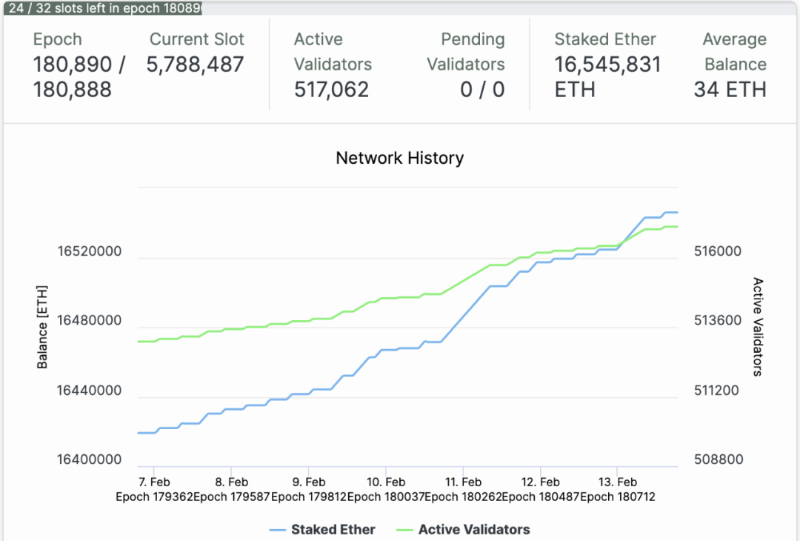
Data source: Beaconcha
However, looking at the distribution among ETH stakers, top staking platforms are mostly centralized entities such as Coinbase, Kraken, Binance, and other centralized exchanges.
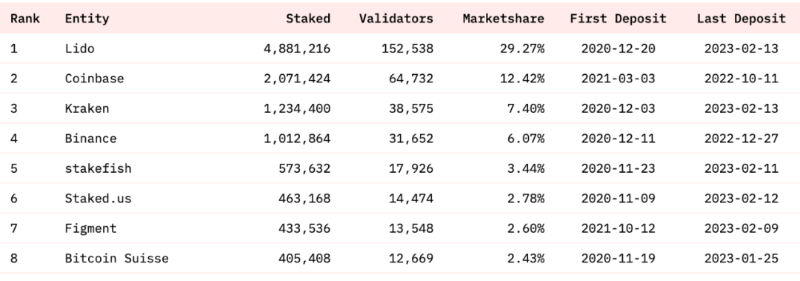
Data source: Dune
Recently, market rumors suggest that the SEC aims to ban retail crypto staking services in the United States. Additionally, Kraken announced it would discontinue staking services for U.S. users and agreed to pay $30 million to settle SEC allegations over offering unregistered securities.
This incident sparked industry-wide discussions on the anti-fragility of the network post-ETH2.0. If such regulations take effect, major centralized platforms like Coinbase, Kraken, and Binance would be directly impacted. Anticipating this, token prices for LSD and DVT concepts逆势 rose against broader market trends.
LSD: Another Promising Business Model in Blockchain
LSD (Liquid Staking Derivatives) refers to liquid staking derivative protocols. Major projects currently include Lido, Rocket Pool, Frax, Ankr, and Stafi. Among them, Lido dominates over 73% of the LSD market share and accounts for 29.27% of total ETH staked.
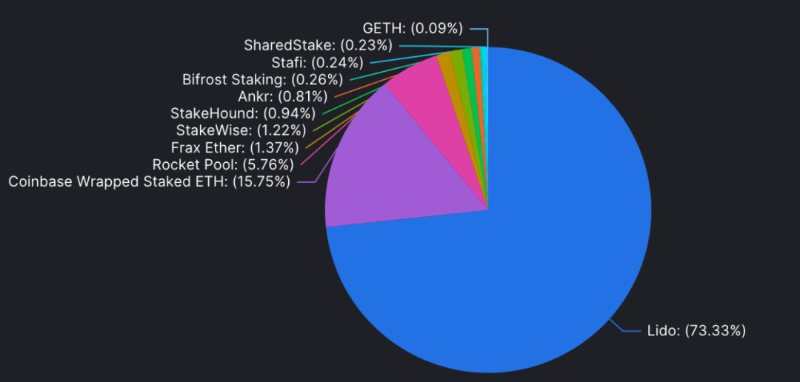
Data source: Defillama
LSD represents another promising business model within the blockchain industry. Many traditional entrepreneurs find blockchain puzzling, believing only certain "water-selling" services—such as exchanges or Bitcoin mining—have mature business models.
The yield-denominated-in-crypto offered by the Ethereum LSD sector may present another attractive opportunity. Currently, base rewards yield approximately 4.1% APY, tips around 2.2% APY, and MEV about 1% APY, totaling an estimated validator APY of 7.3%.
Total staked ETH on Ethereum exceeds 16.5 million, representing a staking ratio of roughly 13.6%. Compared to other public chains, this is relatively low—blockchains like ADA, SOL, BNB, and AVAX typically have staking ratios exceeding 60%. Hence, the LSD market still holds significant room for expansion.
Following the Ethereum Shanghai upgrade, LSD metrics could improve further. Concerns about the Shanghai upgrade often center on potential sell pressure due to unlocked ETH hitting secondary markets. However, this outflow won't resemble a sudden flood. Validator exit rules limit seven validators per epoch (approximately every 6.4 minutes), allowing up to 1,575 validators to exit daily. Should the total validator count begin declining, the rate will slow over time.
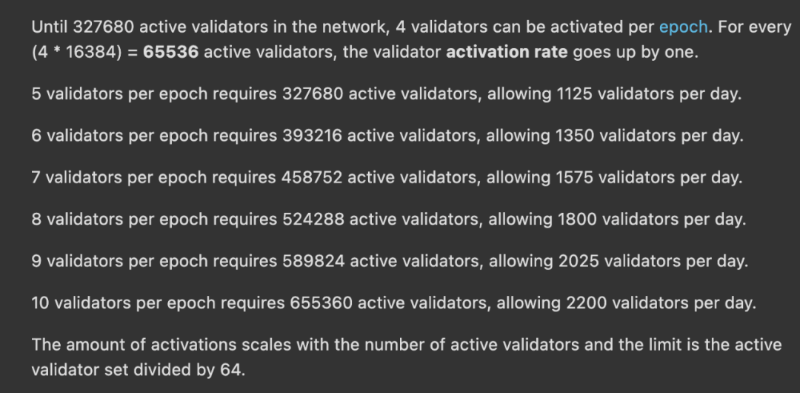
Source: Beaconcha
In my view, the total staked ETH might dip slightly shortly after the Shanghai upgrade but is likely to rise steadily thereafter. With the ability to freely withdraw staked ETH post-upgrade—removing the necessity of long-term lockups—more holders may be incentivized to stake their ETH for yield. This resembles shifting from fixed-term to demand deposits at a bank while maintaining similar interest rates—potentially increasing overall deposit volume rather than decreasing it.
DVT: Enhancing Anti-Fragility in Proof-of-Stake Blockchains
DVT (Distributed Validator Technology) refers to decentralized validation technology. DVT enables Ethereum proof-of-stake validators to run simultaneously across multiple nodes, establishing trustless infrastructure for staking and enhancing both network security and decentralization. Key players in the DVT space include SSV.Network and Obol Labs.
Simply put, DVT organizes node operators into a network akin to blockchain’s distributed architecture, where each node within a DVT provider’s cluster can run different clients, thereby reducing single points of failure.
Take SSV.Network as an example: It is a fully decentralized, open-source ETH staking network based on Secret Shared Validator (SSV) technology. Using MPC threshold schemes, SSV manages its validator network via the Istanbul BFT (IBFT) consensus mechanism to achieve decentralized validation.
The operational logic of SSV works as follows:
1. ETH holders stake ETH through the SSV protocol to become stakers (these may be individuals or institutions holding 32 ETH or more, or even LSD platforms). Normally, users would stake ETH directly into a Validator Client to become an Ethereum validator. Instead, SSV Network aggregates numerous Operators (i.e., Nodes), which assist these stakers in correctly fulfilling validator duties under the IBFT consensus mechanism;
2. The SSV protocol leverages Distributed Validator Technology (DVT) with Distributed Key Generation to distribute Validator Keys across non-trusting nodes. These nodes then act as Operators, performing validator tasks under the Istanbul BFT consensus mechanism;
3. Stakers must pay SSV tokens to compensate Operators for their service. A liquidator mechanism is also implemented to protect Operator权益.
The main advantages of DVT in this process are: forming a distributed validator network that collectively performs validation tasks via consensus (IBFT), enabling client diversity among validator nodes, improving fault tolerance, and significantly reducing the risk of single-node failures.
LSD platforms can collaborate with DVT technology providers. For instance, Lido could integrate SSV.Network’s DVT solution to decentralize its node operations, mitigating risks associated with penalties due to downtime when validator keys are controlled by a single operator.
In summary, consistent with the longstanding principles of the Ethereum community, long-term development of Ethereum will likely continue emphasizing anti-fragility.
Join TechFlow official community to stay tuned
Telegram:https://t.me/TechFlowDaily
X (Twitter):https://x.com/TechFlowPost
X (Twitter) EN:https://x.com/BlockFlow_News
 @iobc_capital






