








2023 Crypto Industry Development Predictions (1): Ethereum Ecosystem Applications to Explode Again
TechFlow Selected TechFlow Selected
2023 Crypto Industry Development Predictions (1): Ethereum Ecosystem Applications to Explode Again
Ethereum's secondary staking and modular upgrades will strive to build a genuine Web3 value network.
 Navigating Web3 tides with focused insights
Looking Back at 2022: Was Web3 Better or Worse for the Progress of Our Times?
It's widely known that 2022 was destined to be a turbulent year for the Web3 industry. Kevin Owocki, founder of the popular social platform Supermodular, compiled and scored major Web3 events of the year, presenting them in a relatively objective and neutral report card format.
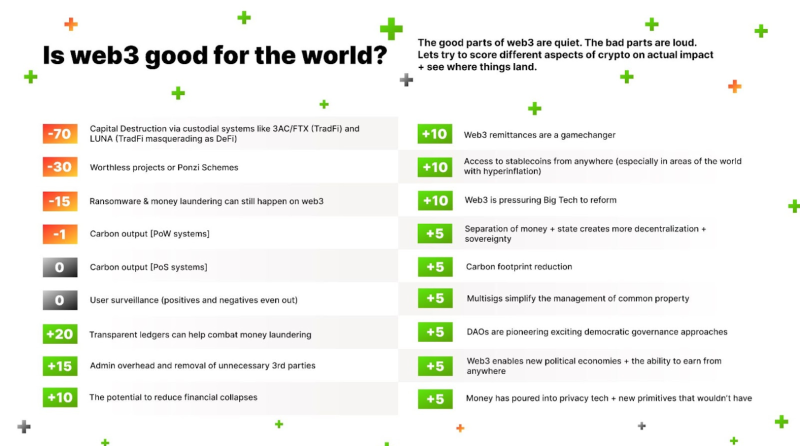
As shown in the image above, the collapses of 3AC, FTX, and LUNA were significant negative events that greatly harmed Web3. Moreover, valueless hype projects and blockchain carbon emissions continue to threaten the long-term sustainability of the Web3 ecosystem. On the other hand, Web3 also contributed positively to societal progress this year:
-
Leveraging the transparency of Web3 networks, fund flows can be traced to combat illicit activities and track assets and risks to prevent financial collapse;
-
Innovation in the Web3 space has pushed major tech companies to reform—for example, Amazon is now building decentralized search engines and social networks;
-
New governance mechanisms like DAOs have demonstrated considerable development potential;
-
......
Although these positive developments appear to have only "minimal" impact based on the influence metrics in the chart, it’s undeniable that compared to four major negative incidents, Web3 has showcased innovation potential across multiple domains. The crypto industry is still in its exploratory phase. To address issues such as unfair profit distribution, platform monopolies, and personal data breaches in traditional internet systems, developers are experimenting with new paradigms for the next-generation internet using blockchain and cryptography technologies.
What changes and opportunities will the crypto world face in 2023?
To seize the momentum of the era, one must ride the wave. Building on current trends in the crypto sector, TinTinLand will launch a series titled "Crypto Industry Trend Predictions for 2023". The first article will provide an overview of the 2023 crypto market with a focus on “Ethereum,” the leading public blockchain. After completing The Merge upgrade, in which directions might Ethereum break through next?
On Ethereum Innovation
Since its inception in 2013, Ethereum has seen continuous growth in its ecosystem. It accounts for over half of the total value locked (TVL) across all public blockchains and hosts multiple DeFi projects valued in the hundreds of millions, solidifying its status as the undisputed king of public chains. Ethereum's evolution impacts countless Web3 builders; below we explore several potential development trends within the Ethereum ecosystem this year.
Restaking May Become Ethereum’s Most Important Innovation
In blockchain development, infrastructure upgrades often lag behind application-layer innovations. This is because deploying applications requires no permission, whereas upgrading core networks demands democratic consensus through specific governance mechanisms. Once established, Web3 network protocols become highly rigid and difficult to innovate upon. To bridge this gap between infrastructure and applications, EigenLayer is introducing a simple yet extremely effective solution: restaking.
EigenLayer is a smart contract layer on Ethereum that allows users to leverage existing trust networks by restaking their staked ETH to secure critical infrastructure and middleware layers. The core idea of restaking is securing other networks using the same staked ETH that secures the Ethereum network itself, giving ETH stakers greater capital flexibility while extending Ethereum’s trust layer to peripheral infrastructures such as sidechains, middleware, and even non-Ethereum networks. Furthermore, restaking reduces the marginal cost of validator services, since stakers can reuse their initial capital across many different protocols beyond Ethereum, earning additional income in the process.
During prolonged bear markets, a large number of projects are expected to seek high security within the Ethereum ecosystem, further strengthening network security. Security will become a key battleground among Layer1 blockchains, driving up the capital costs of native validation networks to prohibitive levels. The security provided by EigenLayer’s restaked ETH will significantly lower expansion costs for middleware, sidechains, and the broader decentralized technology stack, while also increasing staking profitability.
According to Ethereum core developers, the Shanghai upgrade is expected to be completed before March this year, enabling withdrawals of staked ETH on the network. Staking unlock marks a crucial milestone in Ethereum’s transition to proof-of-stake. Combined with restaking, it could bring substantial benefits to ecosystem participants. However, caution is warranted: when users delegate control of their staked ETH to EigenLayer, which then interacts with various middleware components, any misbehavior along the way may result in loss of staked funds.
Ethereum’s Path Toward Modularization
Currently, Ethereum operates as a monolithic blockchain, performing execution, settlement, consensus, and data availability on a single foundational layer. Its congestion issues highlight inherent drawbacks—poor scalability, lack of customization, and high fees. In contrast, modular blockchains divide these functions into separate modules. As discussed in TinTinLand’s article “Will Modular Blockchains Shape the Future of Web3 Users?”, modular architectures offer clear advantages. How then will Ethereum respond to the rising trend of modular public chains amid ongoing scalability challenges?
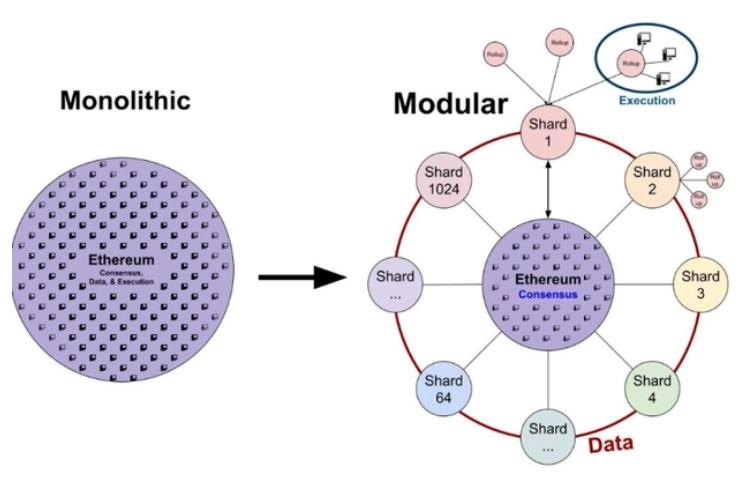
In fact, as early as 2020, Vitalik Buterin mentioned in his talk “The Rise of Ethereum’s Layer 2 Ecosystem” at the Global Blockchain Summit that Ethereum would adopt a hybrid scaling approach—not relying solely on Layer1 or Layer2 solutions. This vision aligns closely with the concept of modular blockchains, which essentially represent a form of hybrid scaling.
Celestia, one of the earliest modular public chains, is being built on the Cosmos ecosystem leveraging Rollups for scalability. Celestia separates the data layer, allowing different chains to offload their data handling to the network, which only verifies data integrity without implementing full consensus. Developers can build various functional chains atop Celestia, improving performance metrics such as throughput. This design closely mirrors the relationship between Ethereum and its scaling solutions.
- On-Chain and Off-Chain Integration in Ethereum Upgrades
After completing The Merge in 2022—a major shift in consensus mechanism—Ethereum will proceed with several upcoming upgrades: The Surge, The Verge, The Purge, and The Splurge.
-
The Surge: Introduces a new transaction type called “Blob.” These Blobs will be implemented via EIP-4844 as part of "Proto-Danksharding," aiming to increase transaction speed and reduce fees on both Layer1 and Layer2;
-
The Scourge: Implements Proposer-Builder Separation (PBS) at the protocol level to prevent centralization and mitigate MEV-related risks;
-
The Verge: Upgrades Merkle proofs with Verkle trees, enabling more efficient and trustless block verification;
-
The Purge: Clears historical data and bad debt to simplify storage, reduce network congestion, and improve transaction processing speed;
-
The Splurge: Includes optimizations and fixes such as account abstraction, EVM improvements, and VDF-based randomness schemes.
The design of these upgrades clearly indicates Ethereum’s trajectory shifting from monolithic to modular architecture. For instance, during The Surge phase, the introduction of “Blob” transactions primarily stores data generated by Layer2 networks. Previously, Layer2 data was stored via Calldata, but Blob storage requires only about 128 KB—cheaper and more space-efficient than equivalent Calldata, expanding blockchain capacity and lowering Gas fees for on-chain submissions. Additionally, The Verge will enhance Ethereum’s verification efficiency, improving not only mainnet performance but also making Layer2 transaction validation via Layer1 faster and more efficient. By combining on-chain and off-chain scaling approaches, Ethereum aims to alleviate current scalability constraints.
- Modular Exploration in Layer2 Chains
Modular exploration isn’t limited to Ethereum itself—Layer2 chains are also advancing along the modular blockchain path. In a sense, Layer2 solutions are already modular blockchains. Take Optimism, Arbitrum, and Starknet as examples: although they differ in execution layers, they outsource consensus, settlement, and data availability to Ethereum, sharing the same underlying layers.
Layer2’s journey toward modularity doesn’t stop here. For example, the Optimism team is developing OP Stack, aiming to elevate Ethereum’s modularity to new heights. First, it’s important to note that Rollups are inherently single chains, each with unique languages and architectural designs differing in execution, settlement, and data availability layers. Currently, bridging isolated Rollup chains requires protocols like Hop, which introduces cross-chain security concerns. OP Stack offers a modular solution to this problem.
OP Stack is a standardized set of open-source modules that can be assembled to build customized chains tailored to specific use cases. With OP Stack, developers can plug in or swap out modules across different execution, consensus, settlement, and data availability layers, free from dependency on any single proof system or technology stack.
Moreover, OP Stack promotes an "Optimistic Garden" vision—any OP chain that voluntarily joins the same shared sequencer set (the entity responsible for generating blocks on each OP chain) can enjoy seamless composability across chains. The team calls this “a hyper-modular solution to the limitations of monolithic blockchains,” enabling hundreds of OP chains on Optimism to achieve full interoperability and connect via a unified technical framework, forming a “Superchain” ecosystem based on common standards.
In summary, Ethereum and its Layer2 scaling solutions will continue refining their modular strategies in 2023. From this growing trend, Web3 is not only decentralized but also modular. Decentralization ensures that network value belongs to users, while modularity builds on trustlessness to enhance Web3 network performance, delivering better services and products. The shift toward modular blockchains will become increasingly pronounced.
Unlike traditional internet models where value is captured at the application layer, Web3 currently concentrates value at the shared protocol layer, with only a fraction flowing to applications. With Ethereum’s The Merge and subsequent upgrades, restaking can greatly resolve infrastructure upgrade bottlenecks. Meanwhile, the arrival of the modular blockchain era makes “one-click chain deployment” feasible. With dramatically improved Web3 network performance, technological innovation in Ethereum’s infrastructure is poised to trigger an explosion of killer applications within the ecosystem.
(This article is for informational purposes only and should not be construed as legal, business, or investment advice.)
Conclusion
The story of Web3 is still unwritten and open-ended—and its direction depends entirely on us. The crypto winter will persist throughout this year, but our focus shouldn’t be whether Web3 benefits society today. Instead, we should ask how we can use Web3 to make the world a better place. Ethereum’s innovations in restaking and modularity ultimately aim to strengthen infrastructure to fuel application growth, helping Web3 gain broader recognition among developers and users. This is a year of technical accumulation—a quiet period of preparation before the breakthrough.
Join TechFlow official community to stay tuned
Telegram:https://t.me/TechFlowDaily
X (Twitter):https://x.com/TechFlowPost
X (Twitter) EN:https://x.com/BlockFlow_News
 @OurTinTinLand






