








Understanding Distributed Validator Technology (DVT): How It Works and Key Projects
TechFlow Selected TechFlow Selected
Understanding Distributed Validator Technology (DVT): How It Works and Key Projects
This article introduces the necessity of distributed validation technology for network decentralization by explaining the principles of Ethereum node operation, and provides a brief analysis of the technical highlights of Obol Network and SSV Network that adopt this technology.
 Navigating Web3 tides with focused insights
Author: Tyrannosaurus Haym
Translation: FIHRY Isla, Core Contributor of Biteye
Ethereum operates on a decentralized and resilient network of nodes, yet a significant number of these nodes are currently centralized and relatively fragile. This article will focus on Distributed Validator Technology (DVT), Obol Network, SSV Network, and the roadmap for further decentralization of Ethereum.
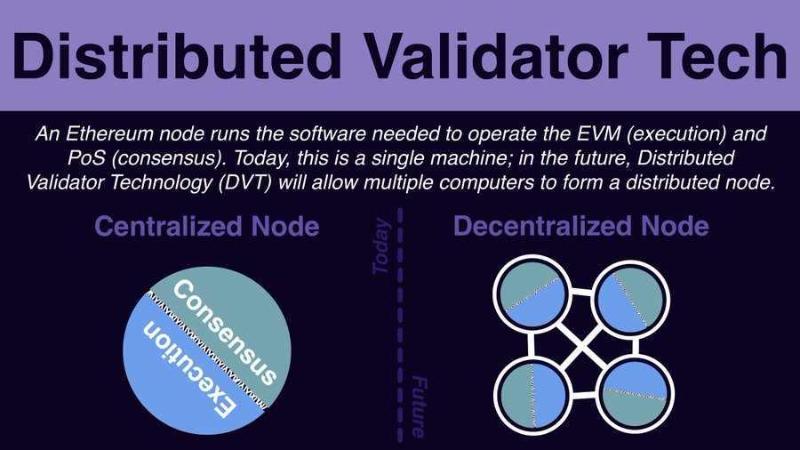
(Currently, an Ethereum node is managed by a single computer handling both the EVM execution layer and PoS consensus layer, whereas a distributed "node" can consist of multiple servers.)
01 How Ethereum Nodes Work
As widely known, Ethereum is hailed as the "world computer," a network composed of nearly 20,000 computers (nodes). Each node is a real-world physical computer (server) communicating directly with others in a peer-to-peer manner.
The sole purpose of maintaining such a vast number of Ethereum servers is to provide a stable and reliable shared computing platform—the Ethereum Virtual Machine (EVM).
The EVM provides the context for transactions (computations); everything users do on-chain happens within the EVM.
Each node runs a local instance of the EVM, which then gets finalized on-chain through a process called Proof-of-Stake (PoS), staying fully synchronized with all other copies of the EVM across the network.
In this architecture, each Ethereum node currently runs two software components simultaneously.
Execution clients (e.g., @go_ethereum, @nethermindeth), responsible for implementing the EVM.
Consensus clients (e.g., @ethnimbus, @sigp_io), which monitor PoS and ensure Ethereum's security.
A node can exist without staking any $ETH; however, it earns no rewards and does not participate in block validation—only syncing network data. When a node operator stakes 32 ETH, their node creates a new validator and begins participating in PoS.
(Translator’s note: A single server can host multiple validators depending on its hardware performance and the amount of ETH staked.) Alternatively:
- Multiple nodes form a globally synchronized computational system, keeping the Ethereum network continuously connected and ensuring secure synchronization of the EVM
- A validator is a virtual entity operated by a node, existing within the node server, and participates in PoS
It's clear that the overall network is resilient—with thousands of nodes, few events could affect them all—so Ethereum has maintained solid operational records over time. But what about individual participants? In terms of fault tolerance for those managing substantial portions of the Ethereum network, it’s far from perfect.
Let’s take a simple example: suppose you’re a home staker (running a server at home), and your power goes out for several hours. During that downtime, you’ll incur penalties (losing the equivalent of what you would have earned). If offline only briefly, resynchronizing your node to the chain head won’t take long. However, the longer you stay offline, the more time full resynchronization requires—potentially taking days.
During this period, you face continuous penalties. For a home staker, this is already bad enough. Now imagine being a major staking-as-a-service provider like Lido Finance or Coinbase—data center failure or misconfiguration could impact the entire DeFi ecosystem. One might suggest running a backup node—if the primary fails, load the private key onto the backup and continue validating. But with today’s technology, this itself poses risks.
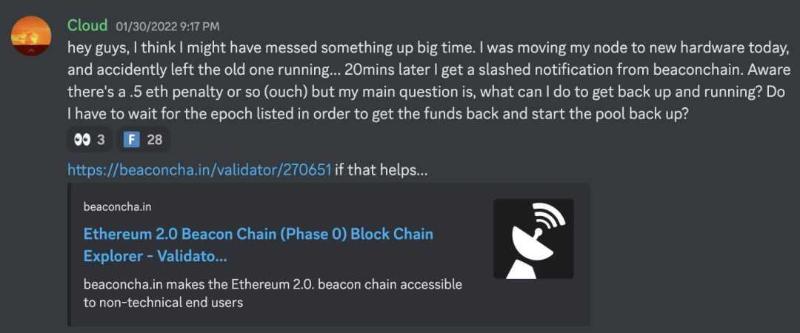
(This user was penalized due to signing with both old and new hardware after migrating nodes.) The Distributed Validator Technology (DVT) we introduce today perfectly avoids such issues.
02 What is DVT?
Simply put, while a regular node consists of execution and consensus components running on one machine, a DVT node comprises multiple consensus and execution clients distributed across several machines.
When 32 $ETH are deposited into the Ethereum deposit contract, they form a DVT cluster consisting of n members, generating an m-of-n shared validator key (where m < n). Every time this validator signs during PoS, at least m members must agree.
From the protocol’s perspective, the fundamental requirement for smooth Ethereum operation is that each validator fulfills their duty to sign promptly during their assigned slot.
DVT is precisely a cryptographic technique enabling validators to fulfill signing responsibilities more reliably and securely by distributing responsibility across an m-of-n group. Let’s revisit the home staking scenario: with DVT, suppose you, I, and Vitalik form a DVT cluster, and we include Coinbase as a fallback option.
For example, even if my Singapore-based node loses power completely, you in Dali and Vitalik in Canada still have power—we remain safe because validation continues. DVT provides the tools Ethereum needs for further decentralization, reinforcing its position as a trustworthy, neutral settlement layer for the internet. And DVT is just one technology—there may be many different implementations.
03 Projects Using DVT Today
Now let’s look at two projects utilizing DVT.
Obol Network
Obol Network recently raised $12.5 million to bring their vision to life. Simply put, while a standard native node runs an execution and consensus client, an Obol node adds a third-party client on top.

Obol Network hasn't launched yet, but users can get a good sense of how DVT works through screenshots from their DVT Launchpad (shown below).
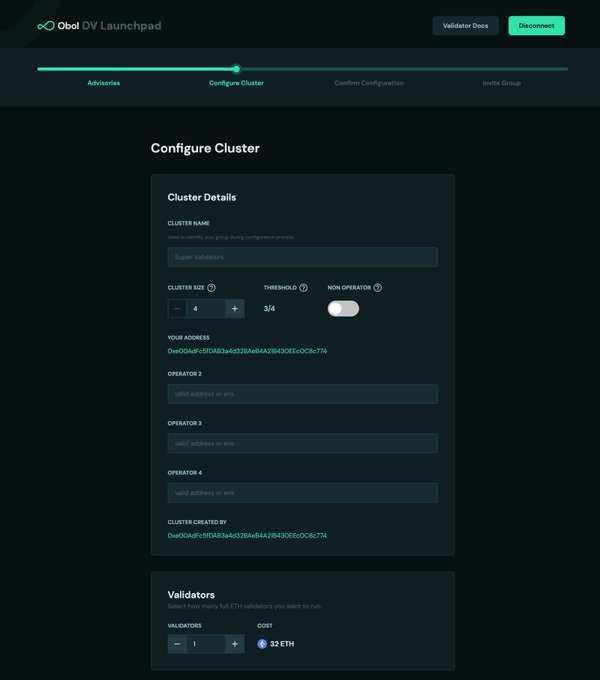
(Choose your cluster size, add operator addresses, select number of validators, deploy.)
SSV Network
SSV has just announced a $50 million ecosystem fund (congratulations—an important milestone in the DVT space). SSV Network uses the same DVT concept, but its true highlight lies in its operator network.
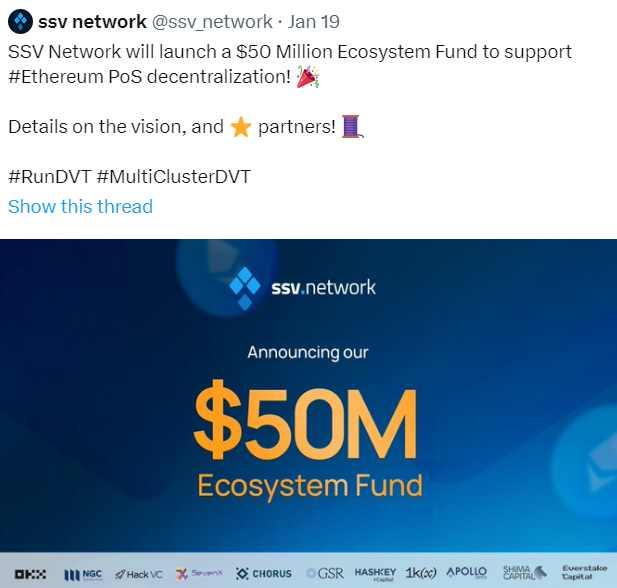
Users interested in deploying validators bring their ETH to SSV, which creates a DVT cluster from four operators. This is just the beginning. DVT isn’t merely about creating more stable Ethereum nodes—it enables clearer separation between nodes and validators, clarifying their distinct roles. A direct example appears in Ethereum’s next roadmap phase: one of the core technologies required for Danksharding involves advanced elliptic curve cryptography per block. This could be computationally heavy for current Ethereum nodes, but easier to achieve using DVT clusters.
For more on Danksharding, see this link.
04 Airdrop Speculation (Added by Translator)
Obol launched its Bia testnet on January 31, aiming to test the scalability of Obol DVT, targeting >500 active clusters, >5,000 participants activated via the launchpad, and successful operation for >30 days.
-
01/30/2023 Bia Testnet Launch
-
01/30/2023 Cluster Creation
-
02/06/2023 Cluster Activation
-
02/06/2023 – 03/31/2023 Operation Period (minimum 30 days)
-
03/31/2023 End Date
-
04/20/2023 Bia Testnet Report
Although the official documentation emphasizes that Bia is a non-incentivized testnet, participants meeting requirements will receive a Technical Ambassador POAP. Whether this POAP leads to future airdrop rewards remains speculative but worth pursuing.
POAP Eligibility Criteria:
-
Cluster creation and successful distributed key generation ceremony (proven via submission of cluster type form)
-
Operating an active cluster for over 30 days
-
Acting as a cluster leader
-
Running three different configurations among four types: 6-node setup, multi-client, multi-geo, or multi-host (e.g., home, cloud, etc.)
-
Submitting complete feedback forms after cluster creation and at the end of Bia
-
Submitting a full Grafana dashboard to the dashboard competition (more details to be released mid-February)
Officially, earning five Technical Ambassador POAPs grants the title of [Junior Technical Ambassador] in the community, along with recognition, access to the Obol team, and additional benefits.
Beyond Bia, there are other tasks available to earn Technical Ambassador POAPs. For the full list, refer to the [Obol Ambassador Program] page.
Join TechFlow official community to stay tuned
Telegram:https://t.me/TechFlowDaily
X (Twitter):https://x.com/TechFlowPost
X (Twitter) EN:https://x.com/BlockFlow_News






