









Top LSD Solution Evaluation: Analysis of Pros and Cons for Lido, Frax, and Rocket Pool
TechFlow Selected TechFlow Selected
Top LSD Solution Evaluation: Analysis of Pros and Cons for Lido, Frax, and Rocket Pool
The LSD war is heating up, with entire DeFi teams coming up with more innovative solutions.
 Navigating Web3 tides with focused insights
Written by: Kodi
Compiled by: TechFlow
After more than a year of decline, we’ve finally seen a surge in token prices. And you may have noticed that some of the top-performing tokens—like Lido (LDO) and Rocket Pool (RPL)—are tied to Liquid Staking Derivatives (LSD).
What exactly are LSDs? Is this narrative justified?
LSDs are how Ethereum (ETH) stakers get to eat their cake and have it too.
Now that Ethereum is a Proof-of-Stake (PoS) chain, you can stake your ETH and earn a comfortable, stable yield of around 4–6%. Sadly, staked tokens cannot be used elsewhere.
I know, single-digit APYs sound a bit boring—but don’t worry, LSDs allow you to deposit ETH into a smart contract and receive a tokenized derivative representing that staked ETH in return.
Will the LSD narrative continue?
Our view is: yes.
This is because despite Ethereum’s dominance, staking ETH is still seen as risky since users currently cannot withdraw their staked tokens.
Do you know the typical staking ratio for PoS chains? According to Staking Rewards, it's between 40% and 70%. Ethereum’s staking ratio is only about 13%.
As Ben pointed out in “Musical Chairs,” this number could increase after the Shanghai upgrade expected in March, which will allow users to withdraw their staked ETH. This will reduce the risk of ETH staking, and as more tokens get staked, demand for LSDs will rise accordingly.
In April 2021, LSDs began outperforming other staking solutions. By September 2022, when Ethereum successfully transitioned from PoW to PoS (the Merge), they had already reached the top of the food chain.
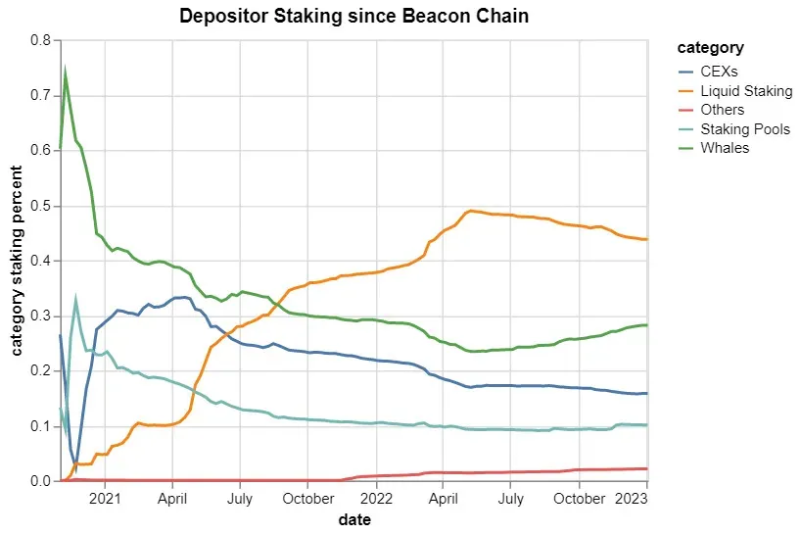
I (hopefully) have convinced you that LSD is a story here to stay—so let’s get down to business and examine some of the most popular liquid staking solutions.
The Contenders
Right, this is crypto after all. LSD solutions are dApps, and you can always count on dApps to issue governance tokens to further decentralize and empower their communities.
This gives us the chance to directly bet on the growth and hype around LSDs. According to DefiLlama, the leading LSD protocols are:
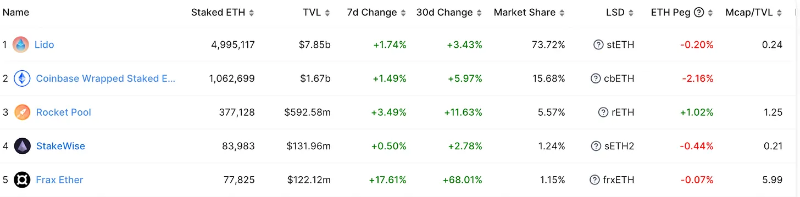
Since we’re focusing only on protocols with governance tokens, we won’t discuss Coinbase. While Stakewise has seen some early success, its adoption has stalled, so we’ll exclude it from our discussion today.
Therefore, we believe the three protocols best positioned to benefit from the LSD narrative are Lido, Rocket Pool, and Frax.
Lido (LDO)
The leader in LSD is Lido. Among LSD protocols, up to 30% of staked ETH—and over 70% of all LSD-staked ETH—is held within Lido.
Lido is structured as a decentralized autonomous organization (DAO), and LDO serves as the DAO’s “membership card.”
Holders of LDO can vote on various aspects related to Lido’s operations, such as the fees the DAO should collect or which node operators and oracles Lido should use. The DAO also accumulates profits, which are allocated toward R&D, liquidity incentives, and other initiatives.
However, LDO does not accrue any value for token holders. Thus, holding LDO is more of a speculative bet on the success of LSD and Lido’s continued dominance.
And there’s nothing wrong with that. Sometimes, tokens driven purely by narrative are the best bets.
Consider that during the 2021 bull run, meme coins were arguably the best-performing sector. Uniswap’s UNI, which shares a similar structure to LDO, was one of the top-performing DeFi tokens. Before crypto matures, memes and narratives reign supreme. We’d do well to remember that.
However, if you want to earn a share of profits from the DApp where you hold your tokens, you’ll need to look elsewhere.
For example, to Frax.
Frax (FXS)
At least in the LSD space, Frax is relatively new. But its growth has been remarkable—becoming the fifth-largest LSD solution in terms of ETH staked in just three months. That’s even more impressive considering we’re in a bear market.
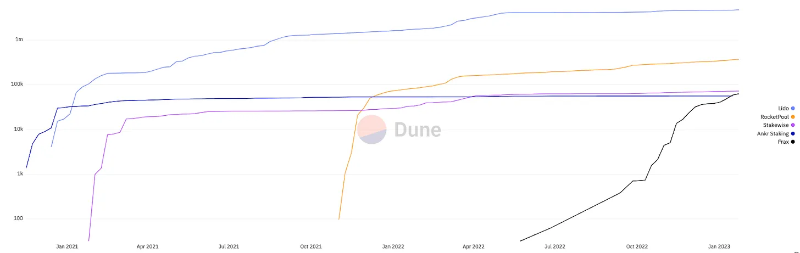
One key reason for Frax’s rapid success in LSD is its existing suite of DeFi products—including a stablecoin, lending markets, and a decentralized exchange. Additionally, it leveraged its influence on Curve to offer users substantial ETH yields.
So how does Frax’s governance token FXS work?
Frax implements a veToken model via FXS, similar to Curve’s model.
FXS holders can lock their tokens to receive veFXS—the longer they lock, the more veFXS they earn. The more veFXS you hold, the greater your yield boosts, voting power, and share of protocol profits.
At the time of writing, locking FXS for four years yields an annual rate of 1.58%. Not spectacular, but better than nothing—and fully profit-backed and sustainable, which is rare in crypto.
LSD is just one of their products, and (currently) not their core offering. Therefore, FXS isn't a pure bet on LSD success. However, since Frax’s products are deeply interconnected, failure in one area could impact others.
That said, the protocol’s overall success remains closely tied to LSD performance.
Rocket Pool (RPL)
Launched in November 2021, Rocket Pool positions itself as the LSD solution for the masses, contrasting with venture-backed Lido. Whether that characterization holds true or not, the reality is Rocket Pool has successfully captured over 5% of the market share.
We won’t dive deep into the technical details of Rocket Pool’s staking mechanism. For now, what matters most is:
-
Rocket Pool node operators earn rewards in both ETH (from staking yields) and RPL (from Rocket Pool inflation).
-
Node operators must provide collateral alongside their ETH. If a node operator gets slashed, this collateral acts as insurance.
Guess what currency this collateral is denominated in?
Yes, RPL. The more RPL you post as collateral, the higher your RPL rewards.
To prevent RPL whales from capturing most of the rewards, the maximum collateral you can post is capped at 150% of the value of your staked ETH. There’s also a minimum requirement of 10% collateral to qualify for any RPL rewards. These serve as soft upper and lower bounds for RPL’s price relative to ETH.
If RPL’s value rises too much, node operators will withdraw collateral from their vaults, since they gain no extra rewards beyond the 150% cap. Aside from selling, they have little else to do with excess RPL at that point.
Conversely, if RPL’s price drops too low, node operators will need to buy and post additional RPL as collateral to continue earning RPL rewards.
In practice, this model stimulates demand for RPL based on ETH staking activity, tightly linking the token’s success to the success of its staking solution.
The Choice
So which LSD governance token holds the most potential?
If you want to play it safe, the answer is simple: LDO.
Lido dominates the LSD space by a wide margin. More importantly, it owns the narrative.
When people think of LSD, Lido is usually the first protocol that comes to mind. It’s also the go-to choice for most people staking ETH. And Lido’s stETH has become synonymous with staked ETH.
But the token doesn’t accrue any value.
So what?
If DOGE can break $1, then a “useless” governance token can make you rich too.
If you want to take a riskier bet, FXS is the token to watch.
Note: not for value accrual. Exchanging my tokens for a low single-digit APY while locking them for four years? I don’t think so. FXS is attractive now because of its explosive growth.
However, betting on Frax means betting on all its DeFi offerings, with no guarantee of continued success. So it’s a higher-risk, potentially higher-reward play.
Rocket Pool has achieved significant success. However, RPL is currently not an attractive bet. Rocket Pool is far from catching up to Lido, and its growth has slowed considerably.
If that changes, we’ll update our view.
Overall, it’s clear that a protocol’s success and its token aren’t as intertwined as one might assume. A successful protocol can be a poor investment—and vice versa, though that’s rarer.
In any case, the LSD wars are heating up, and teams across DeFi are rolling out more innovative solutions. We expect the Shanghai upgrade, making ETH staking more attractive, will only amplify the momentum further.
Join TechFlow official community to stay tuned
Telegram:https://t.me/TechFlowDaily
X (Twitter):https://x.com/TechFlowPost
X (Twitter) EN:https://x.com/BlockFlow_News






