DeFi Buyback Wave: Uniswap, Lido Caught in "Centralization" Controversy
TechFlow Selected TechFlow Selected
DeFi Buyback Wave: Uniswap, Lido Caught in "Centralization" Controversy
Who holds the control, how sustainability is ensured, and whether "decentralization" is gradually giving way to corporate logic.
 Navigating Web3 tides with focused insights
Author: Oluwapelumi Adejumo
Translation: Saoirse, Foresight News
On November 10, when Uniswap's administrators submitted the "UNIfication" proposal, the document read more like a corporate restructuring than a protocol update.
The proposal plans to activate previously unused protocol fees, channel funds through a new on-chain treasury engine, and use the proceeds to buy back and burn UNI tokens. This model closely resembles stock buyback programs in traditional finance.
A day later, Lido introduced a similar mechanism. Its decentralized autonomous organization (DAO) proposed an automated buyback system: when Ethereum’s price exceeds $3,000 and annualized revenue surpasses $40 million, excess staking rewards would be used to repurchase its governance token, LDO.
This mechanism deliberately adopts a "counter-cyclical" strategy — stronger during bull markets and more conservative when market conditions tighten.
Together, these moves mark a significant transformation in the DeFi space.
For years, DeFi has been dominated by "meme tokens" and incentive-driven liquidity campaigns; now, leading DeFi protocols are repositioning around core market fundamentals such as "revenue, fee capture, and capital efficiency."
Yet this shift forces the industry to confront difficult questions about control, sustainability, and whether "decentralization" is gradually giving way to corporate logic.
The New Financial Logic of DeFi
For much of 2024, DeFi growth relied on cultural momentum, incentive programs, and liquidity mining. Recent actions such as "re-enabling fees" and "implementing buyback frameworks" indicate the industry is attempting to directly tie token value to business performance.
Take Uniswap: its plan to "burn up to 100 million UNI tokens" redefines UNI from a pure "governance asset" into something closer to a "protocol equity instrument"—even if it lacks the legal protections or cash flow rights associated with equity.
The scale of these buyback programs is substantial. BREAD, a researcher at MegaETH Labs, estimates that at current fee levels, Uniswap could generate approximately $38 million per month in buyback capacity.
This amount would exceed Pump.fun’s buyback pace but remain below Hyperliquid’s monthly buyback volume of around $95 million.
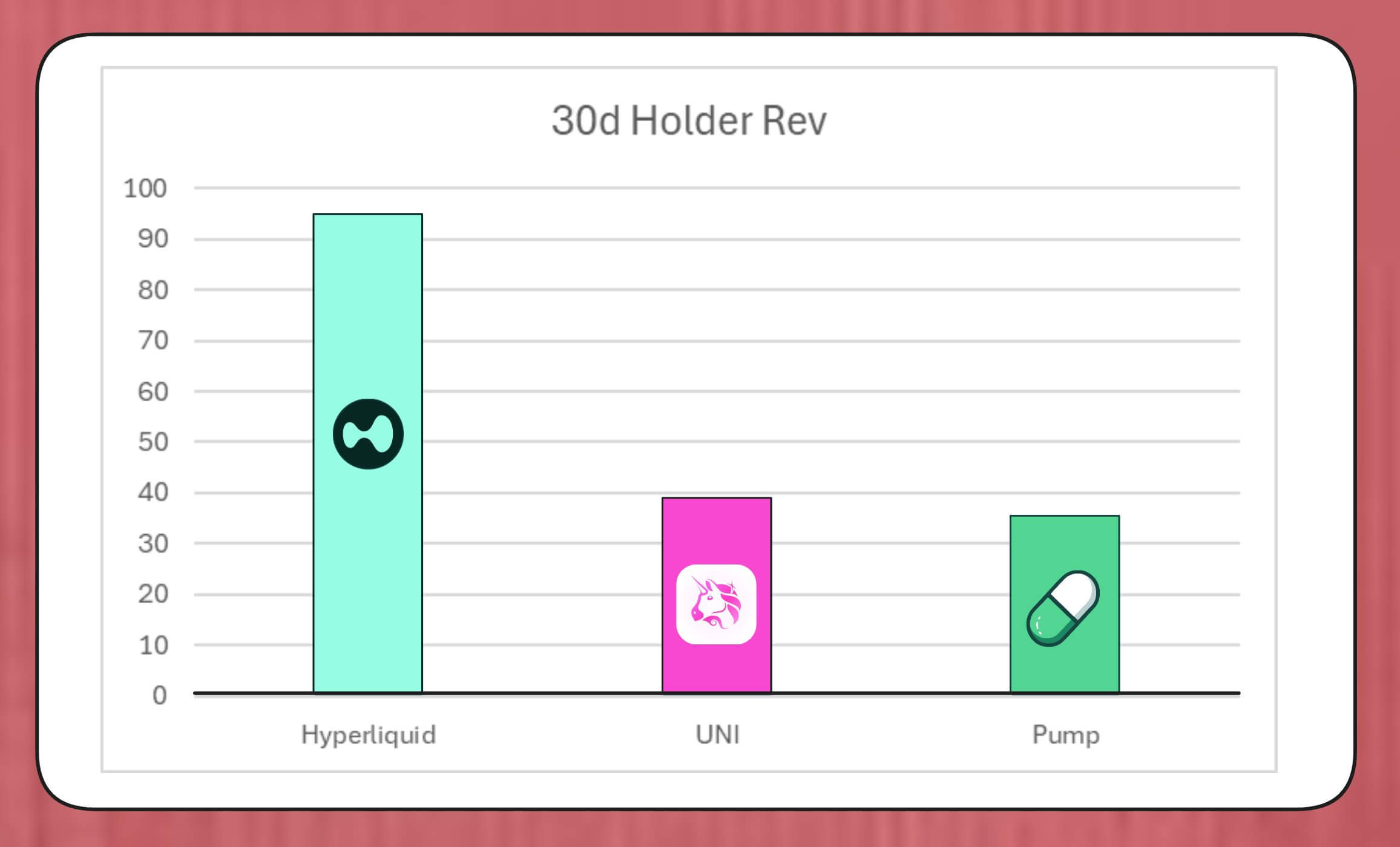
Comparison of token buybacks between Hyperliquid, Uniswap, and Pump.fun (Source: Bread)
Lido’s simulated mechanism suggests it can support roughly $10 million in annual buybacks; repurchased LDO tokens will be paired with wstETH and injected into liquidity pools to enhance trading depth.
Other protocols are accelerating similar initiatives: Jupiter allocates 50% of operating revenue to JUP token buybacks; dYdX directs one-quarter of network fees toward buybacks and validator incentives; Aave is developing a concrete plan to spend up to $50 million annually from treasury funds on buybacks.
Data from Keyrock shows that since 2024, income-linked distributions to token holders have grown over fivefold. In July 2025 alone, protocols collectively spent or allocated approximately $800 million on buybacks and incentives.
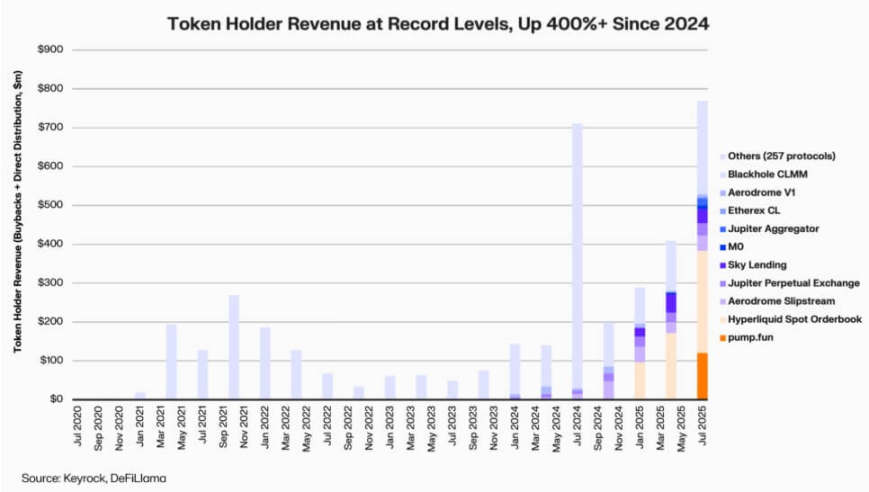
DeFi Protocol Holder Income (Source: Keyrock)
As a result, about 64% of top protocols’ revenue now flows back to token holders—a sharp contrast to the earlier cycle prioritizing reinvestment before distribution.
Underlying this trend is an emerging industry consensus: "scarcity" and "recurring revenue" are becoming central to DeFi’s value narrative.
Institutionalization of Token Economics
The buyback wave reflects deepening convergence between DeFi and institutional finance.
DeFi protocols are increasingly using traditional financial metrics—such as "price-to-earnings ratios," "yield thresholds," and "net distribution rates"—to communicate value to investors who now evaluate DeFi projects similarly to growth-stage companies.
This convergence provides fund managers with a common analytical language but introduces new challenges: DeFi was not originally designed with institutional requirements like "discipline" and "disclosure," yet the industry now faces expectations to meet them.
Notably, Keyrock analysis highlights that many buyback programs heavily depend on existing treasury reserves rather than sustainable, recurring cash flows.
Such models may temporarily support token prices, but their long-term sustainability is questionable—especially in market environments where "fee income is cyclical and often correlated with token price increases."
Additionally, Blockworks analyst Marc Ajoon argues that "discretionary buybacks" typically have limited market impact and may expose protocols to unrealized losses when token prices decline.
Given this, Ajoon advocates for "data-driven, self-adjusting systems": allocating funds when valuations are low, shifting toward reinvestment when growth indicators weaken—ensuring buybacks reflect real operational performance rather than speculative pressure.
He stated:
"In their current form, buybacks aren’t a silver bullet... The existence of a 'buyback narrative' has led the industry to blindly prioritize it over other paths that might yield higher returns."
Jeff Dorman, Chief Investment Officer at Arca, offers a broader perspective.
He notes that corporate buybacks reduce outstanding shares, but tokens exist within unique networks where supply cannot be offset through traditional restructurings or mergers.
Therefore, burning tokens pushes protocols toward "fully distributed systems"; however, holding tokens also preserves future flexibility—allowing for minting if demand or growth strategies require it. This duality makes capital allocation decisions in DeFi far more impactful than those in equity markets.
New Risks Emerge
While the financial logic behind buybacks is simple and direct, their implications for governance are complex and far-reaching.
Take Uniswap: its "UNIfication" proposal plans to transfer operational control from the community foundation to the private entity Uniswap Labs. This centralizing tendency has raised red flags among analysts, who warn it may replicate the hierarchical structures that decentralized governance was meant to avoid.
In response, DeFi researcher Ignas observed:
"The original vision of decentralization in crypto is struggling."
Ignas emphasizes that this "centralizing tendency" has become increasingly evident over recent years—the clearest example being how DeFi protocols often rely on "emergency shutdowns" or "core team-led rapid decision-making" when facing security issues.
In his view, the core issue is that even if centralized power is economically rational, it undermines transparency and user participation.
Supporters, however, counter that such concentration may stem from "functional necessity" rather than "ideological choice."
Eddy Lazzarin, CTO at venture firm a16z, describes Uniswap’s "UNIfication" model as a "closed-loop system"—where revenue generated by decentralized infrastructure flows directly to token holders.
He adds that the DAO will retain the ability to mint new tokens for future development, thus balancing flexibility with financial discipline.
The tension between "distributed governance" and "execution-layer decision-making" is not new, but its financial consequences have now dramatically increased.
Today, top protocols manage treasuries worth hundreds of millions of dollars, and their strategic decisions can impact the entire liquidity ecosystem. As DeFi economics mature, governance discussions are shifting focus—from "decentralization ideals" to "actual balance sheet impacts."
Testing DeFi’s Maturity
The wave of token buybacks signals that decentralized finance is evolving from a "free experimentation phase" into a "structured, metrics-driven industry." The era-defining spirit of "open exploration" is gradually being replaced by "cash flow transparency," "performance accountability," and "alignment with investor interests."
However, maturity brings new risks:
-
Governance may tilt toward "centralized control";
-
Regulators may treat buybacks as "de facto dividends," triggering compliance disputes;
-
Teams may shift focus from "technological innovation" to "financial engineering," neglecting core business development.
The durability of this transition hinges on implementation choices:
-
"Programmatic buyback models" can embed transparency via on-chain automation while preserving decentralization;
-
"Discretionary buyback frameworks" offer faster deployment but risk undermining credibility and legal clarity;
-
"Hybrid systems"—linking buybacks to measurable, verifiable network metrics—may offer compromise solutions, though few have demonstrated "resilience" in live markets.
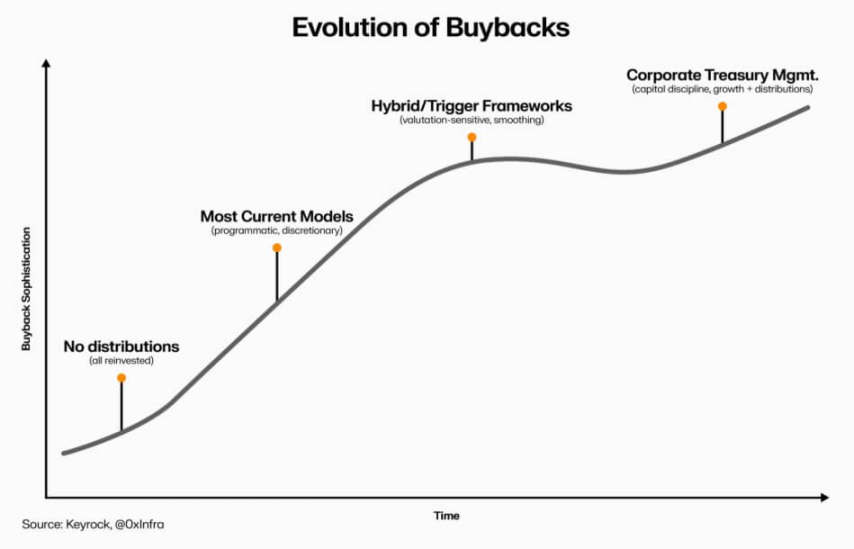
Evolution of DeFi Token Buybacks (Source: Keyrock)
One thing is clear: DeFi’s interaction with traditional finance has moved beyond "simple imitation." While retaining its open-source foundations, the sector is now integrating enterprise principles such as "treasury management," "capital allocation," and "balance sheet prudence."
Token buybacks epitomize this fusion—merging market behavior with economic logic to transform DeFi protocols into "self-funded, revenue-oriented organizations": accountable to communities and judged by "execution outcomes" rather than "ideology."
Join TechFlow official community to stay tuned
Telegram:https://t.me/TechFlowDaily
X (Twitter):https://x.com/TechFlowPost
X (Twitter) EN:https://x.com/BlockFlow_News
 @CryptoSlate