








Understanding Way Network: Building a Trustless Cross-Chain Protocol with ZKP Technology
TechFlow Selected TechFlow Selected
Understanding Way Network: Building a Trustless Cross-Chain Protocol with ZKP Technology
Way Network uses zero-knowledge proof technology to truly achieve trustless cross-chain interoperability, positioning it as a potential next-generation cross-chain protocol.
 Navigating Web3 tides with focused insights
Author: Jiang Haibo
Cross-chain protocols have become indispensable as the multi-chain ecosystem evolves. However, due to the large amounts of funds they handle, they rank among the most technically and security-challenging types of projects. According to PANews statistics, in 2022 alone, cross-chain bridges such as Wormhole, Ronin Network, BNB Chain, Horizon, and Nomad suffered over $100 million in losses from hacker attacks.
Returning to fundamentals, security is the paramount concern for cross-chain protocols. Zero-knowledge proof (ZKP) solutions based on "trustless" assumptions can eliminate potential human intervention or subjective factors in protocol design and may represent the future development path.
The Evolution of Cross-Chain Protocols
The evolution of cross-chain protocols can be seen as an ongoing process of decentralization and reducing external interference. After excluding fully centralized solutions like exchanges and wallets, even today's so-called decentralized cross-chain protocols still rely on relatively centralized approaches. These include security mechanisms such as POS consensus, multi-signature schemes, and multi-party secure computation. This category is particularly vulnerable to security incidents, and once funds are stolen, it is difficult for project teams to prove their innocence.
For example, although Ronin Network requires signatures from 5 out of 9 validators to complete a withdrawal, Sky Mavis controls 4 validators and can also sign on behalf of Axie DAO—the fifth validator—meaning that by compromising Sky Mavis alone, hackers effectively controlled 5 out of 9 validators and successfully executed the attack.
In recent months, cross-chain protocols led by LayerZero that adopt decentralized security mechanisms have gradually gained momentum. LayerZero is a universal interoperability protocol that deploys an Endpoint on each supported chain. The Endpoint runs a lightweight node, which uses an Oracle to transmit block headers containing cross-chain information on demand, while a Relayer transmits proofs for verification, ensuring message integrity. This architecture relies on two off-chain components—the Relayer and Oracle—for message passing between chains. Users must trust that the Relayer and Oracle will not collude maliciously and that the protocol itself won’t compromise the Relayer. However, according to experiments conducted by L2BEAT and others, both the Relayer and Oracle in LayerZero’s architecture can be altered, allowing attackers to extract underlying assets at any time by modifying these components.
This does not mean the end of progress in cross-chain technology. Regarding Ethereum’s two primary scaling approaches, Vitalik Buterin, Ethereum’s founder, believes that in the long term, ZK Rollups will prevail over Optimistic Rollups. Recently, projects like Way Network have begun applying zero-knowledge proof (ZKP) technology to cross-chain protocols to build truly trustless bridges. Users no longer need to trust any third party—including the protocol itself—and instead rely solely on mathematical and cryptographic proofs to ensure secure inter-chain communication.
-
First-generation cross-chain protocols typically rely on POS, multi-sig, or multi-party secure computation, requiring validation by dozens of nodes before completing cross-chain message transmission.
-
Second-generation protocols are built upon game-theoretic assumptions where the Oracle and Relayer operate independently without collusion. This simplifies the first-generation model—originally requiring multiple validators—into a system where the Oracle verifies the correctness of messages transmitted by the Relayer.
-
Third-generation protocols use pure mathematics and cryptography to generate zero-knowledge proofs for message transmission, verified by smart contracts deployed on the target chain, ensuring validity of the proof, the message, and the user payload.
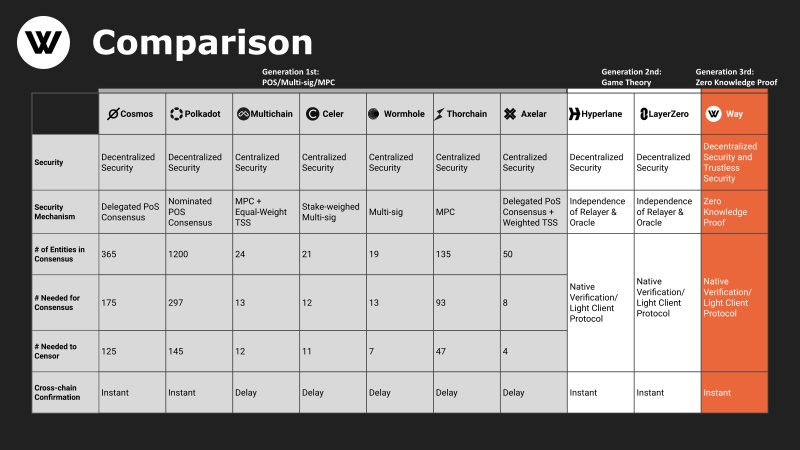
Figure 1: Three Generations of Cross-Chain Protocols
Way Network's Technical Architecture
Way Network is a fully composable interoperability protocol based on zero-knowledge proofs, operating under completely trustless assumptions. It features a modular architecture that allows applications to easily integrate with it. Way Network consists primarily of 3 routers and 4 core components.
The three routers are:
-
Core Router, implemented via zkRelayer;
-
Upper Router, implemented via Way Luggage;
-
Lower Router, implemented via Way IMTP.
The four components include Sender and Receiver smart contracts, zkRelayer, Luggage, and IMTP.
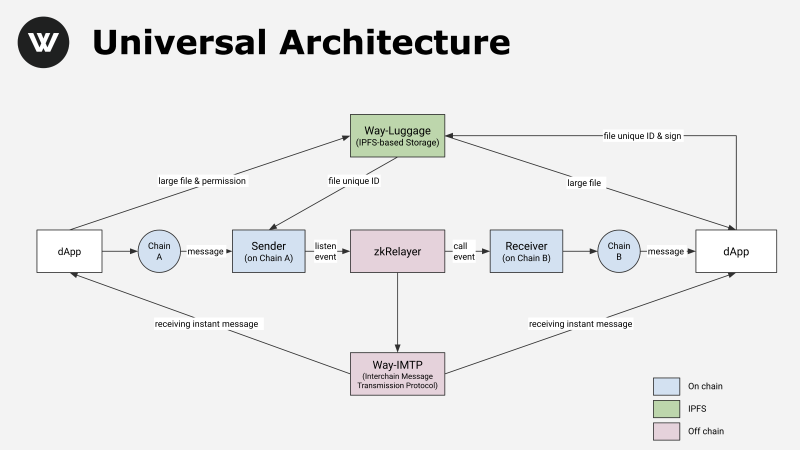
Figure 2: Way Network Technical Architecture
zkRelayer relays block headers from the source chain along with proofs, messages, and payloads to the destination chain. zkRelayer is key to Way Network’s trustless and scalable design, detailed further below.
Way Luggage is a cross-chain data transfer protocol where users retain ownership of their data, ensuring data availability across chains. In the Web2 context, user data is stored on centralized servers owned by platforms, leaving users without control. A major distinction of Web3 is solving data ownership—users can store data on decentralized systems like IPFS, Filecoin, or Arweave. Way Luggage builds on this by providing cross-chain permission controls, inter-chain data transfer and processing, and privacy protection, ensuring true user data sovereignty.
Way IMTP is an Inter-Message Transfer Protocol that enables faster inter-chain communication by delivering verified messages to dApps. Users can preview messages on the destination chain before full validation, reducing verification time for the Receiver. Unlike XMTP—a Web3 encrypted messaging protocol focused on communication between users or apps on the same chain—IMTP addresses inter-chain communication, akin to the difference between WAN and LAN.
The Sender contract on the source chain and the Receiver contract on the destination chain form a pair of smart contracts built atop zkRelayer. The Sender receives cross-chain messages and forwards them to zkRelayer; the Receiver maintains an updated list of block headers and refreshes it after verifying proofs from zkRelayer.
By integrating zkRelayer, Way Luggage, Way IMTP, and other components, Way Network enables not only asset transfers but also instant messaging, state synchronization, and file transfers across blockchains, going beyond simple asset bridging.
How Is Trustless Cross-Chain Communication Achieved?
Cross-chain operations require balancing security, decentralization, cost, and efficiency. While most protocols prioritize differently, achieving trustlessness has become a critical goal in current developments.
zkRelayer is central to achieving trustlessness and scalability. Using zero-knowledge proofs, it sends and receives messages in a trustless manner, creating a secure environment for inter-chain messaging. In Way Network’s entire proof flow, the process A-chain → Sender → zkRelayer → ZK Verifier → Receiver → B-chain relies solely on mathematical and cryptographic formulas. Once deployed, no external intervention is needed. As the code will be open-source, it can be verified that no external force can influence the cross-chain process.
Cross-chain communication built on zkRelayer offers the following advantages:
- No trust assumptions, enabling trust-minimized security
- Permissionless
- Decentralized
- General-purpose and universally applicable
- Scalable and extensible
- High efficiency, low cost
At the heart of zkRelayer is zkProver, responsible for generating computationally intensive zero-knowledge proofs. Zero-knowledge proofs are a cryptographic technique allowing a prover to convince a verifier that a statement is true without revealing any additional information.
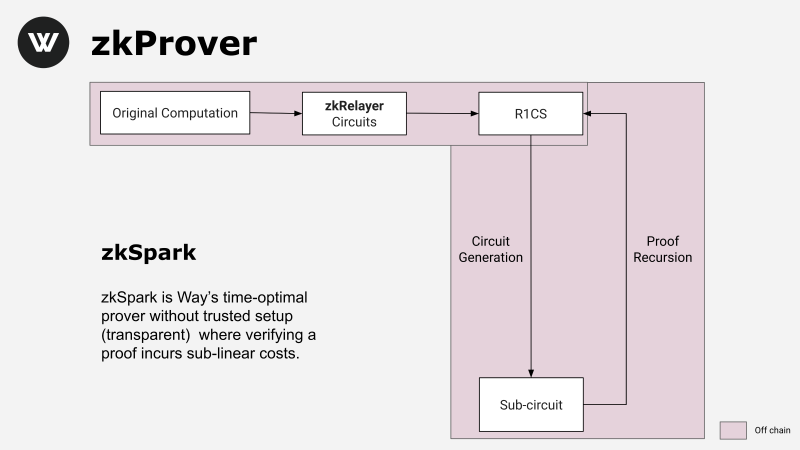
Figure 3: Zero-Knowledge Proof Components in Way Network
The zero-knowledge proof system used by Way Network is called zkSpark, a transparent zkSNARK (zero-knowledge succinct non-interactive argument of knowledge) that offers fast proving and verification times. Importantly, it requires no trusted setup, involves no secret parameters, and avoids complex procedures for generating public parameters.
zkSpark is based on sublinear-time programmable code and represents one of the most time-efficient proof systems among all ZKPs. Verification incurs sublinear costs, and zkSpark is a cryptographic primitive designed by the Way Network team. Without increasing message transmission overhead, zkProver ensures users experience secure and trustworthy cross-chain interactions without added latency.
ZKP-Based Cross-Chain Bridge Application: Send Finance
Using Way Network’s SDK/API, a new generation of cross-chain bridges—zkBridges powered by zero-knowledge proofs—can be developed. Send Finance is Way Network’s upcoming official zkBridge. It qualifies as a next-generation bridge because it achieves true trustless inter-chain messaging (Trustless Messaging) for the first time.
The core mechanism of Send Finance is Trustless Messaging via Way Network’s zero-knowledge proof relay. Based on the validity of inter-chain messages, tokens are deposited into a pool and undergo Trustless Messaging. If security checks pass, tokens are released to the user’s wallet on the destination chain. If checks fail, tokens are returned to the user.
The most critical component in the latter stage is the Receiver—a smart contract deployed on the destination chain whose core element is zkVerifier. Its role goes beyond receiving messages from zkRelayer; it must rigorously verify them. zkVerifier operates on-chain, while zkProver runs off-chain. They are strictly paired: zkVerifier can only validate proofs generated by its corresponding zkProver.
Verification includes:
- Proofs generated by zero-knowledge proofs on zkRelayer;
- Messages sent from the Sender smart contract on the source chain;
- Payloads generated when user accounts interact with the Send Finance cross-chain application.
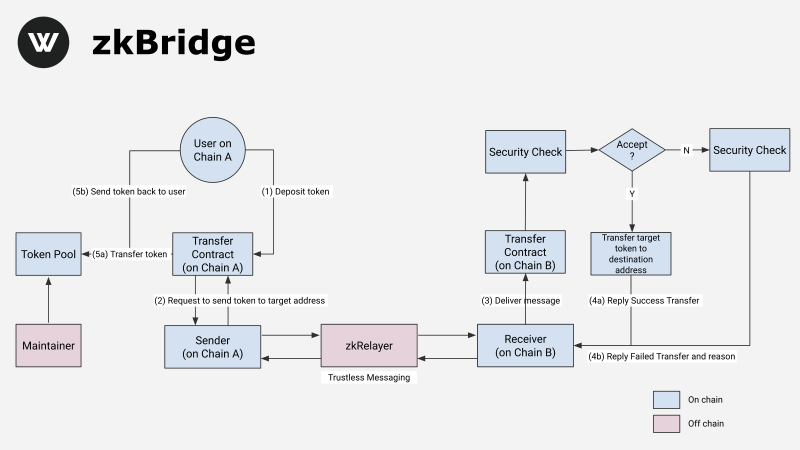
Figure 4: Send Finance zkBridge Architecture Built on Way Network
Use Cases: From Asset Bridging to DeFi, Gaming, and Beyond
Earlier leaders in cross-chain technology, Polkadot and Cosmos, were limited to internal ecosystem bridging due to technical constraints. The congestion and spillover effects on Ethereum fueled unexpected growth in EVM-compatible chains. Solana and Terra briefly captured attention, and now developers are shifting toward Move-based chains like Aptos and Sui Network. Most cross-chain bridges emerging alongside these ecosystems remain confined to asset transfers, often limited to EVM chains.
Way Network’s initial use case will be asset bridging—but this is just the beginning. It will expand into DeFi, Social, Marketplaces, and gaming.
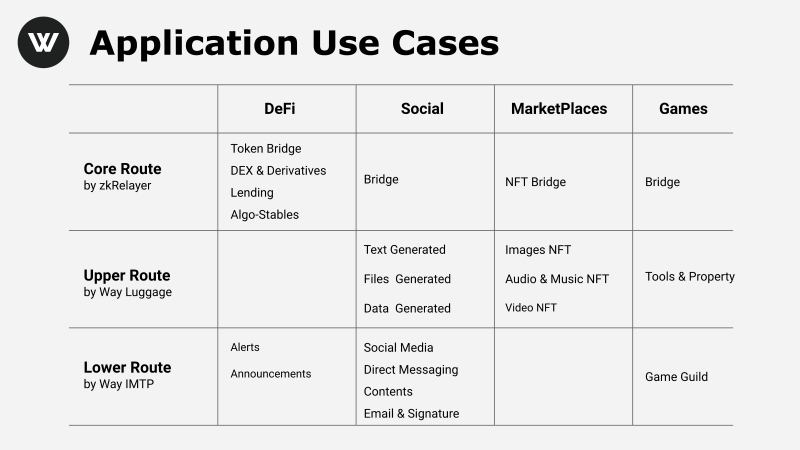
Figure 5: Way Network Use Cases
DeFi is currently the most promising sector to integrate cross-chain bridges and significantly enhance user experience.
For instance, a fully composable DEX built with Way Network could enable one-click cross-chain trading. To swap UNI on Ethereum for GMX on Arbitrum, users today must go through three steps:
-
Swap UNI for ETH on Ethereum,
-
Bridge ETH from Ethereum to Arbitrum,
-
Buy GMX with ETH on Arbitrum.
By combining cross-chain bridges with aggregation protocols like 1inch, users could convert assets on the source chain into base assets (e.g., stablecoins), bridge them, and complete token swaps across chains—all initiated by a single transaction on a universal DEX.
In lending, multi-chain protocols like Aave can integrate with cross-chain bridges to enable cross-chain collateral and borrowing. The bridge acts as a fallback mechanism only triggered during liquidation. When collateral is sufficient, no bridging occurs. With Way Network’s SDK/API, a user holding USDC on Optimism could use it as collateral to borrow ETH directly on Arbitrum. If no liquidation occurs, the user simply repays the debt on Arbitrum to reclaim their USDC on Optimism. Only upon liquidation would the bridge move USDC from Optimism to Arbitrum for settlement.
For cross-chain stablecoins, applications like MakerDAO can leverage Way Network’s SDK/API to implement cross-chain DAI minting. Users could deposit ETH on Ethereum and mint DAI on chains like Arbitrum. Currently, DAI minting is restricted to Ethereum, and existing bridges struggle with liquidity issues, causing DAI to lag behind USDC across chains. Integrating Way Network would resolve this, enabling decentralized stablecoin issuers to deploy stablecoins natively across multiple chains.
Data, files, messages in social apps, NFTs in marketplaces, and in-game items can all be transferred across chains via Way Network, fostering a vibrant multi-chain ecosystem.
Join TechFlow official community to stay tuned
Telegram:https://t.me/TechFlowDaily
X (Twitter):https://x.com/TechFlowPost
X (Twitter) EN:https://x.com/BlockFlow_News






