








From Degen to Regen: How to Enable Web3 to Play Positive-Sum Games?
TechFlow Selected TechFlow Selected
From Degen to Regen: How to Enable Web3 to Play Positive-Sum Games?
2023 will be the year of rebirth.
 Navigating Web3 tides with focused insights
Written by: Kevin Owocki, Founder of Gitcoin
Compiled by: TechFlow
Back in the DeFi summer of 2020—ancient times in Web3 history—the term "Degens" emerged. This meme typically describes Web3 enthusiasts who speculate on high-yield (APY) and high-risk projects. It's a cheeky label that also reveals the profit-driven and self-interested side of the industry.
In the first two years of this decade, thousands of traders flooded into Web3 amid headlines, rising prices, and FOMO, aiming to make quick money. Despite this year’s sharp sell-off, crypto has still broken into the mainstream. Cryptocurrency ads appeared during the Super Bowl, and news emerged about banks adopting decentralized finance (DeFi). Yes, there were also negative headlines about bankrupt crypto firms.
Tragically, many lost money as custodial systems like BlockFi and FTX collapsed. This was devastating for those affected and deeply damaging for the space.
Since Satoshi solved the Byzantine Generals Problem in the Bitcoin white paper, cryptocurrency has experienced cycles of boom and bust—similar from an evolutionary standpoint to natural systems. In times of abundance, thousands of new projects flourish. In times of scarcity, projects fail. Survivors become the dominant species in the next boom.
Survival of the fittest is a simple yet powerful mechanism observable in the Web3 ecosystem—the fittest being those best aligned with market preferences. This may explain why Degens are only interested in short-term gains rather than long-term success, a behavior that ultimately leads to their downfall. Purely self-serving behavior turns out to be maladaptive in Web3—just as it often is in many parts of the natural world.
In fact, the industry now known as Web3 has always had another side beyond greed and profit. Cryptocurrency is a tool for building collaborative organizations and shared resources—long-term trends that have consistently inspired participants.
Recently, there's been growing awareness and focus on blockchain-based public goods—things we all rely on (like open-source software or privacy research) but which are difficult to maintain and fund.
Another term in this space is "regenerative economics"—the idea that money can be used to incentivize communities to solve systemic problems. Even if an open-source project fails, its work can still benefit other initiatives if everyone moves along the same axis toward societal improvement. Innovate, iterate, evolve, repeat.
That’s why, even in the depths of a crypto winter, 2023 is already shaping up to be the year of Regen.
Degen to Regen
Degens come to Web3 seeking financial gain. Regens are those working in or building regenerative crypto economies. They hold a long-term vision for how Web3 can benefit the world—not just financially.
Regens believe financial systems can be designed as conduits for broader human flourishing, serving the needs of all humanity. My friend Gregory Landua, co-founder of Regen Network, argues people have eight fundamental needs that can be expressed as forms of capital. Beyond financial capital, these include our social, material, living, intellectual, experiential, spiritual, and cultural needs.
With programmable money, we can encode our values directly into currency. Cryptoeconomics itself holds the power to create systems as extractive and fragile as existing financial systems—or better ones.
When a Degen trades, they’re playing a zero-sum game—the token leaves their wallet and enters someone else’s, and vice versa. But Web3 can also build more positive-sum protocols that expand resource capacity over time.
The Journey Toward a Regenerative Crypto Economy
Within the regenerative ecosystem, there’s a common thread linking many individuals—they used to be Degens! Lured by the promise of better economic conditions for themselves and their families, they entered the ecosystem to make profits.
Over time, however, they became captivated by the promise of collective action—often through direct contributions to or experiences with a project. Their attitudes and motivations shifted. This transformation is by design, built into the structure of cryptoeconomic systems. For example, decentralized autonomous organizations (DAOs) allow people with shared missions to come together and pool resources—each participant at least partially aligned in values and commitment.
When you join such a community, you begin learning how to manage risk and navigate volatility. You start thinking differently about capital allocation.
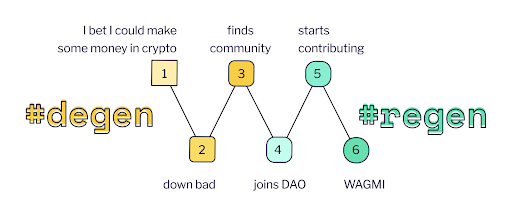
Many Regens were once Degens who began this journey in the previous cycle—back in 2017. And this is part of why I’m so optimistic about the future of regenerative systems. Thousands of relatively new people entered Web3 over the past year-plus; they’re now likely entering the second phase of the journey (i.e., navigating downturns). They’ve made mistakes and learned from them—an experience base that can inform a more pragmatic approach in the next market cycle.
For newcomers to Web3, the window of opportunity is here—to move into the third phase: finding community and discovering regenerative use cases for crypto. From there, they’ll build the projects of the next cycle, many of which will have meaningful, positive impacts on the world.
Impact Is Already Happening
People sometimes say to me: “Hey Kevin, the talk around regenerative cryptoeconomics is great—but are there real-world examples where this theory is being put into practice?”
Regen isn’t just talk. It’s happening! In fact, Alejandra Borda and I wrote an entire book detailing 100 different projects where people are using crypto to rebuild the world.
A few examples: Proof of Humanity, Celo, Kolectivo, and Gitcoin are all doing meaningful work.
2023: The Year of Regen
In this down cycle, we have the chance to filter signal from noise and rediscover our purpose. Through decentralization and peer-to-peer technology, we can build a fairer, more equitable financial system. We can bring more democratic and organic financial tools to the masses.
As individuals, we can find communities, join DAOs, and contribute to BUIDL projects that will form the foundation of the next era of Web3.
To regain legitimacy, the Web3 ecosystem must find ways to shift capital, attention, and talent away from projects with the best Ponzi-like economics and toward those that will generate the most lasting positive impact. We don’t want crypto to merely be “okay” for the world—we want crypto to benefit the entire world.
Many of today’s most prominent crypto projects already generate strong positive externalities. For instance, OpenSea, the largest NFT marketplace, has enabled thousands of artists to monetize their work—a far less extractive revenue model than their Web2 counterparts.
Lens Protocol is a Web3 social media platform gaining increasing traction in crypto circles as Twitter evolves. Lens gives people true ownership of their data, allowing them to carry it seamlessly across websites. Web3 social media has the potential to disrupt Big Tech.
Proof of Humanity is a Sybil-resistant identity registry with 18,000 verified profiles, distributing UBI tokens as stipends. Gitcoin is a crowdfunding platform that has disbursed $72 million to public goods and recently launched a protocol suite enabling others to run community fundraisers. Kolektivo is a set of protocols empowering local communities to launch, fund, and manage their own regenerative economies.
Web3 carbon credit systems like KlimaDAO and Toucan Protocol enable faster, cheaper, and more efficient carbon credit trading. While carbon credits aren't perfect, Web3-powered systems such as Hypercerts allow users to reward projects with observable outcomes. Moreover, Hypercerts can be applied beyond climate impact—extending to education, healthcare, AI safety, and open-source software.
2023 will be the year of Regen. We’re not just rebuilding and regenerating the Web3 space—we’re rebuilding and regenerating our communities and ourselves.
Join TechFlow official community to stay tuned
Telegram:https://t.me/TechFlowDaily
X (Twitter):https://x.com/TechFlowPost
X (Twitter) EN:https://x.com/BlockFlow_News


