Casual GameFi Could Become the Next Trend, Game Space to Launch Galaxy Program
TechFlow Selected TechFlow Selected
Casual GameFi Could Become the Next Trend, Game Space to Launch Galaxy Program
Before the next bull market arrives, it remains to be seen whether Casual GameFi can fill the void prior to widespread adoption of AAA-grade games.
 Navigating Web3 tides with focused insights
Against the backdrop of a deep bear market in crypto, the GameFi sector has suffered significant setbacks. However, the blockchain gaming market remains one of the fastest-growing segments within the Web3 industry, with daily active unique wallets reaching as high as 800,000 at peak times. Recently, Game Space organized the industry's first touring tournament, supported by Splinterlands, ImmutableX, and Big Time. The event generated 200,000 Twitter interactions and retweets, gathered nearly 20,000 blockchain gamers within a week, and attracted million-follower-tier GameFi streamers like Sky Vee to broadcast live gameplay.
After Axie Infinity—the representative of GameFi V1.0—faded from the spotlight, AAA-grade large-scale GameFi became the most anticipated evolution in the industry. There is strong hope that high-quality blockchain games will address the core issue of early Play-to-Earn (P2E) games: lack of fun. Yet, more than a year after the initial wave of blockchain games, why have AAA-grade GameFi projects remained scarce?
Why Is It So Hard for AAA-Grade GameFi to Launch?
Despite sustained user interest in top-tier blockchain games, AAA-grade titles have remained elusive since the rise of GameFi. Major traditional game studios such as Zynga and Ubisoft publicly announced their entry into Web3 and GameFi, yet none have delivered tangible products. According to Michael Cameron, CEO of Game Space and former developer of the industry’s first AAA MMORPG blockchain game Bless Global, there are several key reasons. First, the barrier to entry for building AAA-level blockchain games is extremely high—only teams with funding exceeding $50 million can even begin to compete. Additionally, long development cycles, monetization challenges, and the ongoing bear market have further hindered progress.
Michael’s team previously launched the industry’s first GameFi-as-a-Service (GaaS) platform, aiming to provide traditional game developers with rapid blockchain integration solutions to address issues such as high user onboarding barriers and non-closed transaction loops in early GameFi. However, the bear market cooled overall industry momentum, slowing traditional studios’ adoption and preventing any breakout new titles from emerging.
Amid this recalibration, an accidental experiment opened up a whole new world for Michael—Casual GameFi, or blockchain-enabled casual mini-games.
Big Games Stumble, But Mini-Games Stage a Comeback?
To promote its GameFi SDK, Game Space developed blockchain versions of classic mini-games like Merge Bird in 2022 as showcase projects, demonstrating how traditional games could be upgraded to blockchain in just seven days. This small move unexpectedly brought Game Space’s official Twitter account close to 20,000 followers. The blockchain transformation of casual games reignited interest among existing fans, who began flocking to the Game Space platform.
Following this success, Game Space launched the hit casual blockchain game Goat! Goat!, built on the classic match-three mechanic. During its debut week, Goat! Goat! partnered with over 50 DAOs and institutions globally—including BitKeep, Nawarat, and Meta Galaxy—for launch events that sparked excitement across India, the Philippines, Vietnam, and other regions, achieving 600,000 weekly active users in its first week.
Building on the familiar match-three gameplay, Goat! Goat! integrated iconic NFT avatars with strong metaverse and Web3 aesthetics as core game elements. The game requires no advanced skills or understanding of complex economic models. From onboarding to gameplay and interaction, everything is designed to be as simple as possible.
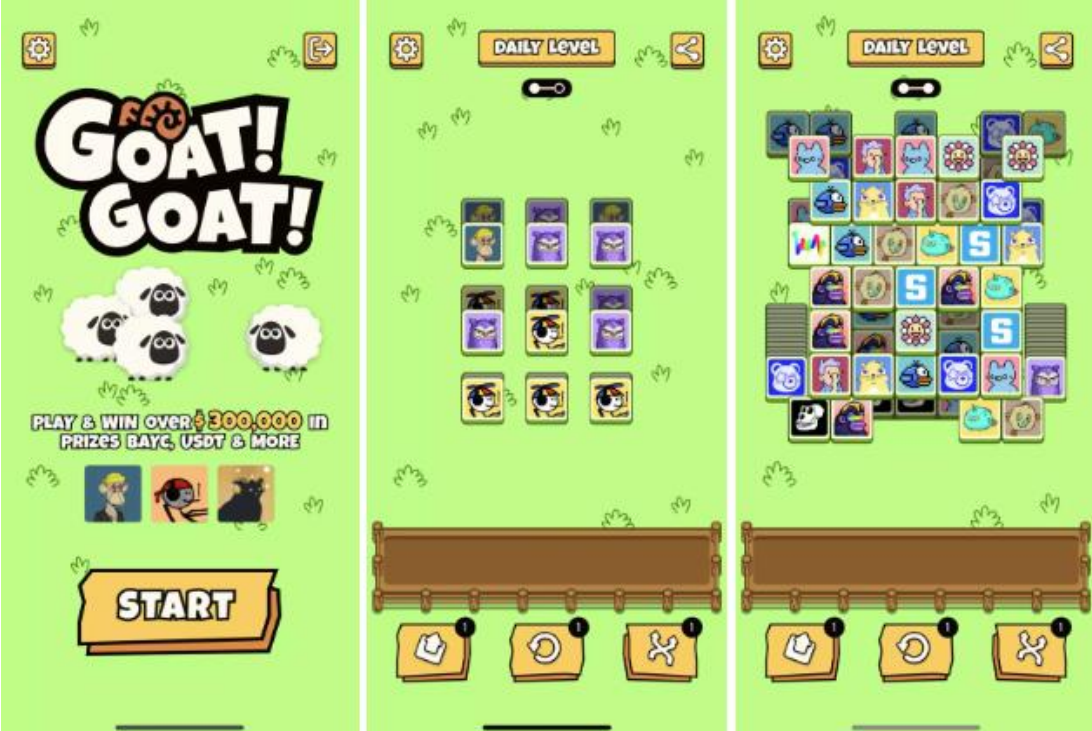
Beyond entertainment, players earn randomized mystery boxes of varying rarity—gold, silver, and bronze—upon completing levels. These boxes can be sold on NFT marketplaces and may contain USDT or different tiers of Merge Bird NFTs. The randomness of rewards significantly boosts player engagement. According to Twitter data, Goat! Goat! has seen over 6 million game sessions, produced more than 2 million mystery boxes, and revealed 1.5 million Merge Bird NFTs—setting a historical record for Casual GameFi (blockchain mini-games).
The unexpected popularity of Goat! Goat! gave Michael a major revelation: the fun factor of hit mini-games far surpasses that of P2E gold-farming games, marking the first time blockchain gaming achieved high playability, strong user retention, and low cost.
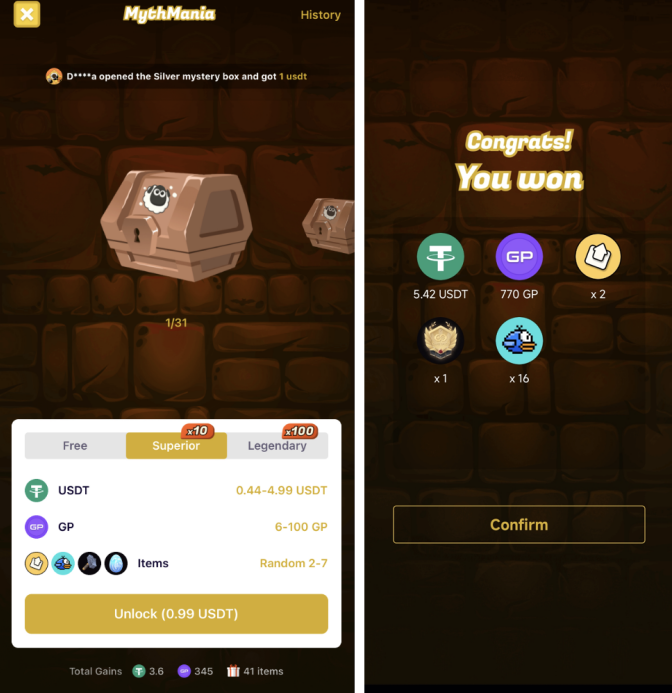
Capitalizing on this momentum, Michael launched two more games: Magic Pot and MythMania. Magic Pot consumed over 1 million Merge Bird NFTs, becoming the largest asset consumption scenario in Casual GameFi. In MythMania, paying players can amplify their mystery box rewards tenfold, enabling the entire platform to achieve sustained profitability. Notably, this盈亏平衡 was achieved without issuing a platform token for user incentives—an especially rare feat during a bear market.
Why Has Casual GameFi Achieved Counter-Trend Growth?
Statistics show that casual games have over 4 billion users worldwide, with the global casual gaming market exceeding $500 million in 2022 alone. Historically, mini-games have held immense power: short development cycles, low complexity, and relatively simple economic models. Though often overlooked by mainstream markets, they represent a dominant force in gaming, accounting for 77% of total users and over 1 billion monthly active users—a true case of "playing humble while dominating."
Michael attributes GameSpace’s success in Casual GameFi to three main factors:
First, ease of access. Instant play, flexibility, and suitability for fragmented entertainment make lightweight mini-games highly attractive in terms of user scale and stickiness. Unlike AAA games requiring complex logins and account setups, this simplicity is a core advantage of Casual GameFi. Game Space’s GaaS SDK allows users to log in instantly using traditional Web2 accounts like Google or Apple, with no need to purchase entry tickets—dramatically lowering the barrier to blockchain gaming.
Second, selecting proven hits. From Merge Bird to Goat! Goat! and Melon Fusion, Michael focuses on transforming currently or previously viral mini-games into Casual GameFi, ensuring high playability from the outset.
Third, efficient production capacity. Michael notes that all current Casual GameFi transformations are completed within seven days using Game Space’s GaaS SDK—this agility enables his team to rapidly capture market trends and achieve breakthroughs.
Santhosh (Twitter), a loyal Game Space user, said: “Mini-games are accessible to everyone, with very low barriers. I used to spend 1–2 hours daily on Voodoo (a traditional mini-game platform). Since discovering Game Space, I’ve stopped playing elsewhere because they pick the exact games I love, and now I get mystery box rewards on top. It’s not just fun—I often make money too.”
The “Lego Effect” Triggered by Casual GameFi
Beyond simplicity and fun, Santhosh praised the “composability” across multiple games on Game Space: “I spend 2–3 hours daily on Goat! Goat! farming gold mystery boxes, then use them in MythMania to unlock 10x rewards—usually earning around 10 USDT and 10–20 level-1 Birds. Then I go to Merge Bird to craft level-20 Bird NFTs, and finally melt them down in Magic Pot, where I might earn another 1–10 USDT. Even though opening boxes costs money, I usually earn it back.”
As described by Santhosh, the combination of multiple Casual GameFi titles offers richer gameplay than standalone AAA games. This combinatorial effect mirrors the DeFi boom in the previous bull cycle. For example, Uniswap introduced the AMM protocol, which was reused across lending platforms like Curve, while yield aggregators like YFI pooled returns from various protocols. Each project had only a handful of developers, but together they formed the vast DeFi ecosystem through modular stacking.
The Lego effect is fully realized in Game Space’s Casual GameFi: by launching a series of interconnected mini-games, each with its own production and consumption mechanics, assets like USDT, in-game items, NFTs, and Game Points (GP) become interchangeable across titles. Assets earned in one game can be used in others—mystery boxes from Goat! Goat! can be used in MythMania, and Bird NFTs unlocked there can be merged in Merge Bird.
This multi-game integration not only multiplies enjoyment but also strengthens the overall economic model, avoiding the short lifespans typical of single P2E games.
GameSpace to Launch the “Galaxy Program”
In 2023, Michael—having accidentally stumbled into an ideal starting position—is openly ambitious about his vision.
After validating the Casual GameFi model, he plans to expand the portfolio to over 10 titles in Q1 2023 and 20 by Q2. In his view, each new high-quality Casual GameFi exponentially increases the platform’s overall playability. Game Space is nearing 100,000 Twitter followers and aims to accumulate 1 million users by year-end through its Casual GameFi strategy, positioning itself for explosive growth ahead of the 2024 bull market.
Beyond self-developed titles, Michael plans to open up the platform further. With the upcoming Galaxy Program, Game Space will invite more casual game developers (CPs) to quickly integrate their games, bringing fresh mechanics and collectively capturing the growth红利 of Casual GameFi. Participating games must remain polished, professional, innovative yet familiar, offering smooth gameplay and broad appeal. He also plans to collaborate on next-gen social games, exploring Social GameFi through DID and other identity technologies.
Michael says he is most excited about the team’s new slogan: “Add One More Hour of Joy to Web3 Every Day.” This, he says, is the driving force behind his relentless pursuit.
Conclusion
After the Play-to-Earn-driven GameFi V1.0 era, the GameFi space experienced a brief resurgence. The rise of Casual GameFi has lit a faint but hopeful candle in the darkness of the bear market.
As an innovator seeking to reshape the GameFi landscape, Game Space demonstrates new strategies and provides valuable insights and direction for future entrants. As the next bull market approaches, it remains to be seen whether Casual GameFi can fill the void before widespread adoption of AAA games—but the potential is certainly worth watching.
Join TechFlow official community to stay tuned
Telegram:https://t.me/TechFlowDaily
X (Twitter):https://x.com/TechFlowPost
X (Twitter) EN:https://x.com/BlockFlow_News