Decoding On-Chain Games: The Future of Complex On-Chain Applications
TechFlow Selected TechFlow Selected
Decoding On-Chain Games: The Future of Complex On-Chain Applications
Against the backdrop of blockchain infrastructure innovation, on-chain games could be the prototype of the next-generation killer application.
 Navigating Web3 tides with focused insights
Authored by: Maxlion & StarkNet Astro
TL;DR
-
Why should we care about on-chain games?
-
(1) Against the backdrop of blockchain infrastructure innovation, on-chain games may represent the prototype of the next-generation killer application.
-
(2) On-chain user growth has hit a bottleneck; there is hope that on-chain games can sustainably bring more active users to blockchains.
-
(3) As blockchain scaling accelerates, the "4G era" of blockchains will drive innovation in complex on-chain applications. New public chains, zkEVM/VMs, and modular architectures—with features like account abstraction, asset management, parallel processing, and ZK capabilities—lay the foundation for low-revenue-per-transaction, high-TPS on-chain applications.
-
-
What is the current state of on-chain games?
-
(1) On-chain games are currently in an early exploratory phase, both in product form and market validation. No mature on-chain game has emerged yet, and most existing ones suffer from poor playability and low completion rates.
-
(2) Compared to traditional games and GameFi, on-chain games still offer innovations such as decentralization, composability, on-chain collaboration, and contract-based interactions, exemplified by games like Dark Forest, Isaac, and Treaty.
-
-
On-chain games can be divided into two categories: ported and native.
-
(1) Ported on-chain games unlock possibilities for traditional games. Simulation and management games, due to their composability, asynchronous turn timing, and financial gameplay elements, are better suited for migration to the blockchain than other genres.
-
(2) Native on-chain games are more likely to drive innovation in complex on-chain applications. Related concepts include hyperstructures and autonomous worlds, which expand the imaginative scope of on-chain gaming.
-
-
What is the current state of on-chain game engines?
-
(1) In the early stage of on-chain gaming, engine teams often take on the responsibility of pioneering game products. Engine teams are far fewer than game development teams, with notable examples being MUD on Ethereum and Dojo on Starknet.
-
(2) Beyond game engines, other on-chain gaming infrastructure exists, such as gaming guilds like Guildly and game storefronts like Cartridge.gg.
-
-
Why is Starknet the arsenal for on-chain gaming?
-
(1) Performance-wise, Starknet theoretically supports up to 9,000 TPS. Its STARK proof system can batch 60 million L2 transactions into a single Ethereum transaction, with gas costs potentially as low as $0.001. Moreover, STARK benefits from network effects—the cost per transaction decreases as volume increases—making Starknet ideal for high-volume on-chain games.
-
(2) Starknet’s native account abstraction allows contract wallets to better adapt to the interactive demands of on-chain games compared to traditional wallets.
-
(3) Starknet prioritizes native application incubation. Its core team, StarkWare, has partnered with MatchBox, Only Dust, Volt Capital, Mask Network, and others to host multiple hackathons, fostering a thriving ecosystem of on-chain game developers.
-
-
We believe Starknet is the most important ecosystem for on-chain gaming. In our next research piece, we will dive deeper into Starknet’s technical architecture, its on-chain gaming ecosystem, and the design and construction of on-chain games.
What Are On-Chain Games?
On-chain games (also known as fully on-chain or full-chain games) refer to games that exist entirely on the blockchain via smart contracts. Unlike GameFi projects that merely tokenize in-game assets—a form of partially on-chain implementation—on-chain games store both state and logic on-chain, enabling characteristics such as decentralization, permissionless access, and composability. These games aim not just to incrementally improve existing games or tokenize items, but to pioneer entirely new gameplay mechanics.
Blockchain is a fundamentally new technology. Rather than using it to imitate, modify, or graft old products, it's better to build something natively new. The horse manure problem of the horse-drawn carriage era was never solved—it disappeared with the advent of the automobile. Similarly, on-chain games were not created to solve the legacy issues of Web2 games or partially on-chain games; they are built for radical innovation.
-
Limited gameplay and content.
-
Centralized operations where project teams can alter game rules at will.
-
Known for Ponzi-like models, often seen as extensions of DeFi rather than a genuine new "game genre."
-
Merely off-chain games ported onto the chain, not natively built for it.
Can on-chain games resolve these problems and promise a better future? The answer is: no.
Blockchain is a fundamentally new technology. Instead of using it to imitate, modify, or graft old products, it's better to build something natively new. The horse manure problem of the horse-drawn carriage era was never solved—it disappeared with the advent of the automobile. On-chain games weren’t created to fix the old problems of Web2 or partially on-chain games; they’re dedicated to radical innovation.

The 19th-century horse-powered train may seem absurd today, but it was a compromise shaped by contemporary public psychology, policy, road conditions, and product forms. Today’s consortium chains and GameFi are similarly compromises—new technologies adapting to old ecosystems—modern-day horse-powered trains. Yet, we all sense they cannot represent the future. Eventually, new technologies reshape entire ecosystems. On-chain games may be an immature beginning—but a significant one.
Therefore, the more critical questions are: Why should we pay attention to and explore on-chain games? And what stage of development are they currently in?
Why Do We Need On-Chain Games?
【I don't know what this thing will be worth in the future, but it's new, so let's do it first.】
——Max, founder of Astro Aerospace Industries, said

Technological Evolution Is Inevitable
On-chain games are an inevitable path of technological evolution.
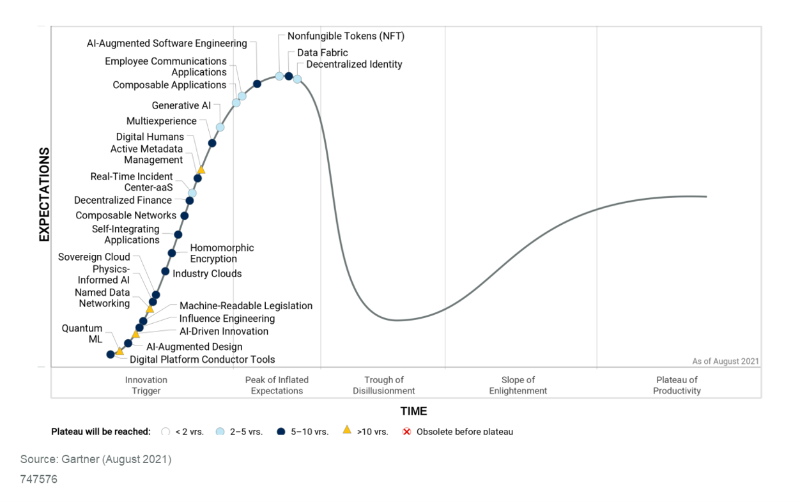
Throughout history, each major technological revolution only gave rise to breakthrough products years later. Secondary innovations and inventions that enable mass adoption are often overlooked, yet it is precisely these cumulative advances—interacting and reinforcing one another—that eventually produce true breakthroughs. Behind every celebrated "from zero to one" innovation lie numerous foundational technologies.
Behind tanks lie oil extraction and refining, steel processing, engines, and explosives. Behind smartphones lie operating systems, touchscreens, processors, and sensors. Behind AI lie computer science, neuroscience, statistics, psychology, and philosophy. But identifying exactly which specific N innovations ultimately lead to globally transformative products is nearly impossible—they're more likely branches along a technological trajectory than final fruits.
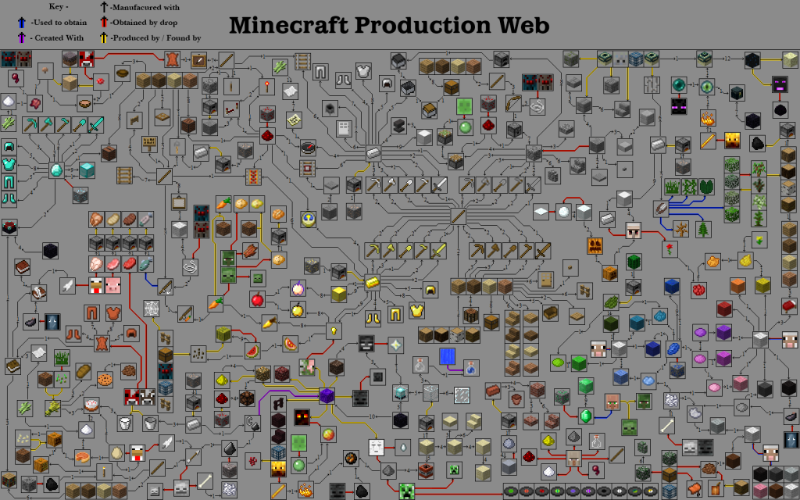
Thus, today’s immature on-chain games may mature over time—or serve as stepping stones toward other innovations. Regardless, they deserve attention and exploration. As pioneers of on-chain applications, even if they aren’t the ultimate killer app, they could be closely related to it—just as history’s great innovations have shown.
Blockchains Need Active Users
Blockchains need application innovation to attract or activate more users.
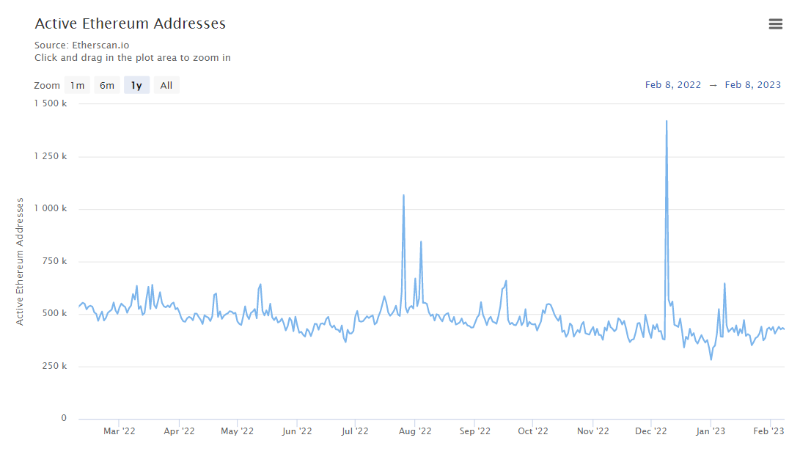
As shown above, Ethereum’s daily active user count has plateaued. We’ve witnessed the explosion of the broader DeFi ecosystem, but from an outside perspective, NFTs and GameFi appear as extensions of DeFi. Blockchains currently lack large-scale applications capable of sustaining long-term user engagement. Hence, gaming has become a key target for blockchain expansion. The experiences of Axie Infinity and StepN show that GameFi is unsustainable. Therefore, more durable and healthy on-chain games are expected to replace GameFi as the next wave of on-chain innovation. Beyond industry needs, some tech enthusiasts want to prove that blockchains can support more engaging, complex, and immersive applications—not just digital currencies and DeFi.
Complex On-Chain Applications
-
On one hand, for blockchains, on-chain games are an inevitable step in technological advancement, and blockchains also require significantly more active users.
-
On the other hand, recent advancements in new public chains, zkEVMs/VMs, and modular architectures provide higher TPS and lower gas environments. Their superior features—account abstraction, asset management, parallel processing, and ZK capabilities—lay the groundwork for application innovation.
Looking back at Ethereum’s history of low TPS and high gas fees, early applications were those tolerant of high costs and requiring low throughput—such as DeFi and NFTs. Initially, many succeeded simply by launching tokens, designing Ponzi-like models, and adding basic operations to generate massive wealth.
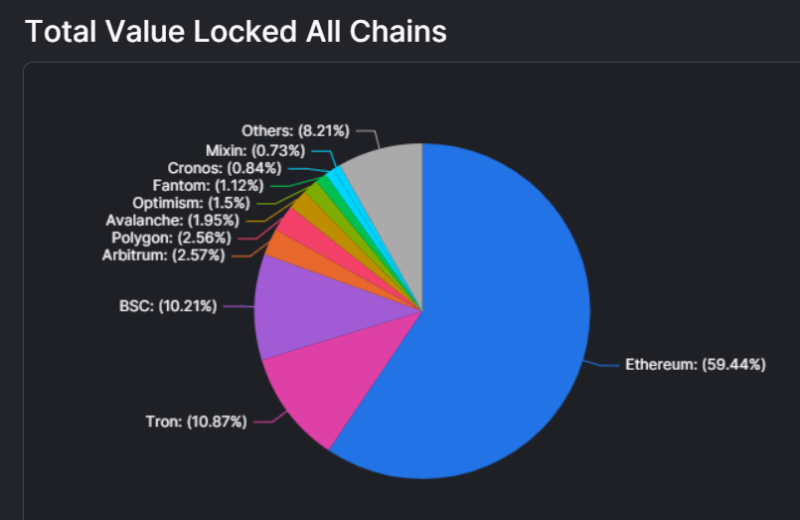
However, in a high-TPS, low-gas environment, applications with low revenue per transaction but high TPS requirements—so-called complex on-chain applications—can emerge. By plotting a coordinate system with TPS on the x-axis and revenue per transaction on the y-axis, we can map existing applications and infer what kinds of apps might emerge on higher-performance networks.
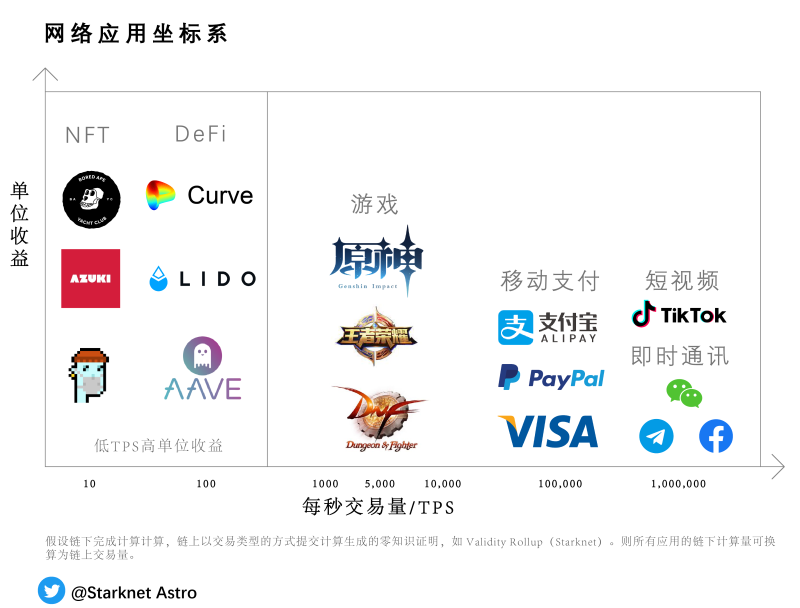
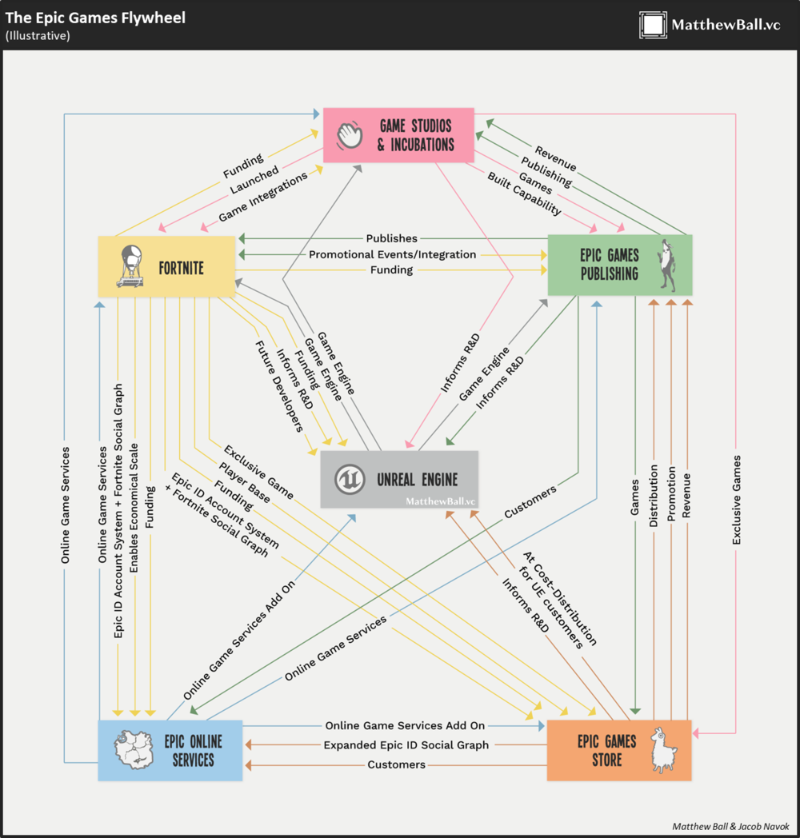
Bas1s Ventures' Wonder argues: A low-revenue-per-transaction, high-TPS on-chain application resembles a Web2 app with low ARPPU (average revenue per paying user), which requires massive user transactions to break through business or tokenomic ceilings—much like Meituan in China or EPIC in the US, which leveraged high-frequency transaction businesses to enter low-frequency domains, eventually building entire ecosystems. Such ecosystems are difficult to emerge directly on Ethereum due to high gas fees and limited throughput, but can thrive on new blockchain infrastructures.
Historically, the transition from 3G to 4G enabled the mobile internet boom. During 4G rollout, many questioned its utility: What good is faster email or more blogs? But the subsequent explosion of smartphone apps silenced skeptics.
Similarly, amid accelerating blockchain scaling, on-chain games may mark the beginning of the next generation of complex on-chain applications. Early explorations in on-chain gaming could lay the foundation for broader innovation. As Jacob describes in Hyperstructures, we now have the chance to build civilizational infrastructure on blockchains—permanent, composable, reusable global applications that outlive us and serve humanity across generations.
Current State of On-Chain Games
A well-known example is Dark Forest, a multiplayer online space conquest game. Members of dfdao are building custom infrastructure Light Forest to allow anyone to run customized rounds of Dark Forest with modified rule sets, leading to variations like Dark Forest Arena: Grand Prix.
“Dark Forest’s setting is an infinitely generated encrypted universe containing various types of planets and spatial entities. The most popular mode is a week-long free-for-all battle where thousands of players, bots, AIs, and even smart contracts compete face-to-face for galactic dominance. Players start on a tiny home planet, harvest resources, conquer nearby planets, and interact with neighbors through alliances, trade, negotiation, or war to expand their empire.” ——"Dark Forest: Three Years of Fully On-Chain Gaming (Part I)"
Dark Forest runs entirely on-chain and uses ZK-SNARKs to let players hide personal information during strategic interactions—many decisions occur under hidden or asymmetric information.
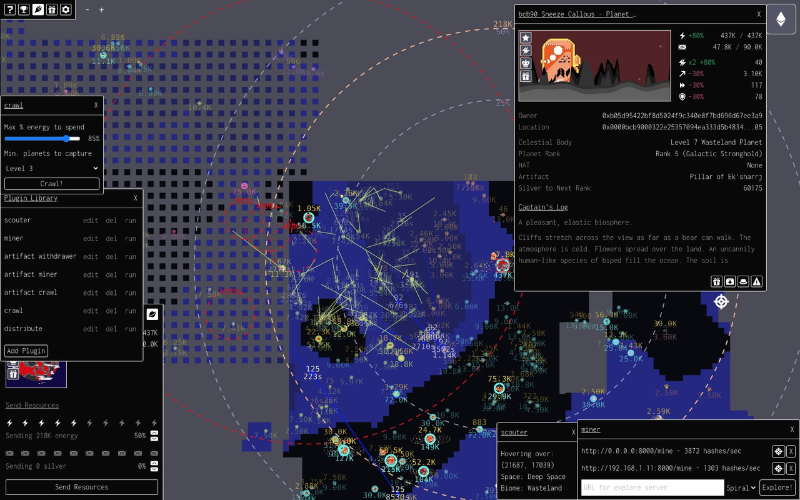
While Dark Forest remains a classic case, more cutting-edge examples include Isaac, Treaty, and LootRealms.
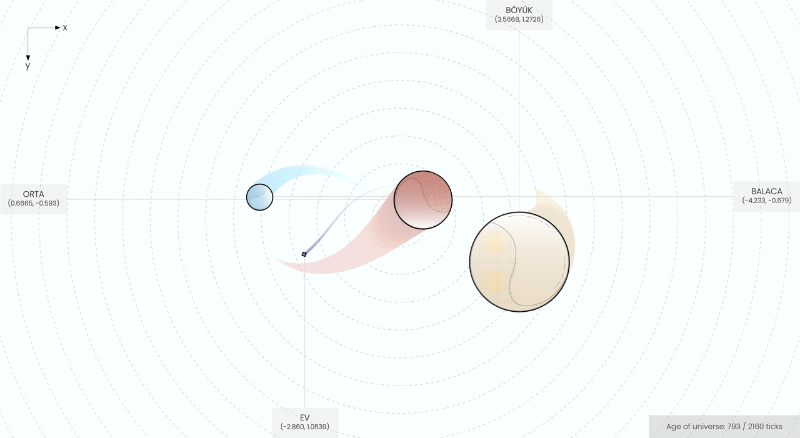
Isaac, developed by the Topology team on Starknet, is a multiplayer physics simulation game based on the universes of *The Three-Body Problem* and *The Wandering Earth*. Deployed on Starknet, players must collaborate to build factories, pipelines, and power grids to convert natural resources into equipment that propels a planet out of the solar system. Its hallmark is requiring on-chain collaboration toward shared goals.
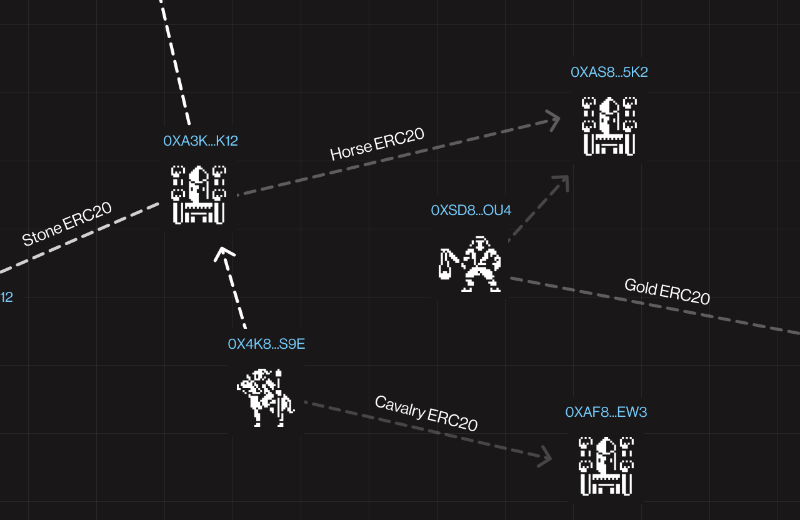
Treaty, developed by Curio, is a massively multiplayer sandbox strategy game. Players act as governors of nations, allocating resources, expanding territory, and forming strategic alliances—similar to simplified versions of Web2 titles like *Romance of the Three Kingdoms: Strategists* or *Rate the Soil*. Its unique feature is allowing players to co-author code-executed contracts—such as embargoes or peace treaties—where members who join and pay dues are prohibited from attacking each other.
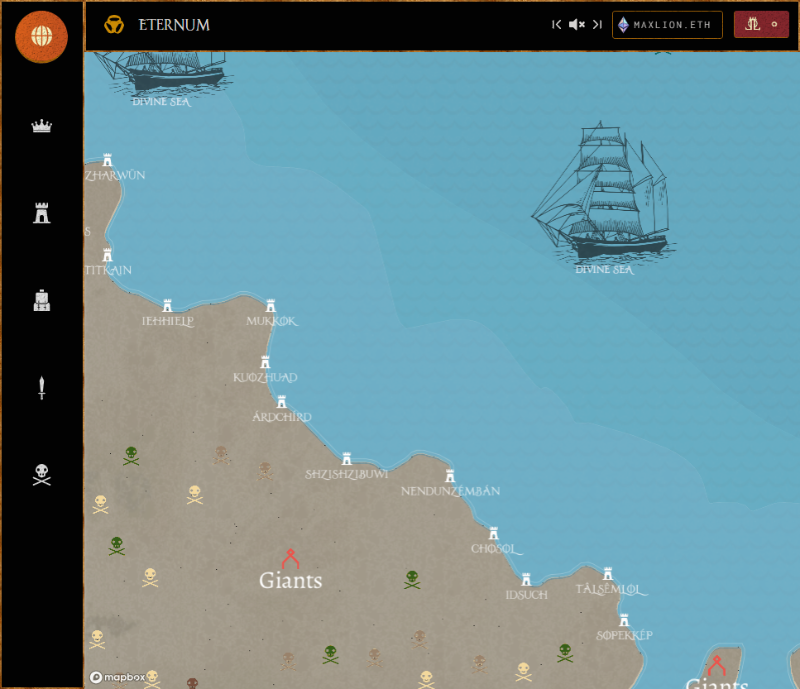
LootRealms, developed by Bibliotheca DAO on Starknet and inspired by Loot, is a sandbox war-strategy game. In version one, players needed to hold Realms NFTs to play; in version two, adventurers can mint NFTs to join. Notably, adventurer gear comes from the original Loot collection. On February 1, 2023, LootRealms raised nearly $4 million in USDC (oversubscribed 6.35x) through community fundraising. It stands out for its high playability and completion rate, having pioneered token distribution and on-chain governance. All in-game transactions flow through a network machine called Nexus, powered by $LORDS as gas. Currently, Mask Network's Kaspar is writing an in-depth report on LootRealms—stay tuned for insights. Other sandbox-style fully on-chain games include Mithraeum and Conquest.
Categories of On-Chain Games
This section highlights subtle distinctions among on-chain games. Given current blockchain computational capacity and cost constraints, on-chain games should ideally have low concurrency to suit blockchain inefficiencies. However, from a radical innovation perspective, this isn’t necessarily true. Two often-overlooked contexts exist: ported games (moving existing games on-chain) and native games (developing games that can only exist on-chain—if we still call them “games” at all).
Ported

Ported games are those that could exist off-chain but are adapted to leverage on-chain features. As mentioned earlier, on-chain versions gain advantages in composability, reusability, and decentralization, enhancing certain gameplay aspects. Intuitively, ported games simply move game storage and computation on-chain.
Inspired by Will Robinson's "Unblocking On-Chain Games: Part Two — The 18xx Genre", consider 18xx games as an example. 18xx is a turn-based simulation and management game set in 1846, where 3–5 railway tycoons compete to earn money and build optimal stock portfolios between 1846 and 1935 by investing in and operating rail companies—think of it as a more complex Monopoly. Each company has its own treasury, separate from player portfolios and banks, used to lay tracks, upgrade infrastructure, or buy trains. The key challenge lies in balancing when to invest in your company versus paying dividends to shareholders—all affecting stock prices.
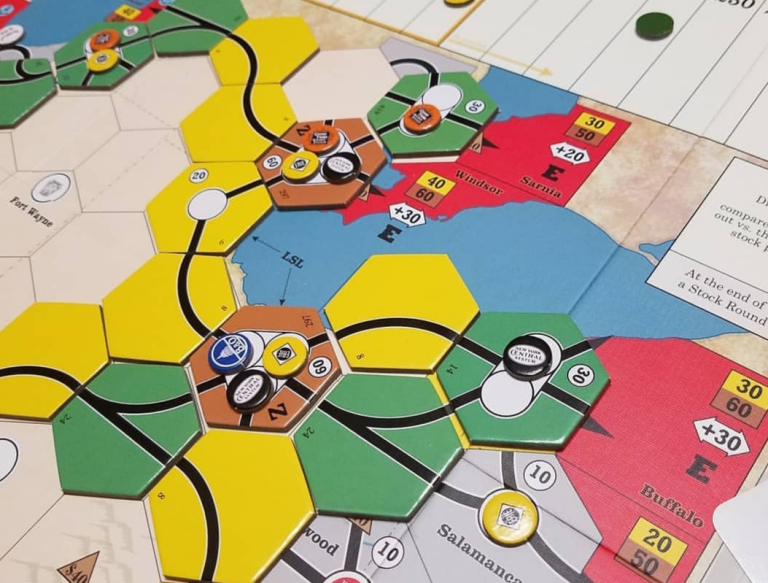
18xx games are highly suitable for on-chain porting because:
-
They have sufficient turn duration. Each player makes a series of decisions within a turn and submits them simultaneously, reducing pressure on blockchain TPS. Transactions can be batched to lower gas costs.
-
They involve financial gameplay. Players engage in market dynamics such as asset auctions, making them naturally compatible with DeFi integrations.
Once ported, stocks in 18xx could be real tokens like UNI, SUSHI, or DAI, with trading markets powered by Uniswap V3. Past game states could be encoded into smart contracts—as Treaty does. In theory, any simulation-management game could be adapted this way—including Treaty, Mithraeum, Conquest, and LootRealms.
Native
Native refers to games created “for the first time” on-chain—if we still call them “games.”
As gubsheep, founder of Dark Forest, wrote in "The Strongest Crypto Gaming Thesis":
Crypto-native games fully embrace the architectural patterns and spirit of blockchain application development:
-
The blockchain is the true source of game data. It’s not just auxiliary storage or a mirror of server-held data. All meaningful data resides on-chain—not just asset ownership. This unlocks programmable blockchain benefits: transparent, permissionless interoperability.
-
Game logic and rules are implemented via smart contracts. For instance, combat mechanics—not just ownership—are on-chain.
-
The game is built on open ecosystem principles. Game contracts and accessible clients are open-source. Third-party developers can customize or even fork the experience via plugins, third-party clients, interoperable contracts, or full redeployments. This lets developers harness the creative output of an aligned community.
-
The game is client-agnostic. Closely tied to the above, a litmus test for crypto-nativeness is: “If the core team’s client vanished tomorrow, could the game still be played?” Only if data is permissionlessly stored, logic permissionlessly executed, and the community able to interact with core contracts without relying on core team interfaces—is the answer yes.
-
The game includes digitally owned assets with real-world value. Blockchain provides a native API for value itself, enabling default interoperability between digital assets and cryptocurrencies. This allows developers to create new positive-sum incentive structures for players and communities.
As GuiltyGyoza, founder of Topology, noted in "On Medium, Validity Rollup, and Digital Physics"—quoting Alan Kay and Marshall McLuhan—blockchain is a new medium, and frontier innovators must build native applications like “autonomous worlds.” For more on autonomous worlds, see 0xparc’s "Autonomous Worlds".
A simple example of a native on-chain game is Starknet’s GOL2, a version of Conway’s Game of Life. Also known as the Conway’s Game of Life, invented by British mathematician John Horton Conway in 1970, it’s a cellular automaton.The rules: cells on a square grid are either alive or dead. A live cell with 2 or 3 live neighbors survives; a dead cell with exactly 3 live neighbors becomes alive; otherwise, the cell dies.
The game prototype looks roughly like this:

GOL2 follows the basic rules of the traditional Game of Life. Players create an initial configuration on the grid, after which cells evolve (live or die) according to the rules, forming complex patterns. Players can use GOL2’s token to revive selected cells or start new games.
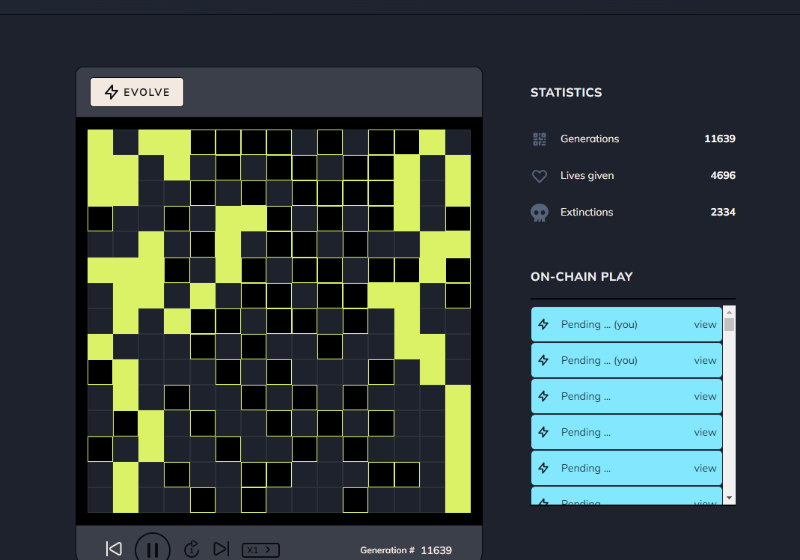
GOL2 leverages blockchain to generate game content on-chain, but suffers from overly simplistic mechanics and low playability—achievements don’t deliver satisfaction. Still, we can hope for iterative improvements in native on-chain gaming.
Current State of On-Chain Game Engines
If the on-chain game market takes off, then game engines for building them become essential infrastructure.
But game engines are tightly coupled with development processes and user experience—especially when user-generated content (UGC) plays a major role. Thus, in the unproven early stage of on-chain gaming, engine teams often must also pioneer actual game products. There’s a common venture mindset—whether building a game or an engine, you first need to build a game.
Factually, teams building on-chain game engines are far fewer than those building on-chain games.
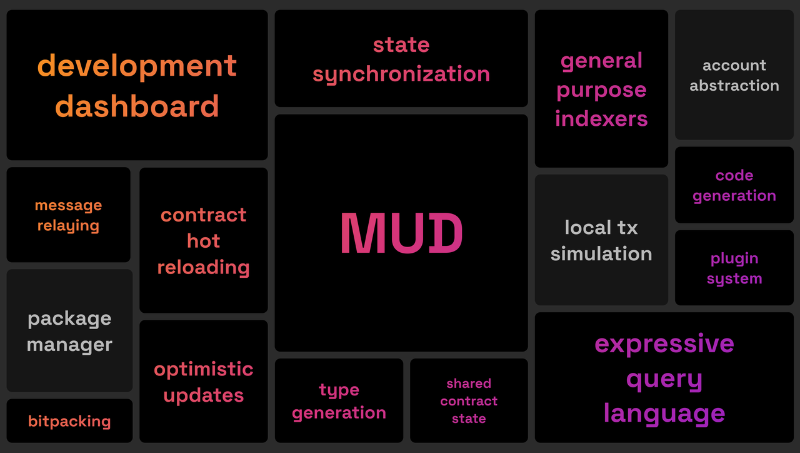
An example is MUD, a development framework for complex applications on Ethereum, primarily used for on-chain games.
It introduces conventions for organizing data and logic, abstracts away low-level complexity, and lets developers focus on functionality. It standardizes on-chain data storage and provides all networking code to synchronize contract and client states—including syncing directly from RPC nodes or generic MUD indexers. MUD is MIT licensed, fully open-source and free to use.
On November 22, 2022, Lattice—the team behind MUD—used MUD to build an on-chain Minecraft clone: OPCraft.
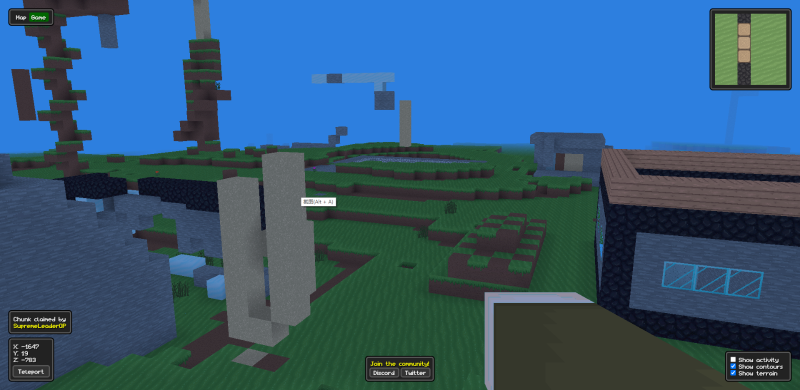
Remember autonomous worlds? Lattice considers OPCraft one: “A 3D voxel world where every aspect—every river, blade of grass, patch of snow on a mountaintop—exists on-chain. Every action executes as an Ethereum transaction.” Lattice’s approach: build the engine first, then the game.
In contrast, GuiltyGyoza, founder of Topology on Starknet, argues against designing engines before games—instead, engines should be built around game needs. Topology walks the talk, having already launched games like Isaac and MuMu. A new on-chain AI fighting game will enter closed beta in February. Incidentally, Starknet developers are building Dojo, a Cairo-based toolchain similar to MUD.
Aiko of Folius Ventures proposes in "Sandbox, Simulation Games, and Fully On-Chain Game Engines" a physics+chemistry+time engine model. She argues that fully on-chain games based purely on physical rules lack meaning, as they reduce players to passive "discoverers" of logic. Instead, she advocates for “game physics”—rules discovered through interaction, such as soil yielding loot when struck—which creates a more interactive, “active” experience versus passive story-driven games.
Meanwhile, Wonder of Bas1s Ventures notes: current on-chain engines mainly upload key event triggers (like geographic coordinates) as data structures, while much logic still runs on centralized servers. For high-concurrency games like MMORPGs or MOBAs, running all logic in a decentralized environment demands high network efficiency and low cost to avoid degrading gameplay during state transitions.
Beyond engines, other on-chain gaming infrastructure exists—like gaming guilds and storefronts.
Guildly is an on-chain gaming guild enabling shared accounts and NFTs—still in development.

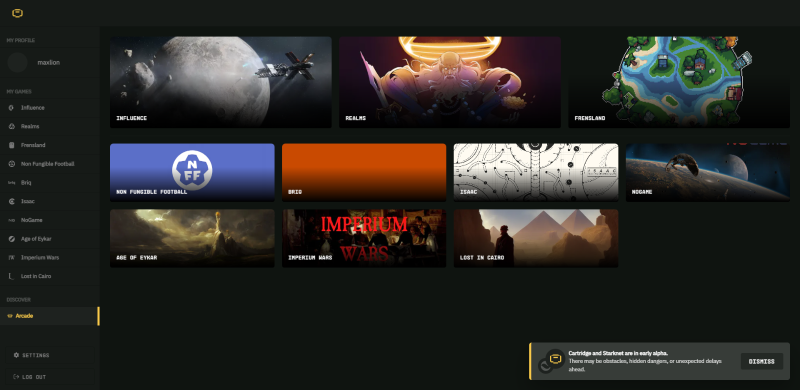
Cartridge.gg is a Starknet-based game storefront where players can discover and access multiple on-chain games. Users can scan QR codes with phones to create and log into accounts—no crypto wallet required.
Starknet: The Arsenal for On-Chain Gaming
Astute
Join TechFlow official community to stay tuned
Telegram:https://t.me/TechFlowDaily
X (Twitter):https://x.com/TechFlowPost
X (Twitter) EN:https://x.com/BlockFlow_News