A Comprehensive Overview of the Current State, Startups, and Success Path of Proof-of-Physical-Work (PoPW) Networks
TechFlow Selected TechFlow Selected
A Comprehensive Overview of the Current State, Startups, and Success Path of Proof-of-Physical-Work (PoPW) Networks
Characteristics of a successful PoPW network, and which ideas can more easily achieve scale and product-market fit.
 Navigating Web3 tides with focused insights
Written by: Mohamed Fouda, Qiao Wang
Translated by: TechFlow
Web3 opens new methods for coordinating human activities globally. This is due to a unique characteristic of Web3: it disregards national borders and user backgrounds, recognizing only individual contributions to the network.
Because of this distinctive trait, Web3 networks can be used to create decentralized solutions that replace centralized companies. Decentralized wireless networks such as Helium, Pollen, and Nodle, along with decentralized mapping projects like Hivemapper and Spexigon, are excellent examples of this concept. These projects demonstrate how participants from around the world can come together to contribute to a unified market accessible to all.
As these networks grow into one of Web3’s largest retail applications, they have the potential to showcase the true power of decentralization. The industry commonly refers to these networks as Proof-of-Physical-Work (PoPW) networks. Although this term does not fully encompass the range of activities these networks can perform, we will continue using it rather than introducing a new one.
In this article, we will explore the characteristics of successful PoPW networks and identify which ideas are more likely to achieve scale and product-market fit.
What Is PoPW? Why Does It Matter?
A PoPW network is a collaborative network where participants build a decentralized two-sided marketplace. Participants are typically divided into service providers and service consumers—those who contribute work to the network and those who pay for and benefit from its services.
Ideally, these networks operate similarly to a decentralized exchange, automatically matching service requests (demand) with provider offers (supply). The network simply collects a transaction fee, which rewards infrastructure nodes operating the network. This may represent the long-term vision for PoPW networks such as Helium.
However, during the launch phase, a centralized entity is required to develop the system and lead its growth through coordination and marketing. This entity must also design a robust tokenomics model to bootstrap supply-side participation and build a valuable network capable of attracting customers.
We can use Amazon as a simplified analogy to illustrate how PoPW development might unfold. Like Amazon, PoPW networks aim to create global marketplaces. In building commercial infrastructure and bootstrapping supply, the marketplace initially operates at a loss. Eventually, as supply grows and the market successfully delivers high-quality services to buyers, the economy becomes profitable.The key difference from Amazon or any centralized marketplace is: when PoPW networks successfully attract customers, economic value flows back to network participants via appreciation of the native token, rather than being captured by a centralized company.
There has already been extensive discussion about the advantages of PoPW networks over existing centralized alternatives, so we won’t repeat them here. As outlined in Multicoin’s research, benefits include cost efficiency from reduced reliance on intermediaries and faster infrastructure scaling enabled by decentralized deployment and broader contributor pools.
How Can PoPW Networks Succeed?
Few discussions address how PoPW networks can deliver quality comparable to centralized solutions—making their cost-efficiency argument meaningful. This article aims to fill that gap. This section outlines five essential characteristics for PoPW network success.
Simple Contributor Operations
For PoPW networks to function globally, service provider contributions should be as simple as possible. Simplicity expands the pool of potential contributors and enables rapid scalability. Networks requiring specialized expertise or training are feasible but will have smaller contributor bases.
Some current PoPW networks require complex operations and multi-layered planning coordination, significantly limiting their user base. Decentralized mobile networks are an example. Operating a mobile network is far more complex than deploying "micro" base stations. Mobile coverage needs are inherently dynamic, and the decentralized structure struggles to adapt quickly to changing demands.
Moreover, mobile networks demand significant technical effort across planning, infrastructure deployment, service delivery, and maintenance—tasks difficult for decentralized contributors to execute. To illustrate the scale of complexity, XNET, a decentralized mobile network project, estimates that $0.60 of every $1.00 in network revenue will go toward supporting complex backend operations, leaving only $0.40 for rewarding base station deployment. This level of complexity suggests the need for a centralized entity to coordinate activities, making fully decentralized PoPW implementation much harder.
Standardization of Contributions
Another critical factor for PoPW success is standardization of contributed work. Service providers’ contributions must not be subjective. Subjectivity risks low-quality inputs that degrade overall network performance. Evaluating such contributions to filter out poor quality would require complex systems impractical to implement on-chain. PoPW projects collecting complex data (e.g., images) already recognize the importance of contribution standardization.
For instance, Hivemapper requires dashcams with specific technical specifications. Spexigon goes further—the software controls drone movements to ensure consistent aerial imagery. Standardization also ensures fairness and neutrality among providers. Rewards can vary based on metrics tied to network goals—such as coverage, frequency, or customer demand—but should never depend on subjective evaluations of contribution quality.
Reliable Oracles
In PoPW networks, off-chain contributions by participants must be provable on-chain. These proofs enable reward distribution in the network's native token. This is the classic oracle problem. Oracles must verify the existence, correctness, and authenticity of contributions before they are recorded on-chain. This remains one of the most challenging issues in PoPW networks. Malicious actors have strong incentives to manipulate oracles to extract maximum value from the network.
Examples include malicious behavior observed in the Helium network. Since the network rewards geographic expansion via proof-of-coverage mechanisms, some participants have faked hotspots or spoofed locations. After community members observed and reported these behaviors, various countermeasures were introduced—including blacklists for untrustworthy participants and hotspot challenge systems. Despite these efforts, verifying the actual existence and correct location of Helium hotspots remains a persistent challenge.
Other PoPW platforms, such as Hivemapper, combat oracle manipulation through hardware attestation. Hivemapper dashcams use GPS location and connectivity to Helium hotspots as part of a location-proof protocol used to validate map contributions. Additionally, Hivemapper employs a human-operated quality assurance layer to verify submitted image authenticity. While helpful, manual review adds complexity and could enable bribery between contributors and reviewers.
Efficient PoPW oracles remain an open problem and a promising area for innovation. Currently, there is no universal solution. Hardware-based attestation provides some protection for specific use cases, as hardware is generally harder to manipulate. Examples include anti-spoofing GPS modules for location-sensitive PoPW contributions. However, more resilient and general-purpose oracles are needed to support broader applications.
Avoiding Monopolies
To succeed, decentralized PoPW networks must avoid single points of failure. These include dependencies on proprietary technology or exclusive software/hardware vendors.
Instead, networks should adopt standards supported by multiple vendors supplying the necessary hardware or software. By eliminating centralization and monopoly risks, networks become more reliable and secure. A case in point is Helium, which has over 20 vendors manufacturing LoRaWAN hotspots compatible with its network.
Conservative and Agile Token Design
A major determinant of PoPW success is token design that effectively attracts contributors, balances supply and demand, and prevents extraction of value through useless or malicious activity.
Balanced token design is a broad topic that may warrant its own dedicated article.
Key guidelines include:
1) Demand is harder to bootstrap than supply,
2) Getting the design right on the first attempt is nearly impossible.
Therefore, the PoPW development team must clearly anticipate and transparently plan for iterative changes to token design based on real-world mainnet data.
The best approach is to begin with a well-considered supply-side design offering conservative rewards, launching this as the initial product. As network usage grows, feedback can guide adjustments to improve economic sustainability.
Current State of PoPW
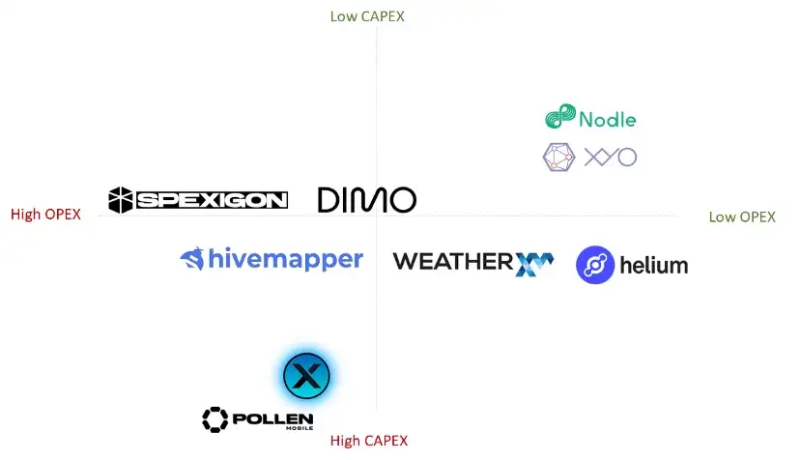
A common requirement for PoPW networks is the need for rapid scaling to compete with centralized solutions. The primary barrier to participant acquisition is the cost of joining the network. Networks with low participation costs can rapidly attract more users, achieve better supply quality, achieve greater decentralization, and test product-market fit more quickly. Participation costs in PoPW are typically categorized into upfront entry costs and ongoing operational costs. This section classifies PoPW projects based on these cost structures.
Entry Cost (Capital Expenditure)
Entry cost refers to the upfront expense users must pay to join the network. For example, the cost of a Helium hotspot or a drone compliant with the Spexigon protocol. We refer to this portion as capital expenditure (CapEx). Higher CapEx makes user acquisition more difficult. High entry costs are often associated with specialized equipment required to participate.
Beyond cost, manufacturing and distributing specialized equipment takes longer, slowing down adoption rates. PoPW networks relying on simple or general-purpose devices (e.g., smartphones) have a better chance of attracting widespread participation.
Ongoing Participation Cost (Operational Expenditure)
This refers to recurring operational expenses paid by users to actively engage with the network. For example, energy and time costs involved in mapping areas using Hivemapper or Spexigon. We refer to these as operational expenditures (OpEx).
High OpEx means participants require faster and more frequent payouts for their contributions. It also implies participants must sell a significant portion of earned token rewards to cover operating costs, creating sustained downward pressure on the token price. This pressure must be balanced by demand—i.e., purchasing power for the native token—to prevent a downward spiral that undermines participant confidence. Networks with high OpEx often benefit from gradual, supply-and-demand-balanced growth strategies.
Startup Ideas for PoPW
As previously mentioned, we envision additional use cases that could benefit from a decentralized marketplace model.
1. Infrastructure and Tools for PoPW Networks
Before discussing specific PoPW use cases, it’s important to recognize shared needs for infrastructure and tools. Examples include innovative oracle solutions resistant to manipulation. These oracles could leverage hardware or cryptographic primitives to verify contribution authenticity and prevent cheating.
Another needed tool is an SDK enabling modular launch of PoPW networks as L2s or app chains, with customizable tokenomics models.
PoPW networks don’t necessarily need to launch as L1s. Such SDKs should emphasize modularity by separating components like token utilities, reward mechanisms, oracle solutions, and storage (especially for data-centric PoPW). Modularity allows developers to independently tune each component for optimal customization. Availability of such SDKs could dramatically simplify the process of launching PoPW networks.
2. Health Data Sharing
A major challenge facing public health researchers is insufficient datasets to test hypotheses. One solution is enabling individuals to share personal health data for research and drug development.
For example, individuals sharing DNA data—a decentralized version of 23andMe—could earn rewards for contributing their genetic and associated health information.Universities, hospitals, and pharmaceutical companies could access this data via a decentralized marketplace for research and commercial purposes.
Another example is sharing physical activity data, heart rate, sleep patterns, and other metrics collected by wearable devices. Such data could help health-focused companies improve their products. In these applications, user contributions are simple and standardized, making them ideal candidates for PoPW networks. Additionally, health data use cases can benefit from privacy-preserving technologies like zero-knowledge proofs.
3. Decentralized VoIP International Calling
Voice over Internet Protocol (VoIP) technology can significantly reduce international calling costs by routing calls over the internet. With decentralization, costs could drop another tenfold. A PoPW network composed of users connecting local phone lines to the internet creates a global telephony network that enables international calls at local call rates.
4. Balancing Renewable Energy Distribution
Sustainability and clean energy have gained increasing attention in recent years. The use of solar panels and other renewable sources can be improved by building efficient distribution networks that balance generation and consumption. Decentralized energy contributions could also integrate with public grids, supporting them during peak demand periods and reducing reliance on fossil fuels. React Network is one example in this space.
5. Decentralized MTurk
Amazon MTurk is a platform that outsources tasks requiring human intelligence to a distributed workforce. Due to task diversity, the current MTurk model isn't directly suitable as a PoPW network.
However, with appropriate technical tools, MTurk could evolve into a PoPW network aggregating smaller, on-demand PoPW subnetworks. In this model, requesters dynamically create sub-PoPW networks, and worker contributions are submitted according to subnetwork rules. All subnetworks share the same native token, forming a contributor-owned platform flexible enough to serve diverse niche use cases. Beyond cost savings from eliminating intermediaries, a decentralized on-chain MTurk offers several additional benefits:
-
Requesters and workers do not need to share personally identifiable information (PII), unlike current requirements on Amazon MTurk.
-
Work histories and job records are transparent on-chain for counterparty verification.
-
Specific worker qualifications can be verified via SBTs issued by third-party identity providers.
-
Reputation earned on-chain can be portable across other user-facing platforms.
-
Payments can settle faster via cryptocurrency rails.
6. AI Dataset Creation
Training advanced AI models requires large and complex datasets. For computer vision, these datasets often consist of labeled images, demanding substantial human labor during creation.
For example, creating a dataset to train autonomous driving models begins with capturing real-world traffic photos under various conditions and times.
Next, these images must be accurately labeled/annotated to train computer vision algorithms. Both steps involve significant human input. A PoPW network aggregating human contributions could create large-scale datasets for AI and other applications. These datasets would be used by companies developing and training large AI models. As AI models grow more sophisticated, PoPW networks can continuously refine and expand datasets to enhance performance.
7. Regenerative Finance
PoPW networks can accelerate regenerative finance by incentivizing sustainable activities with tokens. Tokens are minted as rewards for participants engaging in eco-friendly actions. Institutions seeking to reduce carbon footprints and amplify sustainability impact purchase and burn these tokens. Functionally similar to carbon credits, this system can incentivize harder-to-measure outcomes—such as cleaning waterways, promoting recycling, or funding better industrial filtration systems.
Conclusion
We believe PoPW networks are positioned to build large-scale economic networks that truly demonstrate the benefits of decentralization. Unlike speculative Web3 financial use cases, PoPW networks foster tangible services impacting daily life.
In certain use cases, PoPW networks can outcompete monopolistic incumbents by delivering superior services at lower costs. We are particularly excited about decentralized data-sharing applications and end-user services.
Join TechFlow official community to stay tuned
Telegram:https://t.me/TechFlowDaily
X (Twitter):https://x.com/TechFlowPost
X (Twitter) EN:https://x.com/BlockFlow_News
 Alliance