Why Aptos and Sui Will Ultimately Embrace zkEVM-based zkRollups
TechFlow Selected TechFlow Selected
Why Aptos and Sui Will Ultimately Embrace zkEVM-based zkRollups
An Omnichain zkRollup will ultimately become the final destination for cross-chain and even omni-chain applications.
 Navigating Web3 tides with focused insights
The blockchain industry currently has countless Layer-1 projects, including Bitcoin, Ethereum, BNB Chain, Polygon, Solana, Avalanche, Near, Fantom, and Tron. Even in this fiercely competitive era, new L1 public chains with distinct features and advantages continue to emerge, and their technologies are constantly evolving.
We anticipate that in the future, nearly all Layer 1 blockchains—including Aptos and Sui—will eventually embrace zkEVM-based zkRollups, paving the way for the emergence of Omnichain zkRollups.
New Public Chains Aptos/Sui and the Move Smart Contract Language
As of 2022, among numerous emerging public chains, the so-called Diem L1 chains—Aptos and Sui, both built around the Move smart contract language—have attracted the most attention.
Aptos and Sui were initiated by engineers who previously worked on Diem (formerly Libra) at Meta (formerly Facebook). Diem was Meta’s proprietary blockchain and stablecoin project. These new projects inherit many aspects of Diem while differentiating themselves from existing L1 blockchains in terms of performance, programming language, and mechanisms.
The Move programming language used by Aptos and Sui is notable for completely redefining the "module structure," enabling tokens, NFTs, smart contracts, and other assets to be modularly defined within a single data module in a clean and concise way. This is something the Ethereum EVM cannot match—anyone who has developed on EVM knows how difficult it is to work with complex module and nested structures in Solidity. Consider the classic re-entrancy attack, which has plagued EVM-based projects for years, often resulting in losses of millions or even tens of millions of dollars. Because Move adopts a resource-oriented approach, re-entrancy attacks are fundamentally impossible in Move.
Whether Aptos and Sui will ultimately rise as mainstream public chains depends not only on their programming language but also on the creativity and imagination of future on-chain projects. If ETH is like a four-lane highway—narrow lanes but constant traffic and occasional complaints about congestion—then Aptos and Sui resemble an eight-lane expressway paved with the finest asphalt and equipped with the most advanced and secure traffic signals, yet currently lacking significant traffic. For public chains, technological innovation is one side of the coin; the other is the feedback loop created by applications that drive traffic to the chain itself. No matter how advanced the technology, a chain without strong application support will struggle to stand out.
To tap into the massive ecosystem of EVM, Aptos and Sui will inevitably embrace the EVM ecosystem and Layer 2 networks—especially cutting-edge zkEVM-based zkRollups.
How to Build a zkEVM-Based zkRollup on Aptos/Sui?
In the long term, zkRollup will become the most streamlined, secure, and efficient scaling solution. In principle, a zkRollup can be deployed on any network—as long as that network can verify the proofs submitted by the zkRollup. Therefore, it is certainly feasible to build a zkEVM-based zkRollup on Aptos or Sui.
So, what are the benefits of doing so?
-
First, attracting developers and users from the EVM ecosystem. For developers, deploying their product on a highly compatible zkEVM-based zkRollup on Aptos/Sui would feel just like deploying on Ethereum or other EVM-compatible chains, requiring minimal changes to code or design. This means that with zkRollup support, EVM-based developers could migrate their applications to the Aptos/Sui ecosystem at near-zero cost. With even a small incentive, a large number of successful EVM projects could be encouraged to deploy here, bringing substantial ecosystem activity and use cases to Aptos/Sui.
-
On the user side, zkRollups enable significantly lower (even imperceptible) transaction fees and offer interaction speeds and payment models approaching those of traditional applications. This vision is undoubtedly exciting. So how do we build such a zkEVM-based zkRollup on Aptos/Sui? Let’s examine the universal zkEVM-based zkRollup model designed by Fox Tech.
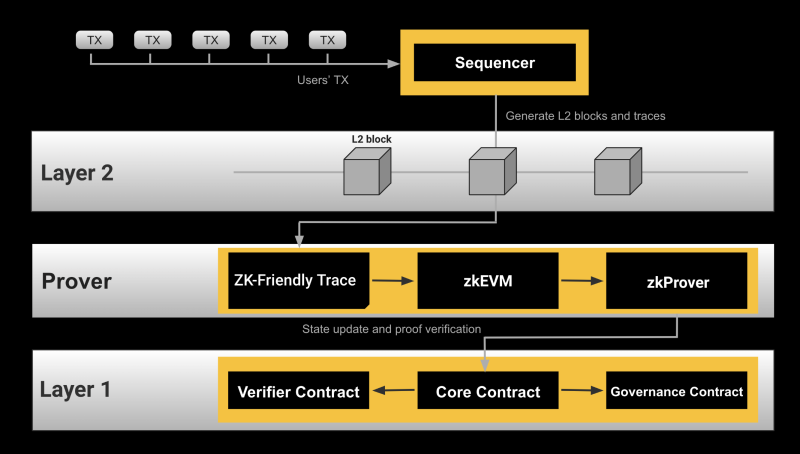
Figure 1: Universal zkEVM-Based zkRollup
First, we need a Sequencer responsible for receiving transactions on the zkRollup. It executes these transactions through a node equipped with an EVM to ensure EVM compatibility. During this process, the Sequencer generates a trace—a record of execution that is easy to prove—and sends it to the proof aggregator, zkProver.
zkProver is a proof generator equipped with zk-EVM. The zk-EVM fully implements zero-knowledge proof circuits according to EVM specifications, verifying whether the execution trace adheres to EVM rules. It then uses a zero-knowledge proof algorithm to generate a cryptographic proof and submits it to Aptos/Sui.
Finally, we need to deploy several contracts on Aptos/Sui: one asset custody contract to manage the flow of assets between Aptos/Sui and the zkRollup.
We also need a verification contract to validate the proofs sent by zkProver, and a governance contract to manage permissions (such as registering provers and asset types within the zkRollup).
Web3 Will Ultimately See the Emergence of Omnichain zkRollups
The future Web3 ecosystem will no longer be dominated solely by Ethereum but will consist of multiple coexisting public chains competing on equal footing, making cross-chain asset transfers and interactions a critical requirement.
If we consider traditional cross-chain bridges, setting aside security concerns, three chains require three bridges, five chains require ten bridges, and twenty chains would require nearly 200 bridges to enable direct communication between every pair of chains.
Therefore, an Omnichain zkRollup will ultimately become the final destination for cross-chain and even universal-chain applications. By integrating an Omnichain Interoperation Protocol (a crucial赛道 over the next five years, with players like LayerZero, HyperLane, and Way Network) into the universal zkEVM-based zkRollup described above, we arrive at what is known as an Omnichain zkRollup. It will aggregate liquidity from all chains and serve as a universal execution layer, using zero-knowledge proofs to guarantee transaction correctness and inheriting security equivalent to the sum total of all connected chains.
We envision an Omnichain zkRollup enabling fully programmable interactions across assets and information from all chains. Users could initiate such interactions by submitting transactions, which would alter account states across various chains. The Omnichain zkRollup would compute these changes in batches and update states across each chain, submitting proofs of state updates.
The vision of Omnichain zkRollup holds infinite possibilities: one could deploy a decentralized exchange aggregating liquidity from all chains, create GameFi and SocialFi platforms uniting users across chains, or build even more diverse, innovative, and boundary-less applications.
Join TechFlow official community to stay tuned
Telegram:https://t.me/TechFlowDaily
X (Twitter):https://x.com/TechFlowPost
X (Twitter) EN:https://x.com/BlockFlow_News