OP Stack: Optimism's ambitious vision for modular scalability
TechFlow Selected TechFlow Selected
OP Stack: Optimism's ambitious vision for modular scalability
OP Stack is an ode to Ethereum's modular scaling.
 Navigating Web3 tides with focused insights
Written by: Donovan Choy
Translated by: TechFlow
In 2021, the cryptocurrency market entered a bull run. Ethereum became congested, and users paid hundreds of dollars in gas fees.
What was the solution? Deploy faster new chains! "Ethereum killers" like Solana, Binance Smart Chain, and Avalanche emerged. They all launched liquidity mining campaigns, siphoning liquidity away from Ethereum.
Despite widespread support for Ethereum in the past, people abandoned it during that period of high demand.
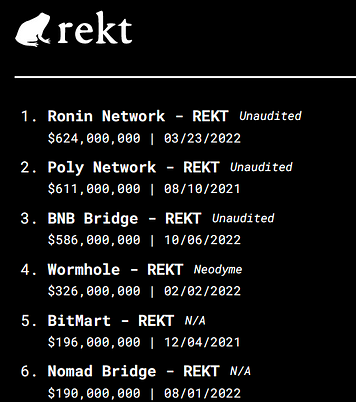
Alternative Layer 1 (Alt L1) chains temporarily satisfied the market’s need for scalability. However, the emergence of so many chains with differing standards also created a need for cross-chain bridges—along with their own set of problems. Not only are they inconvenient, but they’re also dangerous. We frequently see news about bridge hacks, and clearly, no one likes that.
Ethereum attempted to solve scalability differently—through rollups. Transactions are processed on a separate (rollup) chain while inheriting the mainnet's decentralization and robust security.
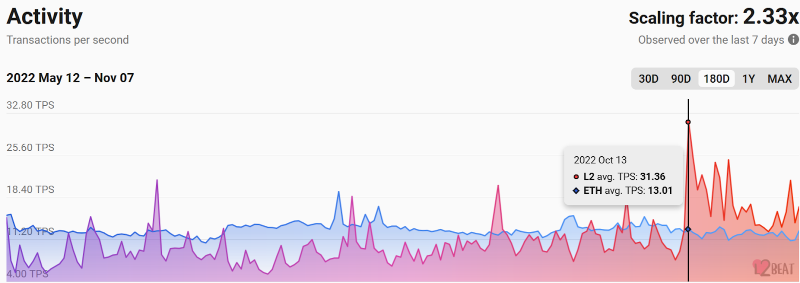
As of October, Layer 2 solutions have already surpassed Ethereum’s mainnet in transaction execution.
But there’s still an issue. Each new chain or rollup is itself a monolithic chain, with its own independent language and architectural design.
What’s the result?
A heterogeneous Web3 ecosystem. This is why we need protocols like Hop to "hop" between rollup chains.
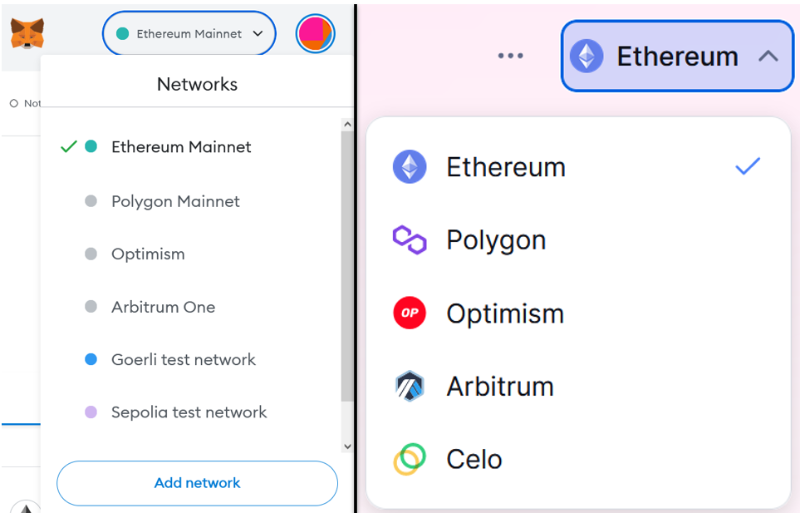
If Web3 is going to achieve mainstream adoption, we need to say goodbye to constant network switching. People don’t want to deal with fragmented, asynchronous chains. It’s like having to exchange currencies every time you make a bank transfer.
If cross-chain bridges are temporary band-aid fixes, then modular rollups begin paving the way toward more comprehensive solutions.
How?
The developers behind Optimism have a direct answer that cuts to the root of the problem: OP Stack.
The Current Challenge
Today, most chains pursue their own modularization strategies.
-
Optimism, Arbitrum, and Starknet differ in execution layer design but share the same settlement, consensus, and data availability layers by outsourcing them to the Ethereum mainnet.
-
Metis and Celestia choose their own data availability layers while still using Ethereum as their settlement and consensus layer.
-
Validium chains based on StarkEx, such as Immutable X or rhino.fi, perform similar functions by running their own relatively centralized data availability committees, hosting transaction data via a set of pre-selected nodes.
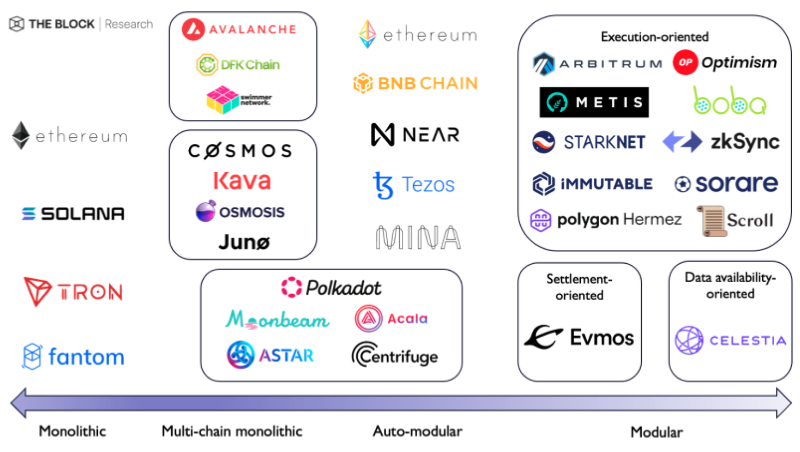
Each chain runs its own strategy, resulting in differences in the design of execution, settlement, and data availability layers.
What if these chains shared a standardized open-source codebase instead of today’s siloed chain/Rollup systems?
Enter OP Stack
This is where Optimism’s OP Stack comes in: a modular set of foundational building blocks for constructing more expressive and precise rollup chains on Ethereum—something impossible on today’s monolithic Layer 2s.
OP Stack is a suite of standardized open-source modules that can be assembled to build a custom chain—Optimism calls them “OP-chains”—tailored to any specific blockchain use case.
Let’s break it down:
Modules are pieces of data that any developer can plug into the OP Stack to create a Layer 2, Layer 3, or even Layer 4. “Standardized” means there is community-wide consensus on module specifications, making implementation accessible to all. “Open-source” means anyone can freely access, iterate upon, and contribute improvements.
With OP Stack, you're not locked into a particular proof system or technology. Developers have the power to swap out modules across different execution, consensus, settlement, and data availability layers—just like switching APIs.
dYdX left Ethereum for a Cosmos appchain because they wanted greater modularity over their chain’s consensus layer. OP Stack solves this very problem.
OP Stack enables code forking in ways much easier than current practices, allowing developers to easily abstract individual components of a blockchain and modify them by plugging in different modules.
Want to transform an optimistic rollup into a ZK-rollup? No problem! Just switch its fraud proof module to a validity proof module at the settlement layer.
Want a chain to use Celestia as its data availability layer? Easy! Replace Ethereum with Celestia as the data availability layer.
Want to replace the EVM in the execution layer with another virtual machine like FuelVM? Swapping execution layers on a live chain is difficult today, but technically feasible within OP Stack.
Want to run Minecraft as an L2 rollup? On-chain gaming computations are too heavy for the mainnet. In fact, someone already did it. It’s called OP Craft. The team behind it, Lattice, plugged their own execution module into the execution slot of an L2 rollup and modified Plasma at the consensus layer to enhance scalability.
Thus, OPCraft exists on Ethereum as its own L2 rollup (an OP-chain), where every in-game action is executed as an on-chain transaction, rolled back to the Ethereum mainnet. This is Minecraft scaled on an EVM-compatible blockchain! Like any other rollup, developers can access it via nodes and deploy smart contracts on top.
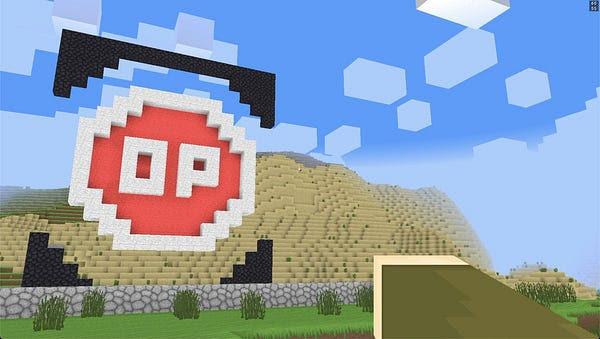
Lattice achieved this by leveraging Optimism’s Bedrock rollup architecture. Bedrock is the first implementation of OP Stack—the collection of modules used by Optimism. Bedrock uses the Ethereum Virtual Machine as the execution layer, making it EVM-equivalent, and employs Cannon—an interactive fault proof system at the settlement layer.
And even wilder forks are coming. 0xPARC built a Game Boy rollup by replacing Bedrock’s execution engine with a Game Boy emulator.
All of it, on-chain.
OP Stack’s Open Garden
Today, the primary issue with modular blockchains is increasing fragmentation. As developers make their own design choices and trade-offs, fragmentation intensifies. This problem resembles Web2’s walled gardens—but in Web3, it happens unintentionally.
OP Stack addresses this gradual fragmentation by embracing the philosophy of an open garden in Web3 development. All OP-chains can enjoy atomic cross-chain composability as long as they voluntarily opt into the same shared sequencer—the sole entity responsible for block production across each OP-chain.
An OP-chain may not want to run its own sequencer, so it can pay a fee to use a trusted shared sequencer operated by Optimism. This opens up a new revenue model for Optimism beyond just dApps on the Optimism chain.
Ultimately, any user on Ethereum will be able to send transactions directly from one end of the ecosystem to another. No more network switching or cross-chain bridges!
This vision gives rise to Optimism’s emerging “Superchain” structure—hundreds or thousands of OP-chains fully interoperable on Optimism, connected through identical technical infrastructure.
Launching rollups won’t be harder than deploying an ERC20 token, accelerating the pace of Web3 experimentation and innovation.
This is about more than just interoperability.
Thanks to the increased flexibility brought by shared OP Stack modules, developers can repeatedly reuse code previously developed by others, making software stronger, more secure, and less vulnerable to hackers and bugs.
For example, when the Lattice team built OPCraft, they configured a much higher per-block gas limit than Optimism’s own chain. Under this different configuration, they discovered certain bugs that were previously invisible.
Making OP Stack More Accessible
In summary, OP Stack is a celebration of Ethereum’s path toward modular scaling.
Optimism is building a fully open-source rollup ecosystem, and OP Stack is the foundation for realizing this vision. But it’s not limited to rollups—OP Stack can also be leveraged to build governance and identity modules, empowering developers to easily design chains from scratch.
OP-chains are neither Cosmos appchains nor monolithic chains. They are a Superchain unified under the same technical standards.
When fully realized, the rollup ecosystem will blossom like thousands of flowers blooming across Ethereum.
Join TechFlow official community to stay tuned
Telegram:https://t.me/TechFlowDaily
X (Twitter):https://x.com/TechFlowPost
X (Twitter) EN:https://x.com/BlockFlow_News