









FTX Collapse, Where Will the Industry Go? (Part 1)
TechFlow Selected TechFlow Selected
FTX Collapse, Where Will the Industry Go? (Part 1)
FTX had always performed well; although it has now collapsed, its product experience was excellent, especially when it came to withdrawals.
 Navigating Web3 tides with focused insights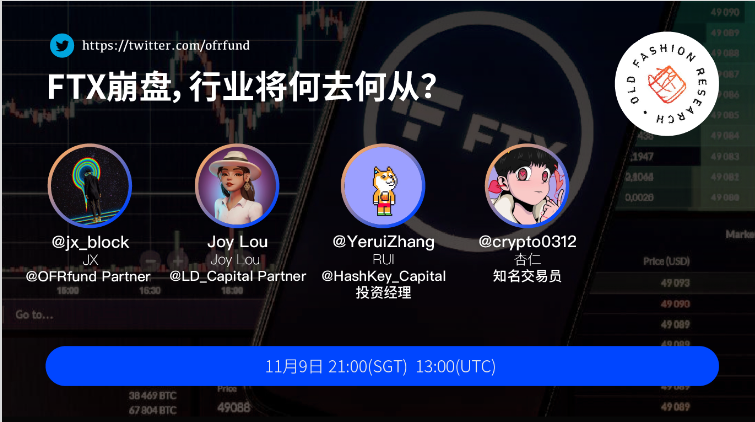
On November 9, OFRTalk #15 invited several seasoned industry participants to review and reflect on the entire FTX incident, discussing the collapse of FTX and where the industry might head next. The event featured many insightful remarks, and this article is a written recap of that discussion.
Guests at OFRTalk #15
-
JX Partner @OFRfund // @jx_block
-
Joy Lou Partner @LD_Capital // @CynthiaLou6
-
Rui @HashKey_Capital Investment Manager // @YeruiZhang
-
Xingren Well-known trader // @crypto0312
JX: Since our prepared topics couldn't keep up with how fast the market evolved, we quickly organized this session to talk through recent developments. There are many important points worth noting in this market cycle. Let's first go over what happened recently. The FTX incident had been brewing for days already, and KOLs both domestically and internationally were discussing it. I'd like Rui to start by sharing how he spotted early signs of trouble with FTX—what were his observations and judgment, and what was his thought process throughout? Rui, did you notice any warning signs before this unfolded?
Rui: Before the collapse, I never thought there was an issue with FTX offering 5% yield—even looking back now, I wouldn't say the interest rate itself was problematic. FTX’s total deposits amounted to $5 billion; paying 5% annually would only cost $250 million per year, which FTX could easily cover given its annual revenue. That wasn’t the root cause of the blow-up. Looking at outcomes today, suppose FTX withdrew $600 million—if they still have a $600 million shortfall, meaning a 1x gap—this clearly wasn't caused by interest payments. So the problem didn't lie in the yield offered.
If there were any real red flags, perhaps it was Sam being too aggressive in mining or misusing user funds for other purposes—it wasn’t the first time something like that occurred. But people still held onto the image of him as infallible because he survived LUNA and other past crises. In hindsight, one particularly telling clue came from Coin Metrics—the fact that FTX gave FTT tokens to Alameda so they could use them as collateral for loans. Let me clarify some background here: It's crucial to understand that FTX and Alameda are two separate entities and must be viewed independently.
For FTX to operate legally in places like the U.S. or Singapore, it must demonstrate compliance to local regulators. This includes proving that funds between Alameda and FTX aren’t commingled—audits can verify this. It would be impossible for FTX to directly hand over customer money to Alameda for trading. These two operations are strictly separated.Since they're separate, their relationship should logically be one of lending. Alameda’s account couldn't appear overly leveraged—full credit lines aren’t feasible—so instead, they’d need to pledge collateral, which in this case was FTT. That explains why FTT suddenly dropped from $15 to $4 overnight: essentially, Alameda couldn't hold the position anymore, so FTX liquidated Alameda.Binance may have told Sam: “If you want us to acquire you, you must settle these accounts.” To do that, they needed to clear out this loan, which also dragged down institutions holding FTT as collateral. This is why FTT crashed—not due to large sell-offs or general market conditions. This, to me, cuts straight to the core risk factor.
JX: When this situation first started unfolding, public disclosure of Alameda’s balance sheet surfaced, followed by CoinDesk reporting potential insolvency. Of course, we don’t know FTX’s actual financial statements, so these are not the same entity. Joy, prior to this event, did your team receive any early warnings? What actions did you take?
Lou: We carefully observed significant token movements on-chain roughly 40 days before the crash. At the time, we didn’t see it as a major concern. Even just two days ago, I couldn’t believe FTX would fail—I thought it could survive because its operational tactics resembled classic Wall Street strategies. Large-cap U.S. stocks often behave similarly to FTT and SOL. During liquidity shocks like the 3AC collapse, they likely felt ripple effects. About 40 days ago, there was a transfer involving hundreds of millions of FTT—then valued at over $4 billion—from an original wallet to a new address, then into FTX. We didn’t pay much attention initially, assuming it was just wallet reorganization. In retrospect, this likely indicated insufficient liquidity. For some reason, a large amount of FTT from ICOs became unlocked, and they used those tokens as collateral to borrow stablecoins to cover Alameda’s liquidity needs. We noticed this signal but failed to connect the dots at the time—especially since the coins were later moved back into an FTX-controlled address, making it hard to suspect anything.
Let me explain why it collapsed. All U.S. public companies issue corporate bonds—say, yielding 5–10% annually. If a company believes it cannot generate returns above that rate from business operations, it uses the proceeds to repurchase its own shares. This is standard practice among large-cap firms. They leverage debt while using cash to inflate share prices.
As stock prices rise, their credit ratings improve, enabling them to raise more capital via convertible bonds or targeted financing instruments, which can then be used again for buybacks. Over the past decade-long bull run, U.S. equities exhibited somewhat Ponzi-like characteristics similar to LUNA. That’s why one-third of our team focuses heavily on macro analysis, especially monitoring interest rate hikes and balance sheet contractions—because U.S. monetary easing is highly correlated with stock prices.
This differs from China’s stimulus model. In China, newly printed money first flows into banks, then gets distributed via government-backed mortgages or loans to local investment platforms, utilities, regional financing vehicles, and real estate developers before eventually reaching other industries and affecting stock valuations. Thus, the correlation between monetary expansion and stock prices in China is weaker, though still positive.
But in the U.S., newly injected liquidity typically goes directly to high-credit-rated firms issuing corporate debt. FTT and Solana operated similarly—first establishing tight control over supply, gradually increasing market cap, and adding leverage. Whether through private placements, crypto IPOs, or leveraging positions with CeFi or DeFi platforms on Wall Street, they kept using their inflated valuations to increase leverage and further pump their token prices—exhibiting certain Ponzi-like traits.
When facing liquidity stress, why was FTT desperately defending the $22 level? We calculated that $22 was their bleeding point—below that threshold, mass deleveraging would trigger. Their borrowed funds showed unrealized gains on paper. Assuming they weren’t speculating in U.S. equities or other unrelated ventures, but solely focused on propping up token prices, they should have been profitable—since each round of leverage addition occurred at different price levels with varying costs, and mortgage loan-to-value (LTV) ratios allowed continuous re-leveraging, lowering overall margin requirements.
I'm unsure about overseas risk controls, but during Q2 this year, FTX acquired several CeFi platforms, possibly relaxing lending standards. Entities like Three Arrows Capital had almost no risk management—mostly unsecured credit. During extended periods, the debts issued and leveraged stablecoins—or fiat-denominated yields—generated positive returns because most of their assets were concentrated in FTT and SOL. However, when faced with a bank run, liquidity issues triggered a chain reaction of collapses—one day seeing drops of 60% or more.
JX: Today I heard a comparison suggesting Alameda engaged in similarly high-leverage practices as seen in U.S. equities. Projects led by them tended to have high valuations with low circulating supply, allowing them to stake locked tokens and borrow fresh capital. From a credit standpoint, these underlying assets are even lower quality.
Xingren: From a retail trader’s perspective, let me share what steps I took. Some of my friends who rarely trade on secondary markets mostly engage in mining or DeFi and kept substantial assets on FTX earning yield. Before things escalated, they reported changes—one being reduced yields, another being individual account limits—and sensed something was off.
No one imagined an exchange of FTX’s scale could fail, but to mitigate risks, they pulled their funds out—including from smaller exchanges. As part of my routine analysis, I monitor on-chain data. I noticed stablecoin outflows from FTX at least half a month ago. Monitoring fund flows, we saw notable stablecoin withdrawals prior to last month’s end. Once rumors began spreading, we still didn’t expect a full-blown collapse—after all, Sam himself is a trader; we assumed he might be using user funds for trading or collateralization, not that the entire exchange would implode.
Later, we observed discrepancies in reserve balances and stablecoin holdings—on-chain data showed transfers occurring. That’s when we grew concerned. We initiated withdrawals early—starting when we noticed restrictions on account sizes. Starting on the 6th, CZ began tweeting, so we started tracking public sentiment, knowing it could significantly impact broader markets. At the time, overall market performance looked strong—ETH broke above $1,600, BTC reclaimed the 120-day moving average—many remained optimistic about upcoming trends.
There were rumors Binance would launch an IEO—no one anticipated such volatility. FTT remained stable around $25. Then, in the early hours of the 6th, CZ tweeted about divesting FTT assets. That’s when we realized sentiment was escalating—knowing resolution wouldn’t come quickly given the complex implications involved.
From regulatory, political, and exchange-compliance perspectives, once this blew up, cleanup would be extremely difficult. We immediately began monitoring tweets from CZ and SBF, adjusting our trading strategy accordingly. Daily volatility reached around 20 percentage points, prompting preparations to trade FTT. Later, when an executive from SBF’s team tweeted about buying FTT around $22—a clear bullish trap—we entered short positions because volume support at that level was weak. We held those shorts until yesterday when we finally closed the position. From a personal trading standpoint, I didn’t focus much on macro factors—just technical chart analysis. That pump lacked real volume, signaling a fake breakout, leading to our decision.
JX: Throughout the event, we witnessed a 1–2 day tug-of-war between CZ and SBF, accompanied by extreme market swings. I’d like to ask everyone: during this period, did you make any trades? What was your logic behind those decisions?
Lou: Our approach is primarily macro-driven. We did observe address migrations, but didn’t realize it was tied to leveraged financing at the time. We reduced exposure on the 6th and 7th—but mainly due to macro signals. The Fed sent mixed messages on the 3rd, and CPI data was due on the 10th. The 3rd wasn’t bad, but tone leaned hawkish. Ahead of CPI, we wanted to de-risk. Afterward, with other data releases and Powell’s FOMC speech shifting from dovish to hawkish, a favorable entry point emerged, so we added some longs. Our reduction wasn’t due to the SBF situation.
Rui: I always thought FTX was doing well—despite its current collapse, the product experience was excellent, especially regarding withdrawals. For users overseas, smooth off-ramping isn’t easy, yet FTX provided seamless on-exchange and off-exchange withdrawal services. Personally, I participated in FTX’s initial offerings and made profits. Overall, my assessment was flawed—I didn’t think FTX had serious issues, hence incurred losses. On Sunday, I exited many positions after ETH and BTC rallied sharply, sensing the market lacked momentum. From Nov 5–6, there were no clear catalysts—sustaining a week-long upward trend seemed unlikely under those conditions, though MASK saw unexpected movement.
Even though the environment seemed okay, I sensed fragility, so trimmed some holdings. When last night’s news hit, my first reaction was: “FTT is doomed”; second thought: “Well, maybe this outcome isn’t terrible.”
Woke up this morning, completely stunned. Reflecting further, Alameda and FTX must be considered separately. Any debt FTX ultimately owes will have to be covered by unwinding Alameda’s entire portfolio. During the withdrawal suspension, CZ couldn’t possibly conduct thorough financial due diligence—likely expecting very poor results anyway. Even if acquisition talks exist, restoring withdrawals won’t happen quickly. Anyone familiar with PayPal knows it took two months just to sort out accounting.
Under such a massive trading entity, with tangled finances, high leverage, diversified investments—possibly across multiple subsidiaries—untangling the books will be incredibly difficult. Users getting their assets back won’t be simple. Under this logic, vast amounts of money remain trapped within FTX, including market makers’ funds—posing a severe threat to overall market liquidity.
About OFRTalk
OFRTalk is a series of voice interviews supported by Old Fashion Research. Its vision is to become a community-driven open forum, bringing diverse perspectives across blockchain sectors, deep research content, project dialogues from its investment portfolio, and discussions on trending topics—to help audiences gain deeper industry insights.
All content in OFRTalk reflects personal views of hosts and guests. Content may include introductions to our invested projects and does not constitute investment advice. Follow OFR Intern and OFR’s official Twitter accounts for live broadcast updates.
Follow us on Twitter
Join TechFlow official community to stay tuned
Telegram:https://t.me/TechFlowDaily
X (Twitter):https://x.com/TechFlowPost
X (Twitter) EN:https://x.com/BlockFlow_News
 Old Fashion Research






