OPCraft: A 3D voxel game built on the OP Stack
TechFlow Selected TechFlow Selected
OPCraft: A 3D voxel game built on the OP Stack
OPCraft, created by the Lattice team, is an on-chain 3D voxel game.
 Navigating Web3 tides with focused insights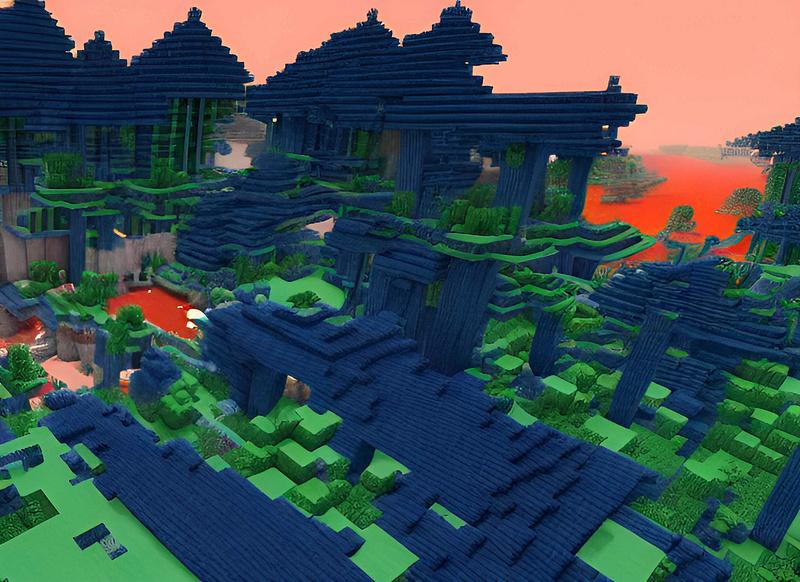
Image source: Generated by Wujie Bantu AI
Author:William M. Peaster, Bankless
Translation: DeFi Dao
Earlier this week, I wrote an article about the challenges of NFT game design.
However, not every game needs to be perfectly polished or follow traditional game wisdom.
This is because some games can serve as experiments to explore new possibilities.
OPCraft is one such NFT project—an intriguing unconventional experiment.
OPCraft is fascinating—it sits at the intersection of a blockchain-based game engine and a Layer 2 (L2) scaling solution, operating in a way we’ve never seen before.
In today’s article, we’ll explore the fundamentals of this innovative project!
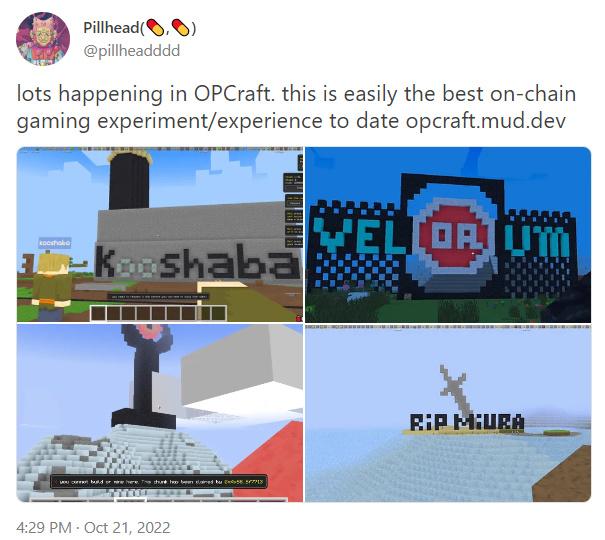
There's a lot going on in OPCraft.
The project may well be the best on-chain gaming experiment/experience yet—opcraft.mud.dev.
Background: The OP Stack
To understand OPCraft, you first need to grasp its foundation.
Notably, the game is built on the OP Stack—a modular system first introduced in October 2022 by the creators of the Optimism L2, designed to let anyone “build their own blockchain.”
As the team explained in their announcement:
“The OP Stack is the code powering Optimism’s next-generation architecture. It’s a series of modules that together form coherent, reliable blockchains. Each of these components implements a specific layer of the stack.”
After noticing their codebase being forked for various unique experiments, Optimism’s developers began formally standardizing this rollup system. One early project among these experiments was OPCraft, which customized its own chain to further expand Optimism’s already significant transaction throughput advantage.
OPCraft 101
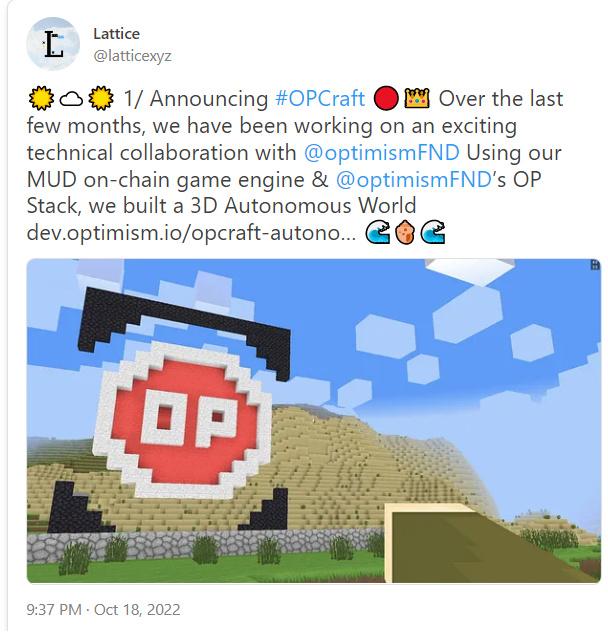
Created by the Lattice team, OPCraft is an on-chain 3D voxel game.
“Voxel” refers to the virtual blocks used to construct structures within the game.
“On-chain” means the project uses a decentralized blockchain—Optimism’s modular L2 technology—to host Lattice’s MUD game engine, rather than centralized servers.
In a sense, you could say OPCraft is extremely “on-chain,” as all of its activities and items are ultimately tracked via Ethereum transactions.
As the builders previously noted:
“OPCraft is an autonomous world—a fully on-chain virtual space where every aspect of the world, every river, blade of grass, and snowflake atop a mountain peak exists on-chain. Every action taken in this world is an Ethereum transaction.
Like other player-crafted voxel worlds, you can explore procedurally generated landscapes, mine ores, place materials, and craft new items. Players can create grand structures, erect monuments, and reshape the land, either solo or collaboratively.
OPCraft runs on an OP chain, meaning the blockchain is primarily used to update the world whenever players modify it. Like a regular rollup, developers can deploy smart contracts on this chain, and anyone can run a node to access it.”
Why It Matters?
Two of the most compelling aspects of building on-chain games like OPCraft are the possibilities for extreme customizability and extreme interoperability.
Regarding customizability, on-chain game engines are a modder’s dream—and modder dreams can lead to player paradise. With such open and continuously available engines, anyone can build upon the base game however they wish.
On this point, Lattice stated:
“Imagine the OPCraft world rendered in 4K clarity with beautiful ray tracing and rendering from Unreal Engine 5. Or imagine an enterprise-grade project management UI for managing and automating mining operations in OPCraft.
Because this world is entirely on-chain, anyone can build a custom client to interact with it without special permissions—as long as inputs and outputs conform to the protocol. Just like a DeFi protocol accessible through many different portals, OPCraft has no canonical representation.
We won’t wait for someone else to build a client and replace all characters with anime avatars or completely rewrite it with beautiful shaders.”
Secondly, since everything in OPCraft is tracked on-chain via smart contracts, all these activities and digital assets can immediately interoperate with other smart contracts. This allows people to build their own on-chain extensions around the game, turning game development into a community-centered, open-ended process—where the possibilities are endless.
“Imagine a smart contract that pays you 1 ETH for every diamond block you mine, or a contract that lets you engrave your name on its world monument—for a fee,” says Lattice.
Another example: In the near future, you could imagine your preferred web3 identity and reputation solution displaying your on-chain gaming achievements as NFT badges alongside your other personal web3 accolades, since the relevant smart contracts can directly connect with each other.
How to Explore
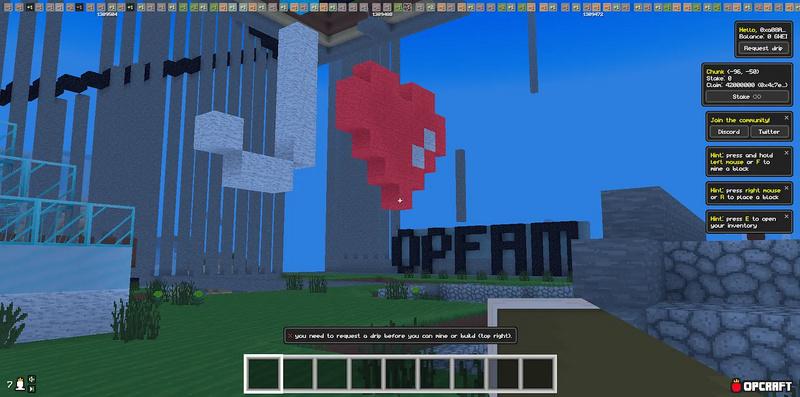
If you’d like to explore OPCraft, you can currently visit opcraft.mud.dev.
But note: OPCraft is currently just a proof-of-concept on a custom Optimism testnet. The experiment will run for two weeks and conclude on Halloween—October 31, 2022 at 23:59 UTC.
Note: "The World will be frozen, making any structures, art, and monuments you've created immortal."
That said, at the time of writing, you still have a few days left to participate in building and exploring before the testnet shuts down—just remember, any creations you make will soon become digital relics.
As for what comes next, Lattice hasn’t revealed much, though they’ve noted that OPCraft “like current rollups… has a credible path toward autonomy and permissionlessness.”
This suggests OPCraft may eventually launch on mainnet—so this experiment appears only to be just beginning.
Could the revival of on-chain gaming follow the same path?
Only time will tell—but I like these odds.
If you’d like to learn more and dive deeper into OPCraft, follow Lattice’s work (Discord, Twitter), or explore and build upon OPCraft’s codebase yourself.
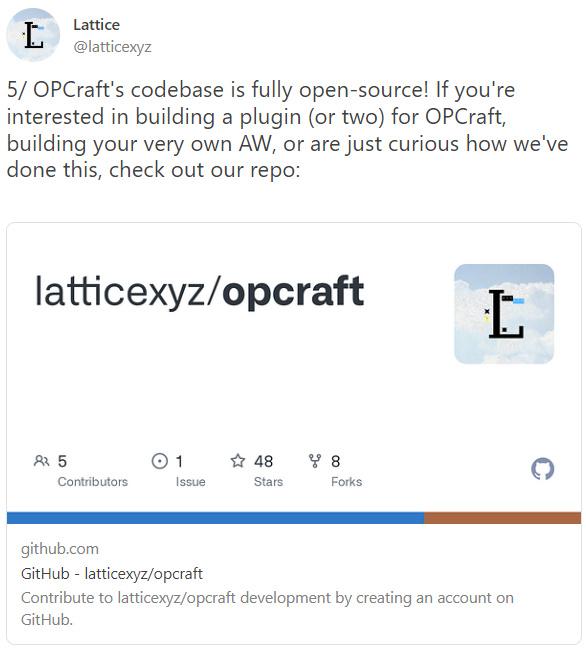
OPCraft’s codebase is fully open-source! If you’re interested in building one (or two) plugins for OPCraft, creating your own AW, or simply curious about how we did this, check out our repo.
Join TechFlow official community to stay tuned
Telegram:https://t.me/TechFlowDaily
X (Twitter):https://x.com/TechFlowPost
X (Twitter) EN:https://x.com/BlockFlow_News