









Six Cryptocurrency Investment Mental Models: Probability, Survival, Cycles, Returns, and Arbitrage
TechFlow Selected TechFlow Selected
Six Cryptocurrency Investment Mental Models: Probability, Survival, Cycles, Returns, and Arbitrage
Money can never be earned enough, but it can certainly be lost completely.
 Navigating Web3 tides with focused insights
Author: KekLabs Research Group
Reprinted with permission by TechFlow
After five years navigating the crypto world, I’ve summarized six crucial mental models—listed in no particular order:
1) Probability — Random Rewards
Do you feel that missing this opportunity will be a lifelong regret? Perhaps you also believe in the idea that one only needs to seize a few big opportunities to succeed.
This statement is true, but it also creates a misunderstanding: it amplifies the perceived value of individual opportunities while ignoring how often they actually arise—the concept of “ergodicity.”
If you've stayed in the crypto market for over a year, you must have noticed: there are countless opportunities. Even during such a brutal month recently, we still had Sun losing control of Huobi, $XEN minting, and $APTOS launching—solid chances.
This is a deep bear market, folks.
However, although opportunities abound in crypto, so do the pitfalls. A scam project, a rug pull, or an ill-timed act of blind faith can lead to devastating losses.
So my consistent view is: You can never earn all the money, but you can certainly lose it all.
Opportunities are plentiful, but traps are even more so. If you acknowledge the role of probability, you’ll realize opportunities are endless, but your margin for error is limited.
Therefore, don’t FOMO easily or get carried away. Wait, observe, then act.
If not this time, then next time.
It’s okay. The road ahead is long.
2) Redundancy — Survival Comes First
After experiencing random rewards, I firmly believe that as long as I stay steady, I will gradually become wealthy over time.
But here's the problem: what if an unforeseen black swan event occurs—like a hacked wallet or a compromised exchange account?
That’s why I decided to block off the downside completely.
The way to do this is by maintaining a reserve of cash at all times—whether USDT, USD, RMB, or even gold bars.
Whatever works.
These reserves won’t be touched easily, and their storage must be secure.
Suppose I face a 10% risk of total loss; by eliminating this possibility, I theoretically become invincible.
Then it’s just a matter of time before I grow rich.
3) Cycle Model
Can humans overcome fate?
I don’t think so.
For example, I believe China’s post-70s generation was the luckiest. They entered the workforce around age 20 during the Reform and Opening-Up period, when industries were booming and opportunities were everywhere. Real estate and the internet—two massive sectors—were just beginning (in the 90s–2000s), and housing prices had just started commercializing. The state encouraged home buying, and doing so felt natural. If you had extra money, you’d buy another property without hesitation.
In contrast, those born 20 years later—the post-90s—had it tougher. Industries hit bottlenecks, they bought homes at peak prices, and by their 30s, when they wanted to push forward, the environment no longer allowed it.
Now it’s an era of cutthroat competition and lying flat.
I’m not talking about individuals—I mean entire generations. Timing really matters.
Back to finance—especially crypto—it’s also highly cyclical. As the saying goes, every four years is a cycle: bear markets drop over 90%, bull markets surge over 1000%.
Making a fortune in a bear market is extremely difficult—both probabilistically and environmentally. Not making money in a bull market is shameful; it’s amateur behavior.
This is the result brought by market cycles.
Undoubtedly, we are still at the bottom of the cycle—or searching for it.
Our strategy should be investing in "infrastructure."
Yes, even us small retail investors have infrastructure: improving knowledge, upgrading skills, finding tight-knit circles, joining quality communities for mutual support, learning new skills, and accumulating accounts at low levels.
These assets will become non-blow-up leverage when the bull market arrives.
4) Return = Research × Skill × Capital × Execution
This formula was summarized by my partner "chad," and I personally agree:
Capital is innate; I don’t recommend borrowing.
Execution depends on personality; some people simply aren't driven by hype.
But you must excel in either research or technical ability.
Technical skills can amplify returns and reduce risks (excluding bugs). If you’re technically strong, team up with someone skilled in research—and vice versa.
Note: this formula uses multiplication, not addition.
Focus on what you do best in the value chain, and collaborate for the rest.
I'm not downplaying execution—execution is often overlooked. I know top-tier airdrop farmers who lack capital, tech, or research skills. Yet, through sheer execution power, they gain recognition and support from others.
They get into exclusive circles and thrive.
Talent remains talent wherever they go.
5) Price Surge = Expectation Gap × Noise (Traffic)
There's a common misconception: if fundamentals are good, buying will surely profit.
That view is clearly naive.
Bear markets are full of fundamentally sound tokens unfairly crushed. Why should yours rise? Many cryptos, valued traditionally via PE ratios, are cheaper than Hong Kong stocks.
This is crypto.
Today’s reality: in the internet age, even great wine fears deep alleys.
A good project with no visibility will see limited gains.
Notice I used multiplication.
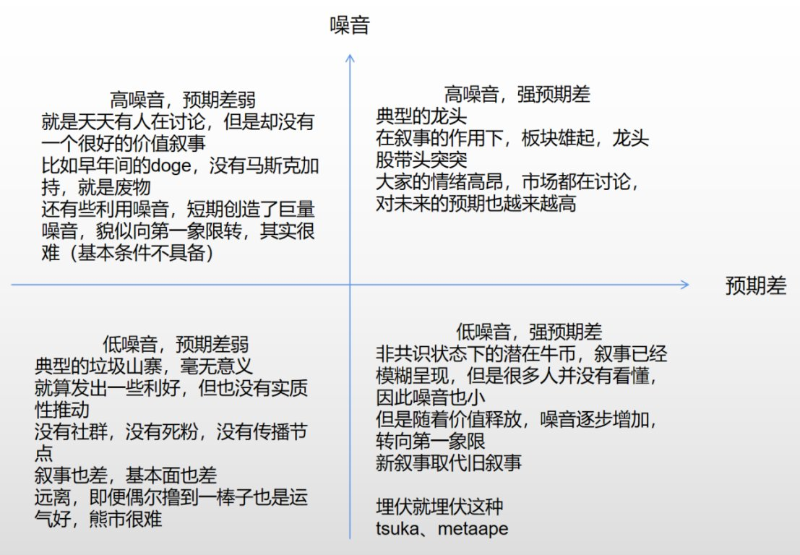
Great project, high price? Useless—limited upside.
What we want is: a strong project priced low, where certain long-term or sudden positive developments drive increasingly bullish future expectations.
The resulting expectation gap becomes our profit margin.
Then what’s noise for?
Noise acts as an amplifier. Someone has to buy eventually—but why would they? First, they need to hear about it.
You need promotion, you need noise!


6) Asymmetric Returns — Arbitrage
Shen Yu said the mental model that influenced him most over the past decade was arbitrage thinking, but I thought hard and couldn’t quite grasp what arbitrage meant.
Arbitrage isn’t just about familiar tactics like cross-exchange trading, futures spreads, fee differences, or new token launches—that’s just technique. True arbitrage means seeking asymmetric returns across broader domains.
Asymmetric return means your cost/risk is far lower than your potential reward.
It’s unequal—that’s why it’s called arbitrage.
The prerequisite for arbitrage is broad vision and comprehensive skills. Otherwise, even if you spot an opportunity, you might not know how to execute it.
Let’s consider a few examples:
1) CRV Vote Buying
In November last year, $MIM obtained massive liquidity from the CRV protocol through vote buying.
Later we learned early participants earned over 10x returns—some even created fake stablecoins, gained liquidity via vote buying, sold them, and easily profited.
The challenge lies in understanding the vote-buying mechanism and calculating its costs.
2) Shorting USTC After LUNA Collapsed
This one was accessible to everyone—even small players could join.
Did you know? Many lost money shorting LUNA because the price dropped 60% from $30 to $10, but then rebounded 700% from $1 to $7—wiping out many shorts on a single bounce.
But shorting $USTC was much safer. LUNA was doomed. Even with rebounds, USTC could never sustainably trade above $1—the maximum is $1.
Thus, shorting USTC at $1 was a guaranteed win—you could go all-in fearlessly. Isn’t that a perfect arbitrage opportunity?
Join TechFlow official community to stay tuned
Telegram:https://t.me/TechFlowDaily
X (Twitter):https://x.com/TechFlowPost
X (Twitter) EN:https://x.com/BlockFlow_News






