








Understanding MEME: More than replication and spread, it's art yet anti-art
TechFlow Selected TechFlow Selected
Understanding MEME: More than replication and spread, it's art yet anti-art
Memes have no authors, but they are not anonymous in the usual sense either.
 Navigating Web3 tides with focused insights
By Felipe Daniel Montero
Translated by Litfour Xiao4
This article raises a question about memes: What is the essence of a meme? According to ancient teachings, the essence of a thing defines what that thing truly is.
But what exactly is a meme?
This may seem like a trivial question: everyone knows that a meme is simply an image macro, spreading through replication and creative reinterpretation, primarily for entertaining the masses. Since Wikipedia already provides an answer, why should we even ask this question?
The Wikipedia definition merely confirms our preconceived notion of memes: “An Internet meme, commonly known as a meme, is a cultural item or concept spread via the internet. It typically spreads on social media platforms for humorous purposes.”
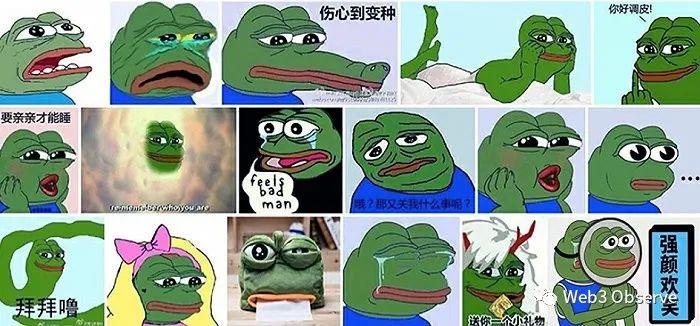
Nevertheless, we must still ask: Is a meme simply a new comedic form?
Many memes are not funny at all, yet no one would deny they are memes…
We intend to interrogate memes, and in doing so, hope to establish a freer relationship with them.
That relationship will be free only if human existence can appear through memes themselves. We can achieve this only when we attempt to face things directly, without resorting to abstract definitions—because such definitions preempt the possibility of memes appearing authentically.
But if we don't rely on Wikipedia, what do we actually know?
Whenever the essence of a thing eludes us, language can help us understand. In the original act of naming, the essence of a thing guides its name. Today, when we hear the word "meme," we immediately think of memes. But when the term was first coined, the name gave meaning, rather than meaning giving the name.
We consulted the dictionary: noun: meme; plural: memes.
An element of culture or system of behavior passed from one individual to another through imitation or other non-genetic means.
An image, short video, piece of text, etc., typically humorous in nature, rapidly copied and shared by internet users, often with slight variations during transmission. 1970s: from Greek mimēma 'that which is imitated'.
The word "meme" originates from the Greek mimēsis, which we translate as "imitation." However, reducing mimesis to mere "copying" misses its deeper significance. In the digital age, continuous replication of information is fundamental. Strictly speaking, due to the lack of mediating layers, this is not true imitation.
The dictionary almost gives us the key to the essence of the meme: “A meme is an image, video, text, etc., usually humorous, rapidly copied and shared online, typically with slight differences.”
Memes are indeed copied, but this is only part of their mode of transmission. When variation is introduced into an existing pattern, a meme is recreated and re-semanticized.
Or more precisely, is a meme a pattern?
When we encounter a meme, are we merely looking at an image?
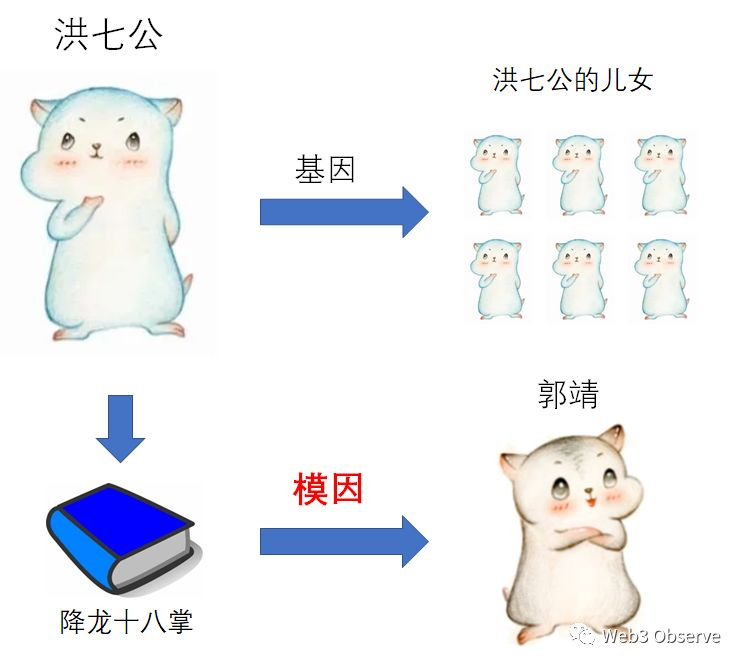
Our experience of any given meme seems to presuppose familiarity with a certain pattern. Every meme consists of two distinguishable elements: the meme pattern and the actual physical image, which introduces a clever variation upon the original. Is this a novel form of imitation?
To equate “imitation” solely with “replication” loses the word’s original Greek meaning. When Aristotle claimed that mimesis was essential to art, he did not mean the frame-by-frame duplication of sensory impressions provided by real objects. For Aristotle, “mimesis” meant imitating the creative process already physically present in nature.
Physis in Greek means “nature,” but understanding it merely as a collection of elements constituting the “natural world” again misses its deeper significance. The literal meaning of physis is “that which arises,” derived from the root phúō, meaning to bring forth, produce, form, or cause to grow. Thus, physis is not a static collection of “dead” elements whose sum constitutes nature—it is essentially dynamic. The Greeks understood nature as a generative force, a cyclical process of blooming and withering, of life emerging and sinking back into nothingness. Is this Aristotelian concept of mimesis the essence of the meme?
A meme is the union of a meme pattern and the actual image before us. A meme lives as long as it can be replicated (memes can die, be forgotten). Yet merely repeating a meme endlessly accelerates its death. To keep a meme alive, new variations of the pattern are necessary. As Heraclitus already understood, identity is founded upon change. Just as a river ceases to be a river when its waters stop flowing—becoming stagnant and soon vanishing—the stream of information constituting the meme (data transformed into pixels before our eyes) must permanently change for the meme to remain a meme.
Therefore, creating a meme cannot be reduced to the mechanical act of copying via Ctrl+C and Ctrl+V.
Instead, it requires familiarity with the meme pattern—a template capable of generating infinite derivatives—to be realized in a particular meme image. According to Aristotle, this is precisely the artist’s task. The artist does not merely copy nature’s colors that impress our senses, but imitates nature as a creative force. The artist assumes nature’s creative role by bringing forth an artwork. Then—is the meme a new art form?
We should examine what kind of imitation exists within memes. In artistic mimesis, reality (people, landscapes, etc.) is imitated. But in memes, what is being imitated is the meme itself. Artworks are either unique (e.g., a painting with only one original) or reproducible (e.g., photographs), but in the latter case, copies are made without alteration. Reproduction serves only to disseminate the work, never modifying its content. In contrast, memes are reproduced *through* variation.
Art usually conceals its prototype or creative process, realizing only one specific direction out of the infinite possibilities inherent in the material. Memes, however, abandon this approach. Rather than fixing infinite possibilities into a final, definitive version—as artists do—memes aim to exhaust a recipe by revealing all its potential variations. If memes are art, they constitute a unique medium, assuming creative reproduction through constant transformation.
Yet perhaps this isn’t entirely new. The idea that artworks are fixed compositions, replicable according to the author’s intent, is relatively modern. In the past, musical works depended on continuous reinterpretation. The formal version of a musical piece—an unalterable recording—is itself a recent development. Previously, each performance of a score (the meme pattern) constituted a re-interpretation of the work. A similar relationship exists between live performances of theatrical and cinematic works. Indeed, the very concept of the author behind a work is contingent. For much of history, poetry was anonymous, transmitted orally with various derivatives (at least minimal changes within memory constraints).
We confront what appears to be a novel phenomenon, only to discover it bears ancient traits.
If memes are art, they challenge core assumptions that have defined our understanding of art for centuries. Memes have no author, yet they are not anonymous in the usual sense. They are not the work of an unknown artist: memes exist only insofar as they are shared and modified by potentially infinite individuals. Memes lack fixed form: they are the result of an infinite number of possible variations on an original pattern. In artistic creation, the pattern is merely an abstract guide, discarded once the work is complete—like Wittgenstein’s ladder, thrown away after use. At the risk of seeming insignificant, no artwork dares reveal the abstractions and concepts that led to its final form. Memes invert the relationship between concept and work. The specific image realizing the pattern is less important than the pattern itself. Such images may be seen merely as pretexts for reusing the pattern.
But are memes really art?
For all forms of art, value seems rooted in our concrete, personal experience of the work. Art cannot be explained the way memes can. In this respect, memes seem closer to jokes than to art—they are easily understandable and explainable. Artworks are different. They can be interpreted, but the individual’s lived experience of a work remains incommunicable. Moreover, every great artwork admits multiple interpretations. This cannot easily be said of memes…
But perhaps we should step back and ask a simpler question: If memes don’t need to be funny, then what do they require?
All memes are designed to be intelligible to at least some group. A meme that cannot be understood—a derivative too far removed from the original pattern—is a failed meme. Yet familiarity with the pattern alone is insufficient, as derivatives are built upon shared knowledge and references. This introduces a third element into the meme experience (meme image + meme pattern + universe of shared meaning). For example, any given meme pattern can be realized within the shared universe of American politics, a TV series (such as Neon Genesis Evangelion), or even scientific discourse.
Thus, memes can be considered primitive in another sense: a meme must generate a sense of belonging. When we understand a meme, we do not merely confirm our familiarity with the pattern (which could easily be explained), but more importantly, it affirms our membership in a shared world of meaning. Only if I have some philosophical background can I grasp the shared references within a set of philosophy memes. Understanding a meme is an affirmation that I belong to the group of people who have studied philosophy. Is this text itself a meme?
This form of tribal identification also exists in art. Are not the legends of ancient mythology a shared universe of meaning, whose consensus validates an individual’s belonging to a community?
Memes are art, yet anti-art. They embody all the features that art has rejected since modernity. Memes have no fixed form and no author—not even an anonymous one. Their primary function is tribal identification, something absent since art liberated itself from religious and political power. While modern art emphasizes the author who expresses his individuality through the work, the essence of memes might be seen as affirming intersubjective identity through infinite collective creation.
Yet memes are products of the internet, enabling responses to non-hegemonic identities. Indeed, memes can promote political ideologies and agendas, prompting large groups to self-identify under normalized standards. Nevertheless, analyzing small communities dedicated to sharing memes reveals the diversity of identity in our era.
Join TechFlow official community to stay tuned
Telegram:https://t.me/TechFlowDaily
X (Twitter):https://x.com/TechFlowPost
X (Twitter) EN:https://x.com/BlockFlow_News






