








CZ's 15 Principles: From Life to Work
TechFlow Selected TechFlow Selected
CZ's 15 Principles: From Life to Work
Not all principles are right or wrong; most are just personal ways of doing things and viewing matters.
 Navigating Web3 tides with focused insights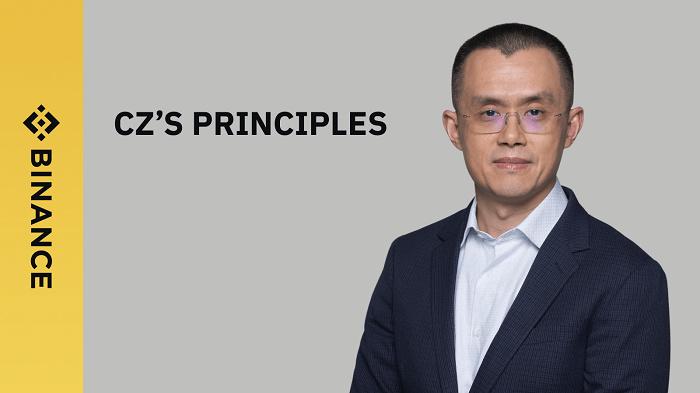
Original author: CZ, Binance
Translated by: Moni, Odaily Planet Daily
Binance CEO Changpeng Zhao (CZ) has shared a set of personal principles he follows, noting that not all principles are right or wrong—most simply reflect his personal way of doing and viewing things.
Below are CZ’s 15 personal principles.
1. General Principles
1.1 Fairness
This is a broad principle covering many aspects of life—from personal relationships and work colleagues to business deals. I truly believe in treating others fairly. Don’t take advantage of others, and don’t let others take advantage of you.
1.2 Build Long-Term, Win-Win Relationships or Deals
Success is built over the long term. To maintain healthy, lasting relationships, one must establish and engage in long-term, win-win arrangements. For a deal to be meaningful, it must benefit both sides.
Always ask what the other party gains. One-sided deals don’t last—you’ll always need to find new (weak) partners to collaborate with.
I oppose short-term profit-seeking, which often leads to negative long-term consequences, distracts focus from long-term goals, and carries high hidden opportunity costs.
Aim for bigger, longer-term victories.
1.3 Avoid “Bad” Relationships
Unethical/toxic people, those who don’t share your values or mission, and those who waste a lot of your time—let them go. Remove them from your life.
1.4 Ethics
Never cross ethical boundaries. When dealing with users, always do what’s right—not what’s easiest.
1.5 Focus
Success doesn’t come from how much you do, but from how well you perform in a few selected areas. Focus allows you to work hard and eliminate distractions. For me, I don’t have many hobbies. I exercise 30 minutes daily, and I own minimal physical possessions—because time cost is high.
1.6 Stay positive
1.7 Have a good mindset
1.8 Keep learning
2. Understanding the World
If someone hopes to achieve any level of success, understanding how the world works is clearly important. Avoid black-and-white thinking—the world is diverse. Many people oversimplify their views of the world.
3. Decision-Making Framework
Making correct decisions is a skill that can be practiced. I use this mental decision-making framework for both quick and carefully considered choices.
3.1 First Principles
If a decision touches one of my core principles, follow those principles—simple. Otherwise, apply the decision-making framework.
3.2 Small vs. Big
First, determine the scale or impact of the decision.
-
Small decisions (e.g., where to eat, small investments)—make or delegate quickly and move on.
-
Big decisions (e.g., major sponsorships, large investments)—collect data, discuss within a group, then sleep on it for 24 hours.
3.3 Reversible vs. Permanent
-
Some decisions are reversible, such as developing a new product feature. You can stop anytime, shift to something else, or even shut it down after launch. There will be some sunk cost in time and effort, but it’s limited.
-
Some decisions are hard to reverse—such as large upfront payments in sponsorship deals, team integrations, or big corporate mergers.
3.4 Do I Have Expertise?
If it’s something familiar or within my background—like technology or product—I can make faster decisions. In areas I’m less familiar with—like marketing—I either delegate, involve other experts, or proceed more cautiously.
3.5 Enough Information?
Finally, ask: Do I/we have enough information? For small decisions, I don’t need much. For big ones, we should gather necessary data. But ultimately, we often have to decide with limited information.
Bottom line: Making a decision and executing is usually far better than making no decision at all.
4. Team and Organization
4.1 Team Over Self
It rarely brings satisfying results for an individual to outperform in a poorly performing team.
4.2 Shuffle Often
Don’t let the organization become stale.
4.3 Internal Competition Is Good
There will always be external competition—some internal competition is healthy, just stay professional.
4.4. Ordered Chaos Is a Structure
This sounds counterintuitive. Consider the two extremes: complete chaos is bad—that’s easy.
4.5 Conduct Local Team Building Frequently
Monthly should be the goal—though due to scheduling, it often ends up being every two months.
4.6 Give Feedback
I provide direct feedback whenever and wherever—in one-on-ones or large groups.
4.7 Not Much Verbal Praise
If you do well, you might hear “good job, nice work,” etc.—but I give very little praise. Conversely, if you do poorly and I see it, you’ll likely hear criticism.
4.8 Escalation vs. Gossip
Escalation is part of normal business, and there are right and wrong ways.
Gossip happens when you complain about someone to me without telling that person directly. Gossip is bad—I don’t handle gossip.
4.9 Lift the Bottom
I believe in “bottom-up.” From experience, high performers like working with other high performers. When a high-performing team collaborates, the work itself becomes addictive. When your team has low performers, everything gets destroyed. Lift the bottom performers out.
5. Hiring
Hire the best people—always.
5.1 Passion
Passion is one of the most important factors I look for.
5.2 Hire people with "hunger"
5.3 Doers vs. Talkers
Hire doers who can express themselves—not talkers who do nothing.
5.4 Purposeful hiring
Every new hire must have clear responsibilities.
5.5 Don't hire people obsessed with titles
5.6 Don't hire people overly focused on salary and compensation
5.7 If you have doubts about a candidate, don't hire
6. Leadership Style
6.1 Don’t try to motivate people who aren’t self-motivated
6.2 Don’t micromanage
6.3 Interview first, decide later
6.4 Work hard, uphold our values, lead by example
7. Goals, OKR/KPI
7.1 Don’t take goals too seriously
My biggest issues with goals are:
1. Goals are never accurate or scientific. Market conditions in crypto change too fast.
2. Goals take too much time (and are costly) to discuss.
8. Business Deals
8.1 Keep deals simple
8.2 Say no early
Too many people waste too much time on useless "partnership" discussions. When your mind is occupied with these, you’re not thinking about useful partnerships.
8.3 No exclusivity
Don’t sign exclusive contracts. Don’t lock yourself in. Don’t expect others to be locked in.
8.4 Include termination clauses
Always include termination clauses in contracts.
8.5 Always assume limited liability
8.6 Treat all customers equally
9. Passive BD, Pursue Low-Hanging Fruit
In life, I generally take a passive approach to BD (business development). People often misunderstand this side of me or don’t know how it works. Don’t confuse this with lack of passion.
I’m passionate about what I/we do, but I’m passive in how I approach others or form business partnerships.
10. Work Ethic—Don’t Waste Time
Time is a more limited resource than money—don’t waste it. Once you start valuing time, money will follow.
10.1 Say “no” early and often
The most effective tool for saving time is saying “no.”
11. Communication
11.1 Be concise and direct
Always clarify your intent or goal—know what you want.
11.2 Keep communication records concise
For me, I don’t want to see:
-
3–5 bullet points for a 15-minute meeting
-
Half to one page of notes for a 30–60 minute group meeting
-
Up to 5 pages for MBR or QBR (Quarterly Business Review)
-
No fancy PowerPoint.
11.3 Use the most effective method/tool available
11.4 Stay off communication chains
11.5 Use IM for synchronous or work coordination
11.6 Use one message to say something instead of multiple messages
11.7 Don’t argue online
11.8 Excessive communication is bad
11.9 Ask questions based on context
12. Meetings
12.1. Keep meetings short
Meetings should be as short as possible—ideally five minutes.
12.2 Start meetings on time
12.3 Get straight to the point
12.4 Discussions shouldn’t exceed 10 people
12.5 Mute people who don’t speak
12.6 Write down key points before the meeting
12.7 Don’t use PowerPoint
12.8 Don’t attend “introductory” meetings
13. Product and Delivery
13.1 Focus only on scalable products
13.2 Focus on users
Having users is key. Everything else matters less. Without users, there is no value. Treat them well.
14. Public Relations
14.1 Don’t do big PR when launching a product
14.2 Don’t casually sign MOUs or LOIs
14.3 PR shouldn’t be delayed—release promptly once ready
14.4 Respond to journalists promptly
14.5 Respond quickly to negative news
15. Rest, Stay Calm, and Relax
15.1 Sleep
I recommend finding the sleep pattern that gives you maximum energy. For me, I sleep 5–6 hours at night and usually take a 30–45 minute nap in the afternoon.
15.2 Stay calm
15.3 Relax and have fun
I’m as calm as most people. I exercise a bit daily and participate in some sports. I enjoy snowboarding, watch movies (usually after recommendations), and when visiting new cities, I do some sightseeing, relax with friends, dinners, drinks, etc.
I don’t like luxuries—cars, jewelry, etc.—although my lifestyle may already be overestimated by most. I travel frequently and stay in nice hotels. I get invited to fancy parties (which I usually don’t enjoy).
I like gadgets—phones, cameras, drones, even smartwatches (many features of which I never use).
Join TechFlow official community to stay tuned
Telegram:https://t.me/TechFlowDaily
X (Twitter):https://x.com/TechFlowPost
X (Twitter) EN:https://x.com/BlockFlow_News






