








Gazing at the Light and Shadow of Cosmos: A Comprehensive Analysis of ATOM 2.0
TechFlow Selected TechFlow Selected
Gazing at the Light and Shadow of Cosmos: A Comprehensive Analysis of ATOM 2.0
This article will introduce the advantages and risks of Cosmos, the major ATOM 2.0 upgrade, and the impact of this upgrade on the Cosmos system.
 Navigating Web3 tides with focused insights
Published by: LD Capital Research
Author: Yilan
Executive Summary
As a third-generation blockchain,Cosmos SDK and Tendermint BFT have lowered the barriers to developing and operating public chains.The Cosmos SDK has become an ideal framework for building app-chains, enabling independent ecosystem chains. Projects leveraging this infrastructure will transcend smart contract applications and evolve into scalable systems with dedicated blockchains and their own communities.
Combines multi-chain interoperability with architectural decoupling.Cosmos offers both ecosystem scalability and coordination, positioning it to stand out in the next wave of blockchain narratives. However, customized application-specific chains face limitations compared to smart contracts due to restricted composability and call flexibility.
On-chain sovereignty and high operational autonomy.The founders of Cosmos believe that because groups and regions differ in opinions and values, no single blockchain can scale universally. Therefore, Cosmos emphasizes sovereignty on each chain to prevent on-chain "tyranny" and fragmentation, establishing equal interconnectivity via the Inter-Blockchain Communication (IBC) protocol. While this weakens value capture for $ATOM and the Cosmos Hub, it is crucial for long-term ecosystem prosperity.
Cosmos’ decentralized model fosters greater Alpha within its ecosystem.The Cosmos Hub captures stable Beta exposure, while the launch of Cosmos 2.0 presents the Hub with new opportunities to capture part of the ecosystem's Alpha.
The Cosmos System Flywheel enhances token value capture.ATOM 2.0 introduces the Interchain Security (ICS), Liquid Staking, Interchain Scheduler, and Interchain Allocator—components that together form the Cosmos System Flywheel. These innovations transform ATOM from a purely staked asset into a more attractive pricing and collateral instrument. In terms of monetary policy, short-term inflation will increase, but medium- to long-term trends point toward a sustainable, capped supply model.
Introduction
On September 28, 2022, Cosmoverse—the legendary Cosmos Conference—concluded in Medellín, Colombia, marking the official release of the Cosmos 2.0 whitepaper. This upgrade unveiled key components: Interchain Security (ICS), Interchain Scheduler, Interchain Allocator, Liquid Staking, and a revised tokenomics model.This article analyzes Cosmos' strengths and risks, offering a comprehensive breakdown of the ATOM 2.0 upgrade and its implications for the broader Cosmos system.
I. Cosmos’ Architectural Design and Operational Mechanism
Cosmos divides its network into Hubs and Zones. In practice, Hubs and Zones are structurally equal. The distinction lies in connectivity: a Zone becomes a Hub when it connects to many other Zones, thereby serving as a provider of interchain services across the IBC network.
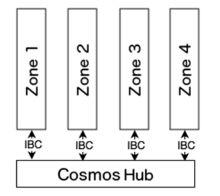
Source: Cosmos Whitepaper
The Cosmos stack consists of three core layers: the Cosmos SDK for application development, Tendermint for consensus, and IBC as the communication layer connecting Hubs and sovereign chains.
The consensus layer uses Tendermint’s Byzantine Fault Tolerant (BFT) mechanism, designed by Tendermint.Inc. This consensus offers strong scalability and interoperability, achieving up to 10,000 TPS, and requires only one-third of validators to be online—with two-thirds honest—for normal transaction processing. However, due to quadratic computational complexity in validation, the system remains relatively centralized, currently limited to 150 validators (growing linearly by 13% annually until reaching 300).
Cross-chain interoperability is enabled through the Inter-Blockchain Communication (IBC) bridging protocol. For any chain to connect, it must implement IBC. Functionally similar to cross-chain bridges, IBC differs critically in security: asset locking and mapping between chains are secured natively by Cosmos’ own consensus mechanism—a feature traditional standalone bridge protocols lack. From a cross-chain perspective, IBC surpasses earlier technologies, though it still faces significant limitations and cannot compete with newer MPC-based cross-chain solutions.
II. ATOM 2.0 and Its Impact on the Cosmos System
The Cosmos 2.0 whitepaper was officially released recently, introducing Interchain Security (ICS), Interchain Scheduler, Interchain Allocator, Liquid Staking, and an updated tokenomics model.
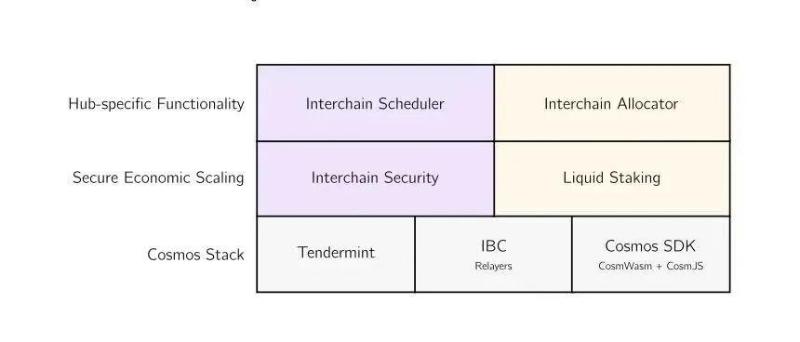
Source: ATOM 2.0 Whitepaper
Interchain Security (ICS) primarily addresses the weak security of smaller blockchains built within the Cosmos ecosystem. ICS allows these chains to rent the staking power of $ATOM validators for enhanced security, paying fees in return. This generates revenue for $ATOM stakers. Beyond security, ICS also enables use cases such as Rollup settlement, IBC routing, relay contract markets, and blockchain domain services.
Currently, four Cosmos ecosystem chains—including Quicksilver and Neutron—have announced plans to adopt ICS, though all remain relatively small in scale. Larger chains like Evmos, Cronos, and Osmosis do not currently use $ATOM for validation or staking. Regarding $ATOM value capture, most of the fees paid by consumer chains will go directly to those chains, with only a portion allocated to the Cosmos Hub. Thus, $ATOM captures value only indirectly—through a share of fees paid by validator nodes leasing security from the Hub.
Liquid Staking significantly improves user experience and capital efficiency within the Cosmos ecosystem. Inspired partly by OlympusDAO’s “liquidity-as-a-service” model, it allows staked assets to remain liquid while earning rewards. By enabling liquidity derivatives of staked ATOM, liquid staking increases the effective staking rate and turns staked assets into primary mediums of exchange. Rewards are funded by staking yields rather than unsustainable inflationary incentives. As a core component of ATOM 2.0, liquid staking optimizes the original pure-staking model, enhancing long-term security through decentralized supply rather than inflation subsidies.
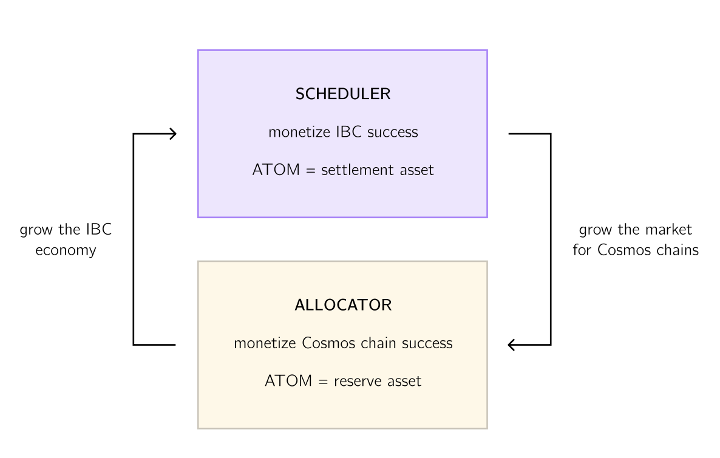
Interchain Scheduler builds upon ICS to create a marketplace for future blockspace across chains. When a chain enables the scheduler module, it can auction off future blockspace via cross-chain smart contracts. The scheduler mints NFTs as proof of reservation for specific blocks. These NFTs can be traded on secondary markets before being redeemed by validators. A portion of auction proceeds goes to the respective chain, while cross-chain MEV revenues generated flow back to the Cosmos Hub via the Interchain Allocator, promoting balanced ecosystem growth.
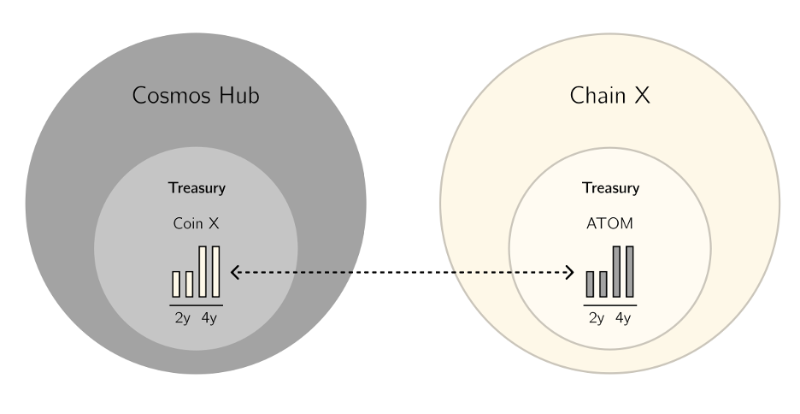
Interchain Allocator aims to improve user acquisition, liquidity provisioning, and long-term ecosystem balance for new Cosmos projects.
Through two mechanisms—covenants and rebalancing—the more tokens a chain holds from the Cosmos Hub, the more $ATOM it receives in return.
A distribution DAO composed of $ATOM stakers can enter agreements (e.g., token swaps) with other chains. Over time, multiple DAOs may coexist within the Hub, with voting power proportional to staked amount and lock-up duration. This effectively transforms the Cosmos Hub into a multi-DAO-managed fund. The rebalancing system reduces slippage during DAO investments, using dollar-cost averaging or Dutch auctions to gradually shift portfolios toward target allocations.
Together, covenants and rebalancing tools position the Cosmos Hub as the largest DAO organization and managed fund, expanding the utility of $ATOM and increasing the number of connected ecosystem chains.
Source: ATOM 2.0 Whitepaper
The Interchain Scheduler and Interchain Allocator, built on interchain security and liquid staking, collectively form the new Cosmos System Flywheel. This evolution moves ATOM beyond a simple staking token, significantly enhancing its appeal as a priced and collateralized asset.
Source: ATOM 2.0 Whitepaper
III. Changes in Monetary Policy
ATOM 1.0 used a variable inflation model ranging from 7% to 20% annually, adjusted based on total staking participation. If staking rates exceeded 67%, inflation approached 7%; if below, it rose toward 20%. This model functioned less as a reward mechanism and more as a penalty for non-stakers—lower staking participation triggered higher inflation.
The ATOM 2.0 token economic update has profound systemic implications.The issuance model transitions from exponential to linear growth, significantly reducing long-term ATOM supply expansion. However, in the short term (first ten months), inflation will exceed the previous 7–20% range to subsidize security expenditures and fund critical infrastructure development. During the initial 36-month transition phase, 10 million $ATOM will be issued in the first month, decreasing by approximately 12% monthly thereafter. Medium- to long-term (after 20 months), total issuance stabilizes, trending toward neutrality with a low, fixed inflation rate (~1%). As shown in the chart below, ATOM 2.0 results in higher cumulative issuance and inflation than ATOM 1.0 over the first 20 months.
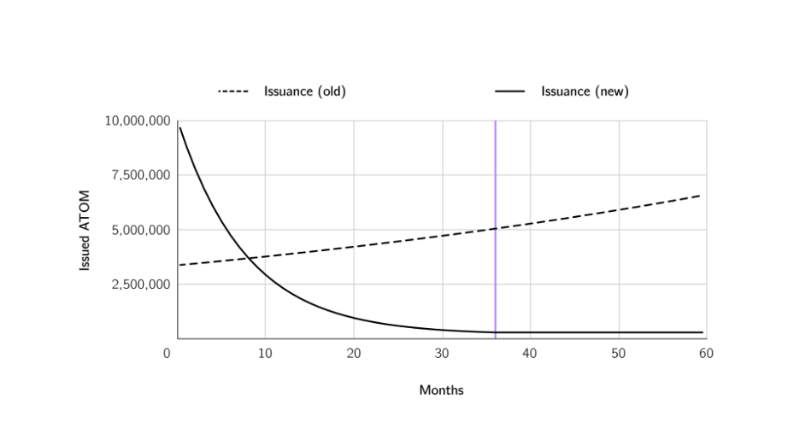
Note: Monthly ATOM issuance curve—dashed line represents ATOM 1.0, solid line represents ATOM 2.0
After 36 months, the issuance model enters a stable phase. Security subsidies cease, and staking rewards shift to income generated from ICS and related services. Monthly issuance settles at 300,000 $ATOM to support and stabilize ecosystem projects. In this steady state, annual inflation approaches 1%.
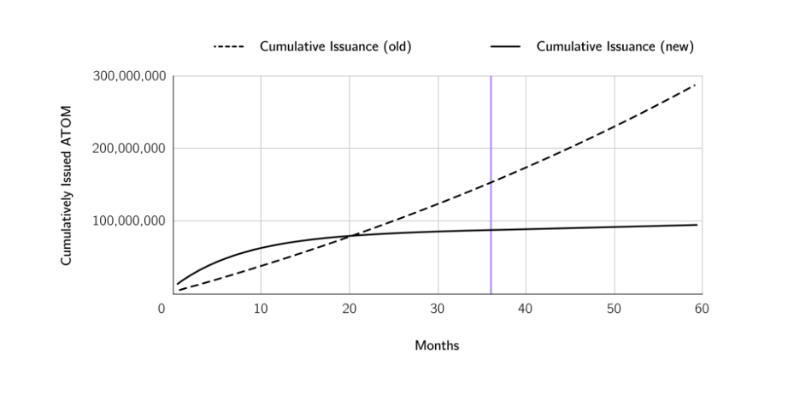
Note: Cumulative ATOM issuance curve—dashed line represents ATOM 1.0, solid line represents ATOM 2.0
IV. Value Capture Analysis
From a $ATOM value capture perspective, holder returns currently stem mainly from staking rewards and minor IBC transaction fees. However, IBC fee revenue is negligible today. To achieve supply-demand equilibrium—where daily income offsets daily inflation—transaction fees would need to increase nearly 500-fold (from current daily revenue of $2.3K to match $150K in daily inflation). The core ethos of Cosmos centers on decentralization and sovereignty. ATOM 1.0 focused primarily on staking functionality. ATOM 2.0 improves this by allowing $ATOM to capture rental fees from ecosystem chains leasing Cosmos Hub security—providing stakers with additional APY. Nevertheless, $ATOM still faces dilution risk, as value capture may be分流ed by staking tokens of competing Hubs.
V. Security Equilibrium and Market Supply-Demand Analysis
The first equilibrium point compares cost of attack versus TVL. Under Tendermint BFT, corruption requires collusion by 2/3 of staked validators. Currently, 2/3 of staked value is ~$1.8 billion, far exceeding ATOM’s $730 million TVL—making attacks economically irrational. However, as the ecosystem grows, security demands will rise, justifying Cosmos’ decision to implement a high-inflation transition period with flexible execution parameters.
The second equilibrium compares daily ATOM supply issuance versus consumption. With a current annual inflation rate of 12.8% and a market cap of $310 million, approximately 10,871 $ATOM (~$154K) are issued daily. Of the 204 million staked ATOM, about 196 million circulate daily. Without a token burn mechanism and with minimal IBC relay fees, achieving supply-demand balance—i.e., offsetting daily inflation with revenue—requires a ~500x increase in fees (from $2.3K daily revenue to $150K daily inflation). For $ATOM to enter a positive flywheel, more consumer chains must adopt ICS, generating sufficient fees to cover security costs.
VI. Ecosystem Projects
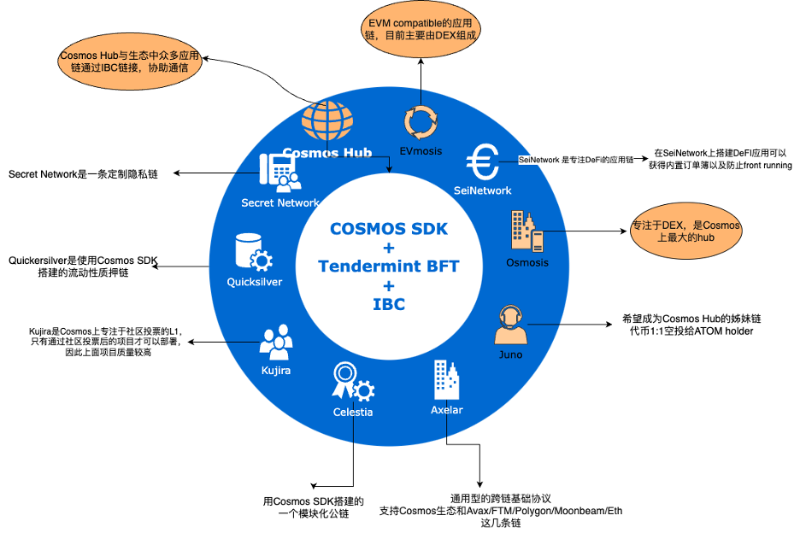
Notable app-chains in the Cosmos ecosystem
Note: Highlighted in yellow are the top three IBC DAU chains (24hr), namely Osmosis, Evmos, and Cosmos Hub, with IBC DAUs of 6,978, 4,728, and 2,711 respectively
In terms of ecosystem metrics, Osmosis functions not only as a leading AMM DEX for cross-chain trading but also as an independently developed application chain built on the Cosmos SDK and IBC. With a TVL of $252 million, it ranks first in the Cosmos ecosystem. Osmosis has more IBC connections than the Cosmos Hub itself, making it one of the most active hubs. Theoretically, this gives OSMO comparable value-capture potential to ATOM at the Hub level. Compared horizontally with other chain-native DEXs, Osmosis has a relatively high P/S ratio—its $1.38 billion market cap appears high relative to $2.5 million in monthly trading revenue. However, considering Osmosis’ dual identity as both a DEX and a Hub-like chain, its valuation remains reasonable when benchmarked against other Layer 1 networks. Osmosis combines privacy-preserving features (threshold decryption to prevent front-running) with cross-chain AMM capabilities, all enabled via IBC.
Kava is a DeFi platform for crypto assets, supporting multi-asset collateralization, self-issued loans, and stablecoin creation via CDPs. Kava’s TVL of $271 million exceeds direct competitors like Evmos, partly due to its extremely high staking yield of 2,800% (vs. Evmos’ 181%). The top two TVL protocols in Kava’s ecosystem are lending platforms, indicating very high leverage. Kava 10 mainnet activated the Kava Network Ethereum Virtual Machine (EVM), allowing users to wrap and unwrap KAVA assets as ERC-20 tokens via MetaMask. This directly connects Kava with tens of thousands of active developers, dApps, and blockchain projects across Ethereum-compatible networks.
Evmos has a TVL of $1.6 million, with 54% contributed by the DEX Diffusion Finance. Among 11 projects on Evmos, 7 are DEXs. Secret has a TVL of $10 million, with 68% from the privacy protocol Sienna Network, and currently hosts four active projects.
Other notable app-chains include Quicksilver, a liquid staking chain; Kujira, which bridges multi-chain assets with DApps like Blue and FIN and enforces governance-based deployment; Axelar, a general-purpose cross-chain protocol aiming to unlock composability and liquidity (though with higher relay fees than Kujira); JUNO, positioning itself as a sister chain to Cosmos and distributing 47% of its tokens via a 1:1 airdrop to ATOM holders; and Sei Network, an app-chain focused on DeFi with built-in order books and front-running protection.
Conclusion
The Cosmos Hub faces competition from other chains with similar Hub-scale capacity and functionality, leaving the influence of $ATOM on the broader ecosystem uncertain. If large chains like Juno, Evmos, Osmosis, or Axelar evolve into independent Security Hubs, they could erode $ATOM’s market share and pricing power.
From a cross-chain standpoint, IBC-enabled interoperability surpasses earlier technologies but remains constrained, unable to compete with emerging MPC-based solutions. Moreover, Cosmos’ custom app-chains suffer from poor composability compared to smart contracts, limiting interoperability at the calling layer.By decentralizing token rights, the Cosmos Hub prioritizes long-term ecosystem growth—even at the cost of reduced immediate value capture. While Alpha is likely to emerge across the broader Cosmos ecosystem, the Cosmos Hub historically captures stable Beta. The launch of Cosmos 2.0 now offers the Hub a pathway to capture a portion of that ecosystem Alpha.
ATOM 2.0’s integration of Interchain Security, Liquid Staking, Interchain Scheduler, and Interchain Allocator forms a new Cosmos System Flywheel, transforming $ATOM from a passive staking asset into a dynamic, valuable collateral instrument. While short-term inflation will intensify, the long-term trajectory clearly shifts toward sustainability and capped supply.
Join TechFlow official community to stay tuned
Telegram:https://t.me/TechFlowDaily
X (Twitter):https://x.com/TechFlowPost
X (Twitter) EN:https://x.com/BlockFlow_News
 Cycle Capital Research






