A New Chapter in Blockchain Game Architecture — Building On-Chain Games on Arweave
TechFlow Selected TechFlow Selected
A New Chapter in Blockchain Game Architecture — Building On-Chain Games on Arweave
From a technical perspective, explore how "pure on-chain games"—the ultimate form of blockchain gaming—are realized.
 Navigating Web3 tides with focused insights
Author: webb
Source: Joint submission by PemaDAO Community and W Labs
Preface: The Rise and Fall of GameFi
The blockchain gaming market experienced its peak moments in 2021–2022. We witnessed Axie Infinity generating higher daily revenue than Honor of Kings, StepN achieving 300,000 daily active users within four months—becoming the hottest crypto app in Q1 2022—and users competing for Otherside land sales driving gas fees to astronomical levels.
Increasing capital flowed into the blockchain gaming sector. In Q1 2022 alone, funding exceeded half of the total raised throughout 2021. From June to August, blockchain games became the highest-funded sector. Mega-rounds exceeding $100 million became increasingly common—MetaApp completed a $100 million Series C round, while Limit Break, parent company of DigiDaigaku, raised $200 million across two funding rounds.
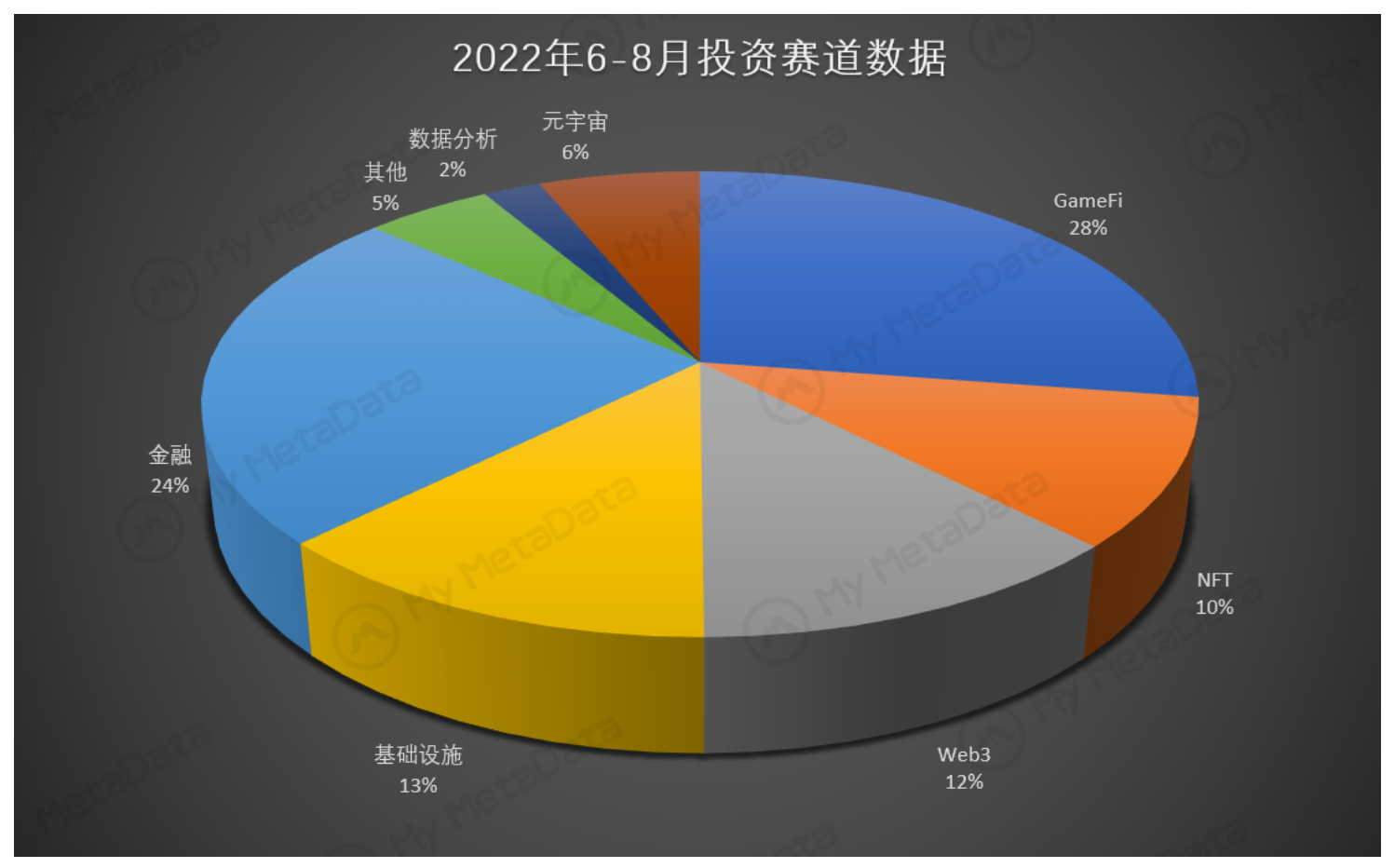
Data from mymetadata.io
However, following the broader crypto market downturn in May, most projects inevitably spiraled into decline, with both user counts and token prices plummeting. Even flagship projects like Axie Infinity and StepN were not spared, leaving the blockchain gaming market in a prolonged slump.
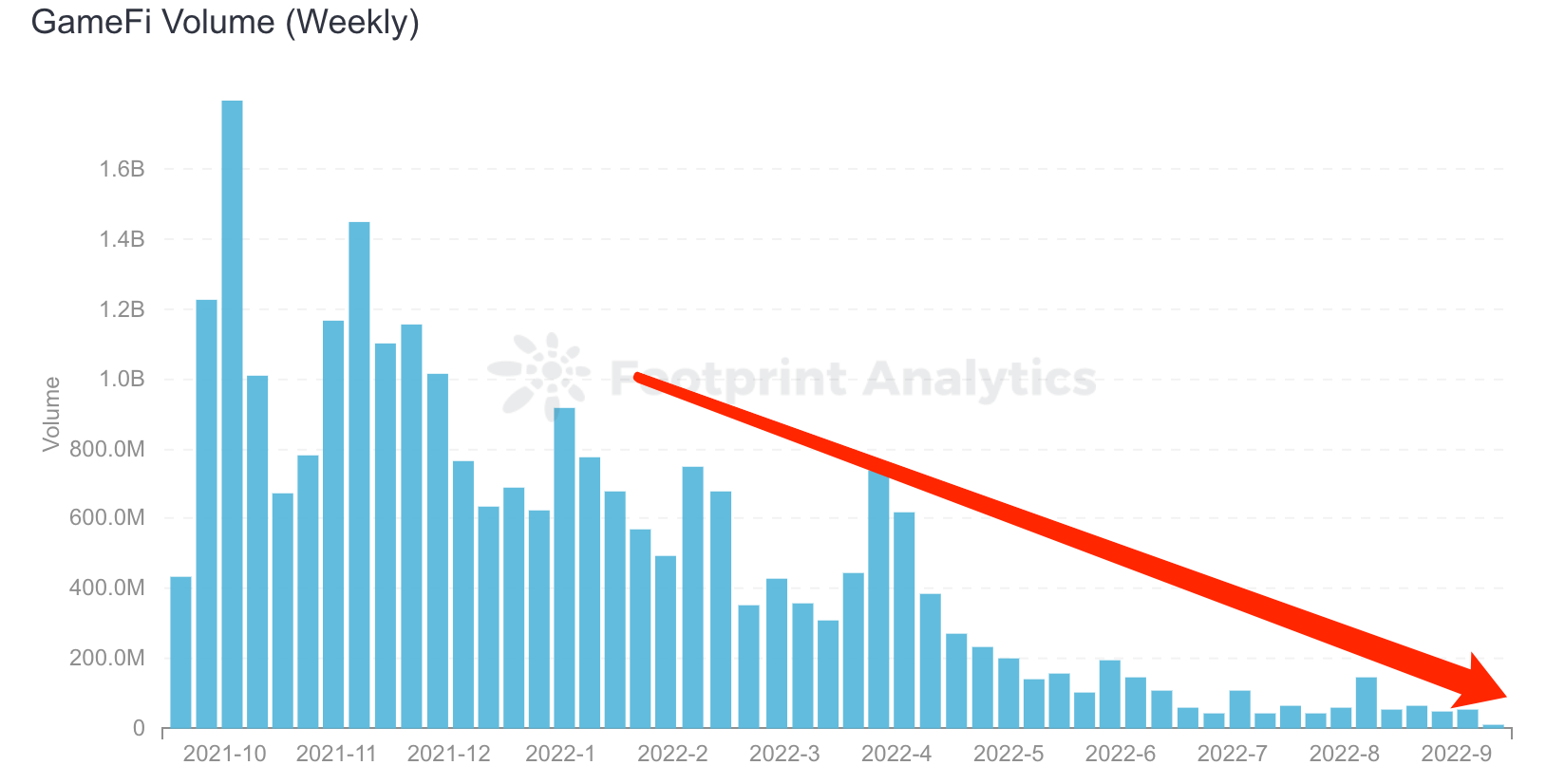
Data from footprint.network
After one full bull-bear cycle, the GameFi market has opened up vast imaginative possibilities while also posing many questions—whether it’s escaping Ponzi-like economic models or achieving decentralized iterations in technical architecture, there remains ample room for exploration.
This article explores, from a technical perspective, how the ultimate form of blockchain gaming—the “fully on-chain game”—can be realized.
I. The Technical Bottleneck of Blockchain Gaming
NFTs and Play-to-Earn models were the catalysts that ignited the last GameFi bull run. Blockchain and NFTs enable blockchain games to disrupt traditional gaming with transformative features:
- Ownership: Through on-chain NFTs, players truly "own" their in-game assets rather than having them controlled by game operators.
- Open Markets: Players can freely trade their game assets on open markets—giving rise to the highly sought-after Play-to-Earn model.
- Composability: Game items and equipment can be used across multiple games. Imagine using a legendary item earned in World of Warcraft within CS:GO. Loot demonstrated this potential effectively.
The story sounds exciting—but the reality is far different:
While game assets exist as NFTs in players' wallets, their underlying values and data are stored on centralized game servers. Project teams can arbitrarily modify attributes or even shut down servers, rendering players’ NFTs essentially worthless.
There are several technical reasons behind this issue:
- High Storage Costs: Storage is a scarce resource on blockchains. Public chains like Ethereum are fundamentally computation layers—essentially ledgers—not designed for large-scale data storage. Projects cannot afford to store gigabytes of game data directly on-chain.
- High Computation Costs: Performing computations on-chain incurs gas fees, which neither players nor developers can sustainably bear for real-time game operations.
- Unbearable Latency: The process from transaction initiation to block confirmation takes time—ranging from seconds to minutes. This delay is unacceptable for games requiring low-latency, high-frequency interactions.
As a result, current blockchain game architectures follow the “assets on-chain, execution off-chain” model. This approach only achieves partial decentralization—while assets are tokenized, token generation occurs off-chain. Players often need to perform a “withdrawal” action to transfer in-game assets onto the blockchain. Most game logic and interactions happen on off-chain game servers, resulting in very limited actual decentralization.
Various Layer 2 solutions and game-specific blockchains (e.g., Avalanche subnets, IMX) have attempted to solve computational costs, but none address the core issues of storage cost and response latency. Some projects have explored fully on-chain games—such as Lssac (a StarkNet-based lightweight on-chain game)—but such examples remain simple numerical games lacking depth. They are unsuitable for complex, high-frequency, multi-gigabyte AAA titles.
The limitations of underlying blockchain infrastructure have created a technical bottleneck for current blockchain games. We are trapped within the constraints of traditional blockchain paradigms.
How do we break through? Let's step outside conventional blockchains and consider a fresh perspective—using the “non-traditional” blockchain project Arweave to overcome these technical challenges!
II. Arweave and the SCP Storage Consensus Paradigm
Most people first learned about Arweave during the recent NFT boom, when it served as decentralized storage for vast amounts of NFT image data. Arweave is often compared to Filecoin, but IPFS and Filecoin attract more attention due to their prominence. However, upon deeper investigation, you’ll discover: Arweave offers much more than just storage!
Permanent Storage and Minimalist Design Philosophy: Economic Incentives
Arweave is a blockchain built specifically for “permanent data storage,” leveraging a unique consensus mechanism and economic incentives to ensure miners preserve data indefinitely.
Arweave operates under a key assumption: annual storage costs decrease at a rate of around 30%, converging toward zero over time. Therefore, charging once for centuries-long storage results in a near-constant fee. This allows Arweave to offer one-time payment for permanent storage.
IPFS is the most well-known decentralized storage project, launched globally in 2015 after being initiated in 2014. Filecoin, serving as IPFS’s incentive layer, didn’t launch its mainnet until July 2020. Even a technically advanced team required years to develop Filecoin, highlighting its engineering complexity. Filecoin relies on an intricate system involving two data markets, dual incentive mechanisms, and dual pricing models to ensure data persistence.
Is such complexity necessary? Arweave took a radically different approach—minimalist design, leveraging economic incentives to motivate miners to store blocks.
Arweave uses a structure called Blockweave (blockchain weave). Unlike traditional blockchains where each block points only to the previous one, Blockweave blocks also reference a randomly selected historical block, known as a recall block.
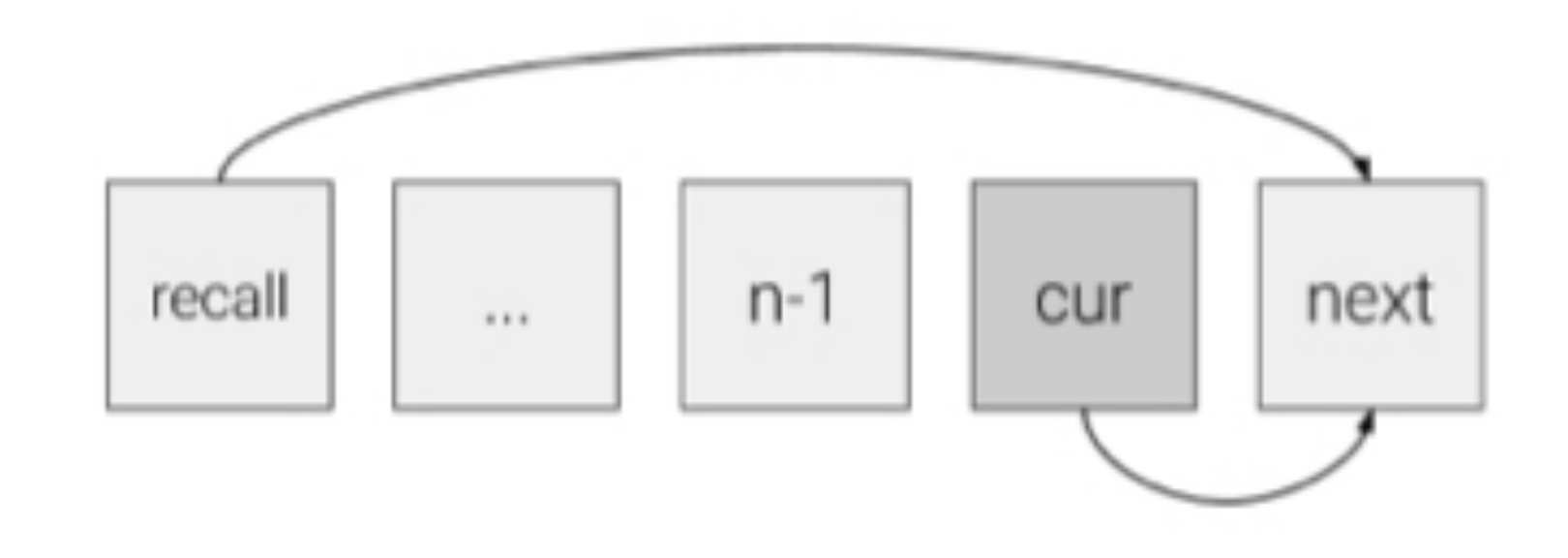
Blockweave Structure
Based on Blockweave, Arweave implements SPoRA (Sparse Proof of Random Access) consensus. Beyond standard PoW requirements, miners must provide proof of storing a randomly selected recall block to generate a new block. Since recall blocks are chosen randomly, miners are incentivized to store more historical blocks—especially rare ones—to increase their chances of mining the next block. In short, a miner’s block probability = probability of possessing the random recall block × probability of finding the correct hash first.
Miners in Arweave don’t need to download all blocks, but the unique design encourages storing more data, particularly rare data, enabling true permanent storage.
The Killer Feature: SCP Storage Consensus Paradigm
Beyond permanent storage, Arweave’s minimalist design enables it to support computation layers, making it a potentially pivotal infrastructure in Web3.
DApps on Arweave operate under the SCP model—Storage-based Consensus Paradigm. These dApps don’t run directly on Arweave; instead, Arweave stores user-submitted transaction instructions, while computation happens above. These upper layers function like L2s on top of Arweave. By downloading and sequentially executing all inputs from Arweave, they produce final outputs. Furthermore, if the program’s source code is uploaded to Arweave, any client can execute it based on the same inputs and arrive at identical, trustless results. We refer to this model as the Turing Machine Tape.
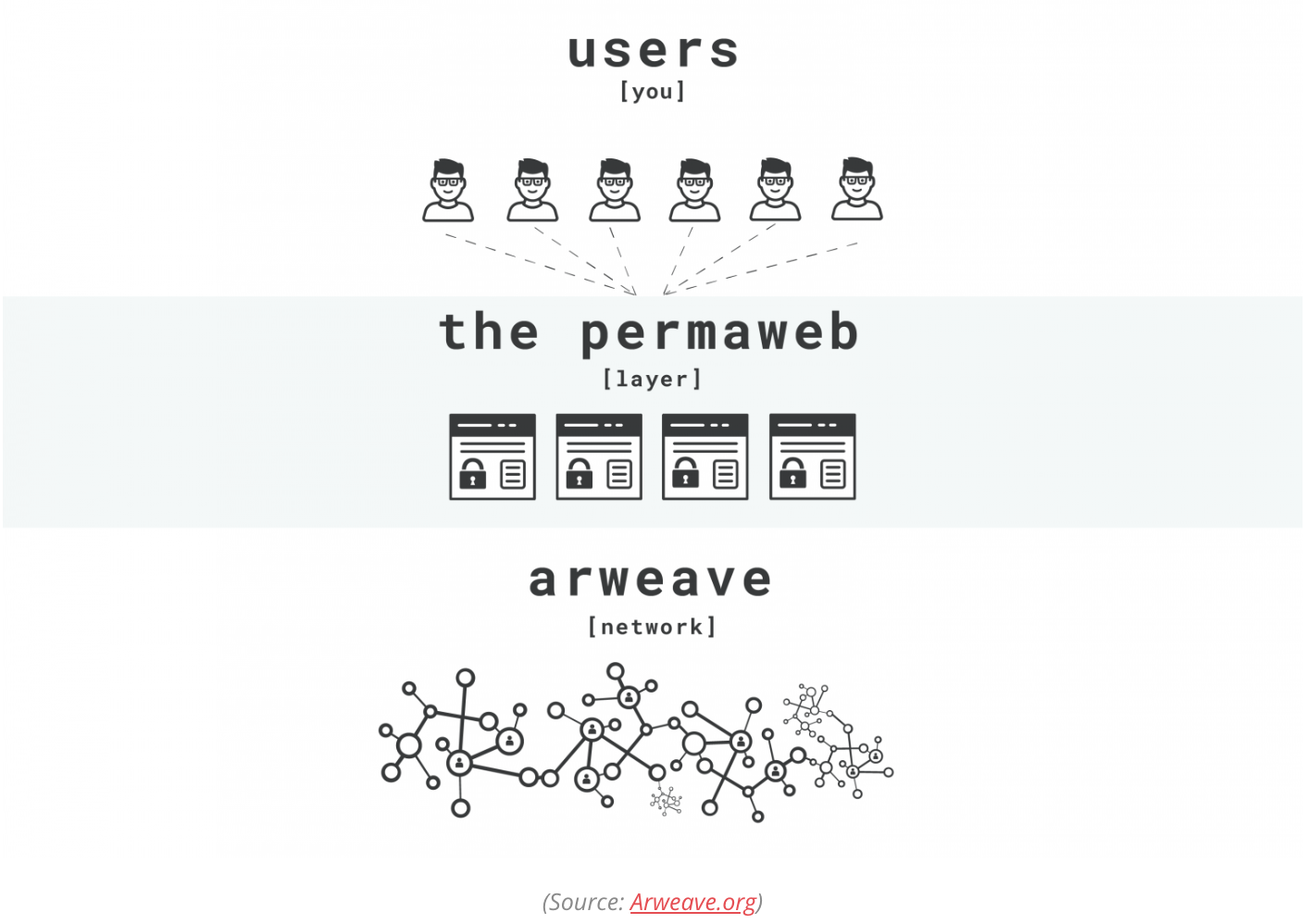
SCP gives developers immense freedom—they can use any familiar language (Java, Solidity, Python), as long as standardized inputs yield consistent outputs.
A compelling example is frontend applications. Static frontends can be stored on Arweave and opened directly via browser. Uniswap, for instance, has archived historical versions on Arweave—users can access old Uniswap interfaces via direct links, with complete verifiability. The frontend itself becomes the contract!
With this, all three challenges facing blockchain games are resolved:
- Storage Cost: Permanent storage on Arweave is extremely cheap—around $3 per GB. Storing apps on Arweave is cheaper than renting AWS servers.
- Computation Cost: In SCP, Arweave doesn’t handle computation—each application runs its own compute layer, eliminating computation costs entirely!
- Latency: Users interact directly with the application layer. Since computation is managed independently, response times match those of traditional web services.
III. Game Architecture Based on SCP
Service Architecture: Each Game Service as an L2
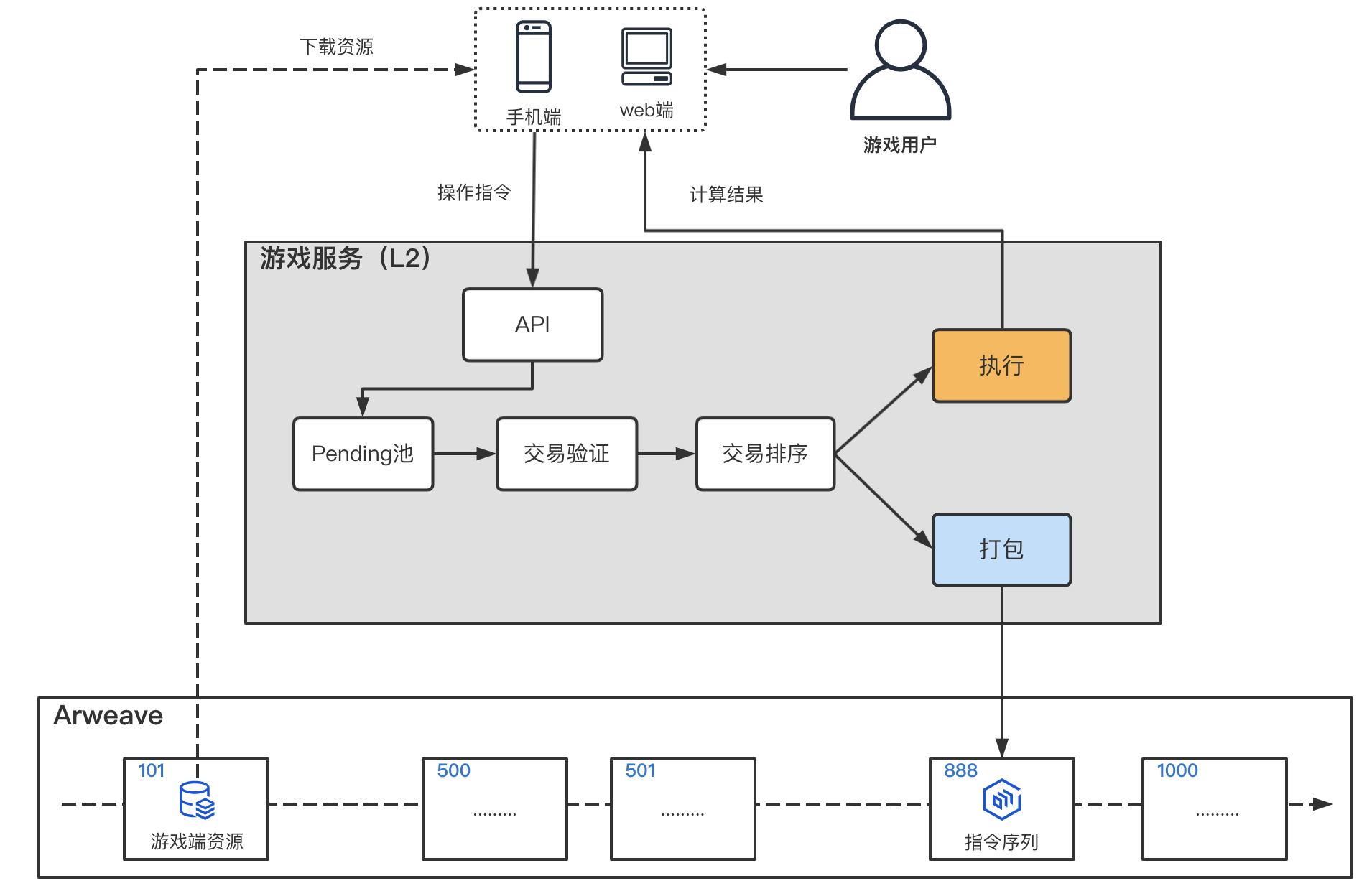
Game Service Architecture Based on SCP
In an Arweave-based game architecture, each game service functions as an L2 layer atop Arweave, responsible for receiving and executing player commands, then uploading these commands in order to Arweave. Once recorded on Arweave, instruction sequences become immutable and can be used at any time to reconstruct the game’s final state.
In this model, clients only record actions and send them to the game server without performing any computation. The game server collects player inputs, orders them, executes them, and sends results back to clients. Think of the client as a “video player”—it simply renders what the server returns. For example, movement, jump, and attack commands are sent to the server, which calculates character positions and damage dealt, broadcasts results to visible clients, and synchronizes all online players.
Ideally, the game service consists of a decentralized set of nodes, reaching consensus on transaction validation, ordering, and execution—offering higher trust and security than a single node. The downside is slightly slower computation and response compared to centralized servers.
This architecture suits games with lower real-time demands, such as turn-based games (Axie), card games (SkyWeaver), management games (Sunflower Land), and narrative-driven games.
Application of P2P and Frame Synchronization
For high-realtime games—like MOBAs (Honor of Kings), action games (ACT), or FPS (PUBG)—high-frequency operations can be processed at the upper layer for fast responses, while command sequences are simultaneously sent to the game server for verification. Final outcomes are determined by the server, with command logs permanently stored on Arweave.
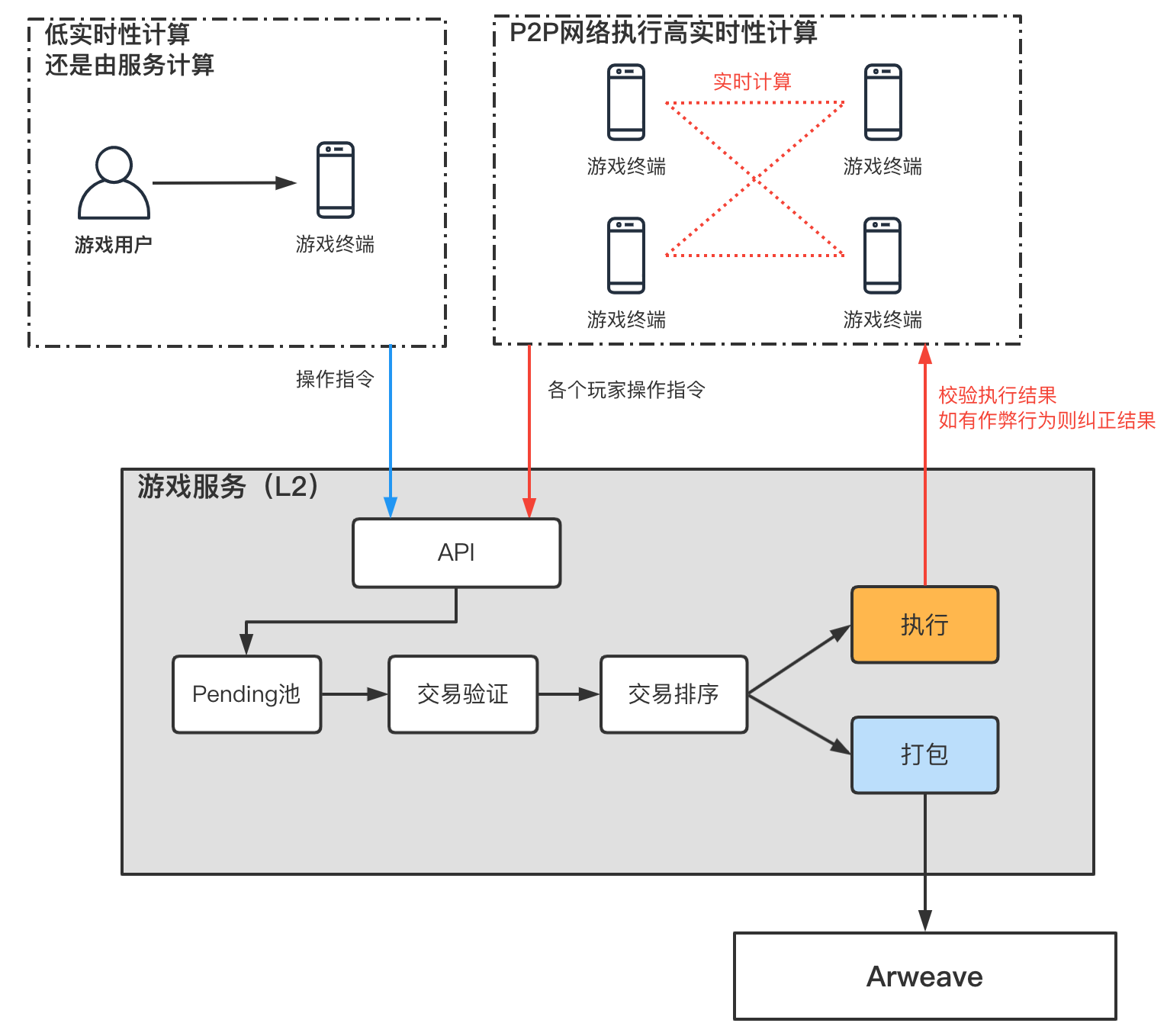
Separation of High- and Low-Frequency Computation
1. Application of P2P Technology
High-realtime games often involve “room creation,” such as matchmaking in Honor of Kings or PUBG, where a fixed number of players engage in localized interaction. We can separate high-frequency and low-frequency operations within such games.
When players join a match, they’re connected directly via a P2P network for real-time communication. Clients synchronize action sequences and perform local calculations, requiring consensus only among participants. Simultaneously, these actions are sent to the game server for execution and validation. The server’s result is authoritative. If cheating or errors are detected, the correct sequence is broadcasted to clients, which replay and correct the state.
This requires all clients and the server to share the same time reference, which brings us to traditional gaming’s frame synchronization technique.
2. Application of Frame Synchronization
Frame synchronization is widely used in real-time games like MOBAs and shooters. Its core principle is identical inputs + identical timing = identical outputs. This aligns perfectly with the SCP paradigm, enabling seamless integration.
Arweave solves the problem of identical inputs. For synchronized timing, we rely on frame sync.
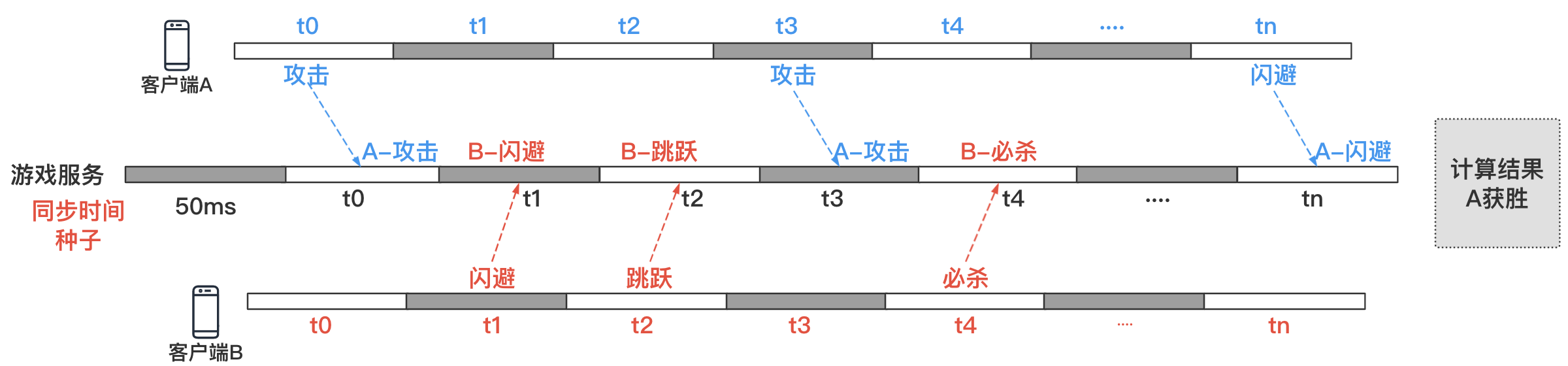
First, the server distributes a time seed to ensure all clients stay synchronized. Time is divided into equal intervals—frames—such as 50 or 80 frames per second. Finer granularity improves control precision, but human reaction limits make ultra-fine slicing unnecessary.
Clients embed player actions into specific frames and send them to the server. The server processes inputs from all clients, computes the outcome, and updates the game state.
In blockchain games, we apply frame sync: the server synchronizes time across clients, clients broadcast actions via P2P networks and to the server, and all parties compute consistent states. The server records the sequence on Arweave. In case of discrepancies, the server’s result prevails for correction.
These commands occupy minimal space, incurring negligible storage costs. Arweave transactions have no size limit—one can store 1KB, 1GB, or even 10GB. Many current AR transactions reach 2GB, capable of handling 20 million instructions.
NFT and Token Issuance
Issuing NFTs and tokens has become standard in blockchain games. While Arweave supports PST tokens (similar to Ethereum’s ERC-20) and NFT issuance, it lacks Ethereum-level computational capabilities. Thus, token minting, settlement, and trading must occur within the game service.
As mentioned earlier, each game runs as an L2 on Arweave. If every game independently handles NFT and token creation, several issues arise:
- Reinventing the Wheel: Every game team must maintain duplicate functionality like NFT/token issuance and trading logic.
- Reduced Composability: Different implementations hinder interoperability.
- Increased Security Risks: Beyond gameplay, teams must manage critical financial code. Poor implementation risks user asset loss.
Therefore, we envision a dedicated L2 focused on NFT and token issuance and trading—to reduce development costs, improve security, and deliver a unified, seamless experience. The architecture evolves into the following:
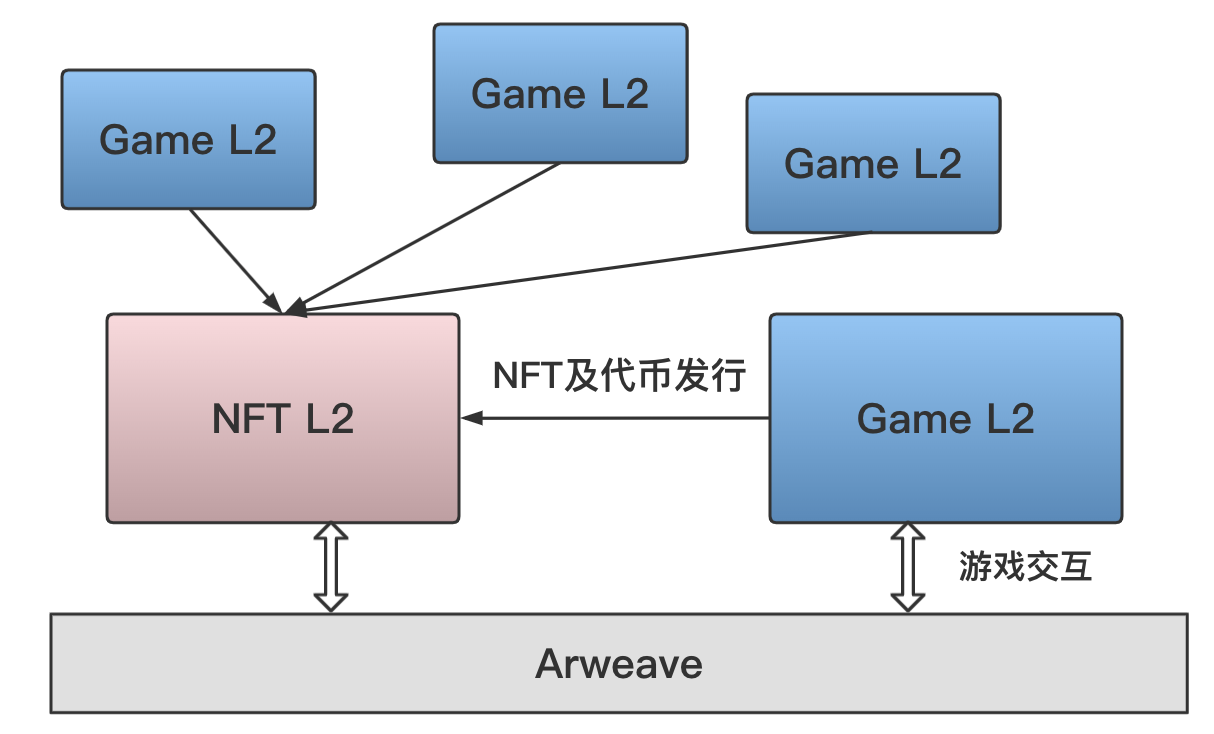
NFT L2 and Game L2 Architecture
The NFT L2 integrates NFT issuance, token creation, transfers, and trading. Game developers simply call NFT L2 APIs to rapidly build decentralized economies, delegating foundational tasks like NFT and token minting to the NFT L2. This allows studios to focus on gameplay innovation and economic design—core differentiators.
Inherent Cross-Chain Capability
This Arweave-based model brings another major benefit—cross-chain asset transfer. Arweave stores consensus-critical data, so all data on Arweave is considered trustworthy and immutable. Tokens and NFTs issued on Arweave can be transferred trustlessly across other public chains.
By mapping addresses from various chains onto the NFT L2, the NFT L2 treats all external chain addresses equally. A transfer can directly send assets from an Ethereum address to a Solana address—only a single record needs to be written on Arweave.
For example, performing a cross-chain transfer on everPay (an Arweave-based SCP wallet application https://everpay.io/):
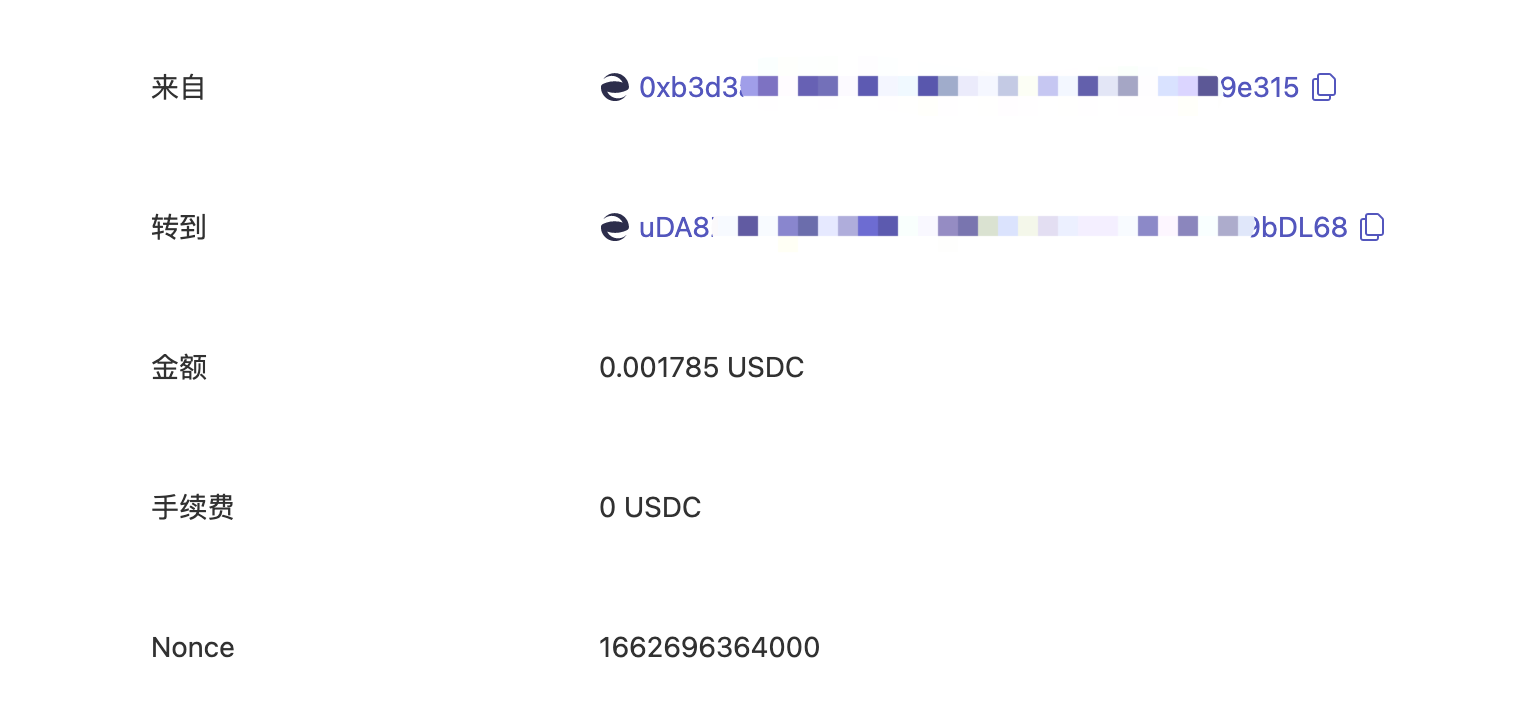
The above shows transferring USDC from an Ethereum address to an Arweave address—all without fees.
This design also facilitates building upper-layer infrastructure like NFT exchanges. The NFT L2 will serve as foundational GameFi infrastructure within the Arweave ecosystem, empowering game services.
Game Storage and Updates
Storage on Arweave is extremely affordable—around $3 per GB. We can store all game content on-chain: assets, executables, configuration files, etc.—just like traditional Web2 games, where players download content before playing.
For large or web-based games, partial downloads can occur initially, with additional resources fetched dynamically during gameplay. This requires a high-speed data loading channel between players and Arweave nodes—functionally similar to CDNs in Web2. Within the Arweave ecosystem, caching layers are needed to help users quickly retrieve data—either by caching locally or storing frequently accessed data on nearby Arweave nodes.
Similarly, game updates can be published on Arweave for users to pull as needed.
Conclusion
Current blockchain game architectures primarily follow the “assets on-chain, off-chain execution” model. This achieves only partial decentralization, leaving player assets vulnerable to arbitrary changes by project teams. The root causes are threefold: high storage costs, high computation costs, and unacceptable latency.
Fully on-chain games built on Arweave effectively resolve these issues. Applications on Arweave leverage the SCP (Storage-based Consensus Paradigm), functioning like a Turing machine tape—Arweave records only inputs and outputs, while computation happens off-chain. This eliminates computation costs and latency concerns. Frame synchronization naturally complements this model, enabling real-time gameplay.
In this model, each game service acts as an L2 on Arweave. A dedicated NFT L2 infrastructure should provide shared services—NFT issuance, token creation, and asset trading—for all games.
Final Thoughts
We believe gaming will be a vital piece of Web3. Fully decentralized, purely on-chain games represent the ultimate evolution of blockchain gaming. Today’s blockchain games remain in their infancy, with significant technical and architectural challenges ahead. Continuous exploration and innovation—in economics and technology—are essential. Arweave and the SCP storage consensus paradigm have already opened a new door. A fundamental technological transformation is quietly underway—and their performance has only just begun!
References:
Exploring the Path of Traditional Games Entering GameFi
CoinMarketCap x Footprint Analytics: GameFi Industry Report 2022
Arweave’s Potential Is Reviving the Library of Alexandria, Not Replacing Filecoin
Foresight Ventures: Understanding Arweave, the Key Infrastructure of Web3.0
About PermaDAO
Join PermaDAO and become a Buidler
everFinance is a tech company focused on providing Web3 infrastructure, aiming to support one billion users entering the Web3 network. Using the innovative Storage-based Consensus Paradigm (SCP), we explore new Web3 development frameworks that enhance user experience, lower development barriers, and boost network performance.
PermaDAO is a builder community initiated by everFinance. Everyone can find their role contributing to the Arweave ecosystem. Any proposal or task related to Arweave can be posted here and receive full community support and feedback. Join PermaDAO, build Web3!
About W Labs
W Labs is a Singapore-based firm specializing in the blockchain gaming vertical. Currently focused on original content creation, it also provides research analysis, modeling, and operational consulting for blockchain gaming projects.
WGGDAO (Guatian Community) is the first product incubated by W Labs—a DAO community aggregating real blockchain game players, enabling creators and players to connect directly.
Linktree: https://linktr.ee/wlabs
This article is for informational purposes only and does not constitute any investment advice.
Join TechFlow official community to stay tuned
Telegram:https://t.me/TechFlowDaily
X (Twitter):https://x.com/TechFlowPost
X (Twitter) EN:https://x.com/BlockFlow_News
 瓜田实验室W Labs