Understanding Hoardusdh Protocol: A Stablecoin Backed by a Basket of Algorithmic Stablecoins
TechFlow Selected TechFlow Selected
Understanding Hoardusdh Protocol: A Stablecoin Backed by a Basket of Algorithmic Stablecoins
Hoard could attract a significant amount of TVL and set a new standard for stablecoins.
 Navigating Web3 tides with focused insights
Written by: Crypto Andrew
Translated by: TechFlow
Before diving deeper into Hoar, we need to break it down into two parts: $USDH and $HRD.
$USDH — a stablecoin backed 1:1 by a basket of algorithmic stablecoins such as $MIM, $USDD, $LUSD, $FEI, and $sUSD.
You deposit $MIM, $USDD, $LUSD, $FEI, or $sUSD to mint $USDH, or redeem your original stablecoin in return. Since $USDH can always be minted and redeemed at a value of $1, users can perform arbitrage, which helps maintain a tight peg.
For example, if $USDH trades at $0.98 on the open market, you buy it and redeem it for $1 worth of MIM (for instance), instantly earning a 2% profit. This increases demand for $USDH, pushing its price back toward the $1 peg.
Use Cases for $USDH
The primary use case is Hoarder: stake $USDH and earn passive income—currently offering 16% APR. To bootstrap liquidity, $USDH yields are distributed in $HRD tokens.
Once the protocol accumulates sufficient collateral in stablecoin form, it will gradually reduce token emissions and transition to a real yield model.
Hoard will deploy these collaterals into delta-neutral strategies to generate yield, distributing it to holders of $USDH (80%) and $HRD (20%).
The protocol aims to deliver 10–25% APR returns for $USDH stakers. This might trigger PTSD memories of Anchor, but $USDH’s approach is more sustainable because it is fully collateralized.
Now let’s dive deeper into $HRD—the governance token of Hoard.
$HRD has two main functions:
- Governance rights (transferable);
- Locking in veHRD form for up to one year to receive rewards (up to 45% APR);
Governance Rights — straightforward. But unlike other governance models, you can re-delegate your vote every 24 hours. As hinted in their documentation, this could spark future "Curve wars" over $HRD voting power.
veHRD — lock your $HRD to receive non-transferable veHRD. The longer the lock-up period, the more veHRD you receive.
Token Emissions
The first five weeks may see significant selling pressure on tokens. Additionally, the more collateral $USDH attracts, the less $HRD will be emitted.
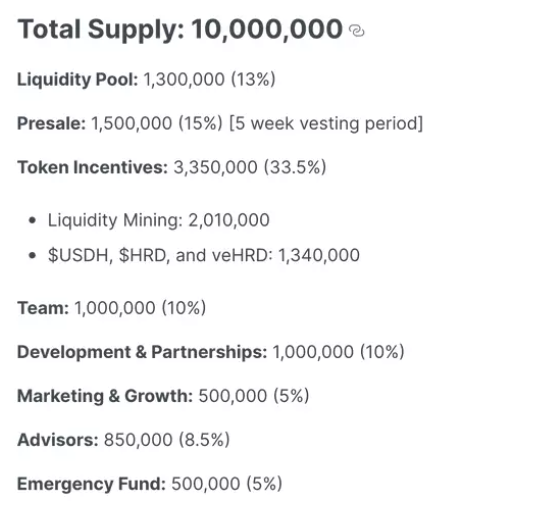
FDV — $6.4 million, trading volume — $1.6 million (on an upward trend), liquidity — $500,000.
PA: Despite the broader market downturn, early investors have still achieved 8x returns. Therefore, I expect poor price action in the short term as people dump their tokens.
However, if the protocol successfully accumulates collateral, deploys it effectively, and distributes real yield to stakers, we might eventually see a strong bullish reversal.
Moreover, let’s review the roadmap to see what’s coming:
- Protocol partnerships/bribes;
- Expansion of the collateral basket;
- Delta-neutral yield strategies;
- Most impressive: Hoard Chain;
Looking at their roadmap, if they successfully deliver—especially Hoard Chain—the project could achieve real value capture:
- $HRD becomes the gas token;
- hUSDH (wrapped $USDH) serves as a consensus token (staked to enhance chain security and earn additional rewards).
Social Presence
The project is still in its early stages, so social metrics aren’t impressive yet: Twitter — 1.7k followers, Telegram — 800 members. However, it has already gained some traction from KOLs on Twitter (with over 10k followers), attracting decent attention.
Comparison and Valuation
Some compare it to Frax Finance and Terra, but I’d rather draw parallels with Tribe (TRIBE/FEI), Liquity (LQTY/LUSD), and Abracadabra (SPELL/MIM). These projects have average market caps around $100 million—about 15 times that of Hoard. Still, it’s too early for Hoard to reach that level.
Data remains very weak (which is expected, given its recent launch), and the ambitious roadmap must be delivered first. Only after seeing further development and adoption can we begin serious valuation—but there’s no doubt Hoard has the potential.
Conclusion
Hoard is definitely a project to watch. It could attract substantial TVL and set a new standard for stablecoins—especially if Hoard Chain is successfully delivered, which would bring significant incremental value to the project.
Join TechFlow official community to stay tuned
Telegram:https://t.me/TechFlowDaily
X (Twitter):https://x.com/TechFlowPost
X (Twitter) EN:https://x.com/BlockFlow_News