SPACE KILL: BSC's most anticipated new game, the first real-time multiplayer Game-Fi
TechFlow Selected TechFlow Selected
SPACE KILL: BSC's most anticipated new game, the first real-time multiplayer Game-Fi
This week, SPACE KILL became the most watched project in the BSC gaming market, with its Soul NFT ranking first in trading volume in the tofuNFT Game-Fi sector. The NFT floor price is 0.35 BNB, and its Game token SKS surged after listing.
 Navigating Web3 tides with focused insights
This week, SPACE KILL has become the most watched project in the BSC gaming market. Its Soul NFT trading volume ranked first in the tofuNFT Game-Fi category, with an NFT floor price of 0.35 BNB. After its Game token SKS launched, it surged over 600%, delivering massive profits to early participants.
At the time of writing, SKS remains stable above 0.11 USDC. According to community-contributed guides, a common gray-tier Soul NFT upgraded to level 30 generates approximately 200 SKS per day—worth about $22 at 0.11 USDC. Compared to the NFT floor price of 0.35 BNB, this results in a payback period of just five days, offering an astonishing return on investment.
The SPACE KILL team is Invictus Lab, a group that previously operated a Web2.0 product with tens of millions of daily active users. Core members bring over 15 years of game development and operations experience. SPACE KILL marks their first foray into Web3 gaming. Beyond its impressive price performance, its unique gameplay has driven exceptional user retention—90% day-one retention and 70% day-14 retention.
Gameplay similar to "Among Us," a global Party Game with over 10 billion users and 250 thousand daily active players
Before diving into SPACE KILL, one must first understand "Among Us."
In 2020, amid the sudden pandemic, the social party game "Among Us" went viral worldwide. As a Party Game, it successfully transformed real-life spy games into a digital format, allowing players to enjoy the fun of murdering and deceiving friends in a humorous cartoon-style spaceship setting. Many Twitch and YouTube streamers built content around it, and even today, it still boasts over 2.5 million daily active players.
Invictus Lab's SPACE KILL adopts gameplay similar to "Among Us," standing out uniquely in the Web3 gaming space and revealing new possibilities for Game-Fi—centered around social party mechanics, emphasizing real-time multiplayer matchmaking and voice-based social interaction, deepening engagement through player-to-player dynamics and boosting user stickiness.
Easy to learn, focused on player-to-player interaction
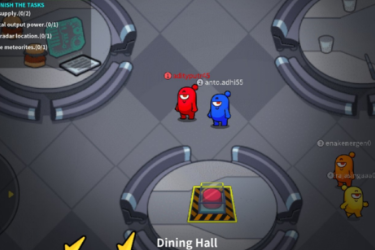
The rules of the SPACE KILL beta version are relatively simple, without complex maps, skills, or class systems, ensuring a low barrier to entry for new players. Each match consists of six players set aboard a spacecraft, randomly assigned as either Crewmates or Impostors. Crewmates win by completing tasks to repair the ship or eliminating all Impostors, while Impostors win by killing off the Crewmates.

An interesting aspect is the voting phase, where players debate and vote to eliminate the suspected Impostor. This means players must be good at "acting"—to avoid being wrongly accused. Imagine: if you're the Impostor, how do you clear your name? If you're a Crewmate, how do you spot the real traitor? These dynamics create rich gameplay depth—centered entirely on player interaction.
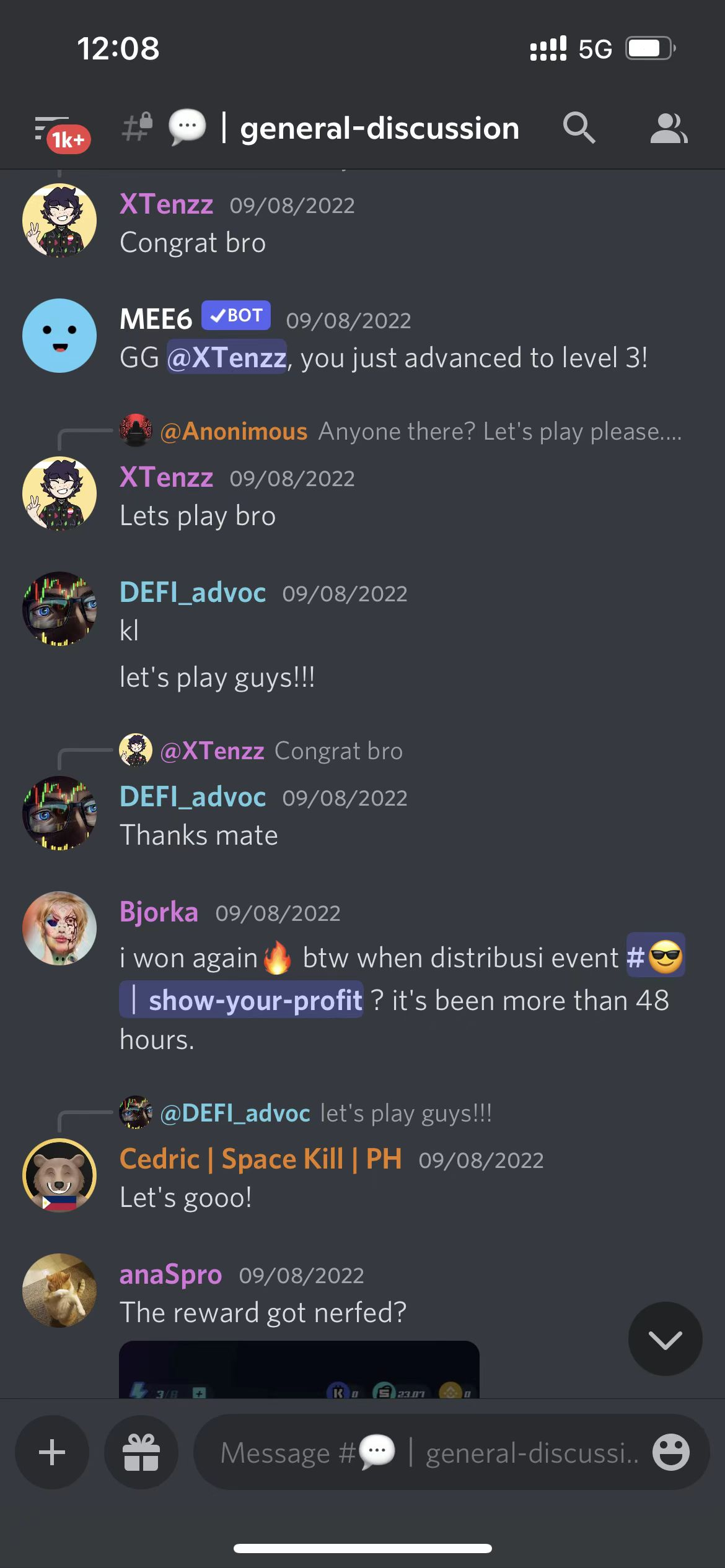
When you enter SPACE KILL’s Discord community, you’ll constantly see players shouting “Let’s play.” The in-game social bonds extend directly into Discord, where players enthusiastically invite friends to join, demonstrating the game’s powerful social appeal.
The first real-time multiplayer-matched blockchain game, rejecting solo mining and bots
Currently, SPACE KILL offers only one mode—Matchmaking—where players must be matched with others to start a game, which begins only when six players are gathered. This largely prevents botting and solo farming—players must wait and play together.
While not groundbreaking in Web2, this approach stands out in Web3 Game-Fi. While most Game-Fi projects now recognize that “fun” is the rarest quality in games, rather than designing complex PVE mechanics, SPACE KILL takes a smarter path—simple rules with rich interactive potential mean lower entry barriers and deeper gameplay. It emphasizes human interaction over machine grinding—opening up far more possibilities compared to bot-ridden single-player models.
UGC Mode launching in December: players can customize maps and game modes
According to the project roadmap, SPACE KILL will launch UGC Mode in December. Players will then be able to design custom maps and even create new game modes—such as defining unique classes and abilities for different roles, enriching game rules and mechanics.
Though this feature isn’t live yet, players are already excited. Based on "Among Us" experience, UGC Mode can ignite community co-creation, attracting many new users. As a Game-Fi product, will UGC reshape the economic model? Can players earn from their custom maps and participate in governance? These questions remain unanswered, but one thing is clear—it’s a bold new direction that has everyone eagerly anticipating what’s next.
NFT + dual-token economy model with algorithmic control over NFT minting speed
As outlined in the whitepaper, SPACE KILL employs a classic NFT + dual-token economic model. The in-game currency is SKS, the governance token is SKK, and Soul NFTs sit at the core of the economy. Players need equipped Soul NFTs to earn in-game rewards. While anyone can play without an NFT, only NFT holders can generate income.
The game features multiple SKS consumption mechanisms tied to NFTs, including stamina refills, NFT upgrades, breeding, and repairs. Until an NFT reaches level 50 (max level), players face continuous demand for SKS spending and cannot earn SKK rewards during this period.
Soul NFTs can be understood similarly to StepN's running shoes, featuring four upgradable attributes: Force, Luck, Tenacity, and Stamina, each affecting different NFT capabilities. Force impacts earning efficiency, while Luck affects drop rates for chests and scrolls—these two are the most commonly upgraded by players. Soul NFTs also have two innate traits—Quality and Star—that reflect inherent rarity and also influence earning power.
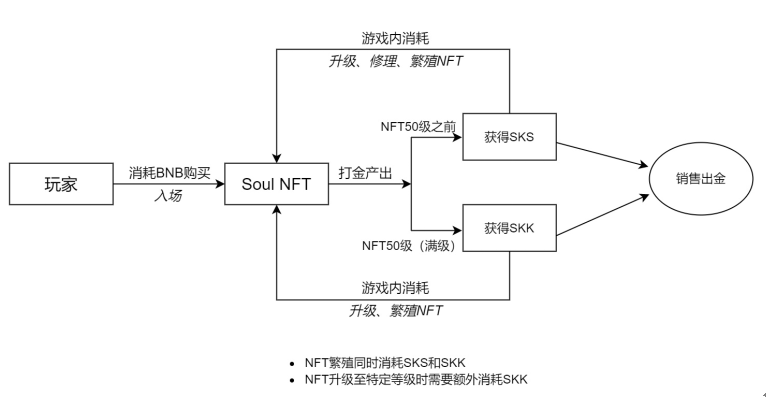
On the economic front, SPACE KILL tightly controls inflation, primarily using algorithms to regulate the NFT minting speed. To date, 1,200 Genesis NFTs have been minted, with over 800 airdropped to early community members and the rest gradually released as community rewards. When a player owns two Soul NFTs both leveled to 10, they can mint a new NFT. Minting burns both SKS and SKK, with costs tied to the SKS price. The formula is: Cost = SKS (A) + base SKK (B) + additional SKK ([A+B]*x)
Powered by Spike Solution engine: Soul NFTs compatible with all games supporting Spike server suite
Notably, SPACE KILL is powered by Spike Solution—an open-source Web3 game engine—with all web3 services provided by the Spike server suite. This means Soul NFTs can be used across all games supported by the Spike engine. Conversely, holders of other NFTs may eventually enter SPACE KILL directly without purchasing new assets, leveraging their existing NFTs to play. This opens vast potential for ecosystem expansion by Invictus Lab.
Additionally, SPACE KILL manages its game tokens and NFTs via dedicated smart contracts instead of personal wallets, enabling more flexible and granular risk control strategies to ensure fund security.
——
As a fresh Game-Fi title, SPACE KILL represents an innovative exploration of Party Games in the Web3 space. Its easy-to-learn mechanics, strong replayability, and real-time matchmaking have delivered a standout debut in an otherwise sluggish Game-Fi market. The planned UGC Mode and integration with the Spike engine further reveal the ambition of Invictus Lab.
For those interested in SPACE KILL, follow the project’s official Discord and Twitter.
Join TechFlow official community to stay tuned
Telegram:https://t.me/TechFlowDaily
X (Twitter):https://x.com/TechFlowPost
X (Twitter) EN:https://x.com/BlockFlow_News