








We need to reimagine the future of blockchain
TechFlow Selected TechFlow Selected
We need to reimagine the future of blockchain
It's easy for people to imagine the future as a better version of the present, but the truly reasonable way to make predictions is to identify the factors driving change and examine what transformations they might bring.
 Navigating Web3 tides with focused insights
Author: Zhang Weiwu @Smart Token Labs
In 1995—the same year Bill Gates published his book "The Road Ahead"—he appeared on a famous talk show hosted by David Letterman and described the future of the internet. He said that with the internet, users would be able to watch any program they wanted, and there would eventually be companies offering video-on-demand services over the internet.
Letterman responded, "Cable TV already has on-demand." Gates replied, "But you can pause it, skip to any part you want." Letterman shot back, "VCRs can do that." The audience laughed.
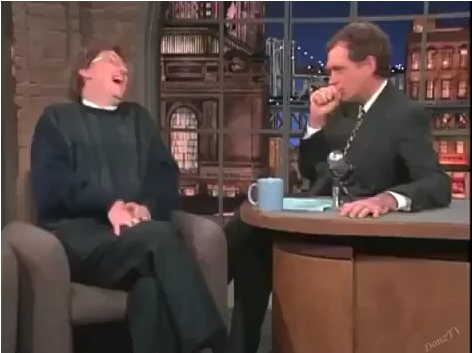
Bill Gates interviewed by David Letterman in 1995 discussing the future of the internet
Today, the internet has fulfilled exactly this vision—turning Netflix, once a DVD rental shop buried in the Arizona desert, into an entire industry.
Twenty-three years after interviewing Bill Gates, David Letterman was lured out of retirement by a $2 million per episode paycheck.
Guess who wrote that check? The very company Gates mentioned—"a company providing on-demand video via the internet": Netflix.
My takeaway is this: It's easy to imagine the future as just a better version of today, but the truly sound way to predict the future is to identify the fundamental drivers of change and see where they lead¹. (Original: It's easy to predict the future based on a better version of today. It's harder to identify the factors of change and predict the future that way.)
In the Netflix story, the role of the internet wasn't merely to provide a channel for video-on-demand. The internet had two key roles:
First, it enabled massive networks, creating a focal point for scale in commerce and giving rise to platforms like Netflix.
Second, it allowed deep understanding of user demand. Through big data, it influenced media creation, tightly linking creators and audiences—classic shows like Firefly (2002) wouldn’t have been canceled after only 14 episodes if Netflix existed then, because Netflix would know exactly whom to recommend it to.
Upon closer inspection, both reasons behind Netflix’s success boil down to unlocking market potential and improving market efficiency.
Earlier I said: It's easy to imagine the future as a better present, but the correct predictive method is to find the drivers of change and see what transformations they enable².
Gates knew the internet was a new kind of connection, so he predicted on-demand video correctly. But he failed to see that the real transformative factor wasn’t connectivity—it was the market.
The internet isn’t just a new link technology—it’s a mechanism that unleashes market efficiency by connecting all networks.
Had Gates understood this, he could have said during the interview: Yes, pause and on-demand functions exist today, but the internet is not just a bundle of features—it’s a bundle of markets. Future internet applications enabling video-on-demand will offer programs and content fundamentally different from what we see today. One day, a single internet-based video-on-demand company could surpass the entire global film industry in size.
In 2018, when Netflix paid David Letterman $2 million per episode, its market cap was $170 billion—larger than the total market cap of the global film industry, which stood at $136 billion.
I’ve been talking about the power of markets since 2018. In my 2019 TokenScript design document, I outlined two key roles of blockchain:
Reducing market friction.
Increasing integration.
These two aspects are intertwined—just like how the internet simultaneously increased connectivity and market efficiency.
Back in 2018, the biggest application on blockchain was MakerDAO’s stablecoin and DeFi built atop it.
Many saw blockchain challenging and disrupting finance. Some imagined a world without banks, where everyone accesses financial services through crypto—hence “blockchain is fintech.”
Three years later, in 2021, the biggest phenomenon on blockchain was NFTs. Many recognized blockchain’s potential to let users hold digital rights.
Many predicted that in the future Web3 world, everyone would use NFTs to represent their online identity and earn money through fan economies.
Some even claimed everyone would suddenly fall in love with art—middle-aged men who never visited galleries or scolded their kids for doodling would become investors in digital art.
Is this really the future of Web3? Is Web3 just Web2 with everyone holding NFTs? Will every non-artistic gamer invest in AI-generated doodles?
I don’t think so. I believe people are making the same mistake Gates did. Let me repeat this crucial point three times:
“It's easy to imagine the future as a better version of today, but the truly sound way to predict the future is to identify the fundamental drivers of change and see where they lead³.”
(Note the superscript indicating repetition count each time.)
Just as the internet is a network of digital information, blockchain is fundamentally a network of digital rights.
But just as envisioning the internet’s future as merely “everyone accessing information instantly” completely ignores the power of markets, so too does imagining blockchain’s future as “everyone owning digital rights” overlook market dynamics.
Tokens can represent far more than digital cats, monkeys, or doodles.
A fitness coach could issue a limited number of fan tokens—this might create some market, but would it be significantly larger than the market for signed memorabilia?
Not necessarily. Alternatively, the coach could tokenize their time and list it on a secondary market. Users could redeem actual services. If the coach becomes more famous, these tokens could appreciate in value. This creates greater market value. But still, it doesn’t fully leverage blockchain’s integrative power. These are still just “slightly better than VCRs,” in the words of David Letterman in 1995.
The tokenized time of a fitness coach, however, can be integrated.
For example, a wellness app like Calm could load such tokens and, when detecting optimal user conditions, suggest personalized fitness sessions using the coach’s tokenized time.
Or, a personal assistant app might notice the user is in San José for an extended business trip, has a one-hour gap between meetings, and is near the coach’s studio—so it recommends booking a session. Upon approval, it bids for a token and schedules the appointment automatically.
Health insurance apps could bundle fitness services into plans; dating apps could let users gift sessions to matches—and so on…
This level of integration was impossible before blockchain, because without it, integration required a central hub. If Google, Facebook, or Apple didn’t support the service, such integrations couldn’t happen within reasonable complexity.
An ideal, fully efficient market may require each app to integrate dozens of different tokens. Without blockchain, this market potential simply couldn’t be realized.
Take another example: car tokens. In 2019, we built a proof-of-concept project for Karma using car tokens. The possibilities for integration are nearly endless.
With a car token, users can let multiple insurers bid for coverage, eliminating hours spent submitting documents and waiting for quotes.
Car tokens can grant users seamless access to various service providers—like car washes—without paperwork.
Owners of luxury cars could gain access to art exhibitions or airport VIP lounges via their tokens.
Car tokens can generate temporary digital keys, sent directly to friends via messaging apps.
Further, lending your car to a rental company could be done entirely via car tokens on rental platforms—something extremely difficult without support from centralized wallets like Google or Apple.
Netflix grew larger than the entire global film industry simply by optimizing the match between creators and viewers through better market mechanisms.
This growth came from transforming just one domain—content creation—and only two media types: TV series and films—not even including newer formats like short videos.
The potential of tokens is far greater—from TV shows to flight and hotel bookings, membership and fan identities, to smart cars and smart home services—all can be tokenized. The resulting scale would dwarf Netflix.
But achieving this requires more than just blockchain.
Tokens capable of such integration and market empowerment must be next-generation tokens—we call them Smart Tokens.
They must have independent runtime environments on mobile devices and websites, rather than relying on host applications to execute them.
They must directly access truth from the blockchain, rather than trusting whatever websites claim.
They must be standalone, composable components with inherent integration and market capabilities.
Therefore, we need a richer and more secure technical framework than NFTs. This is the core expertise of Smart Token Labs.
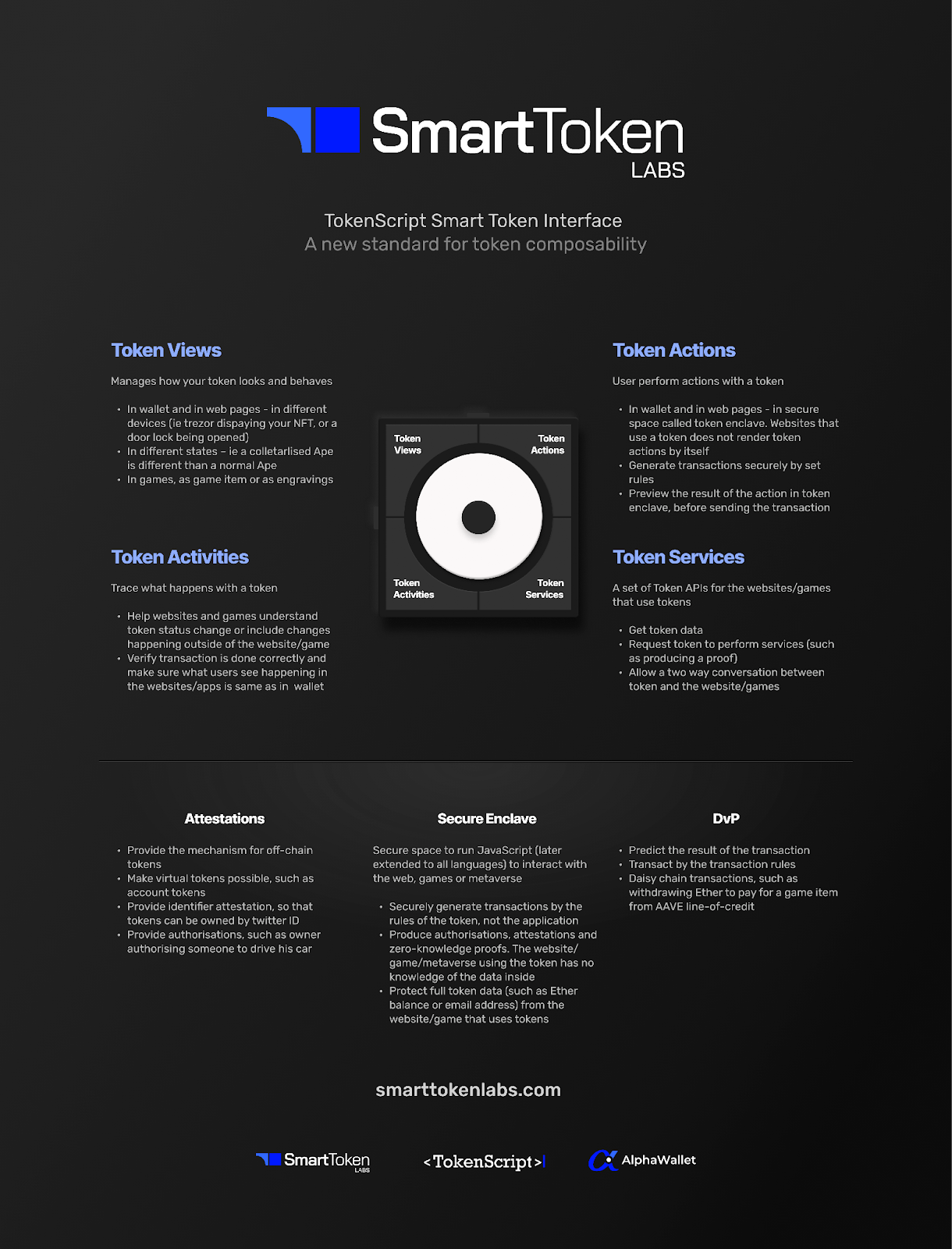
TokenScript Smart Token Interface
Join TechFlow official community to stay tuned
Telegram:https://t.me/TechFlowDaily
X (Twitter):https://x.com/TechFlowPost
X (Twitter) EN:https://x.com/BlockFlow_News
 Smart Token Labs 中文爱好者






