Technology’s Duality in an Age of Polarization: The Bipolar Civilization of AI and Blockchain
TechFlow Selected TechFlow Selected
Technology’s Duality in an Age of Polarization: The Bipolar Civilization of AI and Blockchain
If the world is destined to fracture amid polarization, then let AI expand the boundaries of civilization and blockchain safeguard the bottom line of power.
 Navigating Web3 tides with focused insights
Author: @Web3Ling; @qiqileyuan
Introduction: When War and Technology Accelerate in Tandem
Before 2026, the author had never imagined experiencing a war scenario so closely. From hearing the first evacuation alert to witnessing Iran launch over 200 missiles and thousands of drones toward the UAE within two weeks, the author gained a stark realization: the world’s foundational operating logic is undergoing profound transformation. Simultaneously, another distinct development curve is rising rapidly: the explosive adoption of artificial intelligence (AI), the rapid proliferation of tools like OpenClaw, and Bitcoin’s gradual emergence as a strategic reserve asset for certain nations. The concurrent acceleration of war and technology is no coincidence—it signals unequivocally that human society is entering a “Polarized Era,” where bifurcation will deeply shape future development trajectories.
Lobster and Personal Data Sovereignty: An Unexpected Breach of the Tech Giants’ Iron Curtain
The internet giants’ market monopoly has persisted for so long that both users and the giants themselves have tacitly accepted that user data inherently belongs to the platforms—serving as a core quantifiable metric in corporate financial reports. This assumption has become so normalized that users must surrender ownership of their personal data simply to access platform services; giants need only shut down APIs to raise users’ migration costs to prohibitive levels. Unless users abandon those services entirely, all behavioral, preference, and social relationship data remains trapped within the platforms. Privacy policies’ “forced consent” mechanism further entrenches this monopolistic structure—users lack effective avenues to resist, even if they disagree.
Over the years, countless pioneers have attempted to dismantle this iron curtain—only to fail repeatedly. In 2018, the author attended a workshop in Beijing on Solid, the project launched by Tim Berners-Lee, inventor of the World Wide Web. Solid aimed to equip end-users with a “data pod”—a centralized personal data storage system requiring explicit user authorization before any platform could access it. This vision was highly forward-looking and rational. Yet because it directly threatened the giants’ core interests—essentially asking companies to voluntarily shackle themselves and cut profits—not a single tech giant embraced it. The project gradually faded from public view. More recently, last year’s Doudou smartphone claimed seamless cross-app integration, but shortly after launch faced coordinated resistance from China’s leading internet giants and withdrew hastily.
Whether through internal disruption or external pressure—by individuals or enterprises—the giants’ monopolistic barriers appeared unshakable—until Lobster emerged, offering ordinary users a genuine opportunity to break the status quo. Lobster’s mass adoption has most significantly benefited domestic large language models (LLMs). Companies like Minimax have seen their stock prices and valuations rise sharply, reflecting strong market validation. Its core value lies in business model reconfiguration: previously, domestic LLMs primarily targeted B2B markets emphasizing autonomy and controllability, leaving limited opportunities for C-end users to access or utilize their APIs. But thanks to Lobster, the author began experimenting with domestic models like Minimax and GLM for the first time—expanding their user base to massive numbers of C-end users, many engaging in unconscious coding tasks. This shift clearly improves commercial viability. Beyond overseas offerings like ChatGPT and Claude, Chinese users prefer platforms such as Qwen and Doudou—largely due to their unlimited, subsidized, and unrestricted Q&A services, dramatically lowering usage barriers.
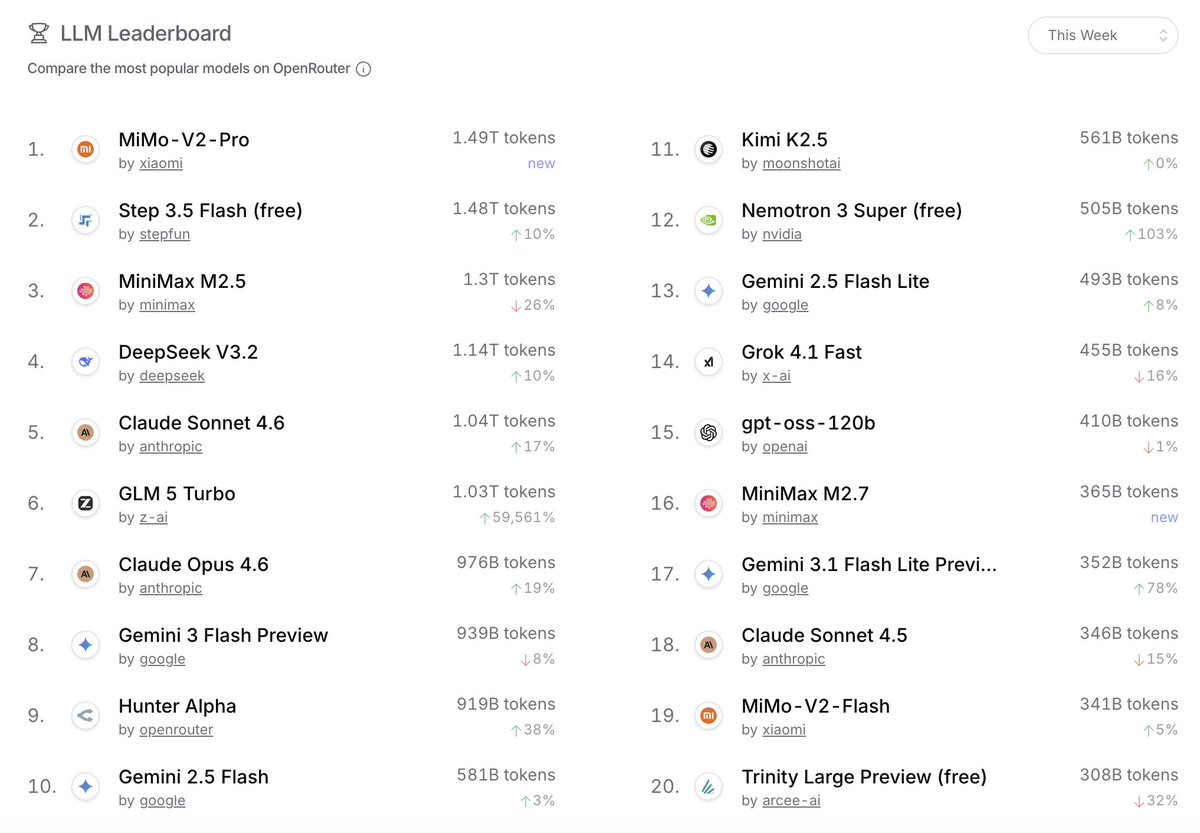
OpenRouter has become a key ranking platform showcasing major domestic models
Once basic Q&A needs are met, Lobster further aligns with users’ workplace demands—enabling them to build complete workflows and transform it into an efficient productivity tool. Notably, for everyday users, routine tasks like scheduling and simple task delegation don’t require high-end models like Claude; baseline models suffice. Thus, users naturally prioritize cost-effectiveness, adopting a “choose whoever delivers better value” consumption logic. Crucially, Lobster restores personal data sovereignty: data no longer resides on giants’ servers but stays on users’ own devices. Following Lobster’s email-deletion incident and related media coverage, many users now install it on personal Mac Minis or work computers—or deploy it via VPS in isolated environments—using it as a “second brain.” This local-storage model eliminates re-adaptation when switching LLMs: previously, using ChatGPT meant all conversation history and usage habits were locked on OpenAI’s servers, making data migration impossible upon switching models and requiring retraining. With Lobster, all data—schedules, conversations, work logs—is stored locally in Markdown format, enabling users to freely select more cost-effective models—even leveraging free tokens for multi-model compatibility. This has delivered massive C-end user volume to domestic LLMs, accelerating their scale-up and growth.
This growth manifests an “East rises, West declines” pattern: overseas products like ChatGPT and Claude rely heavily on subscription models—akin to gym memberships—where some subscribers use services infrequently, allowing platforms to profit through resource optimization. Lobster, by contrast, operates primarily via API integration—and its founder actively recommends using domestic LLM APIs like Minimax. This model better fits Asian users’ low subscription-usage habits; token-based billing also offers superior cost efficiency and flexibility.
Lobster’s value extends far beyond boosting domestic LLMs. Its widespread adoption systematically dismantles the giants’ ecosystem barriers. Once users reclaim data sovereignty, they naturally demand greater Lobster functionality—prompting hardware manufacturers to enter the fray. Previously, firms like Xiaomi and Huawei built proprietary ecosystems requiring dedicated apps for smart hardware control. Today, however, diverse hardware makers are developing CLI tools and compatibility interfaces for Lobster. In the future, users may control smart homes, robots, and other devices through natural-language interactions with Lobster—gradually eroding the premium pricing power giants derive from ecosystem lock-in.
Regarding concerns about whether giants or hardware makers would refuse to integrate Lobster: when the author successfully connected Lobster to a Bambu Lab 3D printer and used it to initiate printing jobs, the answer became clear—“no.” Hardware purchasing decisions now explicitly consider Lobster compatibility as a key factor.

Against the backdrop of fierce competition among Q&A bots like Doudou and Qwen, Lobster has opened a second front for sustained C-end token consumption. Major players cannot afford to let companies like Minimax capture this market—and will inevitably join the “free Lobster installation” initiative, leveraging this traffic gateway to compete for users. Driven by this wave, Lobster’s penetration among ordinary users will reach extremely high levels, further cementing users’ data sovereignty. For hardware makers, Lobster’s vast user base creates a powerful incentive: early adopters gain first-mover advantage in capturing users; latecomers risk missing the window entirely. Hence, hardware makers will proactively adapt to Lobster—and users, when purchasing hardware, will increasingly favor Lobster-compatible products. Ultimately, this forms a virtuous, user-driven cycle: users retain data sovereignty, freely switch models, and flexibly integrate hardware—empowering Lobster to reshape personal data sovereignty and systematically dismantle the giants’ ecosystem monopolies.

Of course, users’ data awareness will continuously seek balance between convenience and autonomy
Tencent’s full integration with Lobster provides convenience—but also makes Tencent the largest “model-data relay station.”
Blockchain and Conceptual Armament: Cognitive Weapons Transcending Versions
Bitcoin has existed for over a decade, gradually entering mainstream consciousness amid persistent skepticism. Some argue that Web3 practitioners are merely “riding the AI hype wave”—but the author contends that AI and blockchain are not siloed domains. Rather, they are “twin stars” resonating across the Polarized Era, converging at history’s crossroads.
As a developer building on Ethereum for nearly ten years, the author has long pondered one question: What is the core competitive advantage of Web3 builders? It is neither stronger theoretical foundations—Satoshi Nakamoto’s original Bitcoin white paper received little recognition from mainstream academia—nor superior engineering capabilities; most early practitioners entered the field from technical grassroots, lacking formal professional training. Nor is it “decentralization” itself: in systemic product development, decentralization often degrades user experience and can even impede progress. After deep reflection, the author concludes that top Web3 practitioners’ defining strength lies in possessing “version-transcending cognition”—and sustaining this cognitive edge is critical for the industry’s continued evolution.
“Conceptual armament” does not operate through physical force. Instead, it is a cognitive weapon rooted in fixed rules—capable of directly reconstructing causality and negating conventional logic. As early as 1992—16 years before Bitcoin’s birth—Hal Finney, a core member of the Cypherpunks, stated in an interview on cryptography and personal sovereignty that computers should serve as tools to liberate and protect humanity—not instruments of control. Humanity must forge a path returning power to individuals, rather than ceding it to governments or corporations. In 2013, Hal Finney further articulated Bitcoin’s essence on the BitcoinTalk forum: “I think Bitcoin will ultimately become banks’ reserve currency, playing the role gold held in early banking. Banks could issue digital cash backed by it—enabling stronger anonymity, lighter weight, and more efficient transactions.”
Twelve years later, this prophecy materialized: the U.S. government formally incorporated Bitcoin into its national strategic reserves—alongside gold and foreign exchange—with explicit instructions prohibiting its sale and mandating permanent retention as a national reserve asset. Since 1970, countless financial assets have emerged globally—but Bitcoin is the only entirely new asset class the U.S. has officially enshrined in its national strategic reserve framework. Stocks, bonds, real estate, and commodities all failed to achieve this distinction. This is the power of “version-transcending cognition”: Hal Finney’s vision, conceived over a decade ago, is progressively becoming reality today. For the blockchain industry, cognitive leadership across versions is its most potent weapon—because purely numerical competition can never overcome the currency-devaluation curse imposed by “infinite money printing.” As the first “conceptually armed currency,” Bitcoin’s operational logic relies not on physical might but on immutable code rules and market consensus.
Traditional fiat currencies derive value from state backing and central bank issuance—supported by credit, state coercion, and economic strength—effectively representing contests of macroeconomic scale. Bitcoin is fundamentally different: it has no issuer, no headquarters, and its sole governing rule is its open-source code. Over the past decade, centralized institutions have attempted to suppress Bitcoin through exchange bans, trading prohibitions, stigmatization, and media attacks—but these efforts only strengthened market consensus. During the recent Iran conflict, the Iranian rial collapsed nearly to zero overnight, while capital flooded into Bitcoin—establishing it as a safe-haven asset. Physical suppression paradoxically amplified Bitcoin’s conceptual weight, earning it growing recognition and accumulation by sovereign nations as a novel reserve asset. This is the core power of conceptual armament: centralized institutions can ban exchanges, prohibit transactions, and smear Bitcoin—but they cannot negate market-formed consensus nor alter the fixed rules embedded in its code. So long as consensus persists, Bitcoin endures—not mysticism, but the domain where Web3 builders excel most: foreseeing the future years ahead and turning that foresight into reality through sustained execution.
Beyond Bitcoin, such cases abound in Web3—and their replicability confirms that “version-transcending cognition” is the industry’s definitive advantage. Long before personal data sovereignty became a hot topic, Web3 practitioners had already charted a viable path: data sovereignty is rooted in asset sovereignty—achievable through transparent, verifiable, and traceable technical design. During the DeFi era, practitioners leveraged smart contracts to build automated, intermediary-free market-making systems—redefining traditional finance’s transaction logic. Before the metaverse concept exploded, Web3 entrepreneurs had already built diverse metaverse scenarios several versions ahead of mainstream markets. Even before the AI multi-agent (Agent) boom, projects like ACT and Virtuals in the Web3 space completed practical explorations of multi-agent interaction and collaboration back in 2024.
Regardless of their ultimate success, these projects vividly demonstrate Web3’s defining trait: consistently positioning itself ahead of the curve—transforming anticipated trends into tangible reality. In this process, blockchain is gradually achieving mass adoption—with AI multi-agent payment scenarios emerging as a critical direction. Human society is steadily entering an era of billions of intelligent agents: each user may soon command multiple agents handling daily management, collaborative tasks, travel bookings, healthcare coordination, knowledge acquisition, and more—all requiring robust payment capabilities. Agents must book hotels, pay transportation fees, and compensate collaborating agents—demanding secure, efficient payment infrastructure.
Yet a fundamental challenge remains: Would users willingly grant agents access to their personal bank accounts? Even if users consent, centralized banks like Citibank, HSBC, Bank of China, and Agricultural Bank of China cannot support direct account access by agents like Lobster. Risk controls, internal audits, legal compliance, and ethical constraints make such access impossible—given uncontrollable risks like agent overspending or hacker exploitation. Here lies blockchain’s decisive advantage: over the past decade, its independent account infrastructure and established Web3 usage habits have reduced the cost of creating a new Web3 wallet address by 99.99% compared to opening a new bank account. Users can deposit modest amounts of stablecoins like USDT (e.g., $100) into standalone wallets specifically for agent collaboration and planning—keeping risks tightly bounded. Thus, the financial infrastructure capable of serving billions of global intelligent agents is taking shape at the intersection of blockchain and AI.
Naturally, traditional institutions won’t cede this market to Web3. Stripe, JPMorgan, and Ondo are accelerating development of their own blockchain infrastructures to seize the future infrastructure market for billions of intelligent agents. They’ll brand these efforts under the “blockchain” banner—attempting to pull rules back into centralized frameworks, mimicking Web3’s concepts and cognition to compete for this core weapon, even planning to tokenize all U.S. equities on blockchain and gradually lifting media restrictions on blockchain coverage—to absorb Web3’s cognitive frameworks, thinking patterns, and technical capabilities into their own systems.
Yet crucially, weapons copied by the strong from the weak can never achieve their original potency. Traditional institutions’ inherent centralized mindset prevents them from truly grasping or implementing Web3’s decentralized consensus—and renders them incapable of mastering “version-transcending cognition.” While AI has already achieved mass adoption, the blockchain and Web3 space must accelerate translating its technical and cognitive advantages into concrete, usable products and services—building sufficient user bases. If Crypto+AI payment solutions successfully serve future AI agents, the entire industry will leap forward. And in the new landscape of the Polarized Era, only those sufficiently strong will secure survival and growth opportunities.
The Future of the Polarized Era: Twin Pillars of Civilization
Since TT first introduced the concept of the “Polarized Era” in 2021, the author has personally witnessed geopolitical conflicts, financial turbulence, and outright warfare—deepening conviction that the world’s polarization trend will intensify. This polarization may manifest in two ways: First, a small elite possessing top-tier capabilities coordinate vast numbers of intelligent agents to control core productive forces—occupying society’s apex. Second, the broader population increasingly relies on entertainment consumption and universal basic income to sustain livelihoods—gradually detaching from core production processes.
Yet the author remains a technological optimist, firmly believing that even in the Polarized Era, ordinary people retain opportunities to change their destinies. The author once spent a week with Michael Bauwens of the P2P Foundation at the Zukas event. Bauwens had earlier received multiple emails from Satoshi Nakamoto and helped publish the Bitcoin white paper for the first time on the P2P Foundation forum. He proposed that the future world will need “local cosmopolitanism”—a community-based physical mutual-aid and peer-to-peer survival model amid escalating geopolitical tensions and armed conflicts. At that time, U.S.-Israeli bombing of Iran and Iranian strikes on U.S. military bases and embassies had yet to occur; looking back now, his insight gains striking relevance and prescience.
In this increasingly fractured world, the fragility of centralized credit systems grows ever more apparent: today’s allies may become tomorrow’s adversaries; today’s resilient fiat currencies may plummet or collapse entirely tomorrow. Blockchain—as an open-source, transparent infrastructure—possesses borderless, faction-transcendent characteristics: regardless of nationality or alignment, users enjoy equal access. Even if geopolitical conflict severs undersea cables and collapses the global internet, blockchain nodes can continue operating via satellite or radio links. It stands as the only trust foundation capable of transcending borders and factions in the Polarized Era—providing unified rule-based scaffolding for a divided world.
Meanwhile, AI unlocks infinite productive potential for humanity. Within a fragmented geopolitical landscape, AI can maximize productivity—helping humanity escape zero-sum internal conflicts and create limitless incremental value in virtual realms. As the author previously noted, 90% of future human activity will occur in virtual worlds, where AI serves as the “intelligence core”—generating infinite content, unleashing peak productivity, and exploring unknown knowledge. Blockchain serves as the “trust core”—establishing transparent, publicly verifiable rules and returning power to every individual, preventing virtual worlds from monopolization by a few tech giants.
The two are symbiotic and indispensable: blockchain without AI empowerment remains functionally narrow—limited to basic ledger functions—incapable of supporting complex virtual civilization construction. Conversely, AI untethered from blockchain constraints risks becoming a tool monopolized by giants—trapping humanity in centralized black boxes and stripping away autonomous choice. Only through AI and blockchain’s “twin-symbiosis” can they jointly uphold humanity’s future civilizational form.

Imagine humanity colonizing Mars: what we carry won’t be Earth’s nations, banks, or credit systems—but AI and blockchain will be indispensable. AI will help humans establish new productive systems on Mars—managing survival and development on this alien planet. Blockchain will help humans build new rule and trust systems—ensuring that no matter how distant from Earth, humanity possesses an order belonging solely to itself—free from reliance on any centralized authority. This is the ultimate value of technological twinhood in the Polarized Era: preserving infinite possibilities for the continuation and evolution of human civilization.
Join TechFlow official community to stay tuned
Telegram:https://t.me/TechFlowDaily
X (Twitter):https://x.com/TechFlowPost
X (Twitter) EN:https://x.com/BlockFlow_News
 y2z Ventures