Zebec, a pioneer exploring new payment scenarios with a focus on streaming payments
TechFlow Selected TechFlow Selected
Zebec, a pioneer exploring new payment scenarios with a focus on streaming payments
With streaming payments building the stage, Zebec's spectacular performance may just be beginning.
 Navigating Web3 tides with focused insights
When discussing Web3, we often emphasize its revolutionary nature: certain processes and steps that exist in Web2 may seem unnecessary in Web3.
But there are exceptions.
Take payroll, for instance. No matter where we are, this step remains essential—fulfilling the rights and obligations between employers and employees through the sending and receiving of wages.
And when it comes to payroll, familiar stereotypes come to mind: a payslip arriving like clockwork on a fixed day each month.
This is more like a "point payment"—a lump sum disbursed at a specific point after an interval.
Yet this model may no longer meet the needs of Web3 development. New work models and organizational forms are emerging—DAOs, gig economies, address-as-identity, and more.
Accordingly, new demands such as daily settlements, dynamic payouts, and crypto-based compensation are rising. The market urgently needs a more flexible payment method capable of supporting these evolving requirements.
Thus emerges the concept of "streaming payments": continuous, flexible, and transparent disbursements.
In exploring streaming payments, Zebec stands out. In the first half of this year, Zebec secured $21 million in funding from top-tier investors including Coinbase, Solana, Alameda, and Lightspeed Venture Partners. Its streaming payment product is already in use, offering new solutions for payroll scenarios—and unlocking novel business models.
Zebec: An All-in-One Streaming Payment Infrastructure
To better understand Zebec, it's important to first dive into "streaming payments"—a concept both familiar and unfamiliar.
It feels familiar because we've heard similar terms—like "streaming media." Yet it also feels alien, as it’s hard to visualize what such a payment would actually look like.
Let’s make an analogy.
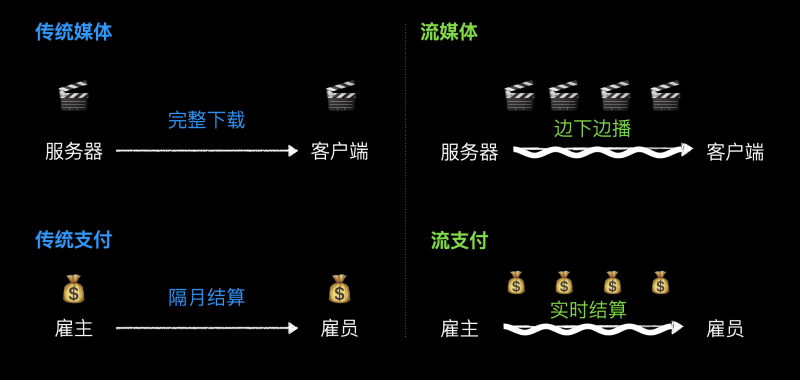
Consider familiar "streaming media," which can be通俗ly understood as "download while playing": you don’t need to fully download a movie before watching—it plays instantly via browser streaming.
Here, the "stream" refers to a data stream—images transmitted in real-time and continuously from a video server to your browser.
Similarly, "streaming payments" follow the same logic—but replace data with money: instead of waiting for your employer to pay monthly, funds flow in real-time and continuously into your wallet. Payment intervals can shrink to seconds or days—continuous work matched by continuous compensation.
Imagine the difference between a reservoir and a river. Monthly salary is like a reservoir—filled only once per rainy season; streaming payments are like a river, with water flowing constantly.
Now that the concept is clear, your next question might be: what kind of situations require such continuous and frequent payments?
Suppose you're a DAO manager, overseeing members who collaborate remotely on projects. Member A is new and must complete an intensive website build over the next few days.
How do you agree on payment terms? Pay one month later upon completion? How can A trust your promise of delayed payment?
Clearly, for high-demand environments like gig work or DAOs—where timing, trust, and frequency are critical—you need a dedicated streaming payment infrastructure. This system should efficiently handle diverse members, tasks, and working hours for seamless payroll settlement.
And today, Zebec has already built exactly that.
Built on Solana, Zebec provides a technical protocol enabling organizations and employers to pay salaries in a transparent, continuous, and automated manner. These capabilities are delivered through two core products: Zebec Pay and Zebec Safe.
From Zebec’s official website, the logic of these two products is clearly visible.
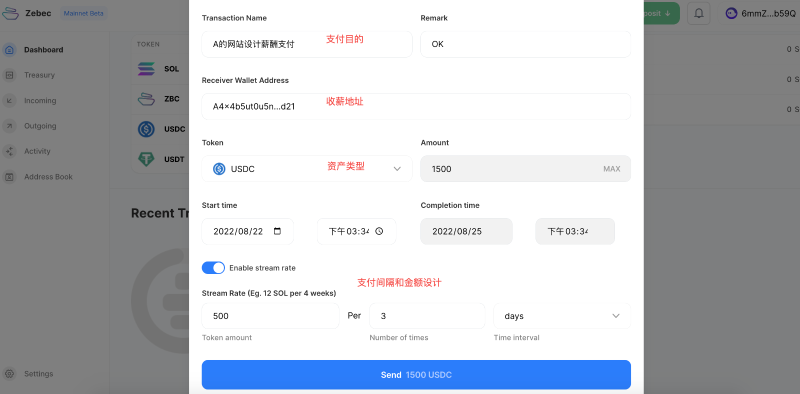
First is Zebec Pay, primarily used for fund disbursement. Continuing our example, if the DAO wants to pay member A for website design work, the manager can initiate a payment via Zebec Pay as shown below:
-
Specify the purpose and description of the payment;
-
Enter member A’s wallet address;
-
Select the desired asset type—currently supporting over 20 cryptocurrencies including SOL, USDC, and ZBC (the project token);
-
Define the streaming payment parameters—e.g., pay 500 USDC per day for 3 days.
Behind this initiation lies Zebec’s smart contract system. Pre-programmed with payment-triggering logic, it ensures funds are sent honestly, automatically, and continuously to the recipient’s address once conditions are met.
Meanwhile, member A can go to the Zebec dashboard, click “Incoming,” and view all future salary inflows. Similarly, the DAO manager can monitor every outgoing payment under the “Outgoing” tab.
For both employers and employees, Zebec Pay serves as a one-stop infrastructure for payroll: payment actions, transaction records, and address management are all integrated into a single platform. While enabling streaming payments, it greatly simplifies the operational and managerial overhead of Web3 payroll.
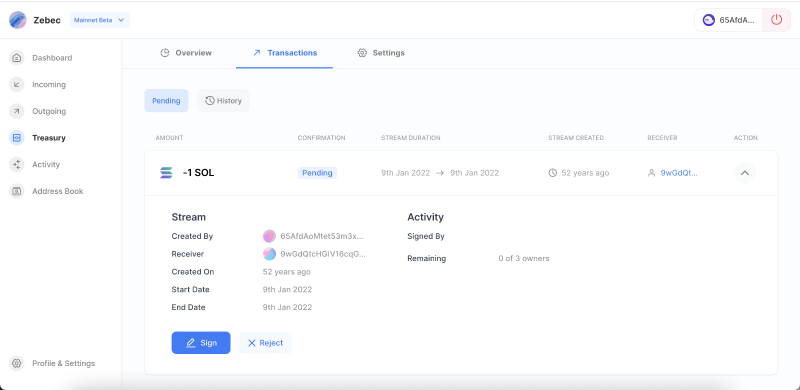
Additionally, treasury management is crucial for Web3 organizations. This is where Zebec Safe comes in: a multi-signature vault enabling collective fund management among organization members.
For example, DAO owners and managers can create a new secure vault via the Treasury page (shown below), adding eligible members (represented by their wallet addresses) during setup. They must also set a signature threshold—for instance, requiring 2 out of 3 members to sign off on a transaction before it executes.
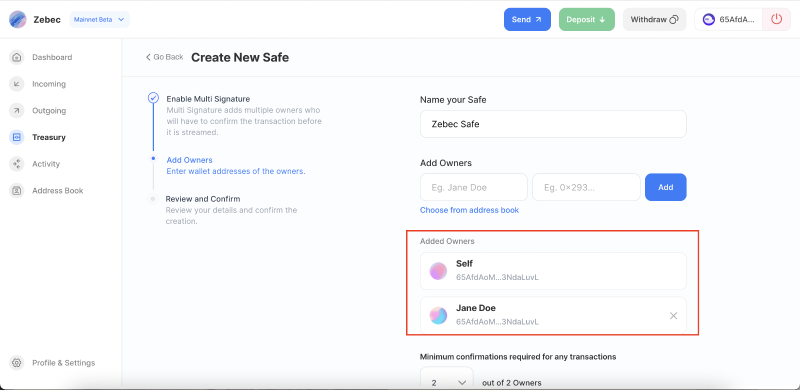
Whenever the DAO incurs a real-world expense, the transaction is broadcast to all vault members, prompting them to approve or reject it via signature. Once the minimum required signatures are collected, the payment executes—and can even be disbursed via streaming payments to employees, members, or external partners. This trustless, democratic design is ideal for DAOs and distributed teams, significantly reducing coordination costs.
Streaming Payments Evolved: Opening a New Gateway to Web3
The surface-level benefits of using Zebec for streaming payments are obvious: real-time work yields real-time rewards, perfectly matching high-frequency, multi-directional, and fragmented payment scenarios. Additionally, payout rules enforced by smart contracts offer some level of protection for employee interests.
Functionally, this represents the baseline—solving the problem of “how to send money.” But Zebec’s potential goes beyond that.
Building on the act of sending money, Zebec has extended its functionality: not just focusing on “how money is sent,” but also “how money is used.”
Since salaries can now be paid in crypto, it’s natural to consider what happens to those assets afterward.
Leveraging Zebec’s programmable flexibility, users can automatically allocate a portion of their income toward dollar-cost averaging into crypto assets, or route funds into DeFi protocols for yield farming. Moreover, within legal frameworks of certain jurisdictions, Zebec can help users set up crypto-based retirement accounts and enable fiat conversion in the real world.
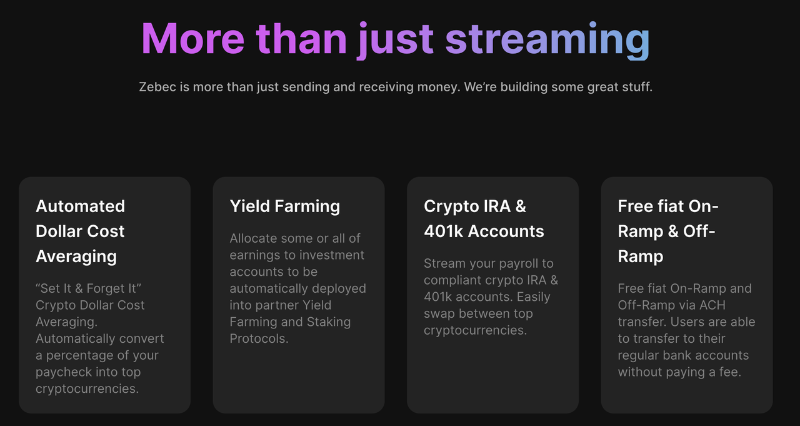
For many users not yet involved in Web3, these features spark "income transformation": your earnings can be reinvested and grown in natively crypto-native ways.
Most outsiders lack understanding of the crypto world, as well as compelling use cases to enter it. Payroll, however, offers a natural and ideal gateway into Web3. By analogy, Zebec isn't just a digital paycheck or savings book—it's more like a banking app where you not only manage incoming and outgoing funds, but also discover associated financial products.
Imagine next to “Yesterday’s Earnings,” there’s a button labeled “DeFi Yield Aggregator” or “DCA into ETH.” With streaming payments, you’re not just receiving a secure and reliable paycheck—you’re gaining entry to Web3 and the broader crypto ecosystem.
Naturally and full of opportunity.
By now, we can map out Zebec’s entire product logic:
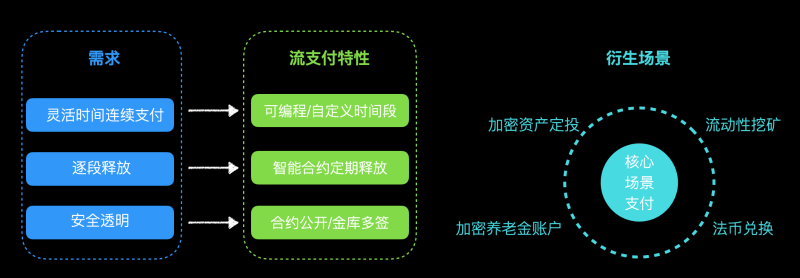
As demand grows for continuous, flexible, and transparent payments, the conditional and automatic execution features of smart contracts can be applied to payments—enabling higher-frequency, more adaptable streaming payments. This naturally extends into post-payment use cases, creating pathways for more users to engage with Web3.
Beyond Payroll: Small Tools, Big Potential
Compared to traditional monthly payroll systems, streaming payments currently feel niche.
But being non-mainstream doesn’t mean it’s not a trend.
The rise of Web3 and the emergence of DAOs have already demonstrated growing needs for flexible and continuous payroll handling. And this demand for agility may extend far beyond payroll.
When streaming payments reduce payroll granularity from monthly to daily—or even second-by-second—theoretically, other Web3 products could also adopt finer-grained payment dimensions.
Consider a high-value blue-chip NFT that’s unaffordable for most individuals. When fractionalized to enable group purchases, could Zebec play a role?
Or take a DeFi bond worth 100 ETH—could its face value be broken down into $1 units for 100 people to buy?
Instead of buying the whole unit, users could leverage Zebec’s streaming payments to continuously and incrementally purchase fractions. This capability relies on Zebec’s SDK, which allows third-party apps to integrate streaming payment functionality. Use cases could include fractional NFTs, financial derivatives, or entirely new applications yet to be discovered.
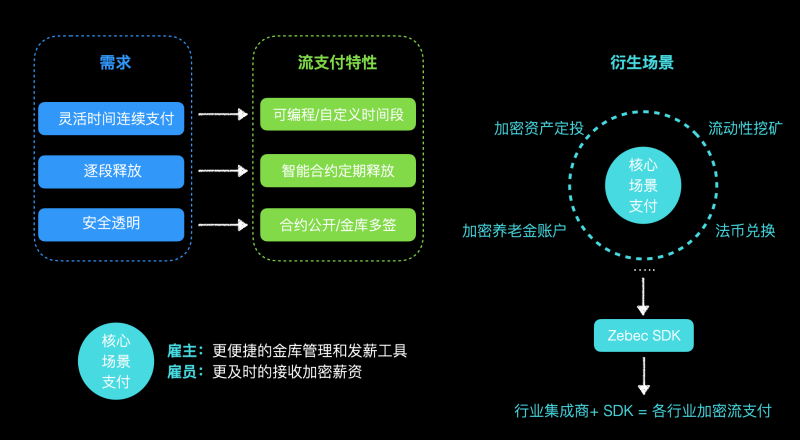
The same principle can apply to Web2.
For example, if a user only wants to stream and pay for 10 minutes of a full-length movie, media platforms could use Zebec’s SDK to implement streaming payments, satisfying personalized viewing demands.
Zebec’s impact on the real economy is already unfolding. On August 15, Zebec partnered with cashback platform Rewards Bunny, enabling users to settle purchases on major e-commerce sites like Alibaba, eBay, Nike, and Adidas using Zebec’s streaming payments.
It’s foreseeable that Zebec will not remain confined to being just a payroll tool. Tools should solve a class of problems, not just one problem. Payments are a fundamental need—today it’s salaries, tomorrow it could support countless high-frequency, fragmented, and flexible payment scenarios.
An undeniable fact is that Zebec’s user base and engagement continue to grow. Data shows its TVL has reached $300 million, platform fees have hit $20 million, and active addresses number around 30,000. As user scale expands further, Zebec will unlock greater traffic and platform potential, funneling users into increasingly diverse applications.
With streaming payments as the stage, Zebec’s performance may have only just begun.
References:
Zebec Official Site: https://zebec.io/
Zebec Twitter: @Zebec_HQ
Zebec SDK Guide: https://docs.zebec.io/zebec-sdk/installation
Join TechFlow official community to stay tuned
Telegram:https://t.me/TechFlowDaily
X (Twitter):https://x.com/TechFlowPost
X (Twitter) EN:https://x.com/BlockFlow_News