








9 Common Cryptocurrency Investment Traps: Don't Overestimate the Alpha in Your Hand
TechFlow Selected TechFlow Selected
9 Common Cryptocurrency Investment Traps: Don't Overestimate the Alpha in Your Hand
How can one truly achieve early-stage investing?
 Navigating Web3 tides with focused insights
Original author: The DeFi Edge
Compiled by: DeFi 之道
Being overly confident in an investment can destroy your portfolio.
Folks, below I’ve listed the 9 most common pitfalls to watch out for when investing in crypto.
Pitfall 1: Overestimating the Alpha You Hold
A paid Discord group is not a real source of alpha.
Of course, at the same time, watching YouTube or reading Twitter posts won’t necessarily help you gain alpha either.
Alpha is your edge over others.
Let me give you two simple examples of such advantages in the crypto space:
-
Information asymmetry / insider knowledge
-
Observing on-chain activity
This is the wild west where "insider trading" runs rampant.
The information flow for every project:
Builders / team members → Venture capital and seed investors → Whales / those connected to insiders → Retail (the majority).
The further down this "food chain" you are, the more vulnerable you become.
Pitfall 2: A Project’s Founder Being Doxxed
"I won't invest in any project whose founder has been doxxed."
Many projects with fully doxxed founders have still failed:
-
Being doxxed doesn’t make them immune to evil or poor decisions.
-
I suspect some information revealed about doxxed founders is actually fake.
The guy below is Jacob Wilson.
He studied computer science as an undergraduate at Stanford. After graduation, he chose to work at Google. Now he's working on launching a new Layer 1 blockchain.

Would you invest in the project he created?
Well, just kidding. All the info above was made up by me—I used AI to generate this fake white nerd.
Pitfall 3: Believing You’re Getting In Early
When a project you're interested in starts gaining hype, you notice it popping up across social media.
You feel FOMO (fear of missing out) and start blindly dumping all your money in.
The project's token then immediately crashes, while you're still naively holding onto what you thought was the "next big thing."
Folks, what you need to do is find projects early, invest with conviction, and let the returns come to you.
So how can you actually get in early?
That’s a topic on its own.
But here are some high-level ideas I’ll give you right now:
-
Monitor on-chain activity
-
Do thorough research before a project's token launches
-
Identify addresses known for discovering hidden gems
Pitfall 4: Projects Backed by Venture Capital
You see a reputable venture capital firm's logo on a project's homepage.
So you assume the project must be safe because top-tier teams have invested in it!
But behind this there are several issues worth paying attention to:
-
Some VCs simply spray and pray, or hope a few bets will yield massive returns, without doing rigorous due diligence.
-
They’re human and they make mistakes.
-
Everyone knows about Three Arrows Capital—we don’t need to dwell on that.
Solana’s Wormhole bridge was exploited for $320 million. Jump Crypto stepped in and protected it, preventing total disaster.
You might say, “Terra Luna will be fine. If something happens, Jump/Three Arrows will save it.”
Even though they did try, it wasn't enough to save the protocol.
Pitfall 5: Protocol Has Been Audited
Many crypto protocols have their code reviewed by third-party firms, which then give them a thumbs-up.
Check out Rekt’s leaderboard.
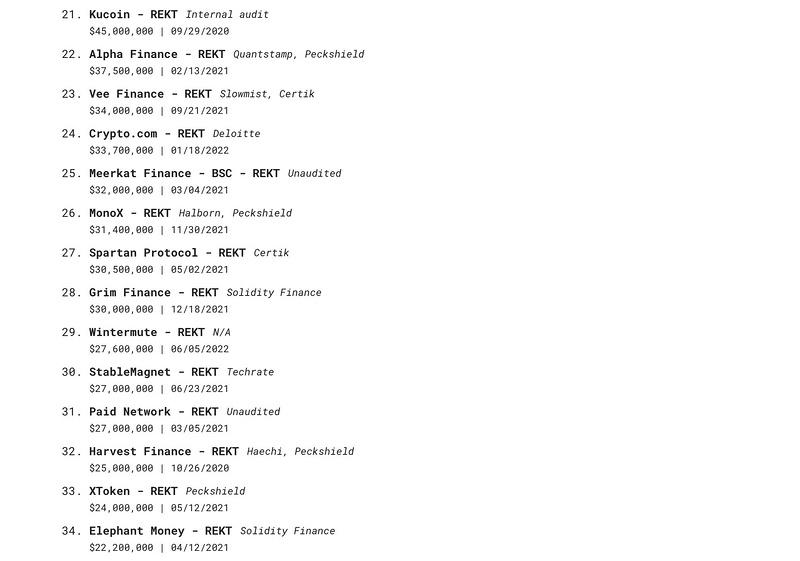
Bad actors have exploited several protocols—even ones that were audited.
But you should know:
-
Hackers keep evolving
-
Some audits may be compromised or orchestrated internally
-
Not all audits are thorough
Pitfall 6: Models and Charts
The Stock-to-Flow (S2F) model was frequently cited in the last cycle.
Due to its popularity, many expected Bitcoin to reach $100K during the previous bull run.
Well, I’d say the S2F model failed pretty badly in the last cycle.
Remember, "Models and charts don’t tell the whole story."

Pitfall 7: An Influencer’s Opinion
This is a very common and dangerous trap in the crypto space due to authority bias:
-
People make mistakes
-
Some are bad actors using their audience as exit liquidity
-
You don’t know when these so-called crypto influencers bought or sold, or what their actual intentions are behind the trade.
Pitfall 8: Echo Chamber Effect
Echo chamber effect refers to a situation in an online space where a piece of information is repeatedly reinforced until everyone inside believes it to be true—regardless of its actual validity—while outside information struggles to enter or spread within that space.
When you like a project, you easily fall into confirmation bias.
You join the project’s Discord and follow the footsteps of top contributors.
As a result, you hear 100 times a day how amazing the project is.
Try to seek out FUD (fear, uncertainty, doubt) about the project.
A good place to find it is in the comments section of a project’s tweets.
Pitfall 9: Dunning-Kruger Effect
The Dunning-Kruger effect refers to a cognitive bias in which individuals with low ability make poor decisions and reach erroneous conclusions, yet fail to recognize their incompetence or identify their mistakes. These people remain trapped in a self-created illusion of superiority, consistently overestimating their abilities while failing to objectively evaluate others’ skills.
It’s a bias—we tend to overestimate our own capabilities.
It’s similar to people thinking they’re geniuses during a bull market and starting to pile on leverage.
When you start showing off your crypto gains to newcomers, it’s time to take profits.
Conclusion
Of course, the pitfalls above aren’t absolute.
I personally prefer protocols backed by VCs, audited, and with doxxed founders.
And sure, not all influential crypto figures are bad actors.
My point is to highlight potential blind spots you might have. Stay cautious and try to adopt more probabilistic thinking.
Most people think investing is equivalent to checking a box list:
-
Which projects passed audits
-
Which didn’t pass audits
Instead, you should ask:
-
Who conducted the audit and what’s their reputation?
-
Did the audit meaningfully increase the probability of investment safety?
Join TechFlow official community to stay tuned
Telegram:https://t.me/TechFlowDaily
X (Twitter):https://x.com/TechFlowPost
X (Twitter) EN:https://x.com/BlockFlow_News






