O(1) Labs: Mina is becoming an L2 providing privacy-focused zk capabilities to any L1 chain
TechFlow Selected TechFlow Selected
O(1) Labs: Mina is becoming an L2 providing privacy-focused zk capabilities to any L1 chain
Effectively handling privacy and authentication with ZK requires a dedicated platform for generating and verifying.
 Navigating Web3 tides with focused insights
Author: Phil Kelly, O(1) Labs
Given recent news around zkEVMs, you might think that in Web3, zero-knowledge proofs (ZKPs) are nearing "mission complete." While we at O(1) Labs are excited about the overall pace of progress in the ZKP space, we believe these announcements are just one step along the path toward fully realizing the advantages of ZKPs. Here's why:
There are essentially two ZKP “movements” in today’s market. They use the same high-level cryptography but have very different technical approaches and practical goals:
(1) Scalability: zkEVMs and other zk rollups announced so far will help scale “conventional” Web3 activity—essentially reducing the cost of running smart contracts in their current form without adding new functionality, addressing challenges faced by large L1s. (Mina also relates to scalability, with potential advantages over other approaches, as detailed later.)
(2) Privacy and authentication: A broader category sometimes called “verifiable off-chain computation,” where privacy and authentication are two key use cases. For clarity, I’ll break this down further. O(1) Labs and a few other projects are focused on delivering entirely new capabilities to the market—users can provide certain proofs without revealing underlying information (privacy, verifiable computation).
Some example use cases include:
-
Private or anonymous voting, tweeting, chatting, etc., restricted only to specific groups (e.g., anyone who held token X within the past six months).
Broader identity verification processes:
-
Proving your Web3 activity without revealing wallets or transactions. For example, proving to a DAO or potential project partner that you held cryptocurrency back in 2014.
-
Proving information from Web2 sources without revealing off-chain activities. For instance, proving to a DeFi protocol that you’re not a resident of an OFAC-sanctioned country, or that your credit score exceeds 700.
-
Proving data provenance even when the data recipient hasn’t witnessed the source (zk oracles and proofs of off-chain computation).
Over time, these capabilities will apply across all chains—via EVM compatibility or otherwise—but they are not currently natively available in zk scaling rollups, EVMs, or other systems, and won’t be for the near future.
To illustrate how these two approaches differ technically: privacy and authentication (verifiable off-chain computation) use cases require complex off-chain operations because there are two distinct steps in the proof lifecycle:
a. Processing sensitive data and generating proofs on the client side (using products built with O(1) Labs’ SnarkyJS library), and
b. Verifying the integrity of those proofs on-chain (in our case, specifically on the Mina chain).
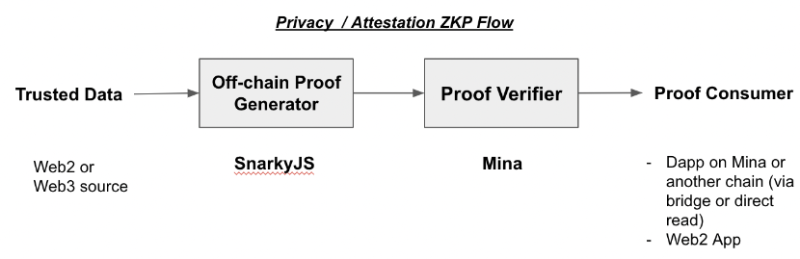
O(1) Labs firmly believes that efficient (in time and cost) handling of privacy and authentication via zero-knowledge proofs requires a dedicated platform for proof generation and verification. Over the past five years, we’ve focused on developing the Mina Protocol and the SnarkyJS library.
Using SnarkyJS with Mina offers many advantages, including:
-
Proofs can be generated directly on the client, inside a standard web browser using SnarkyJS, ensuring only the proof—not the underlying data—leaves the user’s device. This guarantees full privacy (most other proof systems require sending data to external provers, risking data leaks, higher costs, and slower performance).
-
The proof system (SnarkyJS + Mina) is purpose-built for PLONK-based zkSNARKs, which do not require trusted setup, support infinite recursion, and are optimized through techniques like custom gates.
-
Mina has stable and low fees, with no gas fees. The cost of any complex computation is the same as the simplest one.
-
Mina’s blockchain state is extremely small (commonly cited as 22KB, currently closer to 11KB), achieved using infinite recursion. How does this help?
-
It solves the chain bloat problem that plagues other blockchains as state accumulates.
-
Lowers the barrier to running nodes, promoting decentralization. As a practical example: you can set up a Mina node and begin participating in block production within minutes, simply by verifying a constant, fixed number of recent block/state proofs before joining the network. In contrast, syncing a new node on other L1s can take days. Easy setup and operation of Mina nodes should reduce reliance on centralized infrastructure services common on other L1s. Over time, individual mobile devices may even run Mina nodes.
-
Mina’s entire chain state can be directly recorded on other blockchains. To enable this, the Ethereum Foundation and Mina Foundation jointly sponsored Nil Foundation’s Ethereum bridge project—deploying a smart contract on Ethereum mainnet that maintains an up-to-date record of Mina’s full chain state. This is often called a “bridge,” but I see it as a new way of sharing data across chains (it doesn’t rely on methods recently proven vulnerable in some bridges, such as multiple sharded-key guardians or token-driven trust). It should be called a zkBridge—or recognized as an alternative or enhancement to existing bridging technologies. Mina can accumulate many ZK proofs via this bridge and then “roll them up” onto other L1s, offering users greater efficiency and lower transaction costs.
Another way to view it: Mina is becoming a global L2 that provides private zk capabilities to any L1 chain. Although Mina is an L1, due to its unique role in privacy and authentication, we expect that in many cases, ZKP circuits built on Mina will be used by dapps on other L1s—within their clients or throughout the user’s transaction lifecycle. For example, an Ethereum DeFi protocol might use Mina to allow users to anonymously prove residency and credit score ranges during onboarding and account management. That said, we also expect many native Mina use cases and see Mina as an intermediary environment within multi-chain ecosystems.
Does Mina aim to support high scalability?
As recently tweeted by Evan, CEO of the Mina Foundation, yes. In fact, the Mina Foundation funded a rollup project in the previous zkApp Builder Program, and several dapps are exploring app-specific rollups that settle to the Mina mainnet.
With zkApps即将 launching, O(1) Labs will soon publish deeper insights into SnarkyJS and use-case-specific deployments on Mina. In the meantime, feel free to explore the links below to join our zero-knowledge initiatives!
-
Learn the basics using materials from SnarkyJS Week, and if you're a developer, start building zkApps by reading here.
-
Read our announcement about the launch of our Partner Program, where Web3 privacy and proof innovators like Brave Browser, Sismo, and DIA build ZK smart contract code using SnarkyJS and provide feedback.
-
Apply for the upcoming O(1) Labs zkApp Builder Program.
Join TechFlow official community to stay tuned
Telegram:https://t.me/TechFlowDaily
X (Twitter):https://x.com/TechFlowPost
X (Twitter) EN:https://x.com/BlockFlow_News