








The Impossible Triangle of Decentralized Social Media
TechFlow Selected TechFlow Selected
The Impossible Triangle of Decentralized Social Media
Deciding whether to transition to decentralized social media has become a challenge due to obstacles around scalability and mass adoption.
 Navigating Web3 tides with focused insights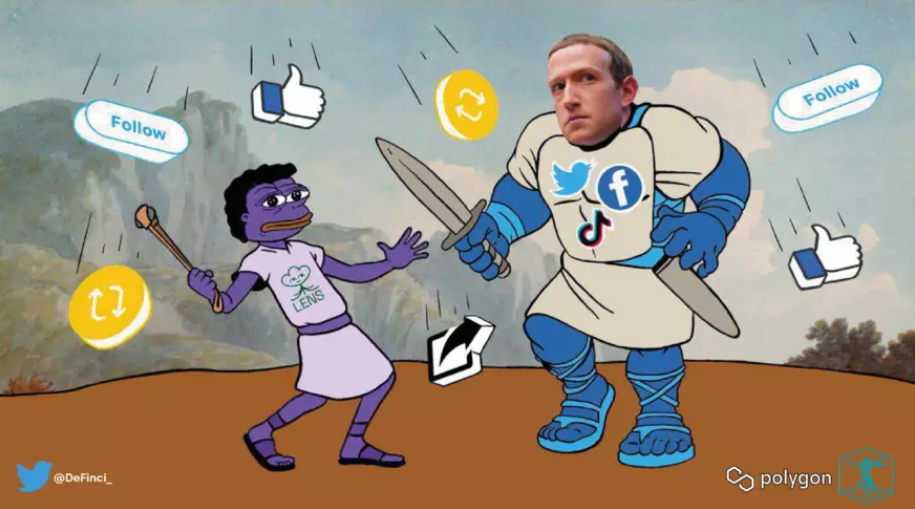
Author: Jack McCarthy, Polygon
Translation: TechFlow
People are increasingly relying on social media for news, publishing, and entertainment.
However, centralized players like Facebook, TikTok, and Twitter have come under fire for exploiting user data and engaging in unjust content moderation.
Today, Web3 solutions have entered the arena, with decentralized social media platforms now racing to solve a defining problem of the 21st century.
Barriers around scalability and mass adoption make the transition to decentralized social media a complex challenge.
Current Landscape
Today, there are approximately 3.8 billion social media users, and this number continues to grow annually as mobile devices become more widespread and affordable globally.
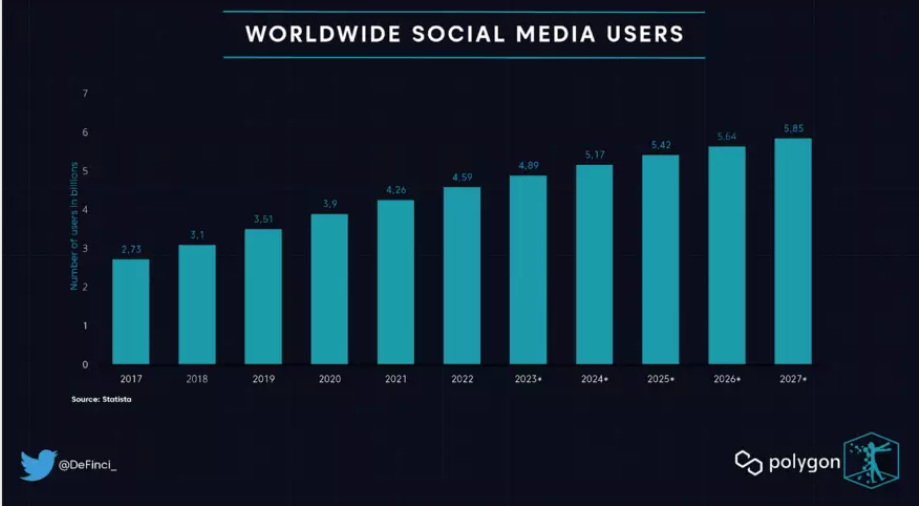
Despite being an everyday part of life, current forms of social media are almost as addictive and toxic as they are beneficial. Existing networks face criticism over excessive regulation, exploitation of user data, addictive algorithms, and isolated ecosystems. Truly "fixing" social media requires a complete paradigm shift, and decentralized social media solutions represent our closest step toward a genuinely democratized social space.
Reimagining Social Media from Scratch
While Web2 companies focus on social media as a single product, Web3 expands the concept of social networks across multiple layers. The foundational layer is the social graph: it represents profiles, followers, and their connections. Next is the application layer: where users consume content and interact with their social graph. To draw a parallel with Web2, think of the social graph as followers and the application layer as the feed. With blockchain, no single entity controls the social graph. Instead, your social graph becomes an asset—not a product owned by a corporation.
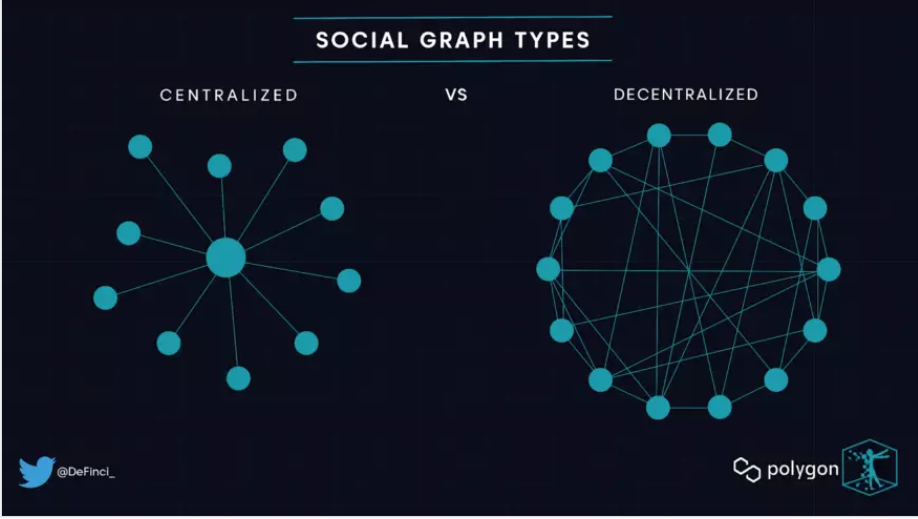
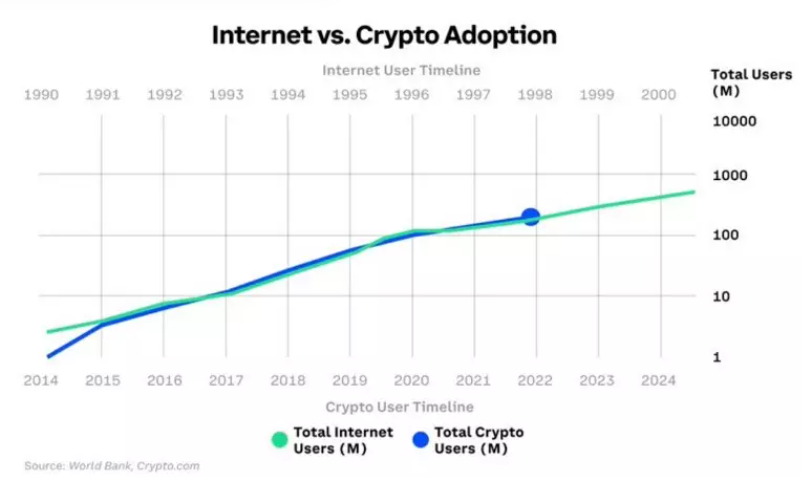
Clearly, the appeal of owning one’s own social graph alone isn’t enough to convince billions to abandon existing platforms. Given growing dissatisfaction among users regarding social media policies and executives, a gap remains to be filled. Beyond data ownership, complaints about siloed followers, censorship, and closed-source algorithms give decentralized social media (DeSoc) an opening to capture market share. Frankly, now is the best time to transition to DeSoc. Existing users are demanding better experiences, and DeSoc could serve as a catalyst for broader cryptocurrency adoption. The latter needs a popular product to drive early-stage uptake.
Solving the Problems
While Web2 followers and connections remain siloed within each app, Web3 social networks allow you to bring your followers across applications. Imagine how simple and time-saving it would be if, when launching your brand on Instagram, all your YouTube subscribers could instantly follow you. This is the benefit of separating the social graph from the application layer: your base-layer graph stays constant while the application layer remains flexible. Future customizability could easily enable self-authorized follower transfers, allowing only selected followers to be ported over.
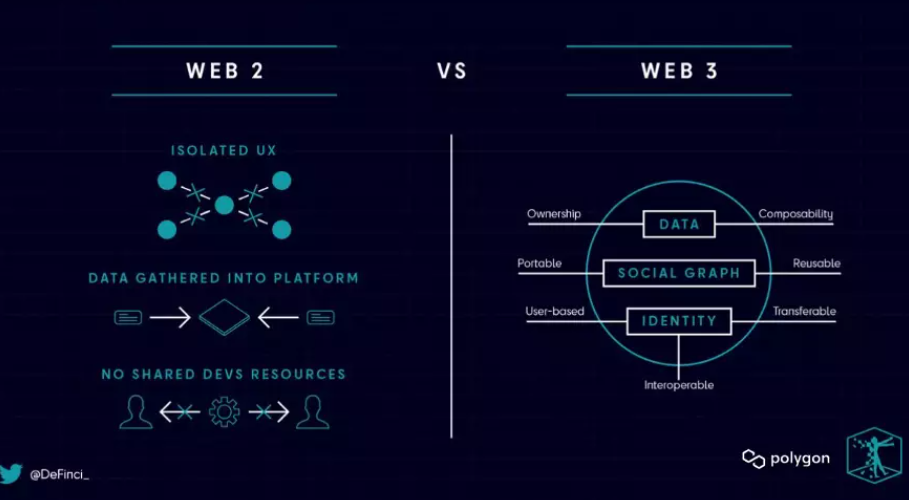
The idea of owning your own audience becomes even more critical when discussing censorship. Donald Trump received a ban from Twitter and went on to launch his own social media app, Truth Social, yet still lost access to his existing Twitter followers. For individuals who aren’t political figures, the consequences are even worse—losing livelihoods due to social media bans. DeSoc apps are experimenting with various moderation technologies to stay within legal boundaries while avoiding the excessive control seen in Web2.
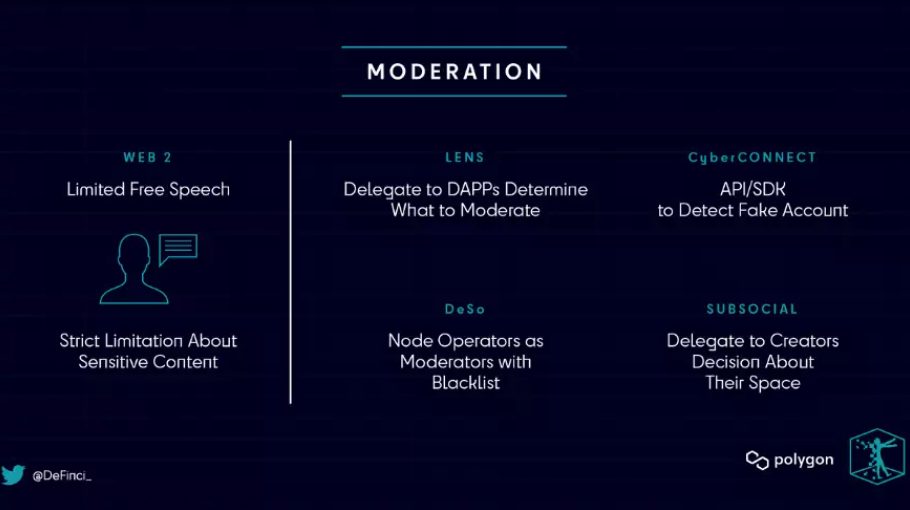
Lens Protocol, a social application built on Polygon, has implemented what may be the best moderation approach: delegating moderation entirely to the application layer—the place where content is published. If a user is banned or censored on one application layer, they can simply switch to another protocol offering a similar experience. Users retain all their followers and continue as if nothing happened. Now, instead of forcing social media companies to act as arbiters of truth and hate speech, users can interact with any frontend willing to host their content—a true free-market experience!
The final puzzle piece for social media is solving the algorithm problem. Today, algorithms powering popular social media apps are arguably more valuable than gold, guarded as closely as family heirlooms. Your data fuels these companies’ profits, but your time is how they acquire more data. Currently, you have no control over these algorithms—if you want to see more inspirational videos one day, there's no way to make that happen. In DeSoc protocols, individuals can create open-source algorithms or multiple application layers with different algorithms, giving users far greater control over what they see. This is not only a leap forward in customizability but could also be transformative for the next generation of social media users, potentially preventing the kind of internet addiction seen among today’s Gen Z.
The Trilemma of DeSoc
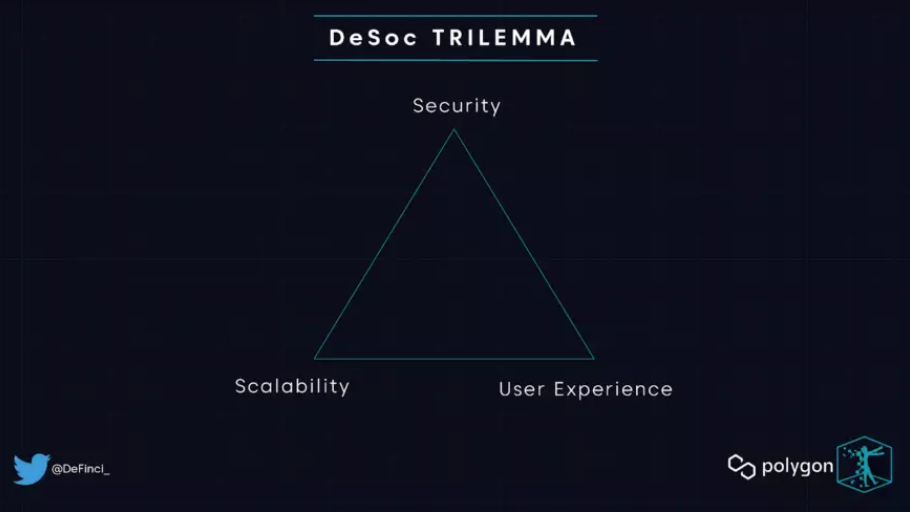
Although DeSoc appears to be the answer to all our Web2 social media woes, a perfect solution does not exist. Yes, DeSoc solves the issues outlined above, but it introduces its own set of complexities. We’ve coined the term “DeSoc Trilemma” to highlight the trade-offs between security, scalability, and user experience (UX) inherent in designing DeSoc protocols. Building slightly on Vitalik’s “blockchain trilemma,” we observe that no protocol reviewed can successfully optimize all three characteristics simultaneously.
Crucially, security in this trilemma has two components: the decentralization of the blockchain and the execution of transactions.
Security vs Scalability
Blockchain decentralization is straightforward: the more validators, the more decentralized and secure the network becomes. However, this creates a trade-off between security and scalability. The more decentralized and secure a blockchain is, the harder it becomes to scale. This explains why no DeSoc protocol can realistically survive directly on Ethereum—gas fees are too high and the network too congested. Until zk-rollups become cheaper and widely available, DeSoc protocols must operate on sidechains, subnets/supernets, or independent L1s. The most secure blockchains are not ideal homes for DeSoc protocols, though fairly, these protocols don’t necessarily require the same level of security as DeFi protocols.
Security vs User Experience
Regarding transaction execution, some DeSoc protocols execute transactions themselves. For example, when a user follows someone, they only sign a message to achieve this goal. They don’t pay gas fees or execute the transaction directly; instead, this responsibility falls on the protocol itself. This creates a trade-off between security and user experience. Abstracting away gas fees is a massive UX improvement. Imagine how dreadful it would be if every time you wanted to post, you had to pay a small portion of Instagram’s AWS bill—that’s friction. The ultimate UX would be connecting your wallet once and never having to deal with pop-ups asking you to sign contracts or pay for transactions. But this convenience comes at the cost of granting smart contracts further permissions and control over your wallet, increasing the risk of hacks. While promoting mass adoption, it contradicts the decentralized nature of Web3. User experience is arguably the biggest friction point in crypto adoption, and to enable broad uptake, decentralization advocates may need to look the other way—at least temporarily.
In fact, Lens’s gasless API is an industry leader when it comes to balancing transaction execution security and user experience. The API allows users to perform blockchain transactions without paying any fees, making DeSoc comparable to free-to-use Web2 social media. The gasless API reduces the need for users to wait for transaction confirmations, enabling them to scroll to the next post and keep interacting freely.
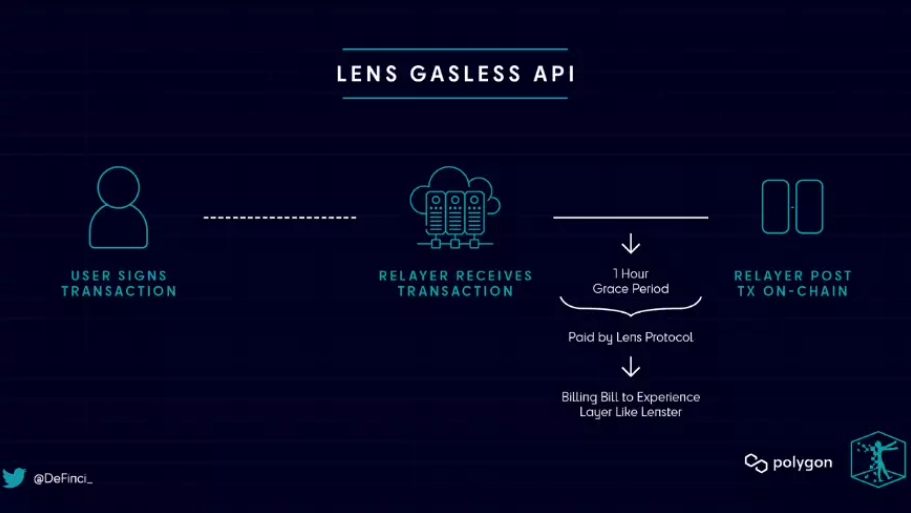
The API allows users to simply sign a message (e.g., a comment), which is then relayed along with required metadata. A relayer verifies the signature and posts the data on-chain to finalize the transaction. This process costs the relayer slightly more in gas, but greatly improves user satisfaction and engagement. The application-layer platform bears the gas cost—in Lens’s case, Lenster pays. Although the downside of using a gasless API is that users rely on relayers to publish transactions rather than doing so themselves, this trade-off is justified given that social media posts don’t require the same security level as financial transactions. Moreover, relayers enjoy greater flexibility with a one-hour grace period to formally post transactions on-chain, allowing them to avoid periods of high gas fees.
User Experience vs Scalability
The trade-off between user experience and scalability is trickier to analyze. Take DeSo (not to be confused with the DeSoc term we've been using)—a blockchain specifically created for social applications. DeSo has scaled to over 1.5 million users (far surpassing competitors like Lens), but it lacks the surrounding ecosystem benefits enjoyed by Polygon users, such as gaming and DeFi protocols. Imagine using your Lens profile on Polygon as collateral in a DeFi protocol to take out a loan. This value-added composability simply doesn’t exist on DeSo or any DeSoc protocol built on an independent blockchain. Similarly, CyberConnect offers immense scalability with over a million accounts, as it’s blockchain-agnostic, allowing you to bring your social graph to any chain.
However, the cost is that CyberConnect cannot leverage NFTs within its ecosystem due to its design. While this saves computational overhead and simplifies development, losing NFT compatibility is a major drawback. Take Lens, for instance—NFTs represent both your profile and your follows. This enables secondary sales of profiles, creating an entirely new market. Who wouldn’t want to create a meme account with a large following? Simply buy an NFT profile already tailored to that audience. Furthermore, NFTs allow creators to generate additional revenue. By making posts collectible, creators can introduce exclusivity and charge for content.
Can Decentralized Social Media Become Reality?
Decentralized social media may offer the only viable solution to challenges users face on existing Web2 platforms. But the question remains: is mass adoption possible? For now, prioritizing user experience and scalability means decentralization purists may need to compromise—so that DeSoc can ultimately achieve sustainable product-market fit. The right approach seems to be separating the social layer from the application layer, enhancing customizability and avoiding the censorship issues inherent in Web2. Finally, by building ecosystems beyond social media on blockchains—such as gaming and finance—and incorporating NFTs and composability into design, we can deliver the best user experience while offering options absent in today’s social media landscape.
Join TechFlow official community to stay tuned
Telegram:https://t.me/TechFlowDaily
X (Twitter):https://x.com/TechFlowPost
X (Twitter) EN:https://x.com/BlockFlow_News






