Sandeep Nailwal: From the Slums of Delhi to Building Polygon
TechFlow Selected TechFlow Selected
Sandeep Nailwal: From the Slums of Delhi to Building Polygon
The distance between survival and success depends on the decisions no one is willing to make.
 Navigating Web3 tides with focused insights
Author: Thejaswini M A
Translation: Block unicorn
Introduction
Sandeep Nailwal's father would often disappear for days at a time.
When he returned, the family’s monthly $80 income was gone—squandered on alcohol and gambling debts.
Their home was in a settlement along the Yamuna river in Delhi, an area locals dismissively called "Jamna-Paar," roughly meaning "the other side of the river." But it wasn’t a compliment.
Young Sandeep often stood outside classrooms because his parents hadn't paid tuition. At age ten, when his younger brother suffered a serious accident, his childhood ended. His father’s addiction meant someone had to step up. That someone was Sandeep.
Today, Nailwal runs Polygon, a blockchain infrastructure company processing millions of transactions daily, partnering with firms like JPMorgan, Stripe, and Disney. From Delhi slums to building technology used by Fortune 500 companies, the journey took just three decades.
But the path wasn’t smooth. The scars of early life shaped every decision he made.
Sandeep Nailwal was born in 1987 in Ramnagar, a rural village at the foothills of the Himalayas without electricity. Both his parents were illiterate when they married. When Sandeep was four, they moved to Delhi seeking opportunities unavailable in their village.
Instead, they found slums.
The settlement on the east bank of the Yamuna River was crowded, filthy, and rife with violence. Illegal guns and knives were the preferred tools for settling disputes. His family squeezed into whatever housing they could afford, moving constantly as circumstances changed.
His parents didn’t understand education. They didn’t know children could start school at ages three or four. Sandeep only began school at five simply because no one told his parents otherwise. Starting so late meant he was always the oldest kid in class—two years older than others—a constant reminder of how far behind he was.
The trauma of poverty wasn’t just the shame of hunger or ragged clothes. It was also the shame of watching your father gamble away your tuition while you stood outside the classroom. It was watching your mother struggle to feed the family while battling an alcoholic husband.
It was learning at a young age that no one was coming to save you.
The Sixth-Grade Entrepreneur
Sandeep coped with poverty by working. In sixth grade, he started tutoring younger students, earning 300 rupees per month. He also partnered with a friend who ran a stationery shop, buying pens at cost and reselling them to classmates at a markup.
The amounts weren’t large, but the lesson was vital: you can create value, capture part of it, and use that money to change your situation.
He dreamed of getting into the Indian Institutes of Technology (IIT), the prestigious engineering schools offering a proven escape from poverty. But competing against millions for just 5,000 spots required expensive coaching. His family couldn’t afford it.
So Nailwal enrolled at Maharaja Agrasen Institute of Technology, a second-tier college, funding tuition through student loans. Sometimes, he used loan money to repay his father’s gambling debts instead of buying textbooks or a computer.
His decision to study computer science came after seeing Mark Zuckerberg on Indian television. Facebook was booming globally, and young Sandeep thought: “I want to build my own Facebook.”
He now admits he was naive. But naivety combined with desperation forged a unique determination.
After earning his engineering degree, Nailwal pursued an MBA at the National Institute of Industrial Engineering in Mumbai. There, he met Harshita Singh, who later became his wife. After graduation, he worked as a consultant at Deloitte, quickly repaying both his student loans and his father’s debts.
Nailwal held various roles across companies: software developer at a tech firm, consultant at Deloitte, and CTO of Welspun Group’s e-commerce division. He excelled, earned promotions, and made good money.
But he could never shake the urge to start something of his own.
In Indian culture, there’s pressure to buy a house before marriage. A man without property is seen as having no future. Nailwal felt this pressure deeply. He had a good job, could get a mortgage, buy a home, and settle down.
Then Harshita said something that changed everything: “You’ll never be happy doing that. I don’t care about owning a house—we can rent.”
In early 2016, Nailwal quit his job. He borrowed $15,000—money originally intended for their wedding—and founded Scope Weaver, an online platform for professional services. His idea was to formalize India’s fragmented service sector, creating an Alibaba-like platform but for Indian service providers rather than Chinese manufacturers.
The business performed decently and generated some revenue. But Nailwal realized he’d become the bottleneck. Clients wanted a face—a person to hold accountable when things went wrong. He was becoming just another service provider, except now he had to pay employees.
The business couldn’t scale. A year later, he began looking for his next opportunity.
An $800 Bitcoin Bet
Nailwal first heard about Bitcoin in 2010. A friend suggested mining together, but Nailwal didn’t have a laptop, so the conversation ended there.
In 2013, during his MBA, he encountered Bitcoin again. He tried setting up a mining rig, but his laptop was too weak. He attempted to read about Bitcoin but gave up after two paragraphs upon reading “no backing,” assuming it was a scam.
In 2016, Bitcoin re-entered his radar. After realizing Scope Weaver wouldn’t become the company he envisioned, Nailwal began exploring “deep tech” opportunities. He considered AI but found the math beyond his grasp.
Then, he actually read the Bitcoin whitepaper.
“Oh, this is huge,” he thought. “This is humanity’s next revolution.”
Whether driven by conviction or recklessness—depending on perspective—Nailwal took the $15,000 he’d borrowed for his wedding and invested it all in Bitcoin at $800 per coin.
He admitted: “My FOMO was off the charts. Even if I’d delayed by a year, I’d have done the same thing at $20,000—and lost everything.”
But he didn’t lose. Bitcoin’s price rose. More importantly, Nailwal discovered Ethereum and its programmable smart contracts—a new computing platform capable of running applications without centralized control.
He was completely captivated.
In 2017, Nailwal connected online with Jaynti Kanani through the Ethereum community. Kanani proposed solving Ethereum’s scalability issues. At the time, Ethereum’s network was clogged by its own success. CryptoKitties caused transaction fees to spike by 600%.
Kanani and Nailwal, along with co-founders Anurag Arjun and Mihailo Bjelic, began developing Matic Network in early 2018. They raised $30,000 in seed funding, planning to build a working product first, then raise more via an ICO.
This principled approach nearly doomed them. By the time they had a functional testnet, the crypto market had crashed. No one wanted to invest—especially in Indian projects. Two Indian crypto ventures had recently been exposed as scams.
“No one believed Indian founders could build protocols,” Nailwal recalled.
The team survived the first two years on just $165,000. Founders took salaries of just a few thousand dollars per month. Several times, they had only three months of runway left. Nailwal remembers begging other crypto founders for $50,000 just to last another quarter.
In 2018, just before his wedding, he hit rock bottom. A Chinese fund had promised $500,000. Two days before the wedding, Bitcoin dropped from $6,000 to $3,000. The Chinese fund called: “We planned to invest 100 Bitcoins. Now it’s worth half—so we’re out.” Worse, Matic’s entire treasury was in Bitcoin—its value also halved.
His wedding went ahead. Friends celebrated. But Nailwal knew they might not have a company in three months.
In early 2019, Binance approved Matic to raise $5.6 million through its Launchpad program. Due diligence took eight months. The approval gave Matic breathing room. But final confirmation still didn’t come. The team participated in countless hackathons, visiting developers one by one to explain their tech.
Growth was slow at first. But in 2021, high Ethereum fees made small transactions nearly impossible, accelerating adoption. Developers flocked to Matic.
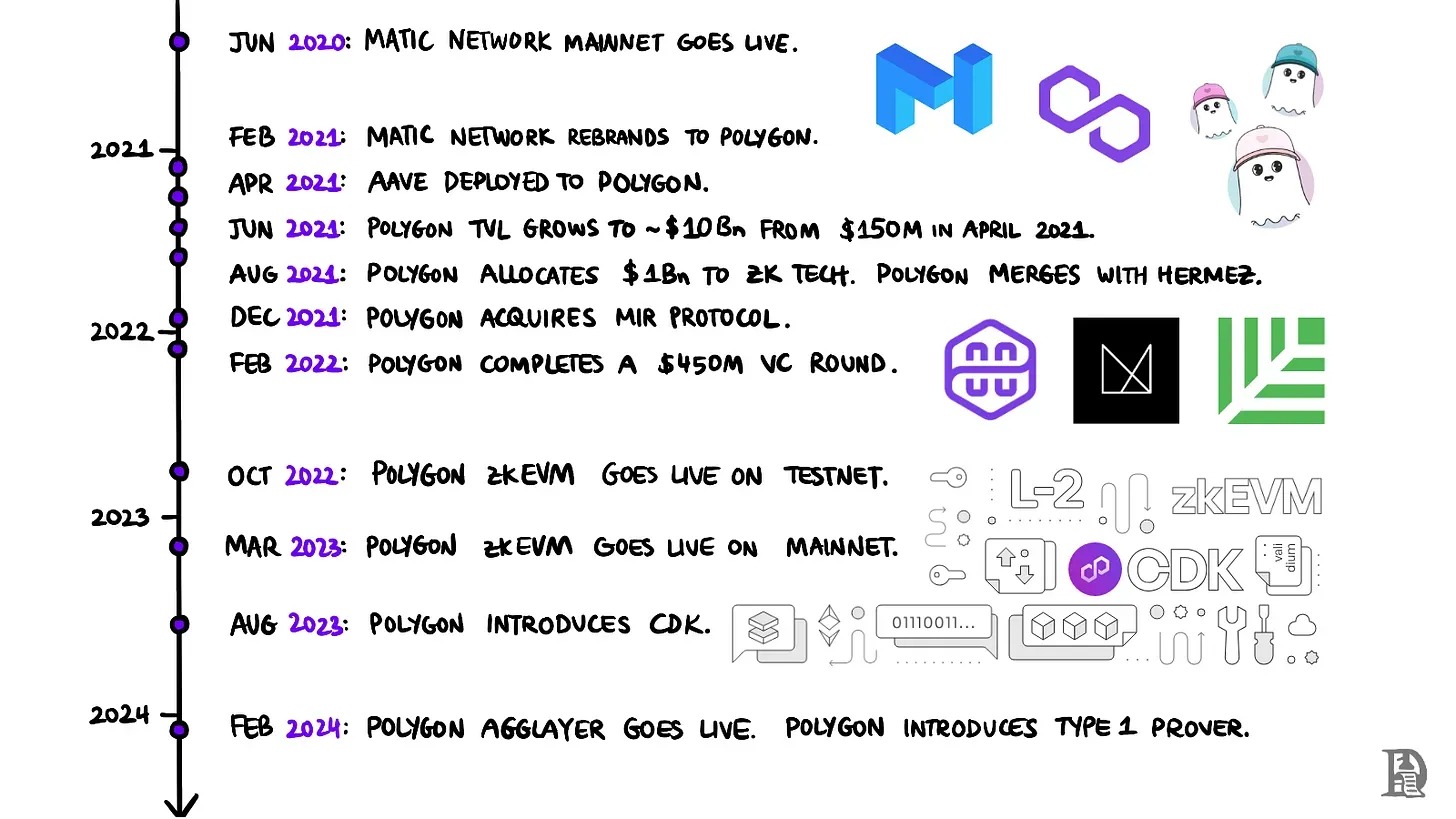
Originally launched as Matic Network, it operated as a single-chain scaling solution using sidechains, combining Plasma and Proof-of-Stake (PoS) mechanisms. In 2021, Matic Network underwent a major rebranding to Polygon, reflecting its evolution from a single chain to a broader multi-chain ecosystem, aiming to offer diverse scaling solutions for Ethereum-compatible blockchains.
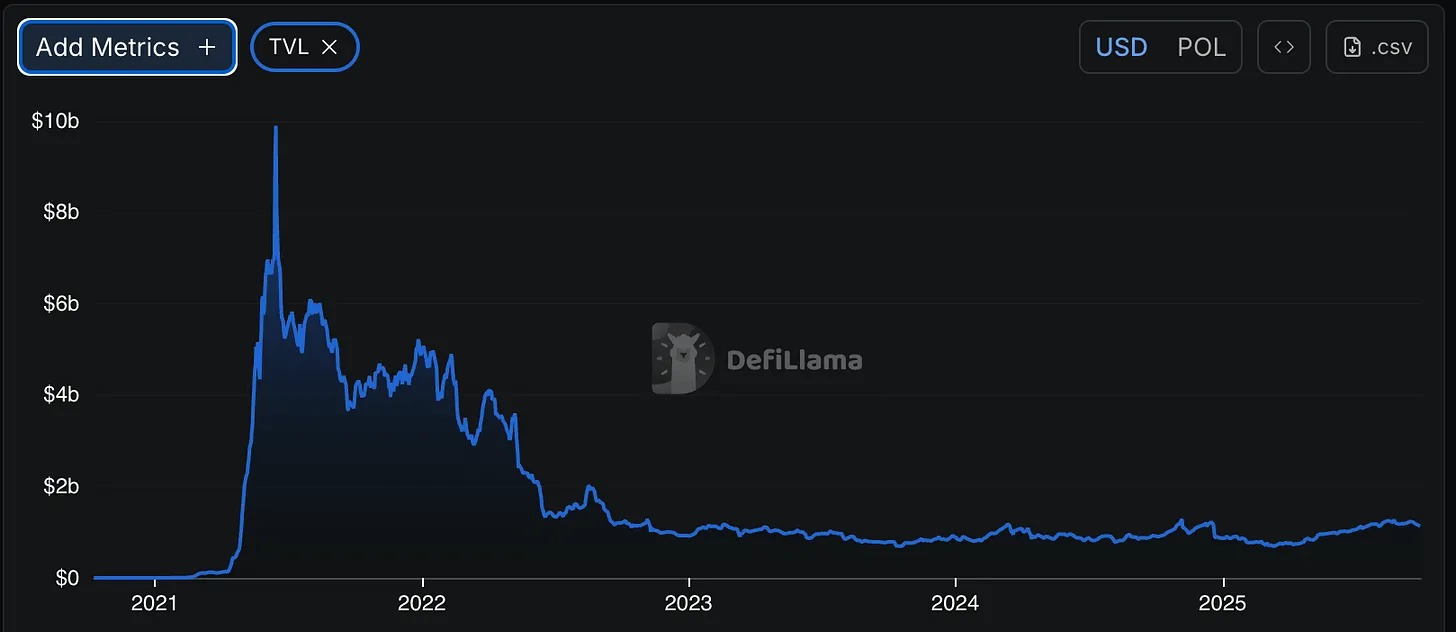
The market responded positively. Polygon’s market cap surged from $87 million in early 2021 to nearly $19 billion by December.
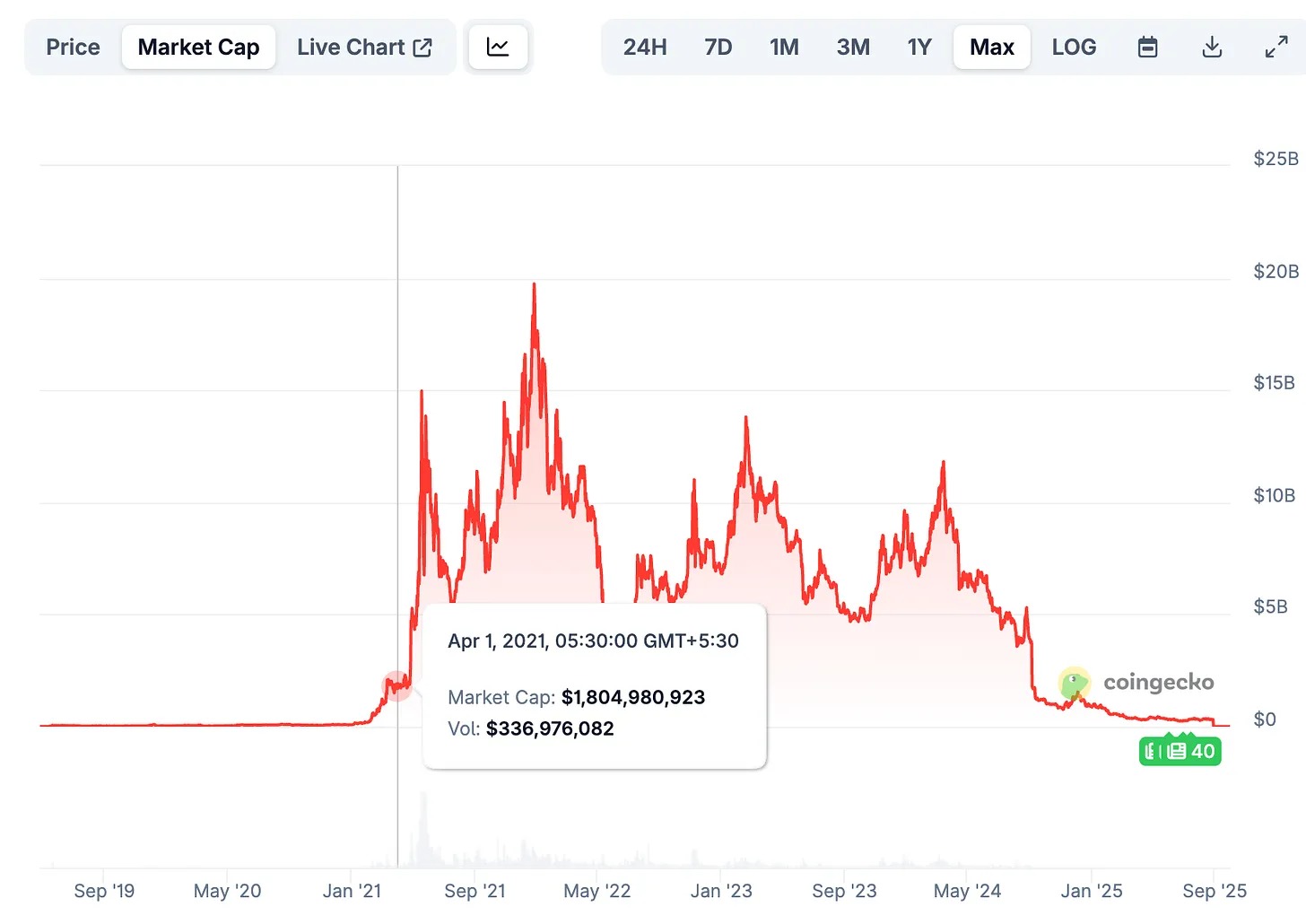
Developers poured into Matic, and the total value locked (TVL) peaked at $10 billion.
In addition, the native token transitioned from $MATIC (securing the original Polygon PoS chain) to $POL (designed to support the entire Polygon ecosystem), especially under upcoming upgrades like the Staking Hub, aimed at consolidating and enhancing cross-chain security and governance. This token migration was crucial, though it introduced temporary uncertainty for holders and led to liquidity fragmentation during the transition.
Polygon Labs also boldly shifted strategic focus toward Zero-Knowledge (ZK) Rollups, acquiring ZK-focused teams to develop zkEVM—a virtual machine achieving Ethereum-equivalent execution while leveraging the scalability benefits of ZK proofs. While Optimistic Rollups (OR) initially gained attention due to simpler design and earlier launch, Polygon’s emphasis on ZK Rollups reflects a long-term bet on ZK as Ethereum’s ultimate Layer-2 scaling solution. zkEVM technology aims to combine high security, scalability, and full compatibility with existing Ethereum tools, potentially positioning Polygon at the forefront of future multi-chain architectures.
The Pandemic Turning Point
In April 2021, India’s second wave of the pandemic hit hard. Hospitals overflowed, oxygen supplies ran short. All of Nailwal’s family in India contracted COVID, and he was powerless, stuck in Dubai.
“It was clear our family might not all survive,” he said. “Not everyone would make it.”
He tweeted that he couldn’t stand by amid the crisis. He created a crypto multisig wallet to collect donations, expecting perhaps $5 million total. Within days, donations reached $10 million. Then, Ethereum founder Vitalik Buterin donated $1 billion worth of Shiba Inu tokens.
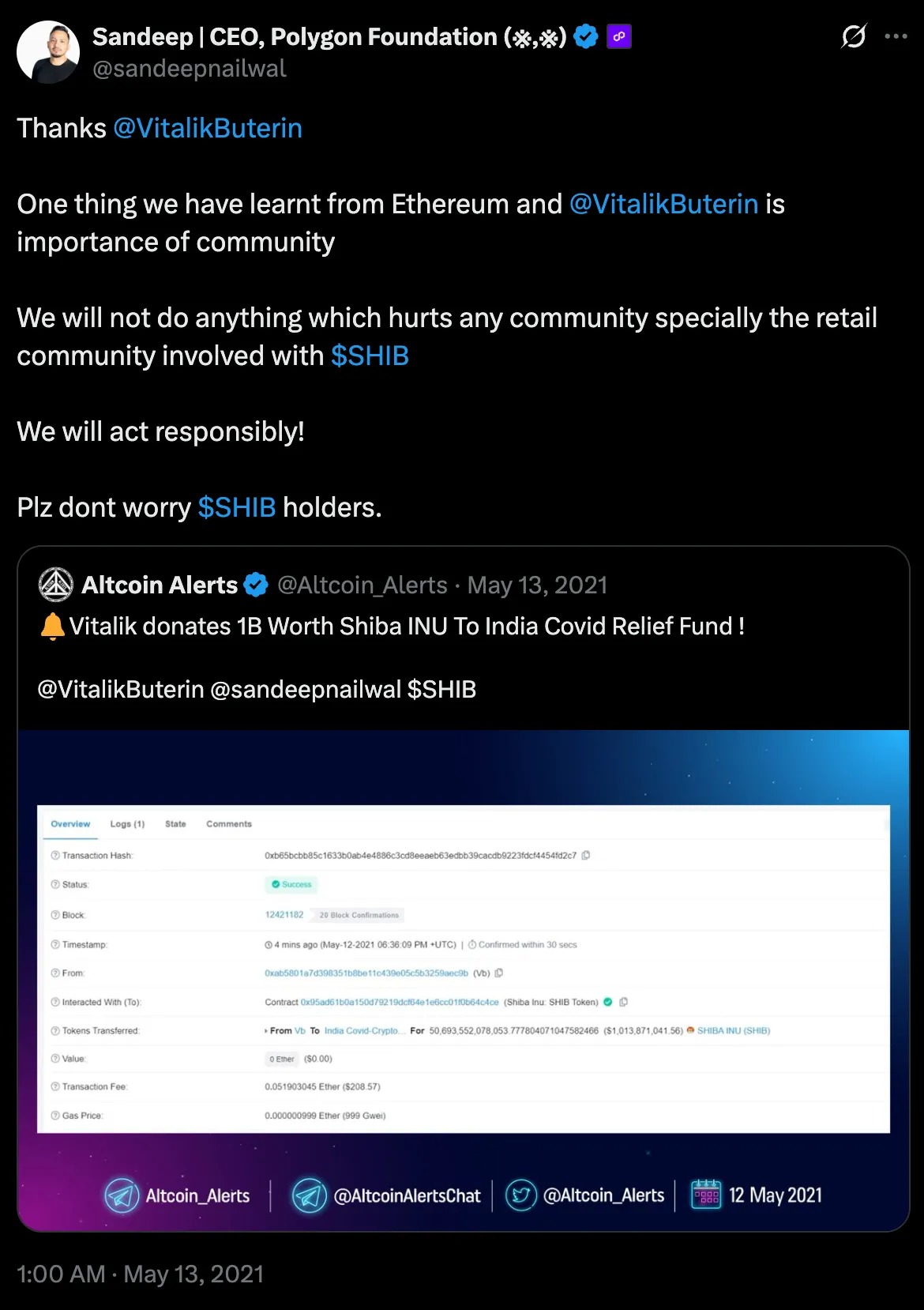
The real challenge: how to liquidate $1 billion in meme coins without crashing the market?
Nailwal partnered with market makers, selling slowly over months. The Shiba Inu community initially panicked, fearing a massive dump, but calmed after Nailwal promised careful execution. In the end, he netted $474 million—far exceeding Buterin’s expectations.
The Crypto Covid Relief Fund deployed $74 million in emergency aid to India. Nailwal returned $200 million to Buterin, who donated it to U.S. biomedical research. The remaining $200 million was reserved for long-term “Blockchain for Impact” initiatives.
Character Forged in Adversity
By mid-2025, Polygon faced new challenges. $POL had fallen over 80% from its peak. Competing Layer-2 solutions like Arbitrum and Optimism were capturing market share. The company had expanded to 600 employees during boom times, leading to cultural drift and organizational bloat.
Nailwal made tough calls. Two rounds of layoffs trimmed the team to a leaner, more cohesive size. Multiple projects, consuming months of engineering effort, were canceled for misalignment with strategy.
In June 2025, Nailwal became the first CEO of the Polygon Foundation, consolidating leadership previously scattered among co-founders and board members. Of the four co-founders, three had stepped back; he was the last one standing.
“When the moment comes, most founders can’t make hard decisions,” he said in an interview. “Executing the strategy ruthlessly—letting go of people who no longer fit, killing projects you’ve poured time and emotional energy into.”
The weight of these decisions changes when you’re cutting projects you personally championed or letting go of people who believed in your vision during tough times.
Under Nailwal’s sole leadership, Polygon refocused on AggLayer, an interoperability protocol designed to unify blockchain networks. Its technical vision is to build infrastructure enabling thousands of independent blockchains to appear as one seamless network to end users.
“By 2030, there could be 100,000 to a million chains,” Nailwal predicted. “All activity will shift to these app-specific chains.”
It’s a bold claim. Whether it materializes depends entirely on execution over the coming years.
The Long Game
Nailwal thinks in decades, not quarters. When discussing Polygon’s competition or the future of DePIN, he repeatedly references 10-year and 50-year timelines.
“If you give me 10 years, I can tell you 100% this is the ultimate architecture for crypto going mainstream,” he said about AggLayer. “But whether it’s Polygon’s version or someone else builds something similar—that’s unpredictable.”
He has unwavering faith in the vision for blockchain infrastructure. Whether Polygon delivers it or someone else does matters far less than seeing it built at all.
Through “Blockchain for Impact,” he’s shifting from emergency relief to “incentive-based” philanthropy. He’s planning awards akin to an Indian Nobel Prize to inspire the next generation of scientists and engineers.
“I want $2 trillion in output from this $200 million BFI,” he explained. The leverage sounds absurd—until you remember he turned $30,000 in seed funding into a company briefly valued at $30 billion.
Yet Polygon faces headwinds. Competitors like Arbitrum and Base have captured more market share, offering simpler user experiences and stronger backing. Polygon’s bridging tech remains complex, and the MATIC-to-POL transition created uncertainty. Its developer-first messaging hasn’t yet translated into mass retail adoption like rivals’. Whether Nailwal’s long-term infrastructure bets pay off hinges on execution in an increasingly crowded market.
What’s certain is that Sandeep Nailwal has traveled further from his starting point than most could imagine. Whether the infrastructure he built will help others the way crypto helped him—remains to be seen.
From a village without electricity to building the internet of value, the destination is uncertain. The journey continues.
That’s the story of the Polygon guy. See you in the next article.
Until then… stay calm and do your own research (DYOR).
Join TechFlow official community to stay tuned
Telegram:https://t.me/TechFlowDaily
X (Twitter):https://x.com/TechFlowPost
X (Twitter) EN:https://x.com/BlockFlow_News