








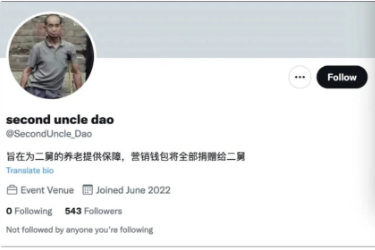
Has the "Uncle 2 Coin" really pulled a rug pull?
TechFlow Selected TechFlow Selected
Has the "Uncle 2 Coin" really pulled a rug pull?
Fake! Only 4 transactions, and the project team took 2,000 yuan.
 Navigating Web3 tides with focused insights
The so-called "Uncle 2 Coin," which was widely shared by numerous media outlets, can be proven via on-chain data to have not scammed 1.3 million USD. In fact, the entire project may not even be worth 1.3 million USD. The actual amount transferred—1.3B—is merely 1.3 BNB. Seriously, someone ran off for just a few hundred dollars?
Uncle 2 Coin has arrived, and Uncle 2 has fled—chances are you've been flooded with this news today. But did he actually rug-pull?
"Collapse of 'Uncle 2 Coin'" trends, with 1 trillion tokens issued>>
Where exactly did the missing 1.3 million USD come from?>>
Conclusion!
Despite claims made in viral tweets by a self-proclaimed security expert—and subsequently amplified by countless media outlets—the "Uncle 2 Coin" can be verified through on-chain data as not having scammed 1.3 million USD. In fact, the entire project may not even be worth that much. The alleged 1.3B withdrawal refers only to 1.3 BNB. Come on—would anyone really rug-pull for a few hundred dollars?
To debunk misinformation, evidence is essential. By analyzing the smart contract source code of Uncle 2 Coin and tracing back on-chain transaction records, I will reverse-engineer the developer's on-chain activities and walk you through the truth behind this incident.
First, let me clarify: I am not affiliated with the project team, nor do I hold any Uncle 2 Coins. This article is purely for technical research purposes. Once again, it must be emphasized that regulations strictly prohibit cryptocurrency trading and speculation!
Background:
Tracing back the origin of this news cycle, it began with a tweet from a so-called security expert on Twitter, which was then picked up and spread widely by numerous media outlets. Through reconstructing the information dissemination chain, the original post appears as shown below:
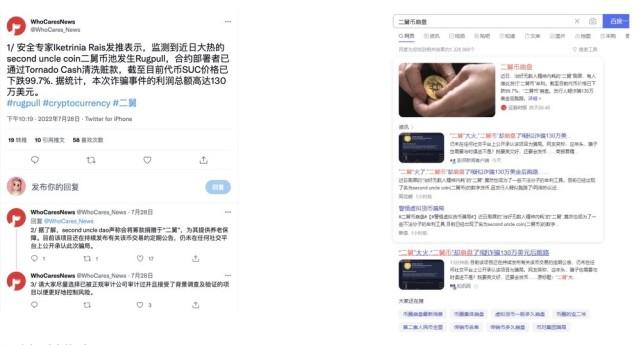
From the perspective of rumor-spreading tactics, this kind of wording is indeed highly convincing—sounding professional with shocking figures—and Tornado Cash is indeed commonly used for laundering illicit funds.
But is that really the case? How exactly was the claimed loss of 1.3 million USD calculated?
The project team has also responded:
Initially, the team attempted to reward their Twitter followers with an airdrop to grow their follower base.
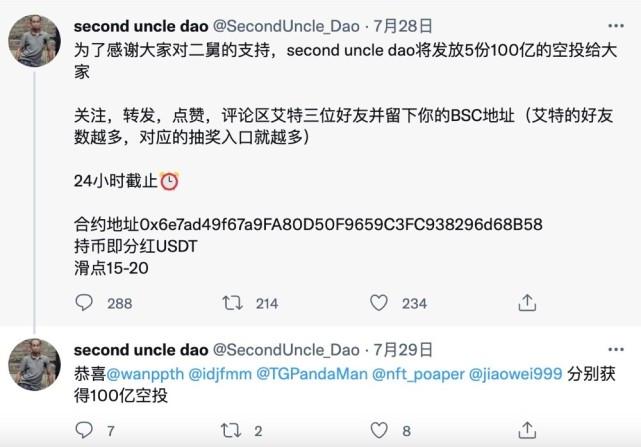
At first glance, this does seem suspicious—like a classic prelude to a rug pull. It’s entirely possible the developers were trying to pump the price before dumping and fleeing. However, whether they actually pulled the plug—and how much money was taken—must be determined based on on-chain data analysis.
1. Analysis
1.1 Project Launch Phase
This token was deployed on BSC (Binance Smart Chain) and its source code has been open-sourced and verified, allowing all evidence to be reviewed at the following addresses:
Developer's personal address: 0x469de2c6357666c69156722e83136ad1919a70aa
Uncle 2 Coin contract address 1: 0x6e7ad49f67a9fa80d50f9659c3fc938296d68b58
Uncle 2 Coin contract address 2: 0xe67cff48da0156e7978bc5a9a44d516a48d2a1d6
I started writing this article at 3 PM on July 31st and pulled a total of 1,686 on-chain transactions for Uncle 2 Coin.
During the initial deployment phase, the developer minted 1,000,000,000,000,000 Uncle 2 Coins to their own wallet.
The initialization function during deployment was significantly modified, mostly related to methods for interacting with liquidity pools. However, the core asset creation and transfer logic lies in the _mint function shown in the code snippet below—which means whoever deploys the contract receives all these tokens at once.
Note: The constructor is the contract’s initialization function, executed only once upon deployment and cannot be called afterward.
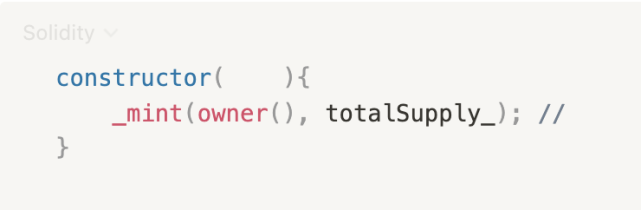
Giving it all to themselves right away—it certainly looks like a red flag for a potential rug pull, no wonder rumors started spreading...
1.2 Minting tokens is actually very cheap
Minting tokens is easy—what matters is whether there's a liquidity pool on an exchange enabling swaps between different cryptocurrencies, which would allow converting into withdrawable funds. Creating a token on blockchain isn't hard; you can create one in just five lines of code. You could mint not just 10 billion tokens, but up to 1 followed by 78 zeros, since the ERC20 standard uses uint256 for balance storage, with a maximum value of 2^256.
Can this token be directly exchanged?
The source code totals around 3,000 lines—not only including standard ERC20 functionality and common plugins, but also embedded code for integrating with decentralized exchanges.
1.3 Extremely low capital involvement in the project
To run off with funds, there needs to be actual capital inflow—either from users trading with the contract or the team withdrawing from exchange liquidity pools.
After reviewing all contract transactions for Uncle 2 Coin, I found only one transaction involving BNB value—and it contained just 0.126 BNB.
Although there are already a large number of trading transfers recorded for Uncle 2 Coin on exchanges (over 8,000), resulting in more than 1,600 unique holding addresses,
to determine if a rug pull occurred, we need to examine whether the massive supply initially held by the developer was converted into other tokens via liquidity pools.
Tracking records of the large token allocation to the developer, besides the initial 1,000,000,000,000,000 issued at deployment,
there is only one additional transfer: moving 990,000,000,000,000 tokens to the zero address.

Furthermore, analyzing all transactions from the developer’s personal address shows that only 1.3 BNB obtained via PancakeSwap V2 was withdrawn. Note: At current rates, each BNB is valued at approximately $271 USD.
Seriously, someone ran off for a few hundred bucks?
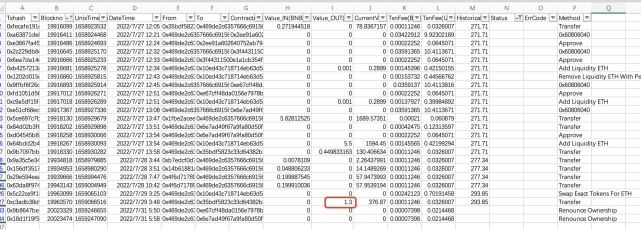
1.4 So where did the claim of $1.3 million come from?
Possibly, the so-called security expert mistook the 1.3B as 1.3 billion USD, then assumed “B” stood for million instead of billion due to perceived absurdity?
Of course, it's true that tokens in the current liquidity pool represent only 0.55% of the total supply—because the developer burned 99% of the tokens. However, this burn operation did not update totalSupply (which was incorrect—the proper standard burn method should have been used).
So far, it’s clear the developer didn’t profit maliciously, and despite questioning the originator of the rumor, no response has been received.
2. What does renouncing ownership mean?
On the afternoon of July 31st, amid rising rumors, the developer made a decisive move: renouncing administrative control over the project.

As seen in the image above, the developer’s final two transactions involved transferring ownership of both Uncle 2 Coin contract addresses to the zero address.
Can ownership truly be relinquished this way?
Yes, it can.
Renouncing ownership calls the renounceOwnership function, setting _owner to the zero address. As a result, any function marked with onlyOwner modifier becomes permanently unusable.
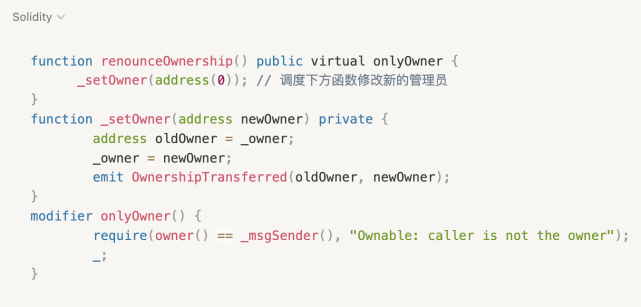
Approximately 20 functions become inaccessible. Most importantly, this removes the ability to mint new tokens. Within the 3,000-line codebase, only _setBalance invokes minting privileges. Although it lacks the onlyOwner modifier, it’s an internal method—meaning it cannot be called externally and only by predefined functions within the contract.
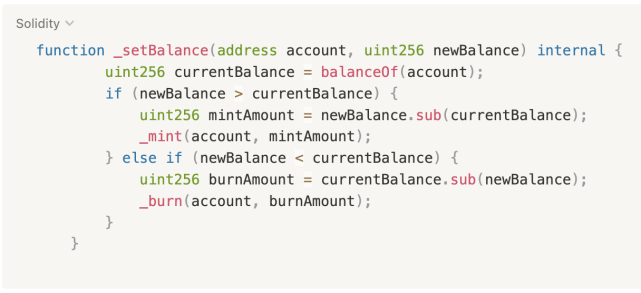
The two functions that call it are clearly marked with onlyOwner, meaning they too can never be used again.

I further analyzed whether the _balances variable (which stores token balances) contains any hidden backdoors under alternate names—none were found. Whether other sophisticated backdoors exist is left to advanced smart contract auditors to verify.
Summary
Logical derivation supporting the conclusion that no rug pull occurred
1. For a rug pull to occur, someone must have lost money. On blockchain-based smart contracts, every transaction is permanently recorded on-chain. Therefore, we can identify losses by examining transaction history.
2. Reviewing all records since launch, only four key transactions exist—and three of them are unrelated to the developer taking funds.
3. The only transaction involving fund withdrawal by the developer amounts to just 1.3 BNB—approximately 2,000 RMB.
4. Since the developer executed ownership renouncement—and after reviewing the 3,000 lines of immutable source code (remember, on-chain code cannot be altered)—it is confirmed that no backdoor remains to enable future minting of additional Uncle 2 Coins.
Why did the developer burn 99% of the tokens?
Motivation unknown. Typically, such actions aim to control token economics—for example, issuing 100 billion tokens might seem excessive, so reducing supply increases perceived scarcity.
During deployment, the developer initially minted 1,000,000,000,000,000 Uncle 2 Coins—the total supply.
Only one subsequent action occurred: transferring 990,000,000,000,000 tokens to the zero address.
To obtain 1.3 BNB (~2,000+ RMB), the developer used 900,000,000,000 tokens. Based on this valuation, the entire coin’s market cap would be roughly 20,000 RMB—nowhere near the rumored 1.3 million USD.
Is creating a token really that easy?
Yes, it is. Recently we’ve seen Uncle 2 Coin, Auntie Coin, Uncle 2 Doge, etc.—all examples of speculative meme coins and potential scams.
Will Uncle 2 Coin be burned?
On-chain data is immutable. Since the developer has already renounced ownership, they no longer possess privileged control over the Uncle 2 Coin contract.
Conclusion
The developer did not rug-pull—this was either deliberate misinformation or a misunderstanding (perhaps the social media manager saw a price drop and noticed the 1.3 BNB transfer, mistaking it for 1.3 million USD).
But on-chain transaction records don’t lie. Smart contract code doesn’t lie. What’s written in the code is what governs the system—unchangeable and transparent.
Join TechFlow official community to stay tuned
Telegram:https://t.me/TechFlowDaily
X (Twitter):https://x.com/TechFlowPost
X (Twitter) EN:https://x.com/BlockFlow_News






