








Exploring Creator Economy 4.0: Building Community DAOs Around Individual Creators for Co-Creation and Shared Ownership
TechFlow Selected TechFlow Selected
Exploring Creator Economy 4.0: Building Community DAOs Around Individual Creators for Co-Creation and Shared Ownership
Web3 content co-creation has brought us to the brink of Creator Economy 4.0—what does this mean for the entire Web3 space?
 Navigating Web3 tides with focused insights
By: lilping, Web3 Gateway
In early 2022, through CSS Podcast Episode 10 titled "Co-Creating the 'Ownership Economy' — Li Jin," I was first introduced to the concept of Creator Economy 4.0.
Li Jin describes the evolution of the creator economy as four distinct phases. Below is a brief overview of each phase:
Creator Economy 1.0: The birth of the internet enabled individuals to become creators.
Creator Economy 2.0: Creators monetize their influence on platforms via ads and brand sponsorships.
Creator Economy 3.0: Creators operate as independent businesses, directly earning from their fans. Key topics include: Passion Economy, building a creator middle class, the “100 true fans” model, and the role of cryptocurrency.
Creator Economy 4.0: Creators and their fans co-create and accumulate wealth together. This is our glimpse into the future of the creator economy.
Regarding how to reflect the "economic" attributes and "business models", here’s my personal summary:
1.0: One-way content output with unclear monetization;
2.0: Monetizing accumulated traffic via ad revenue and fan donations;
3.0: Building individual brands, with fans paying directly for content;
4.0: Based on Web3, forming community DAOs around individual creators for joint creation and ownership.
A key aspect of Creator Economy 4.0 is community. In the Web3 space, NFT projects are similarly heavily reliant on communities. This intersection may offer an answer to a frequently raised question: beyond buying and selling little pictures, what are the practical use cases for NFTs?
Beyond the usual examples like gaming items, access passes (alpha communities, co-creation project entry), certificates (DeFi scenarios), email stamps, commemorative medals (for events, crowdfunding), etc., perhaps Web3 content co-creation — a manifestation of Creator Economy 4.0 — is a promising direction worth exploring.
Of course, as Li Jin noted, creators co-creating and profiting with their fans is just one glimpse into the future of the creator economy, with many possible forms. But even this single idea is enough to inspire exploration and imagination. Here are some preliminary observations:
Two projects that took us down the rabbit hole:
Shibuya
Starting with that recurring question, let's talk about Shibuya. In a Bankless interview video titled Alpha Leak丨Shibuya Disrupts Hollywood Studios, pplpleasr, co-founder of the decentralized video distribution platform Shibuya, said they’re exploring NFT use cases beyond PFPs. Shibuya’s first original animated series, "White Rabbit," consists of seven chapters. The second chapter has already been released. For each chapter, the team issues a Producer NFT (ERC1155). After watching the episode, community members holding these NFTs vote on the direction of the next chapter’s plot (the official Twitter hints that collecting all seven NFTs unlocks a surprise).
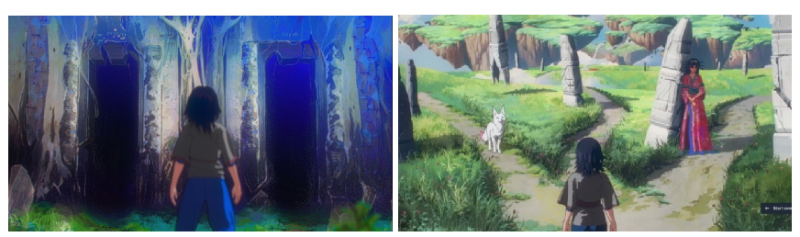
Plot choice screens from Chapters 1 and 2
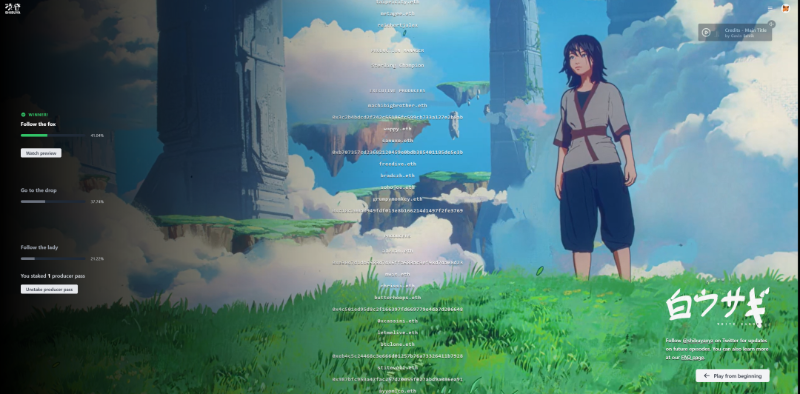
At the end of the film, the producer credits display Ethereum addresses or ENS names
Beyond influencing the plot, these Producer NFTs also determine how much fragmented ownership of the full animation each community member receives: after votes are tallied, members can unstake their NFTs to earn $WRAB tokens. The earlier you vote and the more your chosen outcome wins, the greater your reward. Once the entire animation is complete, $WRAB will be converted into fractionalized NFTs. Decisions about the work’s future — such as whether to sell it to another streaming platform — will be made by community voting.
As a new experiment, beyond token incentives and the promise of shared ownership, how does Shibuya boost community engagement? Treasure hunt easter eggs are one method. In Chapter 1, the mnemonic phrase for a wallet containing four NFTs (created by Shibuya team members) was scattered throughout the episode in text and images for viewers to collect. Chapter 2 was more direct: choosing a gift dropped mid-episode grants an NFT called "Something Cooking," whose purpose remains unclear — but could it be useful later?
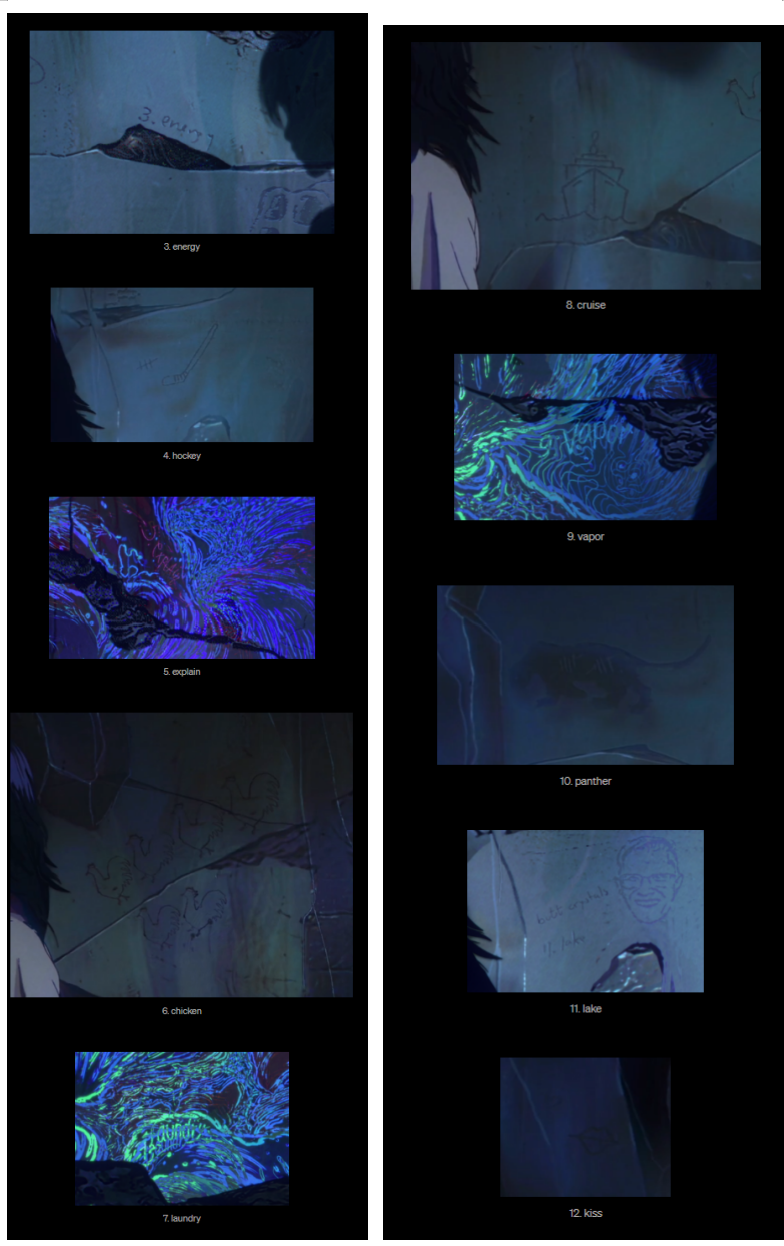
Treasure hunt solution: the first two words appear above the two doors in the Chapter 1 plot selection screen
When talking about interactive videos, many might recall *Black Mirror — Bandersnatch*. While both use interactive gimmicks, Bandersnatch offers a god-like perspective where all plot paths were pre-designed by Netflix. Ultimately, the creators wrote everything; viewers remained passive recipients. That said, Black Mirror did have fun easter eggs — perhaps White Rabbit drew inspiration from it?
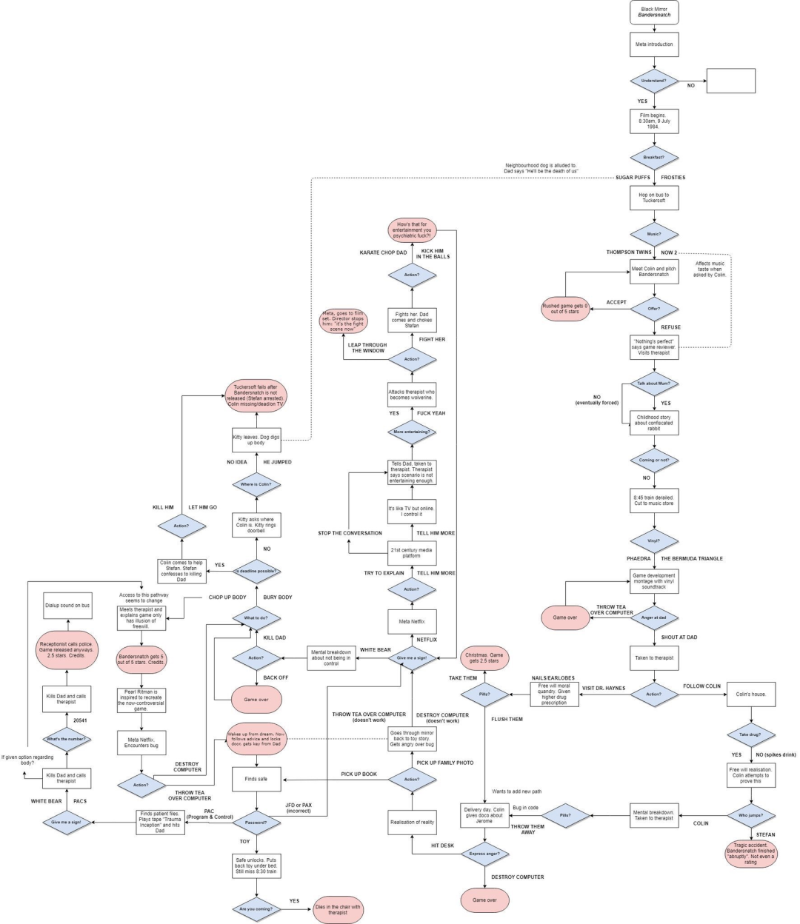
Plot map of *Black Mirror — Bandersnatch* from Zhihu
Mad Realities
Another example of community/content consumers/audiences participating in content creation is Proof of Love, a Web3 dating reality show built on the Mad Realities platform, which received a $6 million investment from Paradigm in April this year. If Shibuya’s model only allows viewers to vote — falling short of true “creation” — Proof of Love gives audiences far more creative freedom and involvement.
Proof of Love issued three tiers of Rose NFTs as entry tickets: 0.1 ETH, 0.5 ETH, and 1 ETH. NFT holders can participate in casting — hosts and contestants are selected through voting — and contribute to script planning and scene interventions (e.g., sending drinks to favorite couples). Top-tier NFT holders can even attend filming on-site. Each completed episode is minted as a 1-of-1 NFT and auctioned on ZORA. Proceeds are distributed as follows: 30% as prize money for the winning couple at season’s end, 10% as rewards for guests who decline matches in each episode, 40% to the DAO treasury, and 15% directed by the auction winner. Setting aside Web3 and crypto elements, this could easily pass as a humorous variety show.
For more on Mad Realities, see "Proof of Love — A DAO Version of If You Are the One"
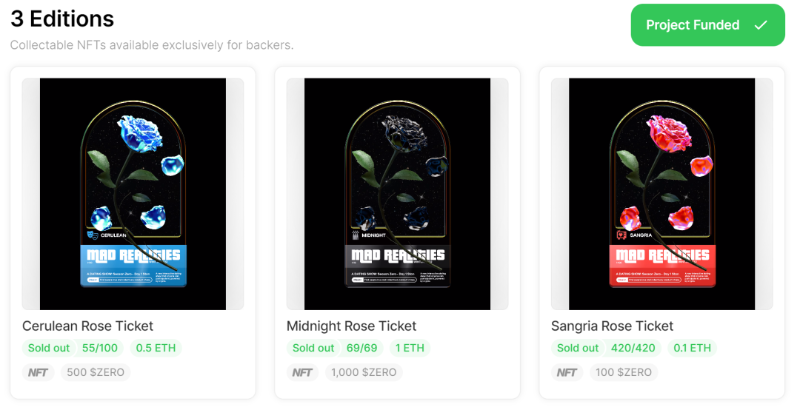
Three tiers of NFT Passes for Proof of Love raised 172.71 ETH, with 390 holders
Initially, I noticed these two projects due to their playful easter eggs and entertaining content, briefly sharing gameplay mechanics on social media and discussing details on the Web3 Gateway podcast. Later, listeners began recommending other Web3 co-creation projects they discovered. I started intentionally collecting such projects to create a mapping, sensing that this trend might soon explode — or perhaps already has. This process of being recommended and fed new ideas feels like a form of co-creation in itself.
Web3 Co-Creation Mapping
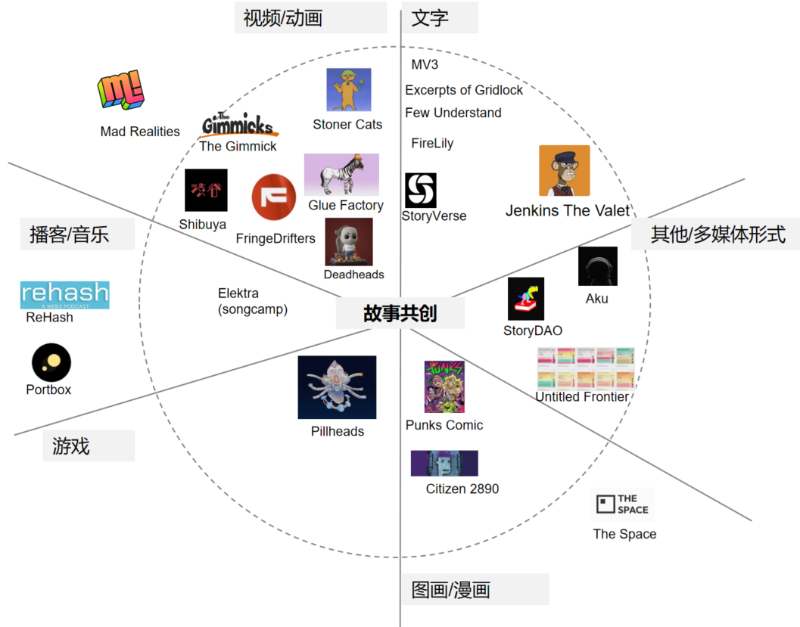
Image source: Compiled by Web3 Gateway community
Why is storytelling at the core of this mapping? Based on incomplete project data, most current initiatives revolve around creating stories, albeit in varied formats — text, images, audio, video — or combinations thereof, such as Story DAO, aiming to build a decentralized Hollywood. Some co-creation projects don’t focus on narrative; these fall outside the storytelling circle.
Currently, two major categories of co-creation projects are not included. One is derivative creations based on PFP NFTs, represented here by Jenkins the Valet — a butler character created based on BAYC. Future creativity may flourish especially within cc0 projects (in the Web3 Gateway podcast, we discussed Nouns as a pioneering cc0 project, and will explore how cc0 could foster cultural symbols and drive creator economy prosperity in a future article). Additionally, taking a broader view of “content creation,” brand innovation can also be considered a form of Web3 co-creation, seen in Web3 + consumer projects like gmgn supply (aiming to be a Web3 Nestlé) and CPG (a “Web3 + consumption” incubator).
This mapping reflects a relatively narrow definition of Web3 content co-creation. Across these examples, a crucial role is played by NFTs — serving as carriers, elements, characters of the story, and access passes to participation.
Podcast
ReHash Podcast is a "community-driven Web3 podcast" launched by Diana Chen on Mirror. Community members holding ReHash NFTs can nominate and vote for preferred guests and topics to co-create the podcast. Originally aiming to raise 10 ETH, ReHash ultimately raised 29.53 ETH. Before launching ReHash, Diana Chen hosted two full-time podcasts — The Unstoppable Podcast and DAOn the Rabbit Hole — completing over 200 episodes, 150 of which focused on Web3.
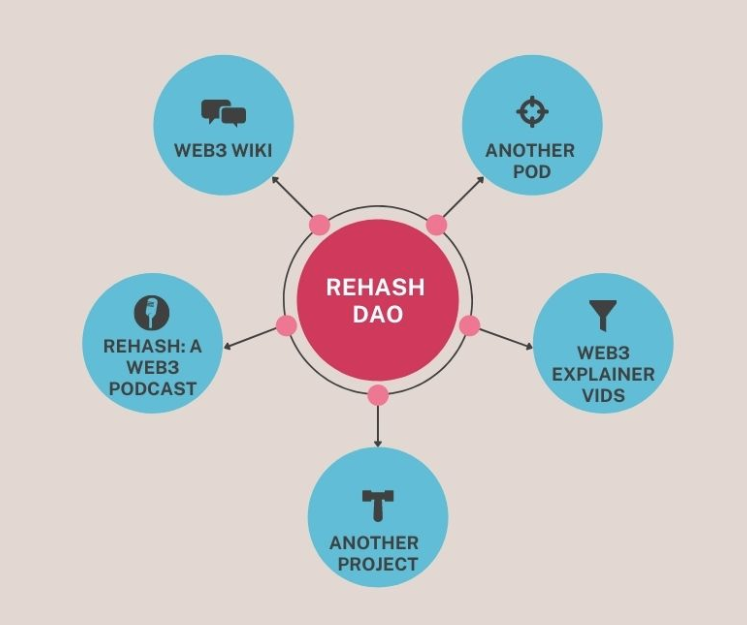
Image source: ReHash Discord governance channel
In the ReHash Discord governance channel, it’s clear they aim to do more than just co-create a podcast. They hope to leverage the DAO structure to unite community strength, evolving into an education center, knowledge hub, support group, media publisher, and podcast incubator. ReHash calls the possibilities “endless.” ReHash Podcast is the first project of ReHash DAO, similar to how Mad Realities’ variety show is just the starting point.
Why create an interactive podcast? ReHash expresses its values: To benefit more diverse groups through Web3, different perspectives must be amplified. Minority voices and individuals from varied backgrounds should be nominated as guests, and their stories listened to with respect and empathy. The world — including Web3 — isn’t black and white; nuanced gray areas deserve discussion rather than simplistic labeling.
What difference does community involvement make? ReHash releases 12-episode seasons. The first season, produced before community co-creation began, covered niche and eclectic topics (personal impression, possibly due to limited exposure): an NFT project helping formerly incarcerated people reintegrate, interviews with DeFi educators/interns, etc. By Season 2, community-nominated guests came primarily from prominent Web3 projects like Gitcoin, DAO Haus, Kernel, AAVE, and Zora.
Extending from ReHashDAO: As a DAO wanderer, I believe content co-creation could be a promising path for small, niche DAOs.
Today, we see large, comprehensive DAOs like BanklessDAO, and smaller, niche-focused ones like Twoplus, which supports mental health among Web3 professionals, along with numerous tightly scoped creative groups. In large DAOs, talent gathers in one space, engaging in unstructured “Brownian motion” to see what opportunities emerge — highly random. Small, focused DAOs begin with specific projects, launch products or works first, then attract more participants to grow their communities. We won’t debate the pros and cons here. But we observe that many small Web3 creative projects now consider DAO integration in their roadmaps or positioning. Among various types of small DAOs, interactive co-creation projects appear particularly promising. In fact, Shibuya mentioned in an official tweet: “One movie, one DAO.”
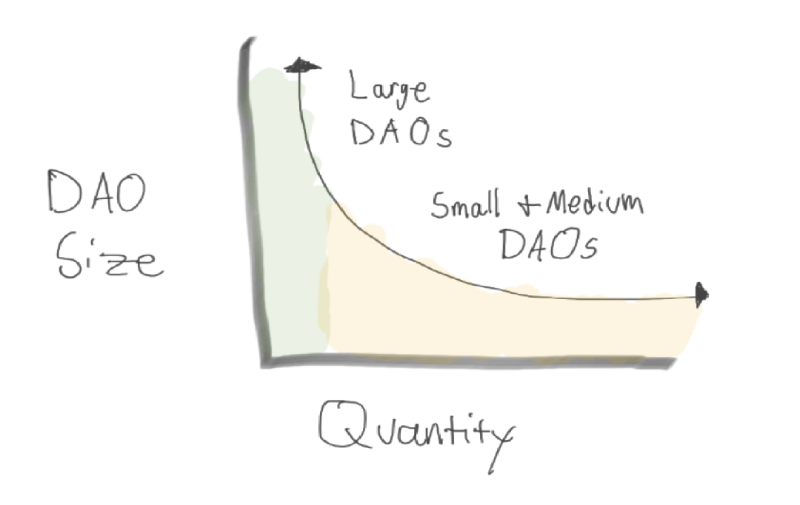
Image source: BanklessDAO
Music
SongCamp has run three camp sessions (music creation hackathons): Genesis, Elektra, Chaos. The third session, Chaos, emphasized the concept of a “headless band.” The term “headless” draws from the research group Other Internet, which coined “headless brand” in October 2019 — referring to brands whose values, beliefs, narratives, and symbols are defined in a distributed, permissionless way by supporters, not top-down. Bitcoin is a classic example of a headless brand.
Image source: SongCamp
Strictly speaking, Chaos differs from the team-plus-community co-creation model described earlier. Chaos brought together 77 creators with no prior collaboration — 45 musicians, 9 visual artists, 7 operators, 6 engineers, 5 broadcast producers, 3 economists, and 2 copywriters/knowledge masters — to produce 45 songs and 21,000 album covers (generated from over 1,000 visual layers).
These 77 professional creators function more like a closed team — there was no open creative space for the broader community or NFT buyers. This is clearest in NFT rights: the 45 songs combined with covers formed 21,000 NFTs, 20,000 of which were sold publicly. The remaining 1,000 were distributed among the 77 creators based on a ratio determined by CHAOS tokens — allocated via a “self-evaluation + peer review + adjustment” system (30% of CHAOS tokens go to SongCamp’s treasury). Only holders of these 1,000 NFTs receive future revenue shares. Thus, “shared ownership” applies only to the 77 creators.
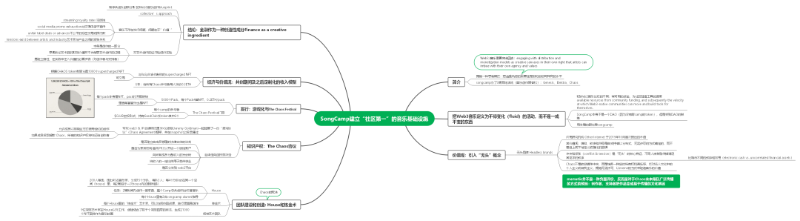
Water&Music, a music NFT research organization, notes that Chaos’s innovative significance lies in embracing a mindset: elevating financial design to equal importance with creative work, treating financial innovation as part of creation, and establishing a blueprint for Web3 music production. By “financial,” I mean coordinating collaboration, discussing financial value early in the creative process, and (in partnership with 0xSplit) designing an automated NFT-based revenue-splitting system.
Compiled from Water&Music report
Why include SongCamp in the storytelling circle? Chaos doesn’t tell a concrete story, but is structured around an abstract narrative arc: Act 1 — Order; Act 2 — Chaos; Act 3 — Entropy; Act 4 — Rebirth. Why build stories? In conversation with Henry, who led the Water&Music report translation in SeeDAO, he shared insights: when music projects start with a story, it often serves as a foundation for future expansions — comics, live concerts — depending on intent and funding.
Video
Video (including animation) projects generally follow a framework set by the team — worldbuilding and basic plotlines — then allow audiences to contribute content and vote on story progression. Beyond Proof of Love and White Rabbit, examples include the animated series Stoner Cats and The Gimmick, a wrestling-themed Solana-based project inspired by Stoner Cats. Unlike White Rabbit, Stoner Cats requires NFT ownership to view episodes.
While NFT holders in these projects can vote and co-create parts of the story, someone like me — skimming too many projects without overflowing inspiration — might struggle to contribute creatively (facepalm)...
An earlier article exploring bottom-up community storytelling listed even more video and text-based co-creation projects — curious readers can explore further.
Shibuya once joked on Twitter about rebranding to NFTFLIX (did you first read it as NETFLIX? Is this challenging Netflix?). What could interactivity and co-creation bring to traditional content platforms? Are Web3 content co-creation efforts just fleeting experiments, or a promising direction for Web3? These questions remain open — we’ll continue observing and seeking answers.
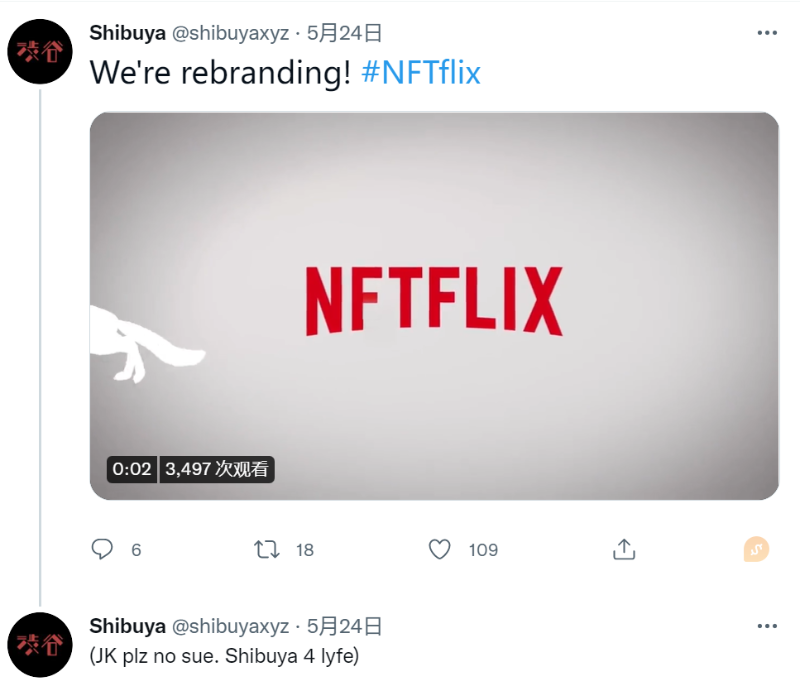
Image source: Shibuya Twitter
Text
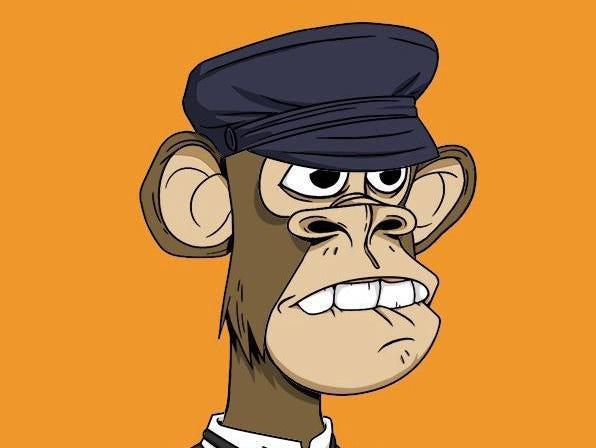
Jenkins The Valet is a typical example of decentralized text-based co-creation. On May 22, 2021, a member using the pseudonym Jenkins purchased Bored Ape #1798, naming him Jenkins the Valet, and began crafting a story around him, experimenting with decentralized creative writing. The day after buying the ape, he wrote a brief 500–600-word origin story: a poor monkey lands a butler job at a yacht club frequented by wealthy apes, making his mother cry tears of joy.
The story spread quickly. Jenkins posted a Google form on Twitter inviting owners to submit backstories for their apes, receiving countless DMs and submissions. He rapidly wrote over a dozen more stories. At the time, Jenkins worked full-time as a product manager, rushing home to write after work. During this process, he developed a desire to scale up storytelling — the origin of Tally Labs, which raised $12 million in a Series A round led by a16z in May 2022. (For more details, listen to the podcast “Bored Ape Creative Stories Community: Jenkins’ Writer’s Room”)
Bored Ape #1798
Three months later, Jenkins launched Writer’s Room (founded by a three-person team, precursor to Tally Labs) and issued 6,942 Writer’s Room Pass NFTs (four tiers: WAGMI Yacht, Yacht Key, Jenkins’ Key, Valet Ticket). Pass holders can contribute creative ideas, vote on story directions, and be credited as authors on all resulting works. The NFTs sold out within six minutes.
From a seed of collaborative storytelling emerged Writer’s Room, followed by Jenkins becoming the first NFT character signed by CAA (Creative Artists Agency), collaborating with best-selling author Neil Strauss, Murda Beatz, MBSJQ, and other celebrities. This entrepreneurial journey is truly remarkable!
According to Writer’s Room roadmap, future storytelling may extend beyond Bored Apes to other PFP projects, potentially giving soulful depth to these avatars.
Images/Comics
The Space is a graffiti wall using radical market theory applied to NFT pixel art. Every pixel on the canvas is a tradable NFT. Owners can color pixels, and the final artwork emerges from repeated social experiments. In these experiments, owners pay Harberger taxes on pixel NFTs, with part of the tax redistributed as UBI dividends to all creators, ensuring everyone benefits.
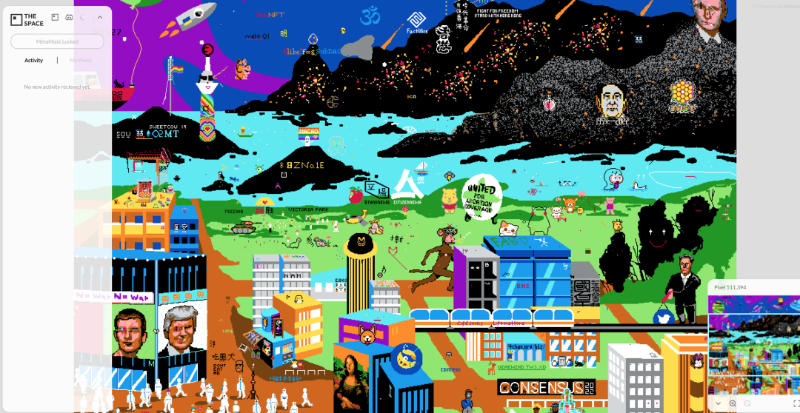
Image source: The Space
Web3 Content Co-Creation Spectrum
In a previous podcast conversation with Tao Yingjun, we explored a spectrum tracing content co-creation from traditional Web2 to Web3. One end represents the founding team (or initiating individual), the other end the community. Each co-creation project involves a certain degree of top-down leadership, while reserving space for community members to participate, express creativity, and contribute content.
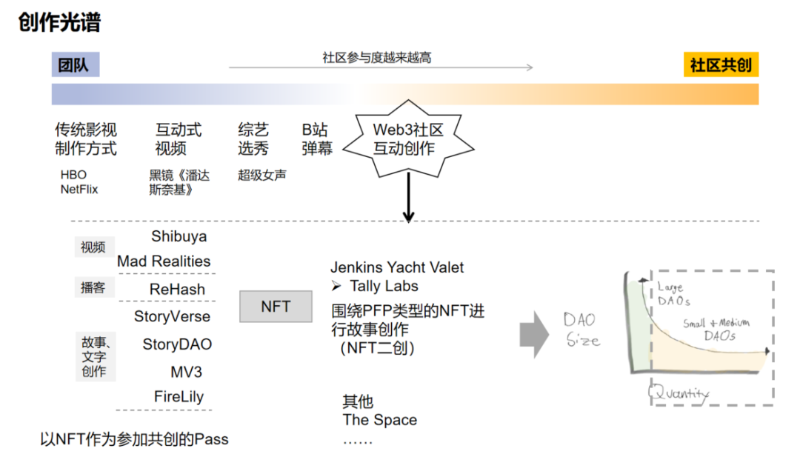
Image source: Vibe Squad & Web3 Gateway
Why propose this seemingly rigid framework? Does it have practical value? I see it as a cognitive tool. When discussing this with newcomers, their first reaction is often: “Co-creation? Can a mob of unqualified amateurs really create anything meaningful? Let professionals do their jobs.”
People tend to assume co-creation means going fully to the far right of the spectrum — equating ideal co-creation with completely decentralized, bottom-up community creation. In reality, most co-creation projects start top-down and require strong founding teams. Like progressive decentralization in DAOs, finding the right balance takes time — ensuring sustainability and enabling infinite-game storytelling while giving communities room to innovate and stay engaged.
An Optimistic Outlook
Web3 content co-creation lets us touch the edge of Creator Economy 4.0. What does this mean for the broader Web3 landscape? Web3 is often criticized for speculation and impractical toys. Currently, most newcomers enter Web3 through speculation, trading tokens and farming airdrops. Without lofty ideals, co-creation at least provides a container for new users. Perhaps in the future, many creatives will first enter Web3 not to speculate, but to build and create. But what if what they create are still just toys? Then SolarPunk advocates might respond: Stay positive! Believe we can create a future of high tech and high quality of life. I’m not sure if Teacher Wang Chao subscribes to SolarPunk ideology, but one of his tweets makes sense and reflects this optimism:
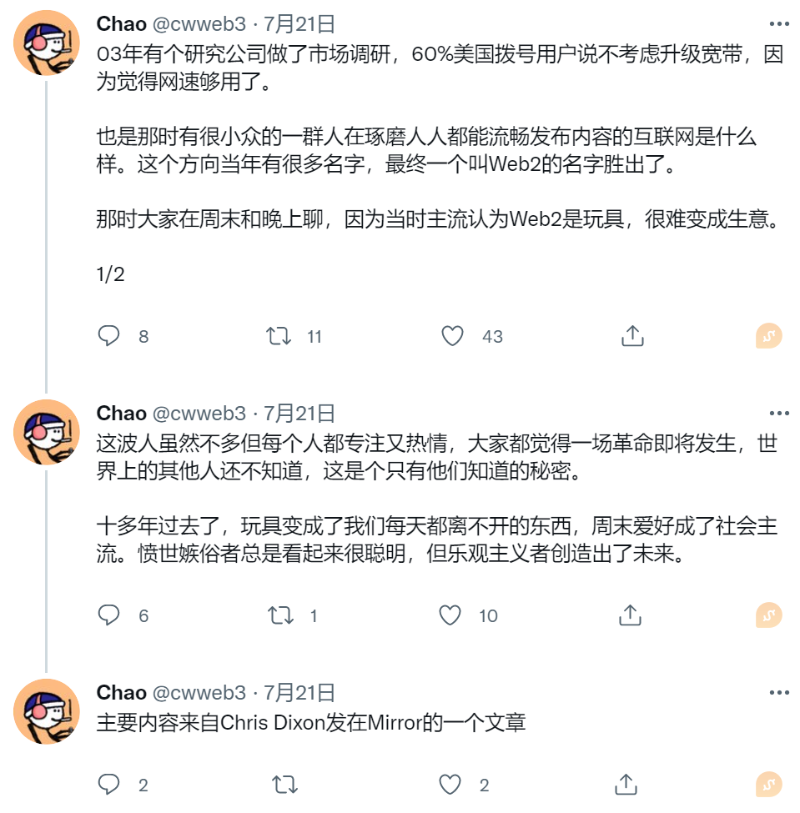
Image source: Twitter
I believe optimism isn’t blind or baseless. Those who hold positive views toward Web3, DAOs, and the creator economy generally align with the philosophy of *The Sovereign Individual*. They believe taking personal responsibility leads to freedom and wealth. By actively seeking and filtering information, stepping outside standardized life paths, creating their own rules, and building leverage, they achieve financial and personal fulfillment. With the anticipated influx of 1 billion highly creative digital nomads/sovereign individuals, and capital backing — such as a16z’s fourth fund focusing on decentralized creation — we catch a glimpse of the vast potential and bright future of the creator economy.
Regarding belief in DAOs, individual creative potential, and the power of sovereign individuals, I recall someone saying, “I don’t have faith in DAOs like you do; I just want to make money.” Rather than saying I have faith in DAOs, I’d say I simply want to push myself to experience the danger, depth, sharpness, turbulence, and recklessness of new frontiers. I want to have faith in myself — to believe I can.
Without believing in the sovereign individual, one tends to view things through a speculative lens — which is neutral. Speculators can also profit greatly, and from an ecosystem diversity standpoint, they play vital roles. “I thought those interactions you mentioned — the so-called ‘building’ — would lead to airdrops. Turns out being a good citizen on-chain is just being a sucker.” Fair enough — I’m a degenerate. What I meant by “doing good on-chain” was building on-chain assets — the digital assets held within NFT containers. My naive hope is: since DeFi developed first, finance led the way in the on-chain world. When the “real economy” catches up, it will need massive creative input. Then DeFi won’t be criticized for “spinning air coins,” but instead support real, enriching digital assets for personal lives.
Critical Thinking
Amid optimism, we must also engage in critical thinking.
Limitations
Looking back at the cases mentioned, the project initiators typically come from elite backgrounds: Shibuya’s co-founders include pplpleasr, a renowned Web3 artist who created promotional videos for major DeFi protocols and NFT covers for Fortune magazine, and maciej_kuciara, a Hollywood animator. ReHash’s Diana Chen has extensive experience in the Web3 podcast space.
We might conclude that creators/initiators capable of mobilizing community co-creation often possess “top-tier creator” status or strong influencer power. In other words, even without building communities, issuing NFTs, or designing participation mechanics, they could already monetize directly under Creator Economy 3.0. As a guest on the Web3 Nameless podcast “The Core of Web3 is Co-Creation Spirit” pointed out: in blockchain-based Web3 creator economies, only about 1% of creators can achieve direct content monetization. How do the other 99% benefit? This ties into the allocation of “attention” — a public resource. Solutions may lie in mechanisms like Harberger taxes and radical markets. Web3 co-creation has limitations in scope and applicability. For non-top-tier creators and niche influencers, new approaches must be explored.
Coordination is Harder Than Creation
Co-creation means creators must spend significant energy beyond pure creation — designing co-creation mechanisms, workflows, and addressing critical issues like copyright licensing. DAO tools will play vital roles in facilitating internal coordination, and we’re seeing more such tools emerge to tackle collaboration challenges. Implementing innovative mechanisms is never easy — we must grant these experimental projects more patience.
Looking ahead, much work remains in exploring the creator economy. Fortunately, Li Jin has freely opened her online course — let’s join, learn, reflect, and build together: https://creatoreconomycourse.xyz/
Finally, thank you to Wang Chao, Joel, Henry, Tao Yingjun, and the Web3 Gateway listeners for providing materials, inspiration, and support.
Join TechFlow official community to stay tuned
Telegram:https://t.me/TechFlowDaily
X (Twitter):https://x.com/TechFlowPost
X (Twitter) EN:https://x.com/BlockFlow_News


