








Understanding Kujira, a New Cosmos Ecosystem Chain: Incentivizing Based on dApp Revenue and Building the First Order Book DEX in Cosmos
TechFlow Selected TechFlow Selected
Understanding Kujira, a New Cosmos Ecosystem Chain: Incentivizing Based on dApp Revenue and Building the First Order Book DEX in Cosmos
Kujira has launched its Layer 1 within the Cosmos ecosystem, debuting with their first dApp: Blue.
 Navigating Web3 tides with focused insights
Author: Opa
Translation: TechFlow intern
Recently, Kujira launched its Layer 1 within the Cosmos ecosystem and burst onto the scene with its first dApp: Blue. Shortly after, the Kujira team introduced FIN, a multi-chain order book exchange.
Here, I’ll share my first impressions of these dApps and discuss why they’re so important for the ecosystem.
Bridging Multi-Chain Assets
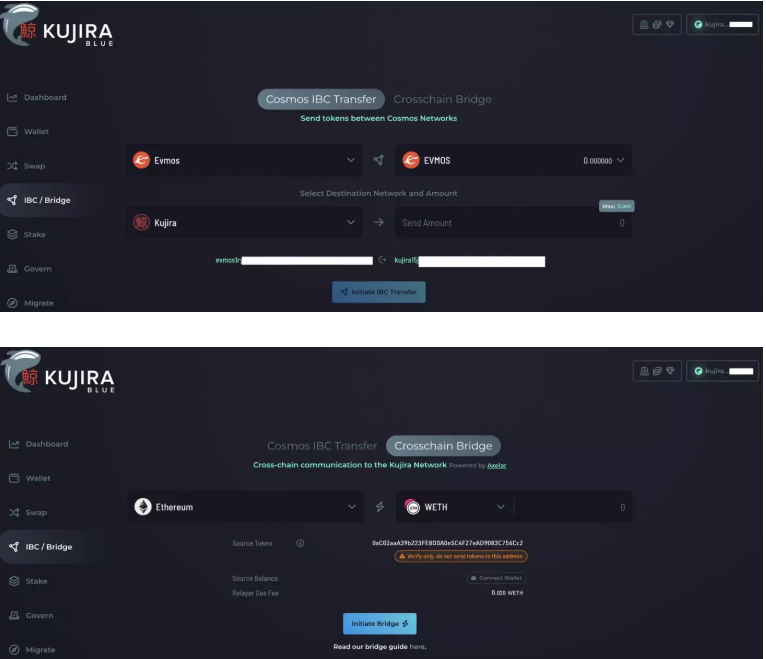
The Kujira team has built an efficient dApp to onboard assets from 17 blockchains across the entire Cosmos network. When you click IBC/Bridge from Blue’s main menu, you can easily bring your native IBC assets over from other chains. Fully integrated with Keplr Wallet, when you select a chain you haven’t interacted with before, a connection approval window automatically pops up.
For example, when choosing to transfer SCRT from Secret Network to Kujira, the amount of your liquid tokens on that chain will be displayed. You select the amount, initiate the IBC transfer, approve a small transaction fee in SCRT via Keplr, and then bring them over. You can then view these tokens in your Keplr Kujira wallet or through the wallet menu option on the Blue interface.
Kujira is being developed within Cosmos and pulls native IBC assets from across the ecosystem for use in its dApps. Moreover, the team has set its sights beyond Cosmos, aiming to integrate interchain assets from other networks. Another option to access the network is using the Axelar bridge to bring digital assets—including -axl synthetic assets and native tokens—from five additional ecosystems: Ethereum, Avalanche, Polygon, Fantom, and Moonbeam.
This also works very well—I’ve already tested it with USDC from Ethereum. However, please note that the relayer fees charged by Axelar are significantly higher than those of IBC (over $20), and the speed is not as fast.
Focused on Yield
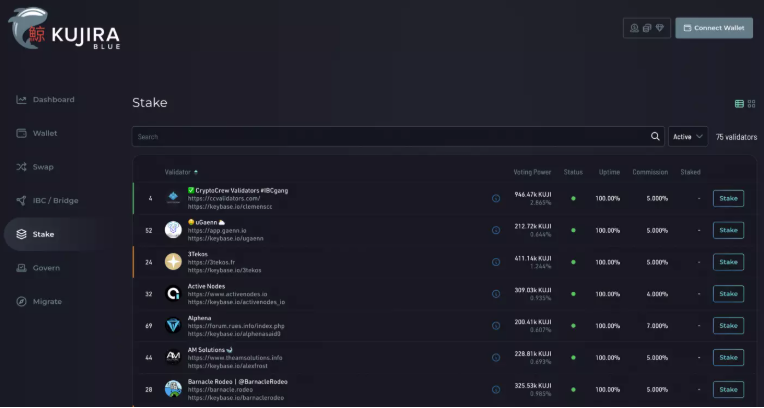
The Kujira team takes pride in their unique business model. In other words, staking on Blue offers a different kind of experience—while current APY may not be high, it could potentially reach +100% in the future. The reason? KUJI staking rewards are not based on inflation but on revenue. When dApps generate income, a portion flows back to KUJI stakers—and not just in KUJI! As a KUJI holder, you receive rewards in top-tier tokens generated on-chain. Seven such tokens are already active, and this list will grow as more assets are added.
The Kujira network is secured by an excellent team of 75 validators, including community-focused groups such as:
Smart Stake
Danku_Zone with DAIC
Oni
PFC
Crypto Crew
Lavender Five Nodes
Imperator
Finally, Blue includes governance voting, swapping, KUJI migration from Terra, and a dashboard.
Spot and Limit Trading
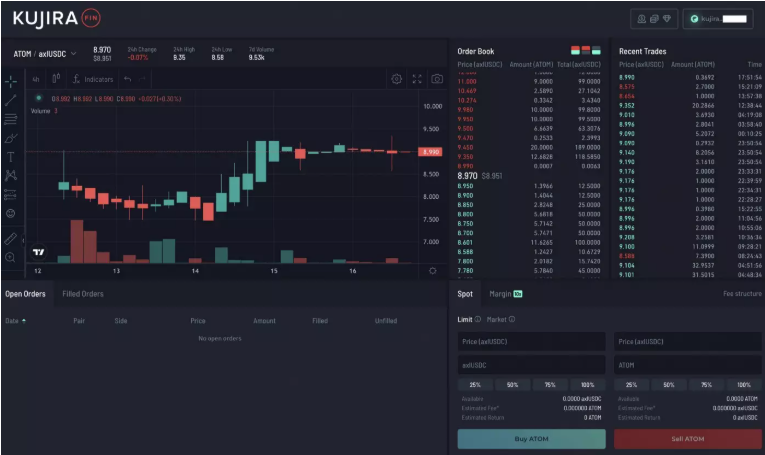
After successfully launching bridging and staking dApps, Kujira quickly rolled outFIN—an order book-based decentralized exchange. Apex assets are being added at a rapid pace, and I’ve been actively testing limit orders and market trading functions. Initial results are promising—orders execute as expected, the user interface is intuitive, and order tracking is impressive.
Each newly added asset goes through a liquidity bootstrapping phase, during which only limit orders can be placed. Once this initial stage ends, market orders are enabled. The exchange provides trading charts and views of buy orders, sell orders, and recent trades. At the time of writing, the following tokens are in full trading mode: KUJI, USDC, wETH, ATOM, JUNO, OSMO, and EVMOS. SCRT is currently in the liquidity bootstrapping phase.
Trading fees (0.075% for makers, 0.15% for takers) are distributed to KUJI stakers. Network fees are also collected but are minimal (just a few cents). By default, fees are paid in KUJI; however, you can change this setting to pay fees in USDC instead.
Your limit orders are visible under the open orders tab. Once your limit order is executed, you can see it in the completed tab. From a tracking and record-keeping perspective, I particularly appreciate this feature. Finally, Kujira also has its own blockchain explorer (Finder), where you can view all your liquid and staked assets, along with transaction history, simply by entering your wallet address.
Impact on the Ecosystem
dApps on the Kujira blockchain work seamlessly together and offer powerful functionality. By choosing to integrate assets from Cosmos from day one, Kujira positions itself as a multi-chain decentralized exchange for the entire ecosystem. They are combining protocols, dApps, and blockchains to add value to Cosmos. As the coming weeks unfold, I expect Kujira to bring more top-tier assets into FIN. The team is also proving that yield generation can be done differently. As KUJI holders, we earn a share of all these top-tier assets.

Just Getting Started
Blue and FIN have laid the foundation for Kujira, and the team is now introducing one of the most critical protocols: Orca. When the lending market launches on Cosmos, Kujira will be able to attract a passionate user community.
In the near future, thanks to Blue's IBC functionality, assets successfully liquidated will flow effortlessly throughout the ecosystem. With FIN’s spot and limit order capabilities, newly acquired assets from bids on Orca can be quickly swapped into stablecoins or other Cosmos assets. The blockchain collects fees at each step, creating a profitable flywheel, as Kujira was built from the start as a revenue-generating venture. Most importantly, fees collected from the blockchain’s dApps directly benefit KUJI stakers!
By using an order book exchange, there's no need to accumulate massive liquidity or deal with the complexities of maintaining AMMs.Kujira also introduces a new value model for stakeholders—one based on revenue generation rather than inflation. Additionally, they can bring communities stranded on the Terra chain into the Kujira ecosystem.
First impressions are lasting! When I first discovered Kujira and read about the innovative technologies under development, I was immediately captivated. Now, eight months later, the Kujira team has evolved and rebooted within Cosmos—an impressive engineering feat. They are fulfilling their original mission, bringing early supporters along, and building a new, stronger community. Take my word for it: Kujira is just getting started!
Join TechFlow official community to stay tuned
Telegram:https://t.me/TechFlowDaily
X (Twitter):https://x.com/TechFlowPost
X (Twitter) EN:https://x.com/BlockFlow_News






