PartyDAO: How did a group of strangers turn a single tweet into a $200 million product DAO in just one year?
TechFlow Selected TechFlow Selected
PartyDAO: How did a group of strangers turn a single tweet into a $200 million product DAO in just one year?
PartyDAO has raised $16.4 million in funding led by a16z, achieving a $200 million valuation—the highest to date for a community-driven DAO.
 Navigating Web3 tides with focused insights
By cwweb3
A few weeks ago, PartyDAO announced it had raised $16.4 million in a Series A round led by a16z, achieving a $200 million valuation—the highest valuation to date for a community-driven DAO.
PartyDAO is remarkable. It originated from a single tweet, has no founder or centralized team, and the vast majority of its members only contribute part-time alongside their full-time jobs. Despite these constraints, they delivered a strong product and grew into a standout product DAO within less than a year—funded initially by just 25 ETH from community fundraising.
Origins
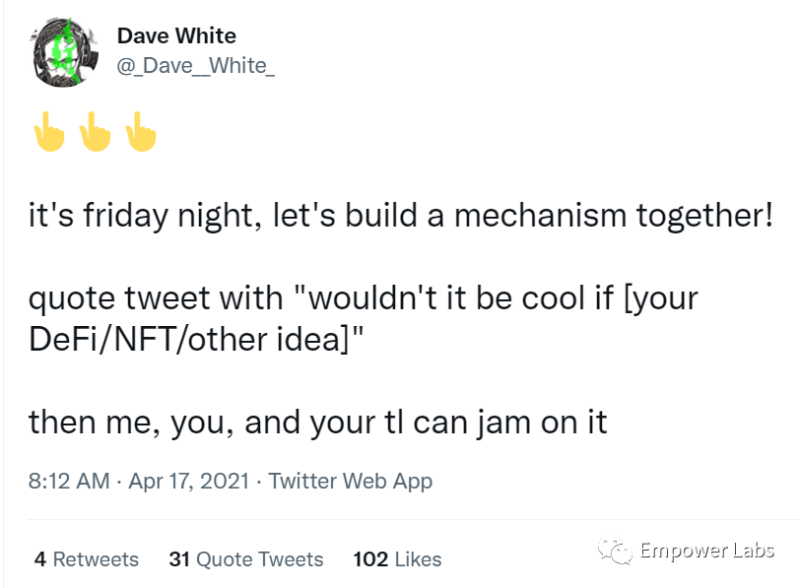
On April 16, 2021—a Friday night—Paradigm research partner Dave White was apparently in a good mood and decided to spark some casual conversation on Twitter:
"It's Friday night—let's play a game. Reply using the format 'Wouldn't it be cool if [xxxx]?' Then we can brainstorm together and see what ideas emerge."
He received 18 responses following the format, one of which came from Denis Nazarov, founder of Mirror.
"Wouldn't it be cool if you could deploy a DAO to automatically bid on any NFT auction? Call it PartyBid."
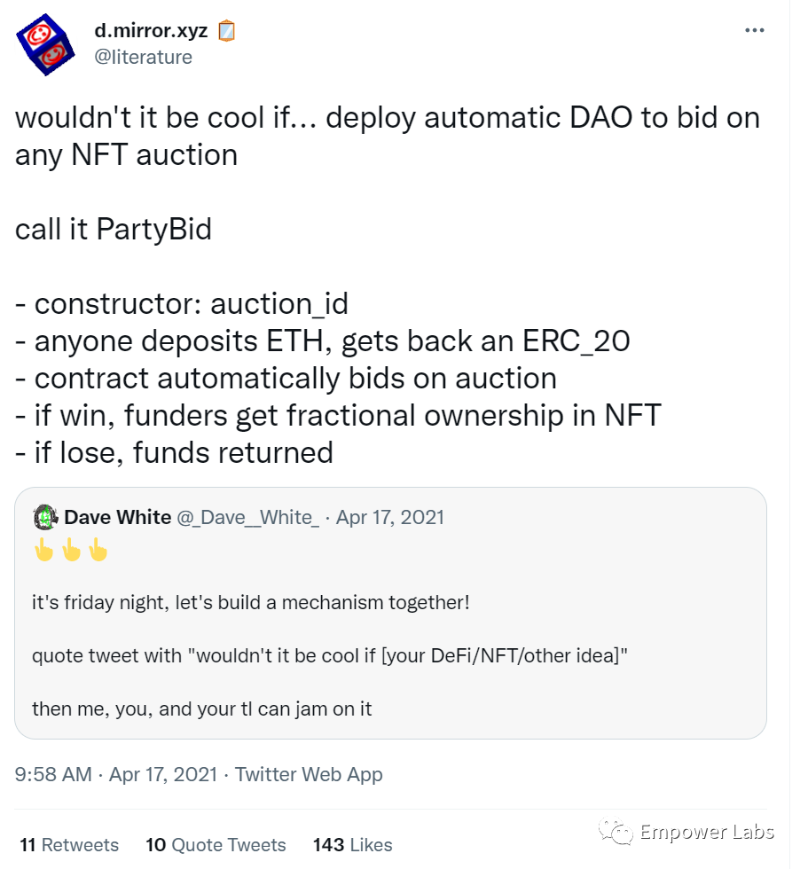
Denis didn’t just propose an idea and name it—he also laid out the core business logic right there in the same tweet, maximizing every bit of that single post’s potential.
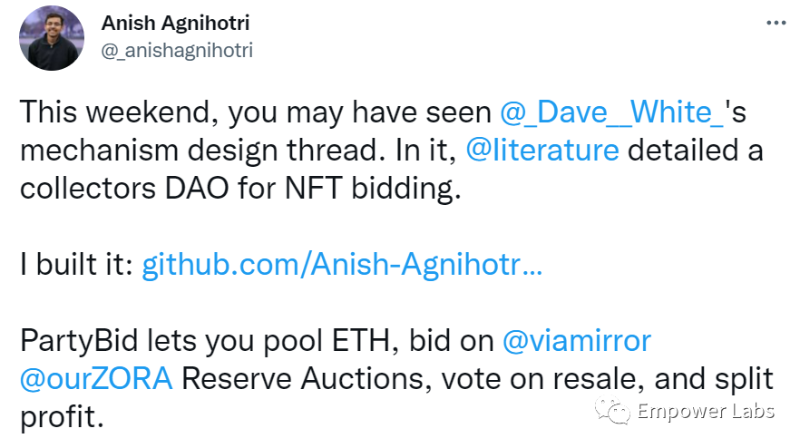
A guy named Anish saw the tweet. By day, he worked on high-performance trading systems at Polychain Capital; in his spare time, he tinkered with Ethereum projects and called himself an amateur Solidity engineer. Anish was being modest. Embodying the ethos of “do more, talk less,” he built a smart contract prototype for Denis’s idea over a single weekend.
Hardly had Anish posted about completing the contract when a woman named Anna replied. She was a professional smart contract engineer. She said, "Hey, I checked your code on my phone—it looks solid. Let me do a proper review and help audit it." People gradually started gathering like this. This MVP—without a frontend, without audits—was discovered by new contributors over the next two weeks. Drawn by the product vision, they even used the system to successfully win two auctions. It worked!
At this point, everyone agreed it was worth investing more resources to evolve the MVP into a mature product. One participant, John Palmer, stepped up. A generative art enthusiast with a previous failed startup under his belt, he volunteered: “I’m good at product management—I can lead this.” With a PM in place, roles for contracts, frontend, design, and auditing followed. Slowly but surely, a team took shape.
The Birth of PartyDAO
To advance the project further, they needed funding. After discussion, they decided to go the DAO route. They launched a crowdfunding campaign on Mirror, aiming to raise 25 ETH, with contributors becoming DAO members.
The 25 ETH target wasn’t much, so the fundraiser closed quickly. Fifty-two people participated, including nearly all future core contributors—meaning more than half the funds were essentially self-funded by those who would build the project.
"See how far the internet can take an idea in just two weeks? It’s crazy. But we can go even further."
● May 7 – Proposal #1: Establish a multi-sig group to jointly manage funds
● May 15 – Proposal #2: Approve six contributor roles with a budget of 11 ETH + 2,500 $PARTY, deliverables due in four weeks (exchange rate: 1 ETH = 1,000 $PARTY)
● May 15 – Proposal #3: Appoint John as Project Lead responsible for overall coordination
● May 17 – Proposal #4: Revise contributor roles to seven, adjust budget to 13.65 ETH + 2,500 $PARTY, assigning each role to specific individuals
The PartyBid V1 team was officially underway.
While only seven people were initially building the PartyBid product, other community members began organically shaping PartyDAO itself. Their goal wasn’t merely to launch a product, but to build PartyDAO into a sustainable long-term organization capable of self-maintenance.
By early August, PartyBid v1 launched. The core contribution team had grown to 11 members, and during development, they received support from over a dozen contributors across various projects and communities.
V1 was not the end—numerous iterations and optimizations followed. The community subsequently approved additional budgets for maintenance and further development.
Over the course of nearly a year, the entire community operated solely on the initial 25 ETH crowdfunding and minor on-chain protocol revenues.
Fundraising During a Bear Market
Let’s dive into the funding details—many readers are likely most interested in this. All public reports so far have cited PartyDAO’s official announcement, which didn’t even disclose the valuation.
In this round, PartyDAO raised $16.4 million in USDC, giving up 8.2%—implying a $200 million valuation. a16z led with $10 million, Standard Crypto invested $3.5 million. These two made up the bulk of the round, with smaller allocations going to Compound VC, Dragonfly Capital, and Uniswap Ventures.
Beyond institutional investors, the round included strategic and community investors.
Strategic investors were mostly top-tier figures in Web3: OpenSea founders Alex and Devin, Zora founder Jacob, FWB founders Trevor and Alex, Loot creator Dom, Flamingo founder Aaron Wright, and others—so many big names that it’s hard to list them all. Community investors were all active PartyDAO members, including most of those mentioned earlier, collectively contributing $1 million.
Tokens will unlock 1/4 after one year, with the remainder vesting monthly over the following 36 months. The round was actually completed in mid-March but publicly announced in early June.
Building the Future of Collective Coordination
Crypto constantly swings between booms and busts. When people pour money into digital images, PartyBid might seem like just another speculative trend.
But that’s not the full story.
With the rise of Web3 and DAOs, people no longer need to rely on traditional institutions. Instead, they can align around shared values and interests. From early hunter-gatherer tribes to retail investors beating Wall Street short-sellers on GME stock, history shows humans naturally seek coordination around common goals—even without formal social ties. As crypto evolves from speculation toward real utility, people are naturally moving toward collective participation in ecosystems. PartyBid is focused squarely on enabling this shift.
PartyDAO is an experiment—one that could become a blueprint for how communities self-organize, fund, build, and scale open infrastructure and next-generation applications. At its core, PartyDAO transforms activities once limited to individuals or centralized organizations into multiplayer experiences. Their ambition is to create powerful tools for collective coordination that anyone in society can use—not just a niche group of crypto enthusiasts.
There’s much more worth saying about PartyDAO. This article hasn’t delved into product development or DAO governance mechanics. I’ve already connected with several core contributors at PartyDAO. Once I gather enough material, I’ll explore how highly decentralized community DAOs collaborate to execute complex tasks like product development and fundraising—sharing the fascinating stories and key lessons learned along the way.
Join TechFlow official community to stay tuned
Telegram:https://t.me/TechFlowDaily
X (Twitter):https://x.com/TechFlowPost
X (Twitter) EN:https://x.com/BlockFlow_News