








Will $OP, used solely for governance, suffer the same fate as $ENS and $UNI?
TechFlow Selected TechFlow Selected
Will $OP, used solely for governance, suffer the same fate as $ENS and $UNI?
Although the OP token has underperformed, Optimism's initiatives are still worth considering and learning from.
 Navigating Web3 tides with focused insights
Written by: Morty, TechFlow
This topic is quite broad, but I really want to talk about it. A common criticism of $ENS is that it lacks substantial utility and serves only governance purposes. The previous surge in $ENS was driven by people’s recognition of the protocol's products and the competition for governance rights over $ENS. The same goes for $UNI. Both DApps are exceptionally strong—ENS has become a critical component of the Ethereum ecosystem, while Uniswap v3 alone generated $7.58 billion in trading volume over the past seven days (even amid poor market conditions). This is precisely what initially motivated whales to buy these tokens.
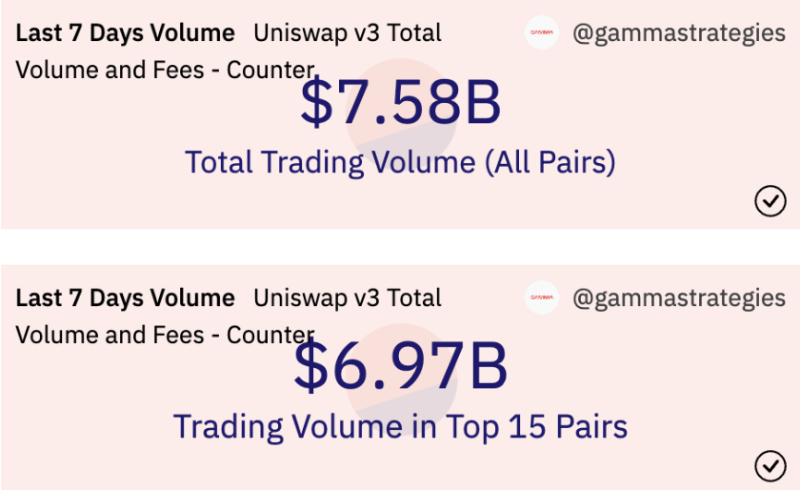
Data source:https://dune.com/gammastrategies/Uniswap-v3-Volume-and-Fees-Collected
But how does this apply to $OP?
Optimism, as a base-layer network, has a different governance logic compared to dApps. While dApp security is guaranteed by Ethereum and their governance tokens are primarily used within the protocol, $OP—the network’s governance token—not only participates in governance but also influences the operation of the Optimism sequencer and consensus mechanism. However, it's still early days.
Now let’s discuss how Optimism’s governance works and what its goals are.
First, the conclusion: Optimism places extremely high importance on governance. "Impact = Profit" is the core principle of the Optimism ecosystem. They aim to create a cycle of “governance → gaining influence → user growth → profit.” This means Optimism intends for $OP holders’ governance rights to generate greater ecosystem profits in the future. It's a flywheel effect—difficult to initiate at first, but accelerating over time as the system matures. A key feature of Optimism is its active effort to reduce the influence of whales and institutions on governance fairness, promoting long-term retail participation during network expansion.
Let’s dive in:
In the article This Governance Will Self Destruct, Optimism states that The Optimism Collective is a large-scale governance experiment aimed at reducing the dominance of large token holders and funding public goods to build a more unified internet. Optimism’s vision is to create a network “built for, and governed by, its citizens.”
How do they achieve this? (The following references come from the $OP claim process)
1. Working Constitution and Bedrock Constitution
Regarding constitutional drafting, the initial constitution is called the "Working Constitution." Its provisions are scalable and will evolve in response to future challenges. Practice is the sole criterion for testing truth. The Optimism team will conduct a series of governance experiments to better understand the ecosystem’s balance and power dynamics, allowing flexibility and encouraging real-world implementation. After no more than four years of experimentation, Optimism will release the "Bedrock Constitution," which will serve as the foundational framework for future governance. In other words, the Working Constitution will inform the creation of a practical and guiding Bedrock Constitution based on real-world experience.
It’s worth noting that Optimism’s current rollup architecture is also named Bedrock, one stage in the network’s development, upgraded earlier this year in May. The goal of the Bedrock upgrade is to significantly reduce transaction fees and increase network throughput.
2. Coexistence of OP Holders and OP Citizens
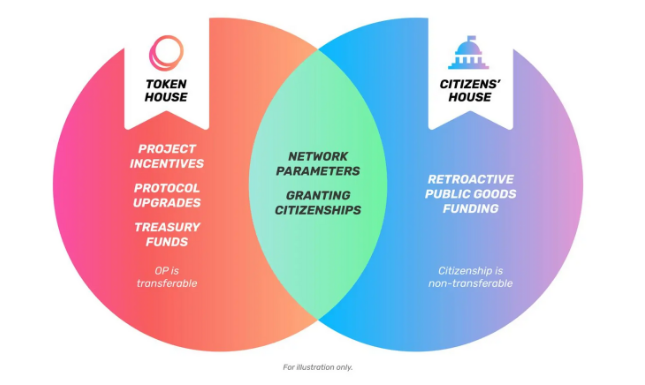
“Dual governance on one chain” (Token House and Citizens House), primarily designed to balance Optimism’s short-term incentives with long-term vision. This governance model can be compared to Curve’s structure—where governance power is tightly linked to LP rewards, which in turn are strongly tied to protocol revenue sharing and token locking. Why is everyone adopting the ve-model now? Because it effectively aligns short-term incentives with long-term goals. While it doesn’t solve the fundamental issues of decentralized governance, it remains a viable solution.
The diagram below makes this clear: Optimism splits protocol governance into two chambers—Token House and Citizens House. In my understanding, Token House members (token holders) are fluid and dynamic, while citizenship in the Citizens House is fixed. The Token House makes decisions on economic parameters (like inflation rate), protocol upgrades, and treasury fund usage through voting by token holders.
The Citizens House (composed of those granted citizenship) is responsible for allocating retroactive public goods funding, with plans to grant even more powers in the future. Network parameters and the granting of citizenship will be jointly decided by both the Token House and the Citizens House.
3. The Steward of the Optimism Ecosystem: The Optimism Foundation
The influence of the Optimism Foundation will gradually diminish over time. Its main responsibilities include:
● Leading the initial phase of governance;
● Allocating treasury assets to fund public goods, incentivize ecosystem participants, and promote the development of Optimism;
● Modifying the constitution (as mentioned above);
If the Optimism Foundation’s board fails to perform adequately, the Token House can remove them or reject proposed constitutional changes—especially if such changes harm the interests of $OP holders.
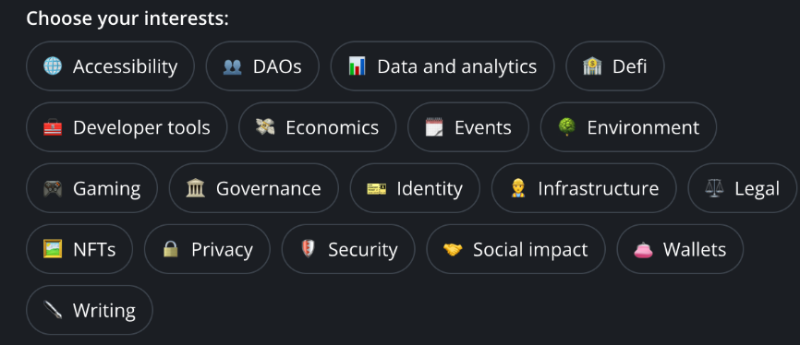
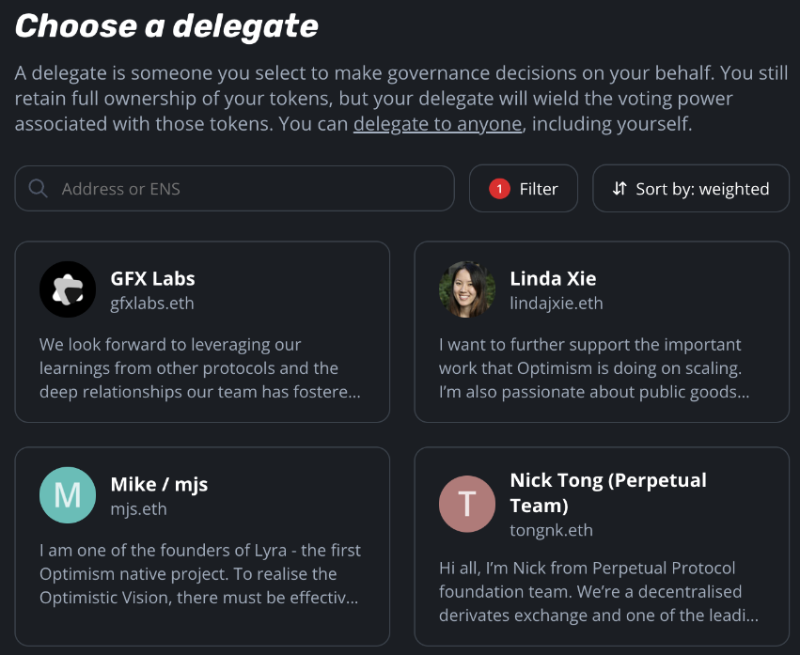
Lastly, it's important to note that $OP holders can delegate their governance rights to others—a common and encouraged practice. I noticed they’ve categorized representatives—for example, if we’re interested in “DAOs,” we can click and choose someone influential or experienced in the DAO space as our voting delegate. This makes it easy to select like-minded individuals. Voters → Representatives → Chambers.
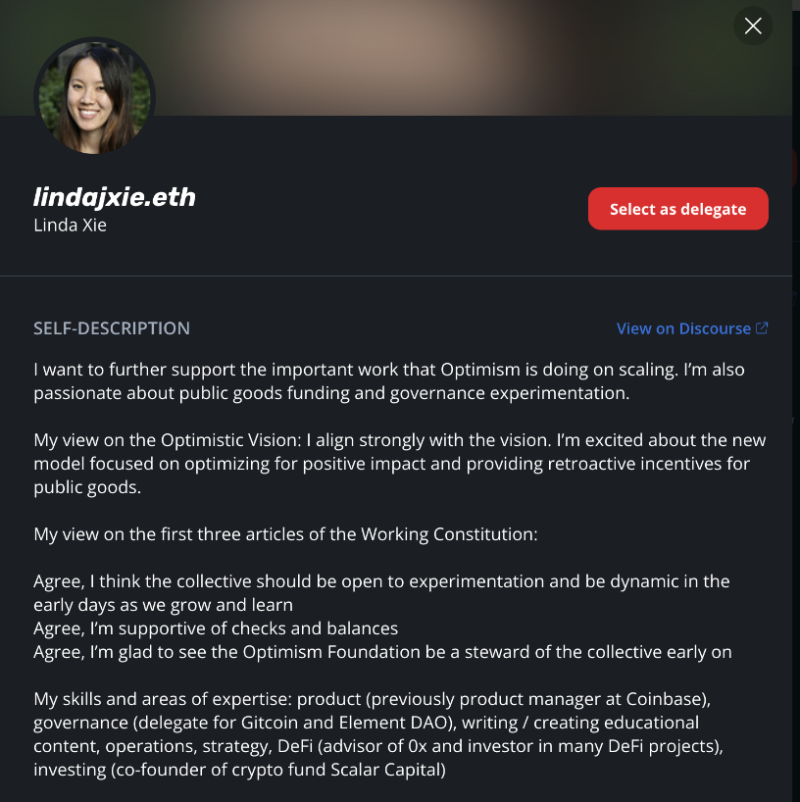
Returning to the earlier point: Optimism aims to use dual governance via the Token House and Citizens House to reduce whale influence—thereby decreasing centralized control over the protocol/network by large holders. By mitigating this concentration of power, Optimism hopes to increase retail investors’ trust and engagement in governance.
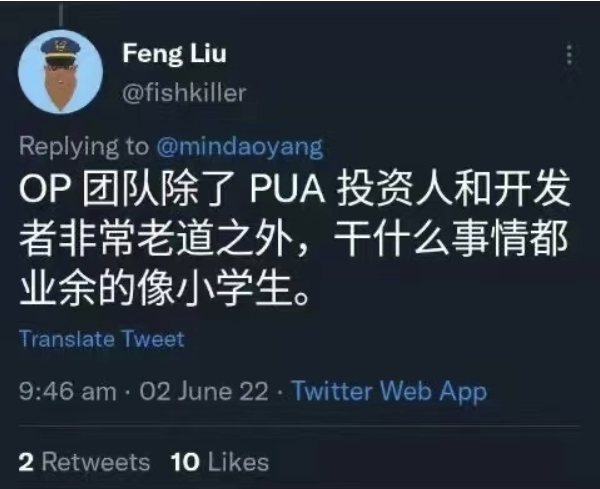
One final note: Despite underwhelming performance of the $OP token, the experiments being conducted by Optimism are still thought-provoking and worthy of reference. However, we must also pay attention to the issues displayed by the Optimism team during the OP airdrop claim period. As Professor Liu Feng put it: “Aside from being highly skilled at PUA-ing investors and developers, everything else the OP team does feels amateurish, like elementary school students.”
As for when $OP might be a good buy—I won’t comment on that.
Original link: https://twitter.com/qiaoyunzi1/status/1532597606215323648
Join TechFlow official community to stay tuned
Telegram:https://t.me/TechFlowDaily
X (Twitter):https://x.com/TechFlowPost
X (Twitter) EN:https://x.com/BlockFlow_News






