








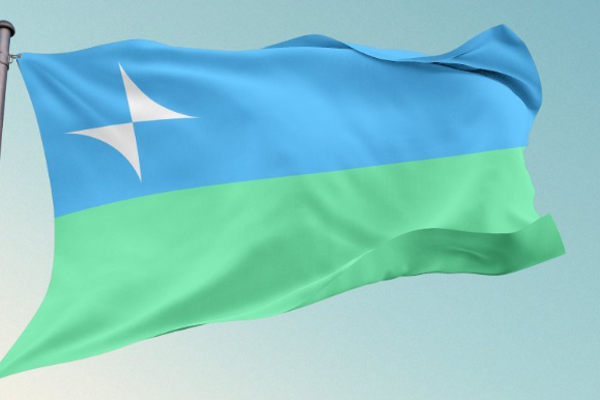
Nation3, a rough yet great experiment
TechFlow Selected TechFlow Selected
Nation3, a rough yet great experiment
What Nation3 aims to do is transcend the nation-state and establish a new national narrative.
 Navigating Web3 tides with focused insights
Author: 0x5willows, TechFlow Intern
Prelude: Since its listing on CoinGecko on April 19, the price of Nation3’s token (NATION) surged from $510 to a peak of $12,749—an increase of 2,399%. I had been following this project since April 10, but unfortunately did not gain significant financial returns. With some regret, I write this article.
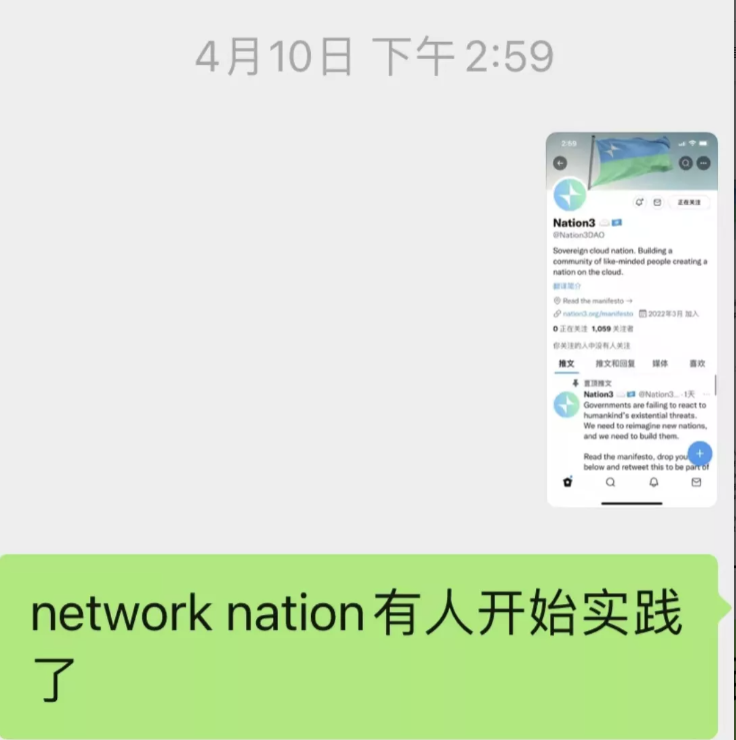
As a newcomer to the crypto world with a background in political philosophy, I’ve always paid attention to projects related to socio-politics. When I first saw Nation3, I felt a sense of surprise—Balaji Srinivasan’s *The Network State* hadn’t even been published yet, and here was a cloud-based nation already going live.
The name "Nation3" itself reveals the project team’s ambition. In English, there are three words corresponding to the Chinese term “国家” (“state”): "country," "state," and "nation." Among them, "country" emphasizes land; "state" refers to government or regime; while "nation" focuses on people. The Latin root of "nation," *natio*, originally meant kinship by blood, later expanding to refer to groups of people sharing common origins. At that time, the state was at version 1.0, taking the form of an "empire" or "kingdom." With the emergence of modern national consciousness, "nation" acquired the meaning of ethnicity and became the object of national identity. The isomorphism between nation and state gave birth to the 2.0 version—the nation-state (nation-state).
Centralized nation-states wielded greater power. Grand visions such as opening new sea routes or the Apollo moon landing were realized by nation-states. Ancient Eastern empires crumbled before the rising Western nation-states. Eventually, the "nation" became the dominant form of political organization.
Yet it was also the nation-state that established the most intense personal control in history. They could manipulate media, mobilize masses, spread hatred, or ignite endless wars, turning citizens into victims. As the Nation3 whitepaper rightly states, such a state system needs to be dismantled. We need new tools to build communities, understand laws, protect citizens from violence, and develop new governance models to fund public goods. The emergence of cryptocurrency, smart contracts, and DAOs makes all this possible.
What Nation3 aims to do is transcend the nation-state and establish a new national narrative.
In terms of narrative ambition, Nation3 is no less grand than Bitcoin. Bitcoin represents an experiment beyond fiat currency; Nation3, an experiment beyond the nation-state—each imagining a new financial and political order for a new world.
However, Nation3 will hardly become the next Bitcoin.
Imagining a new world is important, but proposing concrete plans to build it matters more. In my view, Bitcoin’s current stature does not stem merely from being the first cryptocurrency, but more importantly, from the technological framework born alongside it—blockchain.
By contrast, to this day, Nation3’s official website still contains no detailed project information—only a solitary manifesto sits there. No matter how beautiful the vision painted in that manifesto, it cannot sustain a narrative without concrete implementation.
While ideas may precede action, the power of narrative might be greatly overestimated. In reality, no vision for a new world emerges out of thin air. One can see echoes of Bitcoin’s narrative in Hayek’s *Denationalisation of Money*; similarly, traces of Nation3’s narrative can be found in earlier works—and some have even taken action.
In 1967, former British Army Major Roy Bates and his wife Joan occupied Sealand, an abandoned military platform off the southeast coast of England, declared it an independent principality, and crowned themselves Prince Roy and Princess Joan. Although the Principality of Sealand has never gained international recognition, compared to Nation3, it clearly resembles a real country much more closely.
But if I hadn't specifically mentioned this anecdote, how many people would actually know about Sealand?
Despite vastly superior communication conditions in the Web3.0 era compared to the last century, the crypto space is never short of new projects and narratives. There has never been success based purely on narrative alone—if one must name an exception, only Bitcoin qualifies. As Do Kwon, founder of Terra, once said in an interview with *Fungible Times*, if UST—which uses BTC as external reserve assets—were to fail, it would be equivalent to the failure of cryptocurrency itself.
Of course, another possibility remains: perhaps the Nation3 team will eventually release a concrete plan for building this "cloud nation." If so, could NATION become something like Bitcoin?
The answer is the more successful Nation3 becomes, the less likely NATION will resemble Bitcoin—or rather, the further it will be from Bitcoin in terms of investment return potential. In a real nation, citizenship cannot be freely transferred or arbitrarily issued; this is fundamental to stability. Therefore, as a symbol of citizenship, the liquidity of NATION must be restricted—a principle reflected in Nation3’s mandatory staking requirement. Even without official restrictions, if participants genuinely believe in Nation3’s vision, they would not readily sell their NATION tokens. Ultimately, all NATION tokens would end up in the hands of sincere believers.
Although the current manifesto presents a rather crude vision—so crude that it fails to even define what Nation3 actually is—we don’t know whether Max Weber’s classic definition of the state—"a human community that claims the monopoly of the legitimate use of physical force within a given territory"—still holds true in Nation3. What corresponds to territory, population, and sovereignty—the traditional elements of a state—in Nation3? All remain unclear.
In the dazzling and ever-changing crypto world, Nation3 may well be quickly forgotten. Yet it remains a great experiment, because in the near future, a new Nation3 will surely emerge.
The future of Nation3 does not lie in investment returns, but in expanding the boundaries of the concept of nation—and political organizations more broadly—by establishing a new order in the cloud, thereby pushing the real world toward greater fairness and democracy.
Join TechFlow official community to stay tuned
Telegram:https://t.me/TechFlowDaily
X (Twitter):https://x.com/TechFlowPost
X (Twitter) EN:https://x.com/BlockFlow_News






