








The New King of Venture Capital: How a16z Partner Chris Dixon Fell Down the Cryptocurrency Rabbit Hole
TechFlow Selected TechFlow Selected
The New King of Venture Capital: How a16z Partner Chris Dixon Fell Down the Cryptocurrency Rabbit Hole
He changed WEB3.
 Navigating Web3 tides with focused insights
By Alex Konrad, Forbes
Translation: TechFlow
Note: Recently, U.S. magazine *Forbes* released its latest "Midas List 2022." Launched in 2001, the list originally ranked the top 100 venture capitalists globally based on returns from their investment portfolios over the previous year. Named after King Midas, the mythical figure who turned everything he touched into gold, the list is also known as the “Golden Touch” list and is often regarded as the Oscars of the investing world.
In 2018, Neil Shen, Global Managing Partner at Sequoia Capital China, topped the list—the first time a Chinese investor had claimed the No. 1 spot—marking what now looks like the peak moment of China’s internet golden era.
This year, a new No. 1 has emerged: Chris Dixon, partner at Andreessen Horowitz (a16z). Joining a16z in 2013, he made early investments in companies like Ripple and Coinbase, doubling down on Coinbase in every subsequent funding round, becoming its largest outside shareholder with holdings once valued at tens of billions of dollars.
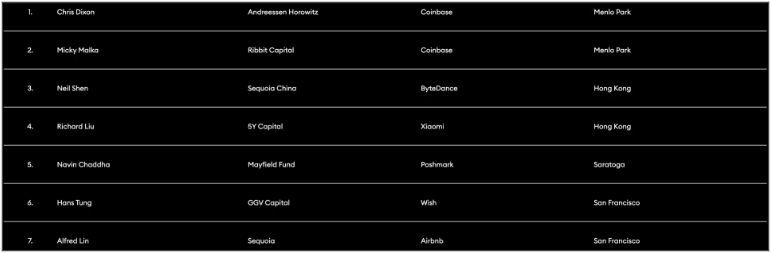
Chris Dixon isn’t alone—more than a dozen investors on this year’s list count Coinbase as one of their key investments, placing it third among all portfolio companies.
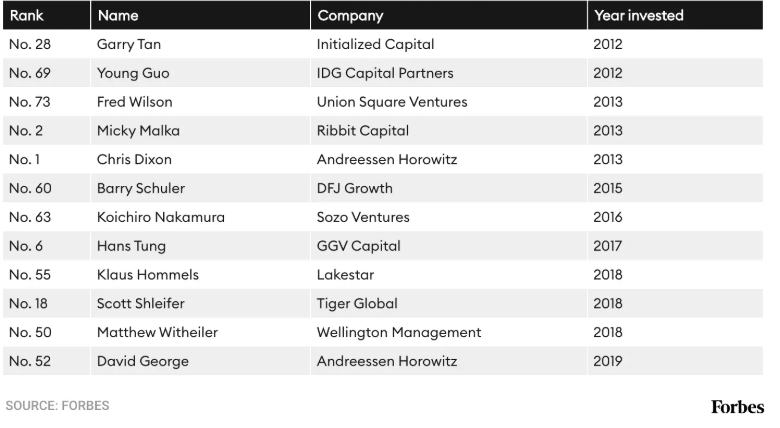
Investors who backed Coinbase
Today, Chris Dixon is arguably the biggest champion of the Web3 narrative—or as Forbes puts it, “he led the charge into Web3.” This is the story of how he fell into the crypto rabbit hole.
Main Text:
In 2013, serial entrepreneur Chris Dixon transitioned into venture capital, seeking the next big technological wave. The 1980s brought personal computers, the 1990s the internet, and the 2000s mobile phones. After joining Andreessen Horowitz as a new partner, Dixon began pursuing his “moonshot” investments—virtual reality, 3D printing, and drones.
But it was his early bet on cryptocurrency exchange Coinbase that would define his career. In 2013, his firm led a $25 million funding round for Coinbase. By April 2021, when Coinbase went public via direct listing, Andreessen Horowitz had accumulated nearly 30 million shares (about 15% ownership) through 14 additional rounds of investment.
At the close of Coinbase’s first trading day, those shares were worth approximately $10 billion—an astonishing ~60x return. (The firm has since sold some shares; the current valuation is roughly half that peak.)
Coinbase became the crown jewel in the portfolio, propelling the 50-year-old Chris Dixon to the top of the Midas List.
Dixon has made several other major bets, including decentralized exchange Uniswap (with a $10 billion fully diluted valuation, including tokens not yet in circulation), open-source blockchain Avalanche ($62 billion), and Dapper Labs ($7.6 billion), the creator of NBA Top Shot.
Currently splitting his time between New York and California, Chris Dixon stands as both an elder statesman and financial powerhouse in the crypto space. Thanks to the success of a16z’s first dedicated crypto fund (named for the 16 letters between “a” in Andreessen and “z” in Horowitz), Dixon and his team turned $350 million into $6 billion in realized and unrealized gains by the end of 2021—a staggering 17.7x return, according to someone familiar with the fund’s finances.
That source told Forbes that Dixon and his team are now raising fresh capital, reportedly aiming to launch the largest-ever cryptocurrency-focused venture fund, targeting $4.5 billion. Andreessen Horowitz declined to comment on its performance or fundraising activities.
“By any measure, he’s the preeminent crypto investor,” says Hemant Taneja, managing director at General Catalyst (ranked No. 23 on the Midas List), who backed Dixon’s first startup nearly two decades ago. Colleague and a16z co-founder Ben Horowitz (No. 87) goes even further: “I think in 10 years, everyone will view him as the greatest investor of his generation.”
Chris Dixon rarely gives interviews, but during a conversation with Forbes, he downplayed his own “Midas touch.” “My job isn’t to predict the future,” he said, “my job is to recognize smart people who can see the future and back them.”
The son of two English professors at Wittenberg University in Germany, Chris Dixon grew up in Ohio, taught himself programming, and later instructed others at computer summer camps. An interest in cognitive science and logic led him to pursue a bachelor’s and master’s degree in philosophy at Columbia University in the early 1990s.
Skeptical of corporate capitalism from an early age, Dixon defied his parents’ wishes and took a developer job at a hedge fund—one offering the highest salary available. Roughly three years later, he earned an MBA from Harvard and briefly worked at Bessemer Venture Partners.
He then left to co-found SiteAdvisor, a tool that warned users about viruses and malware. Less than a year later, security giant McAfee acquired the still-revenueless startup.
Next, Dixon co-founded Hunch, an early recommendation engine. Like SiteAdvisor, it was acquired—in 2011 by eBay for around $75 million. After building and selling two companies, Dixon was exhausted. He faced a choice: continue as an independent investor, treating his blog and podcast as his main output, or become a full-time venture capitalist.
While building Hunch, Dixon had already begun personally investing in other startups within New York’s then-small tech scene, some of which borrowed desks in Hunch’s office. His more than 50 individual investments include crowdfunding platform Kickstarter (2009), social sharing site Pinterest (2011), and online payments company Stripe (2012).
He also helped launch a seed-stage fund called Founder Collective, collaborating with other successful entrepreneurs-turned-angels such as David Frankel (Midas No. 11), Bill Trenchard (Midas No. 86), and Eric Paley (a former Midas lister).
But in Silicon Valley, Dixon gained most recognition for his personal blog launched in 2009, where he shared entrepreneurial advice, personal reflections, and commentary on big tech. The blog remains active today, featuring highlights like a 2011 warning about Apple TV’s entertainment ambitions and an early defense of NFTs a decade ago.
Though Dixon publicly believed New York’s tech ecosystem would eventually thrive, investing so far from California felt like watching from the sidelines. Fortunately for him, Marc Andreessen and Ben Horowitz—the most disruptive and vocal figures in venture capital—were avid readers of his blog and invited him west to join them. Dixon recalls thinking, “This is my path forward—I can go find the next thing and be part of it.”
Dixon’s so-called frontier or “moonshot” investments led him to back Oculus (later acquired by Facebook), drone company Skydio, and cryptocurrency firm Ripple.
Through an investment in 21.co, a Bitcoin mining startup founded by former a16z partner Balaji Srinivasan, Dixon connected with Brian Armstrong (co-founder of Coinbase), gaining access to invest in Coinbase.
Armstrong recalled a four-hour conversation in 2013 where the trio found common ground on regulatory compliance for cryptocurrencies. That December, Dixon led Coinbase’s Series B round, joining a syndicate that included investor Garry Tan (Midas No. 28) and USV partner Fred Wilson (Midas No. 73).
In an email to Forbes, Brian Armstrong noted, “Over the next several years, Andreessen Horowitz was the only firm to reinvest in every single round—including down rounds at lower valuations.”
Dixon proved instrumental across multiple fronts—from securing board members and banking partners to advocating for Coinbase to expand support for Ethereum and non-Bitcoin assets. As Armstrong put it: “I can confidently say a16z was Coinbase’s most impactful investor. Chris has a unique ability to see around corners, especially when it comes to technology and what should be built next.”
In 2018, while Chris Dixon focused full-time on crypto investments through a16z’s inaugural fund, they planted high-profile flags in this emerging field. Today, Dixon and his team face intensifying competition—not just from generalist VCs allocating more resources to crypto, but also specialized rivals like Paradigm, co-founded by Coinbase’s other co-founder Fred Ehrsam.
Yet Dixon’s dedication to cryptocurrency and his willingness to persevere through downturns still carry unique weight. Hayden Adams, CEO of Uniswap—a mainstream decentralized exchange that Dixon backed during its A round (one round after Paradigm)—said Dixon possesses a rare ability to bridge traditional tech and finance worlds with crypto, evidenced by hires like bringing in a COO from BlackRock and an engineering VP from Snap.
Roham Gharegozlou, CEO of Dapper Labs, believes Dixon foresaw the rise of NFTs. His company created CryptoKitties, among the first digital collectibles on the Ethereum blockchain. Dixon snagged Kitty No. 15. “Chris saw this industry before it even began,” Gharegozlou said.
Such credentials are invaluable in an industry that prizes early adoption and conviction. It also means that if he wanted, Dixon could easily strike out on his own and raise billions for his own firm. For example, Katie Haun, formerly a partner at a16z, recently left to launch Haun Ventures with $1.5 billion in commitments. Still, Dixon and his close colleagues insist he has no intention of going solo.
“Going independent isn’t what drives me,” he said. “To me, the next three years might be the golden era for crypto. So I really don’t want to spend the next two years setting everything up, hiring a team, and doing all that stuff.”
Instead, multiple sources tell Forbes that Dixon and a16z have been telling investors they plan to eventually fold the a16z crypto fund back into the firm’s central fund. Such a move would signal broader institutional buy-in across the entire firm on Web3, reflecting that crypto strategy—and ubiquity—can no longer remain siloed within a single fund. An a16z spokesperson declined to comment on the speculation.
Bringing crypto further into the mainstream is a challenge Chris Dixon is actively tackling. Last September, a detailed Twitter thread by Dixon titled “Why Web3 Matters” went viral.
By December, his advocacy for Web3’s vision of a decentralized internet and more direct user ownership—a missing piece, in his view, from today’s Facebook or Twitter-style “Web2” platforms—caught the attention of Twitter co-founder Jack Dorsey.
Then no longer CEO of Twitter, Dorsey tweeted: “You [a16z] are a fund determined to become a media empire that cannot be ignored… Not Gandhi.” He argued that Web3 would still be owned by individuals—but this time, the owners would be VCs.
The feud ended with Andreessen blocking Dorsey on Twitter; Dixon didn’t block Dorsey, but blocked others involved. Reflecting on it now, Dixon says he “probably overreacted,” quoting a popular saying on Twitter: “The goal of Twitter isn’t to win the game for one day. In this case, I lost.”
Colleagues say Dixon takes such attacks personally, seeing himself as defending underdog entrepreneurs against powerful online figures. “I think he sometimes comes off as brusque or rigid, but it genuinely comes from the best intentions,” said Arianna Simpson, a16z crypto partner.
Now, Chris Dixon offers a more measured perspective toward Jack Dorsey and any other tech leaders questioning Web3’s decentralization potential. “My response is, ‘Hey, great—come join us and help solve these problems.’ In contrast, I feel like there’s a tendency to lob grenades from the sidelines,” he said.
It’s hard for the world’s top-ranked investor to claim victimhood, but Dixon insists that when people dismiss crypto as “just gambling for tech bros to get rich,” the industry and its transformative potential are fundamentally misunderstood.
This year, Dixon plans to spend more time in Los Angeles meeting tastemakers and creators in the entertainment industry, promoting Web3’s promise of more direct ownership for content, and bringing musicians and others to Washington, D.C., to help win over policymakers.
Of course, broader acceptance of crypto would only increase the value of Chris Dixon’s already substantial portfolio. But he insists that chasing Midas-like returns isn’t his sole motivation.
“We’re a VC firm—I don’t want to pretend we aren’t. But I’d say I’m driven because I believe Web3 is a truly important movement, and I want to shape it. I deeply believe in it.” he said.
Join TechFlow official community to stay tuned
Telegram:https://t.me/TechFlowDaily
X (Twitter):https://x.com/TechFlowPost
X (Twitter) EN:https://x.com/BlockFlow_News
 深潮TechFlow






