TVL Surpasses $4 Billion: Can Stargate Become the New Leading Cross-Chain Bridge?
TechFlow Selected TechFlow Selected
TVL Surpasses $4 Billion: Can Stargate Become the New Leading Cross-Chain Bridge?
Views and judgments based on Stargate's on-chain data and recent market trends.
 Navigating Web3 tides with focused insights
Author: planD (Twitter: @crosschaindude)
As a cross-chain bridge launched just about two weeks ago, Stargate has already reached approximately $4 billion in TVL (Total Value Locked) at the time of writing, making it a standout star project in the current market. In this article, we will first review Stargate's underlying protocol and core algorithm, then combine on-chain data from Stargate with recent market trends to offer our views and judgments on its future trajectory.
Note: This article does not contain any investment advice.
Stargate’s Underlying Protocol: LayerZero
Currently, asset bridging solutions in the market can be divided into three categories: custodians (or validators), relayers, and hash time-lock contracts (HTLC):
The "custodian" mechanism, also known as "third-party validation," relies on third parties to verify asset transfers, where validators are typically reputable institutions that use multi-signature technology or similar methods to mitigate centralization risks. Current bridges using this model include Multichain, Synapse, and AllBridge.
The "relayer" mechanism, also known as "native validation," involves relayers monitoring events on the source chain and forwarding encrypted proofs along with block headers to the destination chain. Native validation is favored by official cross-chain bridges of major blockchains, such as Near’s Rainbow Bridge, Avalanche’s Avalanche Bridge, and Terra’s Terra Bridge.
The Hashed Time-Lock Contract (HTLC) mechanism matches users needing cross-chain transfers and uses cryptographic time-locks to ensure atomic and consistent asset release without requiring trust in third parties. Bridges using HTLC include cBridge, Hop Finance, and Meson.
Stargate belongs to the "relayer" category—or more precisely, its underlying protocol LayerZero operates on the relayer model. Before diving into Stargate itself, let's examine LayerZero: positioned as an inter-blockchain messaging protocol, LayerZero functions similarly to the TCP protocol in the internet’s transport layer, enabling various DApps to be built atop it. Its operation can be summarized as follows: a client application on Chain A sends a message to LayerZero’s endpoint, after which independent relayers and oracles separately provide proof of the transaction and proof of block updates. The process is illustrated below:
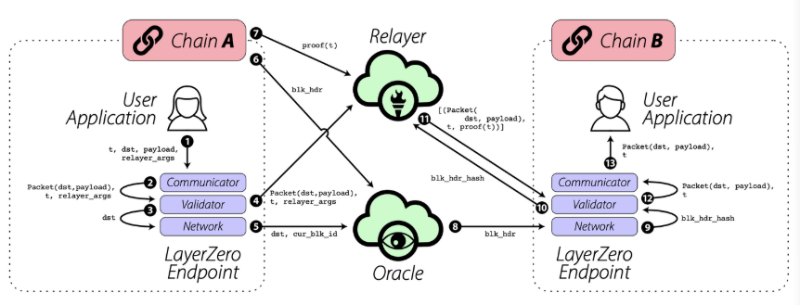 LayerZero protocol diagram. Source: LayerZero Whitepaper
(Steps 1–3 in the figure) UA (User Application—e.g., a DApp contract using LayerZero) on Chain A packages the message and target chain ID and sends it to LayerZero’s endpoint on Chain A;
(Steps 4–5) The endpoint on Chain A forwards the message to the designated relayer and sends the current block ID to the oracle;
(Steps 6–7) The relayer receives transaction proof from Chain A, while the oracle fetches the block header of that block on Chain A;
(Step 8) Once the oracle confirms sufficient finality of the block on Chain A, it sends the block header to the endpoint on Chain B;
(Steps 9–13) The endpoint on Chain B uses the block header to query the relayer and retrieves the original message initiated by UA on Chain A, complete with transaction proof.
In this setup, LayerZero uses Chainlink as its oracle service, while relayers are off-chain services that anyone can operate. Notably, the relayer acts as the "messenger" transmitting information, while the oracle serves as the "supervisor" verifying the message's authenticity. As long as these two roles remain independent, LayerZero’s security is preserved. Chainlink, being one of the most mature oracle networks in the market, has a low likelihood of colluding with relayers.
LayerZero enables smart contracts to communicate across public chains—its utility extends far beyond simple asset transfer bridges. In the future, we may see innovations like cross-chain lending, multi-chain yield aggregators, and shared state protocols that dramatically improve capital efficiency. Users on any chain could access all ecosystems, and developers would no longer need to painstakingly deploy their projects across multiple chains.
But before that future arrives, let's turn our attention to the first DApp built on LayerZero—Stargate.
Stargate’s Liquidity Weapon: Delta Bridge
Stargate’s greatest innovation is leveraging LayerZero’s ability to transmit messages to unify liquidity across isolated blockchain silos, thereby improving system-wide capital efficiency. Specifically, users only need to deposit liquidity on one chain, and Stargate’s Delta Bridge algorithm dynamically allocates that liquidity across other chains while ensuring “instant finality,” “native assets,” and “unified liquidity.” These three properties form what Stargate calls the “Trilemma,” described in its whitepaper as follows:
“Instant guaranteed finality”: Ensures that once a transaction is confirmed on the source chain, funds are guaranteed to arrive on the destination chain. In traditional bridges, issues arise when two users simultaneously send funds from Chains A and B to Chain C, but Chain C lacks sufficient liquidity for both. If Chain B’s block confirmation is slower than Chain A’s, Chain B’s request might fail despite initial assumptions—simply due to timing differences.
“Native asset transaction”: Refers to whether received assets are native tokens on the destination chain. To ensure instant finality, some bridges issue synthetic assets (e.g., Multichain’s anyUSDC) when liquidity is insufficient, redeemable later for real USDC. This sacrifices native asset quality, introducing additional trust assumptions and opportunity costs for DeFi participation.
“Unified liquidity”: Whether liquidity across chains can be pooled and efficiently allocated. Without sophisticated dynamic allocation algorithms, each pair of chains requires a separate liquidity pool—leading to O(n²) complexity and poor capital efficiency.
Stargate claims its Delta Bridge algorithm satisfies all three conditions simultaneously without trade-offs. It maintains one liquidity pool per chain and virtually allocates liquidity to other chains based on predefined weights, following two key principles:
If a channel (a virtual liquidity slot from Chain A to another chain) has a shortfall, incoming liquidity prioritizes filling that gap;
After covering shortfalls, remaining liquidity is distributed across channels according to set weights.
However, implementing rule #2 isn't straightforward. When transferring assets from Chain A to Chain B, only those two chains are involved—the others aren't instantly aware of surplus liquidity on Chain A. Broadcasting this information to all chains would waste significant on-chain resources. Therefore, Delta Bridge introduces a “credit cache” mechanism, temporarily recording excess liquidity allocations on Chain A. This cache is only cleared when a user initiates a transfer from Chain A to another chain.
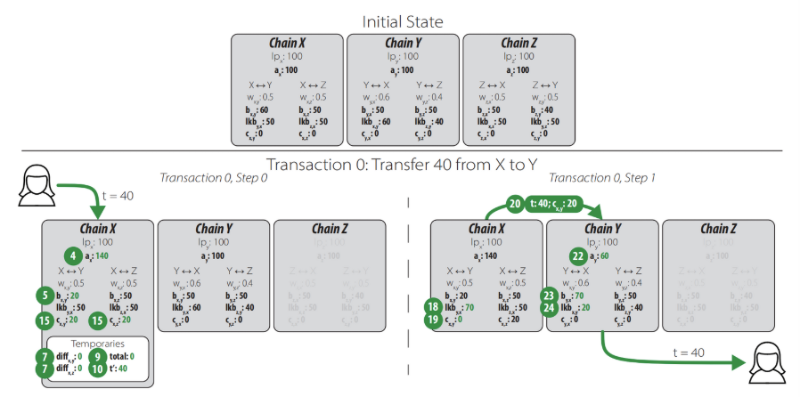
Delta Bridge state update illustration. Source: Delta Bridge Whitepaper
The diagram above shows parameter states during a user transfer from Chain X to Chain Y. Each chain stores the following parameters:
$lp_x$ (liquidity provided): amount of assets staked by users on Chain X;
$a_x$ (asset): actual asset balance currently held in Chain X’s pool;
$b_{x,y}$ (balance): liquidity allocated from Chain X to Chain Y;
$lkb_{y,x}$ (last known balance): latest known liquidity allocated from Chain Y to Chain X, communicated from Chain Y and stored on Chain X;
$c_{x,y}$ (credit): amount of liquidity Chain X intends to allocate to Chain Y in the next transfer—i.e., the aforementioned “cache”.
The Delta Bridge algorithm itself is essentially a mechanism designed to update these parameters in accordance with the two principles above. For a transfer from Chain X to Chain Y, Delta Bridge uses LayerZero to transmit only two values: the “amount” and the “credit,” while all other parameters are automatically updated via the algorithm. The full algorithm is complex; interested readers are encouraged to consult Stargate’s whitepaper for deeper exploration.
Can such an elegant algorithm and mechanism lead a new wave in cross-chain bridges? Let’s examine on-chain data to see what DeFi users are actually doing.
On-Chain Data: Can Stargate Sustain 20% APY?
Delta Bridge allows users to stake stablecoins on a single chain, while early incentives in $STG (Stargate’s token) pushed annualized yields for single-asset staking as high as 20%. High convenience and yield attracted massive DeFi interest, propelling Stargate’s total TVL to $3.5 billion. At the time of writing, farm APYs still hover around 15%–18%, as shown below:
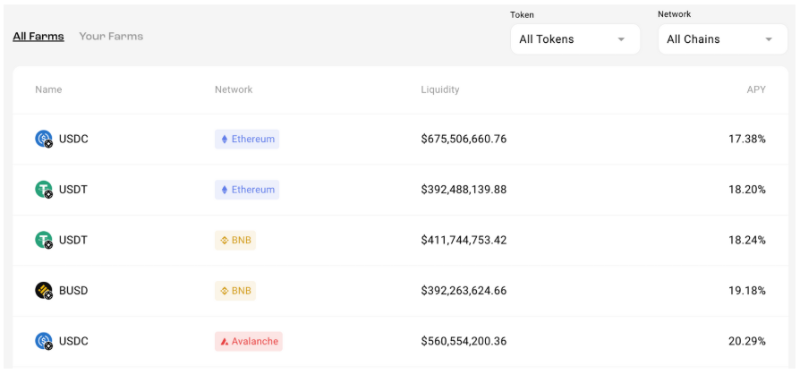
Stargate Farming Yields.
Taking USDC on Ethereum as an example, with $602 million in liquidity and a 14.48% APY, we can calculate the daily reward distribution:

On the other hand, we aim to estimate Stargate’s daily transaction volume and fees to gauge bridge profitability. While Stargate lacks its own explorer, its official documentation provides router addresses across chains, allowing us to analyze interacting transactions for volume estimation.
We leverage Dune Analytics’ database query tools for this purpose. However, since blockchain databases aren’t unified and Dune doesn’t cover all chains, we focus solely on Ethereum data. Below is Stargate’s daily cross-chain outflow volume and transaction count from Ethereum, with queries publicly available on Dune Analytics:
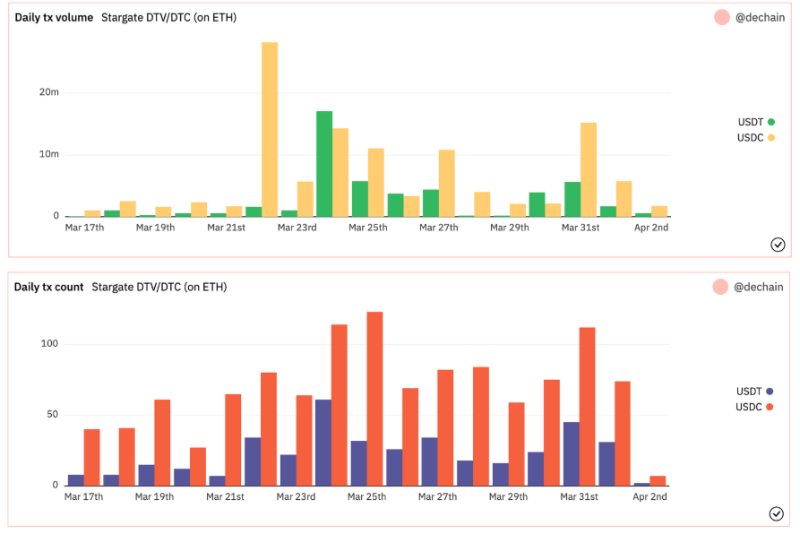
Stargate Daily Transaction Volume
Transaction counts reveal that Stargate’s daily activity is low—averaging around 100 outgoing transactions per day on Ethereum. Even scaling this to all seven supported chains (~700 daily transactions), Stargate lags far behind competitors: Multichain averages ~12,000 daily transactions, and cBridge ~2,400. We further observe that significantly more users call the “Add Liquidity” function than the “Swap” function, indicating most participants are yield farmers chasing early rewards rather than genuine cross-chain users.
These signs suggest few users actually rely on Stargate for cross-chain transfers—and Delta Bridge’s technological edge is not the driver behind its high TVL.
Additionally, Stargate offers a real-time Gas Estimator on its website, as shown below:
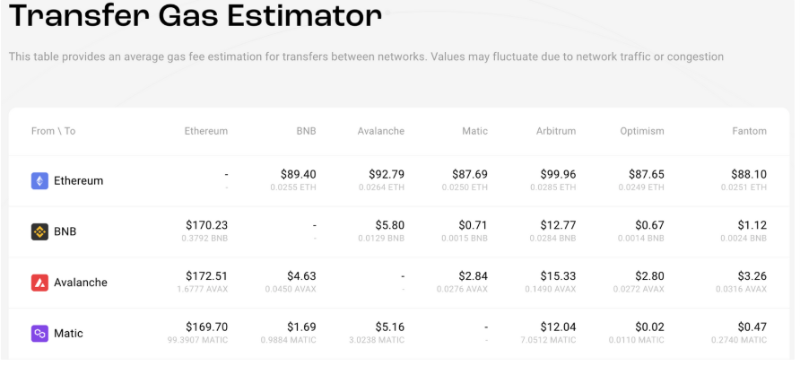
Stargate gas fee estimates for transfers.
Gas estimates vary widely over time, with Ethereum-to-other-chain fees fluctuating between $20 and $100. Assuming an average fee of $50 per Ethereum outbound transaction and ~100 daily transactions, Stargate’s daily fee revenue on Ethereum would be:
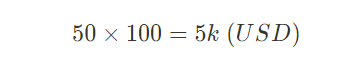
This pales in comparison to the mining rewards distributed daily on Ethereum. In fact, the ratio of fee revenue to daily mining rewards is:

In other words, 98% of the rewards come directly from Stargate subsidies.
We have reason to doubt that APRs above 15% are sustainable. If, before subsidy programs end, Stargate fails to accumulate enough organic users and maintain daily transaction volumes in the thousands, users may lack compelling reasons to stick with it long-term.
Security Risks Behind the Relayer Mechanism
Beyond concerns over unsustainable yields and potential user attrition, Stargate faces deeper, foundational risks—specifically, security vulnerabilities inherent in the relayer model. On March 28, 2022, the LayerZero team updated its cross-chain verification contract. Code analysis by Cobo Security revealed this update patched a critical vulnerability—in the core MPT transaction verification module of LayerZero, which underpins the entire protocol’s functionality. Although LayerZero has fixed this issue, Cobo warns other undiscovered vulnerabilities may still exist. As of March 28, Stargate—the first major application on LayerZero—was safeguarding vast liquidity pools; had attackers exploited the flaw, consequences would have been catastrophic.
On the other side of the blockchain world, Axie Infinity’s Ronin sidechain was less fortunate. On March 29, 2022, the Ronin bridge was hacked, resulting in a loss of $620 million. Ronin relies on nine validator nodes, requiring five signatures to confirm deposits or withdrawals. Attackers compromised four Ronin validators and one third-party validator operated by Axie DAO.
This illustrates that in relayer-based models like LayerZero, the existence of relayers introduces potential attack vectors. In custodian-based models like Ronin, the risk surface is even broader—evidenced by frequent hacks on Multichain, O3 Swap, and Wormhole in recent years. In contrast, HTLC-based bridges like cBridge, Hop Finance, and Meson rarely suffer security incidents—because they eliminate third-party trust assumptions entirely, whether toward whales, developers, institutions, or exchanges. We hope to see more trust-minimized innovations like HTLC emerge at the root of blockchain design.
In an era of intensifying multi-chain competition, cross-chain bridges have become essential infrastructure. We hope to see healthy competition among bridges, prioritizing user asset security over fleeting market hype. History has repeatedly shown that in a blockchain world where “code is law,” only projects truly embodying decentralization will endure.
References:
[1] Dune Analytics query for Stargate DTV: https://dune.xyz/queries/545642
[2] LayerZero and Delta Bridge whitepapers: https://layerzero.network/pdf/LayerZero_Whitepaper_Release.pdf, https://www.dropbox.com/s/gf3606jedromp61/Delta-Solving.The.Bridging-Trilemma.pdf?dl=0
[3] On-chain data for cBridge and Multichain: https://anyswap.net/, https://cbridge-analytics.celer.network/
[4] Stargate’s Farming and Gas Estimator: https://stargate.finance/farm, https://stargate.finance/transfer/gas
Note: Due to delays between writing and publication, some screenshots reflect data at the time of writing.
Join TechFlow official community to stay tuned
Telegram:https://t.me/TechFlowDaily
X (Twitter):https://x.com/TechFlowPost
X (Twitter) EN:https://x.com/BlockFlow_News