A Guide to Understanding the Cosmos Ecosystem
TechFlow Selected TechFlow Selected
A Guide to Understanding the Cosmos Ecosystem
The IBC ecosystem, accumulating strength for a breakthrough.
 Navigating Web3 tides with focused insights
Cross-chain interoperability is a fundamental necessity for the blockchain industry in the multi-chain era. Application-layer projects such as DeFi and GameFi have different performance requirements from public blockchains: DeFi demands high composability, GameFi requires high concurrency performance, and SocialFi emphasizes heavy data storage. As a result, various Layer 1 or Layer 2 blockchains focusing on specific vertical domains have recently emerged—examples include Ronin (focused on GameFi) and DESO (dedicated to SocialFi).
Cosmos' cross-chain model is particularly well-suited for these specialized vertical-focused blockchains. By offering modular blockchain infrastructure, Cosmos enables application developers to easily adopt and customize blockchains that best fit their needs. Applications and protocols within the Cosmos ecosystem connect via IBC (Inter-Blockchain Communication Protocol), enabling sovereign, independent blockchains to freely exchange assets and data across chains.
Currently, there are four main types of cross-chain technical solutions:
1. Notary Schemes
2. Side Chains / Relays
3. Hash-locking
4. Distributed Private Key Control
Cosmos is a typical example of the Relay approach, with Polkadot being another. Cosmos achieves cross-chain connectivity through the IBC protocol, while Polkadot uses the XCMP protocol and relies on parachain slots for cross-chain communication.
This article focuses on Cosmos’ cross-chain solution.
1. Overview of Cosmos
Cosmos is a heterogeneous network launched by the Tendermint team designed to support cross-chain interactions. Its ICO took place in April 2017, raising 4,870 BTC and 240,000 ETH. ATOM has no supply cap and undergoes inflation at a maximum annual rate of 20%. The actual inflation rate is negatively correlated with staking participation. Currently, with a staking ratio of 186M/291M (63.9%), the annual inflation rate stands at 10.05%.
Cosmos aims to create an "Internet of Blockchains," enabling numerous autonomous and easily developable blockchains to scale and interact with one another. Built on Tendermint and using the Tendermint consensus algorithm—a Byzantine Fault Tolerant (BFT) consensus engine—it offers high performance, consistency, and fault tolerance. The Cosmos network can achieve thousands of transactions per second, approaching VISA-level throughput.
The Cosmos cross-chain network consists of three core components: Hub (central hub), Zone (regional networks), and IBC (Inter-Blockchain Communication Protocol).
1. Hub: The economic center of Cosmos and the trust anchor for cross-chain messages. It serves as a multi-asset distributed ledger where tokens are transferred between zones via the IBC protocol. Besides the official Cosmos Hub, other hubs like IRISnet also provide cross-chain services.
2. Zone: Independent blockchains capable of communicating with the Cosmos Hub via IBC for message passing, information exchange, and asset transfers.
3. IBC Protocol: The Inter-Blockchain Communication Protocol is specifically designed for the Cosmos network, leveraging its property of immediate finality to enable message transmission between Hubs and Zones, thus achieving cross-chain functionality. IBC is also a module within the Cosmos SDK.
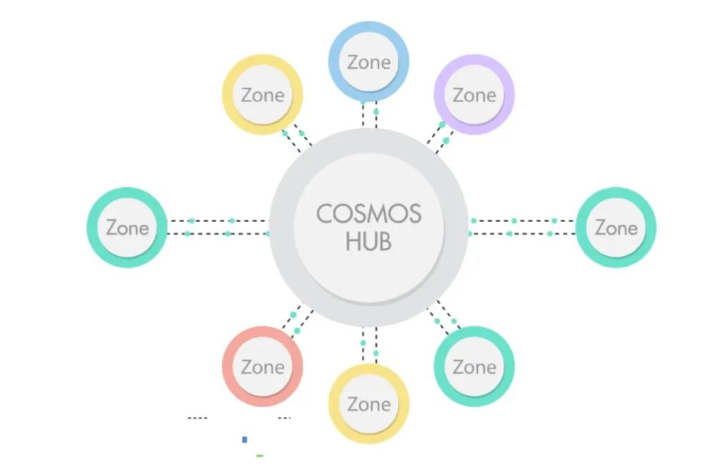
The core logic of Cosmos' cross-chain mechanism: The Cosmos Hub establishes IBC connections with compatible chains, enabling cross-chain asset and data transfers. The Hub acts as a centralized marketplace for cross-chain activity and is the optimal place to hold digital assets and manage accounts across multiple chains. The Hub must track the state of each Zone, and each Zone is responsible for continuously reporting new blocks to the Hub. Once a Zone establishes an IBC connection with the Hub, it gains automatic access to all other Zones connected to that Hub. When a Zone receives tokens from another Zone via the Hub, it only needs to trust the Hub—not every other Zone in the network.
How does IBC actually work? Let's illustrate with an example: transferring 10 ATOMs from ChainA to ChainB.
Both ChainA and ChainB support the Cosmos SDK and function as Zones within the Cosmos ecosystem. A relayer—an off-chain intermediary—polls and routes IBC packets. The general flow is:
ChainA —— Relayer —— Cosmos Hub —— Relayer —— ChainB
This process involves several steps:
1. Tracking: The IBC modules on ChainA and ChainB continuously synchronize each other’s block headers, allowing them to monitor changes in validator sets. Essentially, each chain maintains a light client of the other;
2. Bonding: After initiating a cross-chain transfer via Cosmos, ChainA’s IBC module records the transaction, locking 10 ATOMs on ChainA;
3. Proof Relay: A cryptographic proof that 10 ATOMs have been locked on ChainA is relayed to ChainB’s IBC module;
4. Validation: ChainB verifies this proof using ChainA’s light client data. Upon successful validation, ChainB mints 10 ATOM vouchers, which can be used freely within ChainB. These vouchers can later be sent back via the same cross-chain path, triggering ChainA to unlock the original ATOMs.
2. Cosmos Consensus Mechanism
Cosmos employs a consensus mechanism combining PoS (Proof-of-Stake) and BFT (Byzantine Fault Tolerance). The staking module of the Cosmos Hub is built upon the Tendermint BFT consensus engine, allowing ATOM holders to secure the network by staking their tokens and earning transaction fees in return.
Currently, the Cosmos Hub has 342 validators, with 150 active validators and an average block time of 7.29 seconds.
PoS Rules in Cosmos Tendermint
Suppose three validators A, B, and C stake 1, 2, and 3 tokens respectively;
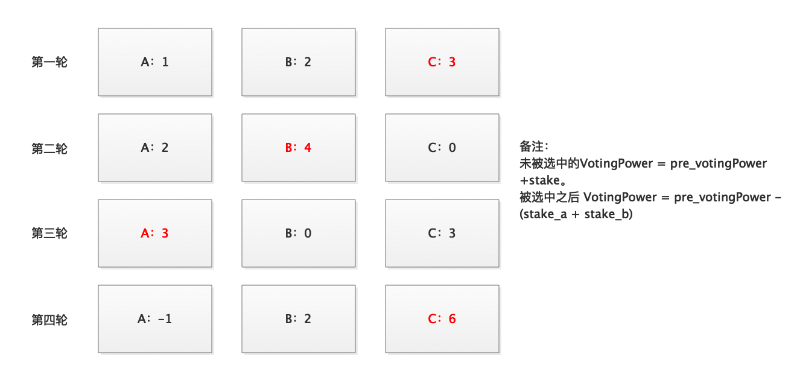
1. In round one, since C has the largest stake, C becomes the proposer;
2. In round two, because C was the proposer in the previous round, C’s voting power becomes pre_votingPower - (stake_A + stake_B) = 3 - (1+2) = 0. B’s voting power becomes pre_votingPower + stake = 2 + 2 = 4, and A’s remains at 2. With the highest voting power, B becomes the proposer;
3. In round three, A’s voting power is 3, B’s is 2 - (2+0) = 0, and C’s is 0 + 3 = 3. Since A comes before C in ranking, A becomes the proposer;
4. In round four, A’s voting power is -1, B’s is 2, and C’s is 6, so C becomes the proposer again.
...and so on.
In summary, the validator with the most stake gets priority as proposer, followed by others in descending order of stake.
BFT Rules in Cosmos Tendermint
BFT stands for Byzantine Fault Tolerance, originating from the "Byzantine Generals Problem."
The Byzantine Generals Problem
Byzantium was the capital of the Eastern Roman Empire. Due to its vast territory, armies were stationed far apart and could only communicate via messengers. During war, generals needed to agree on a unified plan of action. However, some generals might be traitors sending false messages. Thus, loyal generals must follow a predetermined method to reach consensus despite untrustworthy elements—essentially establishing agreement in a non-trusted environment with potential adversaries.
Tendermint is an intuitive BFT consensus protocol based on a simple state machine model. So, how does Tendermint achieve consensus in a trustless environment?
There are two key roles in the protocol:
Validators: Nodes in the network, each possessing voting power proportional to their stake;
Proposer: Selected from validators. The proposer suggests a block of transactions, and both the proposer and other validators vote on it. If approved, the block is committed to the chain at a given height. If not, the protocol selects another validator to propose a new block at the same height, restarting the voting process.
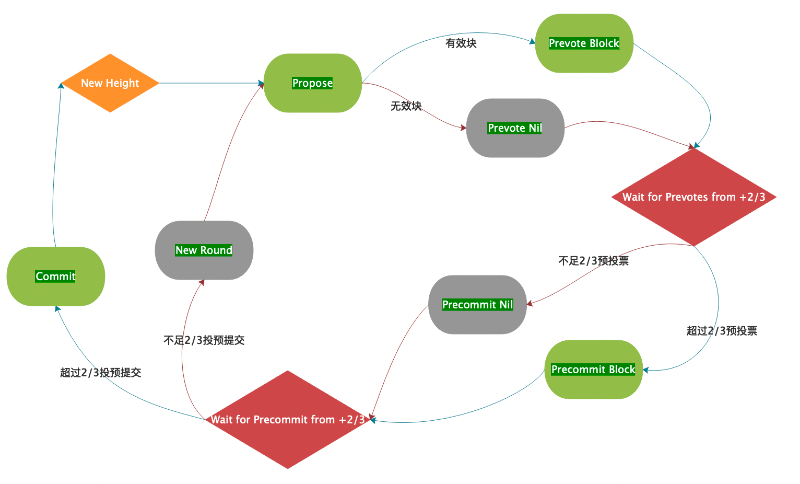
Process:
1. Propose Phase: The proposer broadcasts a proposed block to the entire network;
2. Prevote Phase: Each validator signs and broadcasts a prevote for the received proposal;
3. Precommit Phase: Each validator checks if more than 2/3 of the prevotes have been collected. If yes, they sign and broadcast a precommit vote. If over 2/3 nil (empty block) prevotes are received, they release any previously locked block and return to the Propose phase. If fewer than 2/3 prevotes are received, they remain unlocked;
Later in the Precommit phase, if a validator receives over 2/3 precommits, it proceeds to the Commit phase; otherwise, it moves to the next round of Proposing;
4. Commit Phase: Validators receive the fully committed block and broadcast a commit vote. To finalize, validators must collect over 2/3 commit votes across the network. Once any node receives sufficient commit votes, it immediately enters the Commit phase, sets CommitTime to current time, and advances to NewHeight (next block).
In short, to successfully commit a block, more than 2/3 of validators must vote in both the Prevote and Precommit phases. As long as fewer than 1/3 of validators are Byzantine, Tendermint can produce blocks normally. And as long as fewer than 2/3 are malicious, no invalid block will be finalized.
How does Tendermint propagate consensus from the underlying layer to the application state?
Tendermint consists of two main parts:
1. Tendermint Core: The consensus engine responsible for node-to-node data transmission and BFT consensus;
2. ABCI (Application Blockchain Interface): A protocol enabling transaction processing implementations in any programming language.
Overall, Tendermint can be seen as a modular blockchain software framework, allowing developers to build customized blockchains without worrying about consensus or networking implementation.
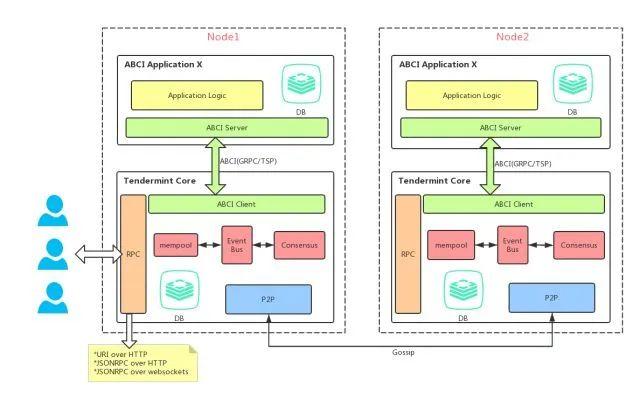
Tendermint separates the application state from the underlying consensus. The consensus engine and P2P network are encapsulated in Tendermint Core and interact with the Cosmos SDK via ABCI (Application Blockchain Interface). This architecture allows application developers to easily build their own blockchains.
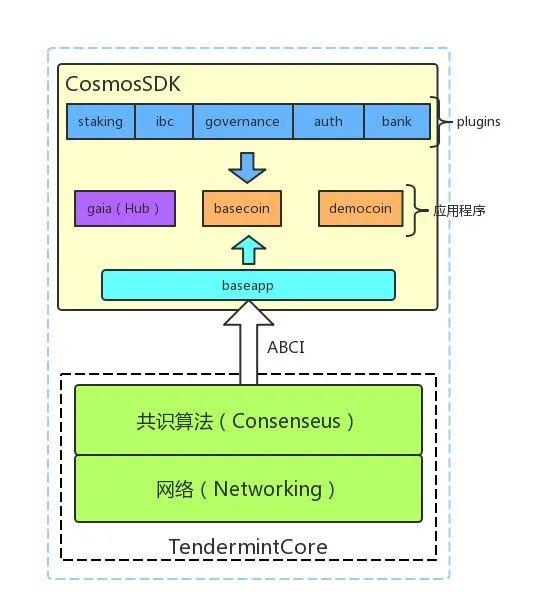
The Cosmos SDK includes the source code of the Cosmos Hub and serves as a blockchain development framework, providing reusable modules such as IBC, accounts, governance, and authentication. Among these, IBC is the key protocol enabling inter-blockchain communication.
By packaging consensus algorithms and networking modules into the SDK, Cosmos provides a plug-and-play blockchain development framework.
In theory, Cosmos addresses three of today’s most challenging blockchain problems:
1. Scalability: The Tendermint consensus operates as a voting-consistent system based on PoS and BFT. PoS selects proposers, and as long as 2/3 of nodes are honest, BFT ensures consistent outcomes;
2. Usability: The modular Cosmos SDK enables easy construction of interoperable, application-specific blockchains;
3. Interoperability: Cosmos uses the IBC protocol to enable cross-chain communication between Hubs and Zones, functioning similarly to TCP/IP in traditional internet architecture.
3. The Cosmos Cross-Chain Ecosystem
According to official data, the Cosmos ecosystem currently hosts 247 projects across 12 categories, with a total market cap nearing $15 billion, making it the second-largest blockchain ecosystem after Ethereum.
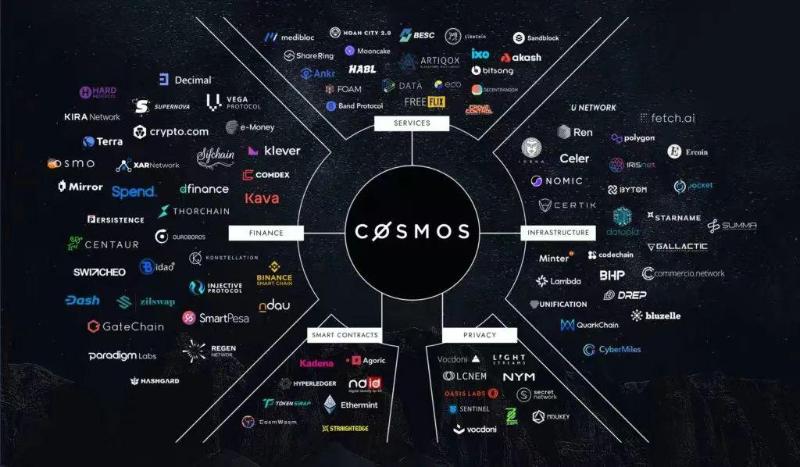
Leading projects in the Cosmos ecosystem include Osmosis, Cosmos, Stargaze, Juno, Umee, Terra, Chihuahua, Crypto.org, Injective, Cronos, Secret, Axelar, Sifchain, Akash, Comdex, Persistence, Gravity Bridge, Sentinel, Desmos, KiChain, among others.
Infrastructure of the Cosmos Hub
-
1. Gravity DEX
Enables seamless exchange of digital assets across the interchain. The protocol improves existing designs by combining AMM mechanisms with order books, delivering richer and more efficient trading experiences.
For real users within the Cosmos ecosystem, Gravity DEX functions like a convenience store in a residential complex. While large-scale traders may not use it, it's convenient for configuring assets during cross-chain operations.
However, to uphold the Cosmos Hub’s core principle of “Credible Neutrality,” the development team plans to migrate Gravity DEX to a separate blockchain called Crescent Network.
-
2. Gravity Bridge
Gravity Bridge is part of the Cosmos ecosystem’s foundational infrastructure—a secure, efficient, and decentralized cross-chain bridge. Leveraging billions of dollars worth of ATOM staked on the Cosmos Hub, it enables Cosmos-native assets to enter the Ethereum ecosystem as ERC-20 tokens, and vice versa.
Developed by the Althea team, Gravity Bridge has its own native token GRAV.
-
3. Domain Name Service
Domain services in the Cosmos ecosystem will be managed on the Cosmos Hub, helping interchain users more easily identify chains they wish to interact with.
-
4. Liquid Staking
Liquid staking is set to become a crucial primitive in the cross-chain DeFi space. At its core, it represents claims against staked ATOM. Like regular staking, liquid staking earns staking rewards. But unlike traditional staking, liquid-staked ATOM is transferable. Because these tokens represent staked ATOM, they carry slashing risk—if the underlying ATOM is penalized, the liquid staking tokens may be burned.
Core Projects in Cosmos Zones
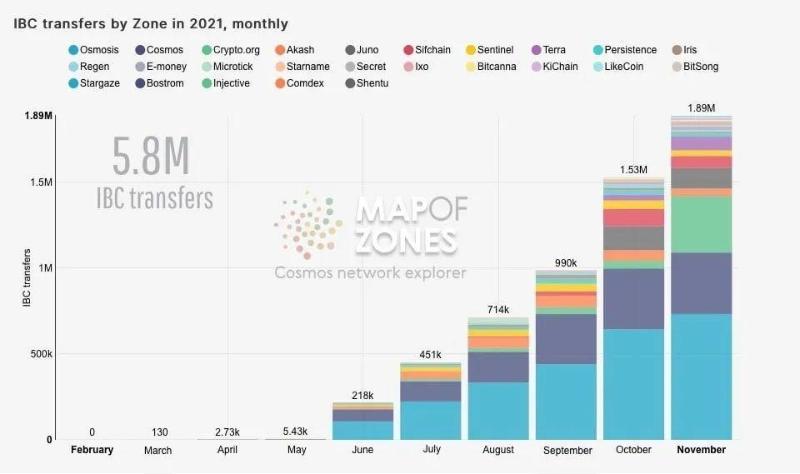
This chart shows the most active Zones in terms of IBC transfers. There are currently 43 Zones in the Cosmos ecosystem, 42 of which are active (have conducted IBC transfers).
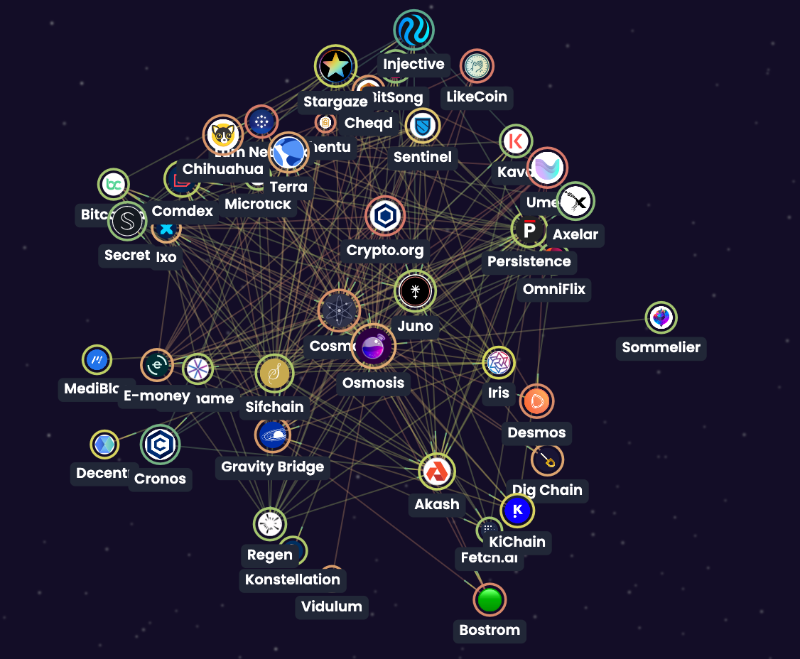
Compared to last year, IBC transfer volumes have surged dramatically. In 2021, active Zones in the Cosmos ecosystem recorded 5.8 million IBC transfers for the entire year. Recently, however, IBC transfers have exceeded 13 million in just the past 30 days.
-
1. Osmosis (OSMO)
An advanced AMM protocol built using the Cosmos SDK. It has attracted $700 million in liquidity and supports trading of IBC-enabled tokens, with total trading volume exceeding $9.5 billion. Osmosis has become a key driver in popularizing IBC.
Notably, Osmosis was the first AMM DEX project outside the Ethereum ecosystem to receive investment from Paradigm.
-
2. Terra (LUNA)
In October 2021, Terra enabled IBC, bringing over $18 billion in liquid assets, along with its native LUNA token and UST stablecoin, into the Cosmos ecosystem.
The integration of such a major blockchain greatly boosted morale within the Cosmos community and drew widespread attention to the growth of the Cosmos cross-chain ecosystem. Thanks to flagship projects like Terra, Cosmos has grown into the second-largest blockchain economy after Ethereum.
-
3. Juno
Juno is a public chain in the Cosmos ecosystem providing an environment for deploying interoperable smart contracts. Over 50 applications and more than 2,000 DAOs have been built on Juno.
Recently, a controversial event occurred on Juno Network: the community proposed a “tax on whale holdings,” reigniting discussions around “Code is Law” in the blockchain world.
-
4. Kava
Kava is a Cosmos-based DeFi platform similar to MakerDAO. Users deposit collateral into debt smart contracts to mint the stablecoin USDX.
After joining the Cosmos ecosystem, Kava evolved from a single-application blockchain into a protocol with over $2 billion in on-chain value, marking significant success.
-
5. Sifchain
Sifchain is the first Cosmos-to-Ethereum cross-chain DEX. In early 2021, it integrated its Peggy bridge, which uses pegged tokens to allow users to cheaply and efficiently swap and pool IBC and ERC-20 tokens—more efficiently than any Ethereum-based DEX.
-
6. Secret Network
Founded by the Secret Foundation and built on Tendermint and the Cosmos SDK, Secret Network is a privacy-focused public chain within Cosmos. All data on Secret Network is encrypted; viewing specific transaction details requires a corresponding Viewing Key.
Secret Network combines privacy protection, scalability, and cross-chain capabilities.
-
7. IRISnet
IRISnet is a cross-chain hub in the Cosmos ecosystem supporting new business scenarios—particularly enterprise-grade decentralized applications—adding scale and diversity to the Cosmos ecosystem.
Beyond these, the Cosmos ecosystem hosts many other prominent Zones, which are not listed here. Future articles will provide deeper analysis of notable projects within the Cosmos ecosystem.
4. Reflections on Cosmos
1. Weak Value Capture for ATOM
ATOM started with an initial supply of 200 million and follows an inflationary model, initially minting at 7% annually for validator rewards. Subsequent inflation rates fluctuate based on staking participation—minimum 7% when staking exceeds 2/3, up to 20% when staking is low. Current staking stands at 63.9%, with inflation at 10.05%.
Besides staking rewards for validator participants, ATOM holders in recent years have largely benefited from airdrops by ecosystem projects.
New chains in the Cosmos ecosystem often use airdrops to attract community attention. In 2021, projects including Osmosis, Juno, Regen, Sifchain, Persistence, Comdex, and Desmos conducted airdrop campaigns.
To qualify for airdropped tokens, ATOM holders must stake their tokens directly with Cosmos validators—not through exchange-run nodes, as most Cosmos airdrops exclude exchange validators.
In 2022, many Cosmos ecosystem projects may launch additional airdrops spanning NFTs, SocialFi, DeFi, and GameFi sectors—including Evmos, Umee, Gravity Bridge, LikeCoin, Game, Stargaze, BitSong, and Cyber. Ensure your ATOM is properly staked to qualify.
In the cross-chain space, Polkadot’s DOT secures both the relay chain and parachains, charging fees as a form of value capture. In contrast, ATOM only secures the Cosmos Hub. Compared to DOT, ATOM appears weaker in capturing ecosystem value.
While the Cosmos ecosystem ranks second only to Ethereum in size, ATOM has not captured value commensurate with this growth. In fact, some individual Zone tokens—such as LUNA and MATIC—have higher market caps than ATOM. Many chains built with the Cosmos SDK, like Binance Chain and Polygon, contribute little to ATOM’s value.
For ATOM holders, this may seem like a drawback—but it might actually benefit the broader ecosystem’s expansion.
2. What Truly Matters Is the Inter-Blockchain Communication Protocol (IBC)
The Cosmos ecosystem is multi-centered and multi-hub. In the future, attention will likely focus more on IBC usage rather than any particular Hub, including the Cosmos Hub.
Cosmos is known as the “Internet of Blockchains,” aiming primarily to enable communication between blockchains. In the future, many public chains and application protocols within Cosmos—like Terra—may thrive independently. While part of the Cosmos ecosystem, their primary value lies in IBC connectivity, not necessarily the Cosmos Hub itself. This aligns better with blockchain’s decentralized ethos: the goal of cross-chain technology is to break down silos, not to become a new central authority.
Finally, special thanks to the Cosmos Chinese community and Anonymous Club community for their technical support and contributions to this article.
Join TechFlow official community to stay tuned
Telegram:https://t.me/TechFlowDaily
X (Twitter):https://x.com/TechFlowPost
X (Twitter) EN:https://x.com/BlockFlow_News