








A Comprehensive Guide to Quantum Computing and Blockchain
TechFlow Selected TechFlow Selected
A Comprehensive Guide to Quantum Computing and Blockchain
The future of quantum computing and blockchain is extremely uncertain—yet it could be one of the defining factors in the future of computer science.
 Navigating Web3 tides with focused insights
By Suzytu
Will Quantum Computing Break Blockchain or Make It Safer?
When discussing the future of computing, blockchain and quantum computing are two of the most fascinating and controversial industries. While blockchain is significantly more advanced in practical applications—including creating cryptocurrencies and cryptographic systems usable by individuals and enterprises—quantum computing is also growing at an astonishing pace. In fact, the quantum computing industry’s growth rate may be second only to blockchain, with projections indicating it will expand at 25% annually from 2022 to 2027.
Some experts believe advances in quantum computing could mark the beginning of the end for blockchain, as quantum computers might even crack the most advanced blockchain encryption. Alternatively, quantum computing could replace blockchain altogether as a more advanced method for securing the future of data.
In some ways, blockchain encryption and quantum computing are locked in a race to determine who will win the cryptography battle. The key question may be whether quantum computers will advance quickly enough to break blockchain encryption. The answer will depend on whether cryptographers can develop secure countermeasures fast enough to defend against quantum hacking.
However, the relationship between quantum computing and blockchain does not have to be adversarial; some researchers believe the two technologies will eventually converge. This could create more secure, faster, and potentially revolutionary computing solutions that might ultimately help solve various cryptographic and real-world challenges.
Table of Contents
1. What Is Quantum Computing—and How Does It Differ From Blockchain?
2. Will Quantum Computing Break Blockchain and End Cryptocurrencies?
3. Can Quantum Computing Merge With or Enhance Future Blockchains?
4. What Is the Quantum Resistant Ledger?
5. What Is Bitcoin Post-Quantum?
6. What Is the Future of Quantum Computing and Blockchain?
What Is Quantum Computing—and How Does It Differ From Blockchain?
For those unfamiliar, quantum computing is a unique form of computation that leverages "quantum states" to solve logic problems so complex they would either require immense processing power or be nearly impossible for conventional supercomputers. Unlike traditional supercomputers that analyze a set of problems sequentially, quantum computers can simultaneously evaluate vast numbers of potential problems and solutions. By harnessing the power of quantum physics, these machines rapidly minimize the number of incorrect answers while honing in on correct ones at incredible speed.
Current computers, often called classical computers, consist of bits that are either 1 or 0—but never both. Quantum computers, however, are made up of qubits (quantum bits), which, due to a phenomenon known as quantum superposition, can exist in both states simultaneously. Furthermore, unlike classical bits, qubits can influence each other through a process called quantum entanglement, creating a unified large-scale quantum state across the entire system. Each additional qubit doubles the number of possible states, giving quantum computers exponentially greater computational power compared to classical systems.
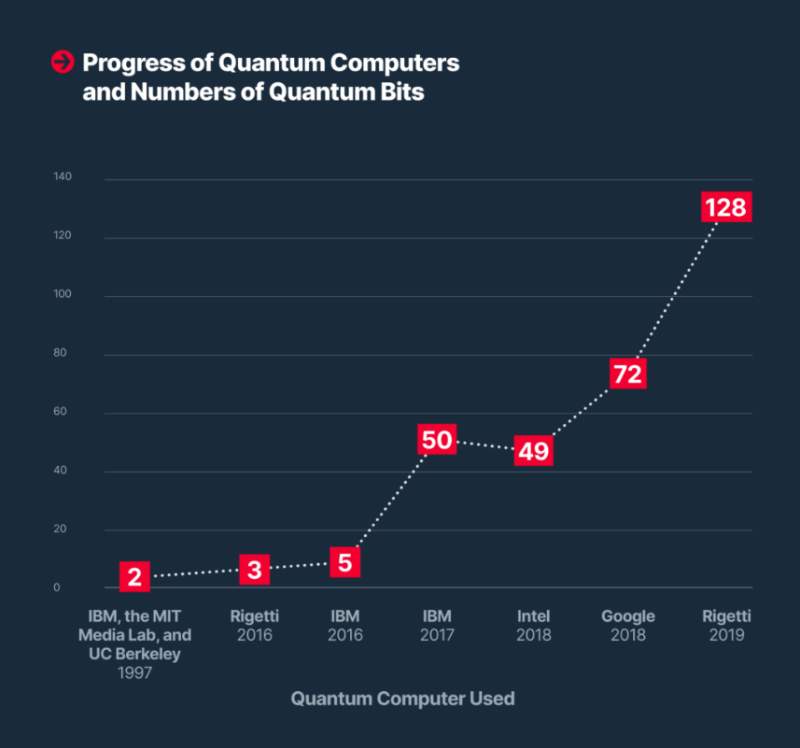
Beyond solving highly complex problems, quantum computing holds extraordinary potential to transform the world of encryption. Due to the nature of quantum physics and quantum states, the state of specific information actually changes when observed. Thus, theoretically, quantum encryption could be truly unbreakable—because any attempt to observe the information by anyone (or any machine) other than the intended recipient would irreversibly alter its state. However, just as quantum computing can enable powerful new encryption methods, it also has the potential to break previously uncrackable forms of encryption, creating a potential conflict with the fundamental purpose of blockchain.
Companies like IBM are already using quantum computers to tackle diverse challenges such as developing higher energy-density batteries for electric vehicles, creating new materials to reduce carbon emissions, and even discovering particles that could reveal the origins of the universe.
In contrast, blockchain can be described as a suite of distributed ledger technologies that use cryptography to create a tamper-resistant record of information, which becomes effectively immutable once validated by a network of distributed computers (called nodes). Through various consensus mechanisms, a decentralized network of nodes agrees or disagrees on whether to "validate" blocks of information and add them to the blockchain. Blockchain operates entirely within the realm of classical computing, meaning it exists in only one state at any given time.
As demonstrated by industry use cases, blockchain technology excels at creating decentralized applications via self-executing smart contracts, including digital currencies, logistics and record-keeping protocols, and various financial products such as lending, staking, liquidity mining, and even decentralized insurance agreements.
However, due to network limitations, blockchains are not inherently good at solving problems requiring high levels of computational reasoning. Indeed, slow transaction speeds remain one of the biggest issues in today's blockchains, prompting new platforms to compete in offering solutions with higher transactions per second (TPS). In contrast, quantum computing shows immense promise in tackling some of science and technology’s most difficult challenges but may not necessarily serve as an ideal tool for building consumer-facing applications used by the general public.
Therefore, while quantum computing and blockchain are profoundly different technologies, their interaction could permanently reshape both fields.
Will Quantum Computing Break Blockchain and End Cryptocurrencies?
The primary concern regarding quantum computing and blockchain is that quantum computers might overwhelm blockchain encryption—potentially ending secure cryptocurrencies as we know them. If quantum computing succeeds in breaking blockchain cryptography, it could lead to massive cryptocurrency theft and widespread disruption—even if the entire crypto industry doesn't collapse.
A study by Deloitte suggested that a single attack could steal 25% of all bitcoins. As of January 2022, this would amount to approximately $300 billion. Given the continued rapid growth of the cryptocurrency market, quantum-based cyberattacks could eventually compromise trillions of dollars, potentially destabilizing the global economy and destroying the blockchain ecosystem in the process.
Specifically, a well-known theoretical computer algorithm called Shor's algorithm, when implemented on a quantum computer, could theoretically solve the prime factorization problem currently protected by elliptic curve multiplication. This mathematical operation is used in hashing and is (for now) nearly impossible to reverse—that is, to discover the original numbers multiplied together to generate a private key.
For example, researchers estimate that a classical computer would need 340,282,366,920,938,463,463,374,607,431,768,211,456 basic operations to derive the private key associated with a public key generated via elliptic curve multiplication. This could theoretically take thousands of years.
In contrast, according to the same calculations, a quantum computer running Shor's algorithm would require only 2,097,152 basic operations to achieve the same result—potentially completing the task in just a few hours. However, it's important to note that mainstream quantum computers today have not yet developed the capability to run Shor's algorithm effectively, and it remains unclear when this functionality will become fully realized.
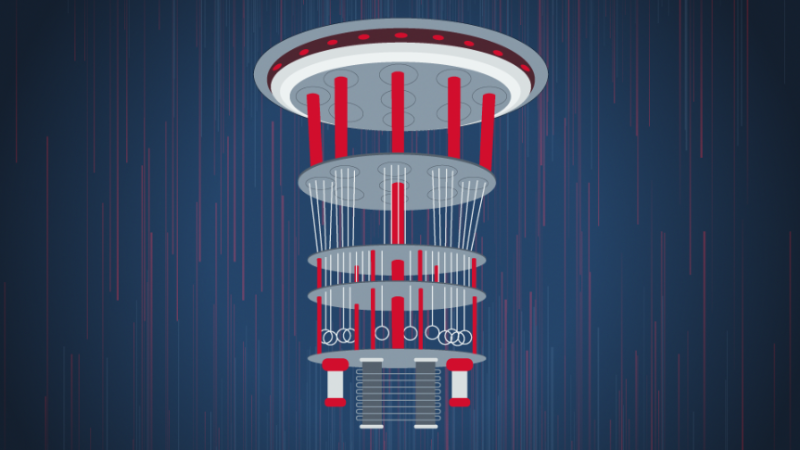
Beyond breaking blockchain encryption, another concern is that quantum computers could supplant traditional computers in cryptocurrency mining. Theoretically, if quantum computers could mine faster than conventional equipment such as ASICs, it could lead to asset price instability, 51% attacks, and extreme centralization of mining power. However, it should be noted that this concern primarily applies to proof-of-work blockchains like Bitcoin and generally does not affect proof-of-stake consensus models. Due to environmental concerns and other factors, most proof-of-work blockchains, including Ethereum, are transitioning to proof-of-stake and other non-computationally intensive consensus mechanisms.
Despite these calculations and estimates, not all experts believe quantum computing will effectively break blockchain encryption or render classical cryptography obsolete. For instance, some argue that SHA-256 encryption used in Bitcoin may be quantum-resistant. Even if quantum computers eventually crack current blockchain encryption methods, this might take 10 to 20 years—giving blockchain cryptographers a critical head start in developing newer, stronger cryptographic techniques.
Moreover, RSA encryption—the most common alternative to elliptic curve cryptography—may also possess certain quantum-resistant properties. While elliptic curve cryptography is considered more secure than RSA under classical decryption, experts suggest the opposite might be true under quantum decryption. Additionally, even if RSA eventually becomes "quantum-crackable," soft forks and regularly changing wallet addresses could mitigate much of the practical risk posed by quantum computers attempting to breach blockchains or steal cryptocurrencies.
Can Quantum Computing Merge With or Enhance Future Blockchains?
While some believe quantum computing could dismantle existing blockchain and cryptocurrency systems, others suggest quantum encryption could be integrated into blockchain to create protocols far more secure than today’s standards. Theoretically, such blockchains would be highly resistant to both classical hacking attempts and quantum computer attacks.
Specifically, experts propose replacing traditional blockchain cryptographic methods—such as asymmetric key algorithms and hash functions based on elliptic curve multiplication—with quantum keys.
Quantum key cryptography, also known as Quantum Key Distribution (QKD), works by transmitting the "quantum particles" of light—in the form of photons—over optical links. As mentioned earlier, any eavesdropping attempt to observe these transmitted photons would fundamentally alter their state, effectively invalidating the transaction.
For maximum effectiveness, these quantum keys must be used alongside One-Time Pad (OTP) encryption, which generates keys that can only be used once.
An intriguing paper titled “Quantum Blockchain: A Decentralized, Encrypted, and Distributed Database Based on Quantum Mechanics,” published in the Journal of Quantum Computing by Li Chuntang, Xu Yinsong, Tang Jiahao, and Liu Wenjie, details how quantum computing could offer additional benefits for future blockchains—particularly in randomizing node selection, a major challenge in current blockchain systems. Quantum blockchain protocols could leverage quantum random number generators to select validator nodes randomly, replacing current randomization techniques.
The paper argues that quantum blockchains might also replace classical Byzantine Fault Tolerance (BFT) protocols with a new type of quantum-enhanced BFT protocol using quantum encryption. While still highly theoretical, this approach could help prevent 51% attacks and enable the creation of new, highly secure quantum-encrypted cryptocurrencies.
While much of the above discussion focuses on creating new quantum blockchains, quantum technologies could also enhance existing blockchains—potentially increasing decentralization and reducing transaction times on major platforms like Bitcoin, Ethereum, and Solana.
One vague and unaddressed issue in the referenced paper is how quantum computing capabilities—including quantum key generation—would be distributed among node operators. Currently, most quantum computers are highly experimental and extremely expensive, making it difficult to achieve the large-scale node participation required for truly decentralized blockchains. However, this situation may change; a company in China has released a compact quantum computer priced at just $5,000—significantly lower than the cost of running a full Ethereum node today.
What Is the Quantum Resistant Ledger?
To date, only two public blockchain projects claim full quantum resistance: Quantum Resistant Ledger (QRL) and Bitcoin Post-Quantum. QRL describes itself as a “post-quantum secure blockchain with a stateful signature scheme and unparalleled security.”
To achieve this, the QRL protocol uses “IETF-specified XMSS, a hash-based forward-secure signature scheme with minimal security assumptions.” XMSS stands for eXtended Merkle Signature Scheme, which leverages Merkle trees—structures where each node is labeled with the cryptographic hash of a data block.
Merkle trees can be defined as “the complete hash of all transaction hashes within a single block in existing blockchain networks.”
Stateful hash-based signature schemes (like Merkle signatures) are considered more resistant to quantum attacks than RSA or elliptic curve cryptography. However, if keys are reused, stateful hash-based schemes like XMSS may become vulnerable—placing them at a disadvantage compared to other cryptographic forms.
Currently, the National Institute of Standards and Technology (NIST) Computer Security Resource Center is actively soliciting research and feedback on these cryptographic techniques to assess their strengths and weaknesses for civilian and government use. Besides XMSS, NIST is currently evaluating nearly 70 new “post-quantum cryptography” approaches.
QRL claims its “extended” Merkle signature scheme is more efficient and secure than traditional Merkle signatures, though this remains difficult to verify without a fully functional quantum computer capable of testing its resilience.
Beyond developing its proprietary blockchain, the group has also launched its own cryptocurrency (QRL), which was priced below $0.20 as of January 2022, with a total market cap slightly above $14 million. Like the blockchain it's built on, QRL’s creators claim the cryptocurrency itself is the first fully quantum-hacker-proof digital currency. Similar to other cryptocurrencies, QRL can be mined from a single node or as part of a mining pool.
What Is Bitcoin Post-Quantum?
In addition to the relatively well-known QRL project, another blockchain initiative, Bitcoin Post-Quantum (BPQ), also claims to use a stateful hash-based Extended Merkle Signature Scheme (XMSS) to protect against quantum computing threats. Specifically, BPQ is an experimental fork of Bitcoin’s main blockchain that employs quantum-safe digital signatures instead of more traditional cryptographic techniques. Research conducted by BPQ over the coming years may lay the foundation for introducing quantum-resistant encryption into Bitcoin’s main network.
Unlike QRL, BPQ is currently more in the research phase, and its planned currency, BitcoinPQ, has not yet been mined.
What Is the Future of Quantum Computing and Blockchain?
The future of quantum computing and blockchain is extremely uncertain—and may be one of the defining factors in the future of computer science. Blockchain has democratized the internet, created cryptocurrencies, and produced the world’s largest decentralized computer networks in the form of popular blockchains like Bitcoin and Ethereum.
In contrast, quantum computing—still in its early stages—holds the potential to help solve many of the most impactful scientific and technological challenges of our time, advancing technology in ways we cannot yet foresee. If quantum computing and blockchain clash, it could result in an epic catastrophe. However, if cryptography continues to evolve with increasingly quantum-resistant methods, or if quantum encryption itself is integrated into blockchain systems, the convergence of these promising technologies could help build a more secure, democratic internet and have a profoundly positive impact on the world.
Join TechFlow official community to stay tuned
Telegram:https://t.me/TechFlowDaily
X (Twitter):https://x.com/TechFlowPost
X (Twitter) EN:https://x.com/BlockFlow_News






