Recueil d'articles sur Token2049 : le secteur est en pleine restructuration, après la morosité vient l’aube
TechFlow SélectionTechFlow Sélection
Recueil d'articles sur Token2049 : le secteur est en pleine restructuration, après la morosité vient l’aube
Ne descendez pas de la table.
 Dédié à des analyses Web3 approfondies
Compilation : TechFlow

Every year after Token2049 ends, it's time for some reflective essays. This article compiles 8 insightful pieces, allowing you to feel the pulse of crypto in Singapore — without even leaving home.
Jewish Director Zhao: Cycles, Dawn, and Liquidity Impotence
1.I've never seen Western project teams work this hard before.
2. In the past, old white men could just talk on video calls, and Asian markets would shut up and hand over their money. But now, they have to host grand side events, dress themselves up extravagantly, and even personally go out selling. The last time I saw them try this hard was in 2019 when the afro-haired guy came to Beijing fundraising.
3. The information gap between the West and Asia remains enormous:
3.1 Western projects still believe there’s money left in Asia, trying to keep extracting value through new Ponzi schemes and asset splits, but the truth is, Asia has no money left — not a drop;
3.2 As for where the money went, Asian exchanges' perpetual contracts have continued their tradition, absorbing most liquidity; meanwhile, the BTC ecosystem (inscriptions, runes, Layer2) successfully carved out a new track for the Asia-Pacific region within the asset issuance domain long dominated by Western players. These two forces captured most of Asia's liquidity;
4. Asia’s liquidity impotence also made writing Chinese-language reflections particularly difficult this year. After an exhausting week, attendees couldn’t articulate any real feelings — whether VCs, projects, KOLs, or retail investors, everyone had already fired all their bullets. Attending felt like a eunuch visiting a brothel — utterly calm, emotionally detached, and at times, surprisingly Zen-like, with no strong desire to make money anymore.
5. After all, whoever wants to make money becomes the greater fool — the best profit comes from taking money from those who want to make money.
6. SOL’s Breakpoint was undoubtedly the brightest star among side events this year. As for Ethereum, neither the Foundation nor its Layer 2s held a single notable event to assert their presence:
6.1. If in April Vitalik was still the “Emperor Xian of Web3,” then little V selling tokens while dating in September can only be called “King You of Ethereum”;
6.2. His singing on stage looked exactly like completing the public shaming mission for his beloved concubine Baosi;
6.3. Calling to “eliminate underperforming Layer 2s” while mentally unfocused resembles a foolish emperor obsessed with beauty over his kingdom, weak-handed yet insisting on suppressing feudal lords;
6.4. I’d really love to see how Web3 will “purge the unworthy around the throne.”
7. Regarding cycles, this current rally isn't a new bull market, but merely the echo of the 2021–2022 cycle. That's why this year’s market feels so similar to 2019. Don’t believe me? Check your altcoin portfolio — aren’t most of them tokens launched back in 2021? 2019 wasn’t far from August 2020’s DeFi Summer that kicked off a new cycle, though it was also closer to the 312 crash.
8. The primary market is filled with tragic self-gratification — and tragedy is a dangerous signal. After all, not investing means waiting to die; investing means rushing toward death.
9. The market will grind down most people’s patience through volatility, while new directions quietly grow in silence. Areas I’m openly bullish on include:
9.1 DePIN projects in Consumer Electronics;
9.2 CeDeFi RWA as underlying collateral for stablecoin issuance (e.g., BlackRock Buidl + USDM);
9.3 All on-chain trading tools and anything increasing on-chain leverage (Perp Dex);
10. A new cycle is approaching, but the darkness before dawn is pitch black, the most demanding time for mental resilience. The convergence of traditional finance and crypto will soon exceed expectations. Whether it leads to moonshots across the industry or widespread institutional adoption, we’re facing an infinite universe of possibilities never experienced before.
11. You mustn’t fall before dawn arrives. None of us, as the last line of defense for this industry, can afford to collapse — because there’s nothing behind us.
12. One phrase to inspire us all: Those who walk out of storms don’t rely on umbrellas.
Ruby (Incuba Alpha): Industry Shuffle in Progress
-
The industry is reshuffling. Mid- and small-sized VCs are being cleared out, many unable to achieve even DPI of 1. Conversely, top-tier VCs continue growing, closing new rounds rapidly within five months. Only early-stage incubators with taste or vertical VCs focused on specific ecosystems can leverage high odds or niche advantages to survive.
-
Regulation is the elephant in the room. Yet Americans remain more optimistic about U.S. regulation than Chinese counterparts. Compared to fearing risk, accurately assessing it and understanding what you're exposed to matters more.
-
Market makers (MMs) remain the most critical players. Many new MMs have emerged, and founders’ ability to select and manipulate MMs has become a core competency — judging bear vs. bull conditions and structuring appropriate MM deals accordingly.
-
The most discussed application sectors were SocialFi and AI Crypto. AI faces hard barriers; we’re waiting for a technological breakthrough. Pumpfun is currently the most successful SocialFi — the right Web3 SocialFi isn’t Web3 Twitter, but rather a gamified casino.
-
Quant profits are further compressed, yet many quant teams exiting China’s A-share market are now entering crypto.
-
BTC, stablecoins/payments, and gambling are currently the only proven business models in the industry. Stablecoins have become the new battleground in the primary market, though no one can clearly explain how to break Tether’s network effect. Everyone must prepare: if no new innovations emerge and all new capital flows solely into BTC, what then?
-
From an ecosystem perspective: Solana’s Breakpoint was livelier than the main conference. Developers welcomed Firedance updates, hoping to finally break Solana’s “chain downtime” curse. “Pay now, buy never” attempts to inject Ponzi mechanics into payments.
-
Ton’s ecosystem traffic effect is gaining momentum. Its scene is fiercely competitive with micro-applications. Several game-focused VCs brought Web2 gaming teams onboard. It remains unclear whether they’ll expose fake traffic or convert Telegram薅羊毛users into genuinely retained ones via VC-backed GameFi Ponzi subsidies.
-
The AI ecosystem feels awkward. After decentralized AI and AgentFi were temporarily disproven, well-funded AI projects began repositioning themselves as new alt-Layer 1s.
-
When listing, don’t blindly trust authority or agents. Exchanges care only about how many new users your project brings. Strong product, brand, and communication matter more than anything.
0xLouisT (Partner at L1D): Alt L1 Revival, GameFi Forgotten
-
Fragmentation and Attention Competition
One highlight of Token2049 was the record-breaking number of side events (over 600), reflecting the field’s current fragmentation.
VC-backed projects are clearly fighting for attention, trying to outshine each other in events, dinners, and marketing. I sense the private market is saturated, overflowing with capital.
-
SOL vs. ETH
Solana unquestionably dominated discussions. Breakpoint showcased an impressively strong Solana community.
In contrast, Ethereum continues struggling with its identity crisis. I noticed some ETH investors lack Bayesian thinking — despite new data points, they struggle to update their arguments.
Notably, despite low sentiment, most people’s ETH holdings have barely changed. Most holders I know haven’t significantly adjusted their ETH allocation. Yet cracks are forming, as some begin swapping ETH for SOL.
-
Alt L1 Revival?
Solana’s success and ongoing ETH philosophical debates have reignited interest in new L1s as never before. Some claim SOL will kill ETH; others argue another L1 might kill SOL.
Monad and Berachain drew significant attention, but when I asked people why they liked them, the main argument boiled down to one thing: higher TPS than competitors. Sui was also frequently mentioned. But here’s the question: do we really need so much blockspace?
-
L1/L2 Shift to B2B Infrastructure Providers Failing
I’ve observed that over the past year, several first-layer and second-layer protocols have struggled to attract usage and attention. Now, they’re pivoting to become infrastructure providers for rollups and app chains. These strategic shifts often focus on B2B deals, which create little meaningful value for tokens. This trend appears bearish for token holders but potentially bullish for equity holders.
-
What Are Fundamentals?
There’s renewed focus on crypto fundamentals, yet market participants disagree on what these actually are: profitability, cash flow, organic vs. inorganic revenue, volume, transactions, TVL, TPS?
While it makes sense for crypto to gradually align with fundamentals, I’ve noticed heightened emphasis on fundamentals and cash flow often coincides with market bottoms. As Howard Marks said, calls for fundamental analysis are loudest at market lows, driven by fear pushing investors toward quality assets.
-
Aave = DeFi?
The narrative of a DeFi revival is slowly forming. However, apart from Aave (which is already quite mainstream), most investors remain skeptical of other DeFi investments... Might I suggest looking at Pendle?
-
VC vs. Liquid
At Token2049, I spoke with many primary-market projects shifting focus from venture capital to liquidity funds, targeting:
-
Liquidity investors: due to lack of secondary buyers.
-
Liquidity providers: amid intensifying competition for capital and attention.
Many VCs realize the landscape is changing and are launching liquidity funds. However, due to poor fund flows, raising capital is currently difficult. Simply put, most secondary funds performed worse than Bitcoin over the past year. Still, I believe secondary funds will significantly outperform VCs in this cycle.
-
Infrastructure vs. Applications
People are slowly realizing we’ve lost ourselves in the ivory towers of infrastructure. Crypto needs more applications and tangible use cases. DeFi and DePIN are currently the two most promising areas for new application development. That said, I haven’t heard consensus excitement around any specific application yet.
-
Use the Products
I never thought I’d say this, but actually using products gives you an edge. Many investors and researchers write 20-page reports analyzing things they’ve never used — which is insane.
After countless conversations, I estimate at least 75% of investors don’t actively use the products they invest in.
-
Hyperliquid: Perp DEX Chad
Hyperliquid is pulling ahead. Its smooth user experience has quickly made it many people’s preferred exchange. Opinions are divided — some love it, some hate it.
Traders are quite transparent: some hold massive points balances, betting heavily on token launches. Initial performance is hard to predict, but worth watching closely.
-
Memecoins Remain Under-Allocated
Interpret this as you will, but surprisingly, most institutional funds and whales have zero exposure to any memecoin — not even DOGE or PEPE.
-
GameFi Has Been Forgotten
I hardly heard anyone mention Web3 gaming or express excitement about it. I believe this indifference signals bottomed sentiment.
I expect a Web3 gaming revival. Currently, several projects offer highly attractive risk/reward ratios at their valuations — but that’s a topic for another day…
Zolo (Co-founder, TechFlow): Optimists Always Drive the Industry Forward
From WebX and KBW to TOKEN2049, each event has set a new ATH in attendance.
Another year, another conference. What were people competing over this time?
1-Competing on dresscode: Started by Berachain, the trend eventually caught everyone. Wearing masks became standard; the boldest skipped clothes entirely during talks. Same goal: virality.
2-Competing on DJs: Checking DJ rankings, physique, even whether they have hair.
3-Competing on awards: Many events handed out trophies this year. Most weren’t real awards — just social favors.
That said, the most impressive award ceremony came from Breakpoint — one of the best conferences I’ve attended recently.
Breakpoint2024 — One of the Best Conferences This Year
Main features:
1-Most speakers limited to 5 minutes, forcing concise, impactful sharing;
2-Incorporating debates instead of dull panels;
3-Creative award segments, maximizing community vibes.
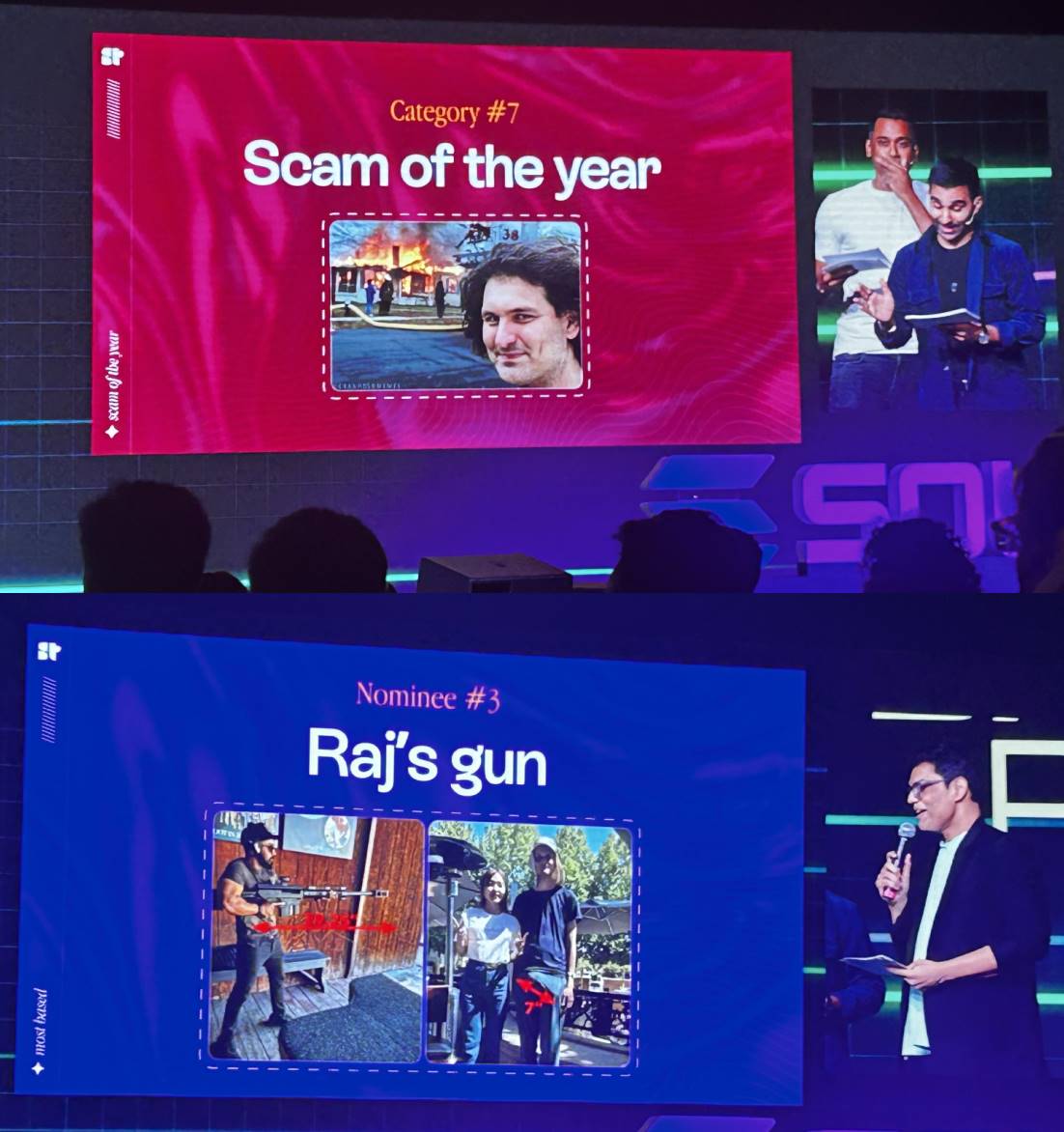
Walking into the Solana pavilion felt like entering a supermarket — not just an exhibition.
Projects like Jupiter, Pyth, Wormhole, Birdeye launched dozens of new products — non-stop action.
The conference had two stages. Left to right, right to left — I lost count of how many times I ran back and forth to catch key sessions.
Day one ran from 10:30 AM to 6:00 PM. Thanks to tight scheduling and almost no ads, every session was packed.
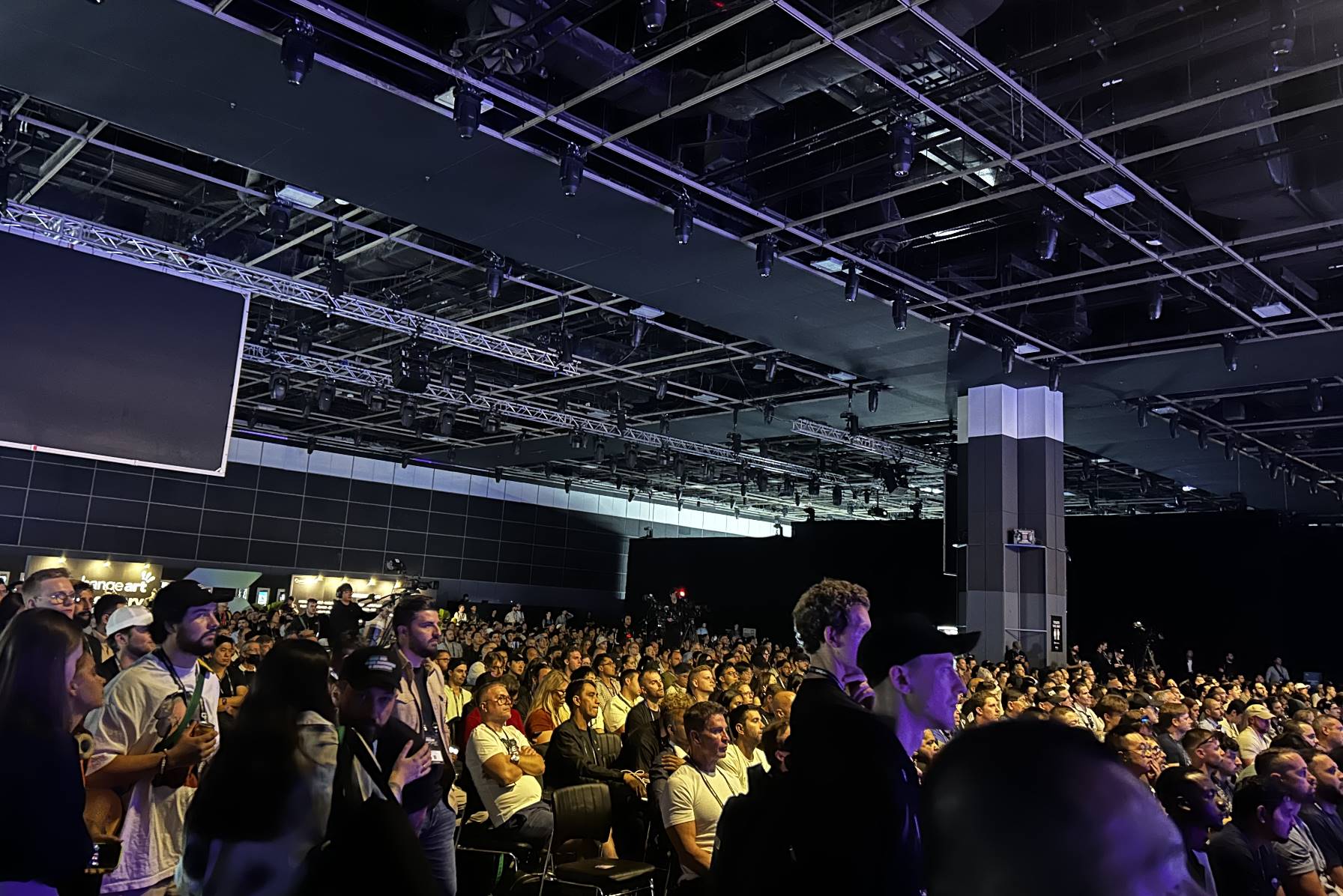
During talks, whether it was thunderous applause for “Firedancer” or chants of “GO!” for “DeGods,” it was clear the Solana community shares strong consensus on major directions.
Everyone knows what Solana’s future priorities are;
Everyone knows which projects are truly loyal members of the Solana ecosystem;
Everyone understands inside jokes only insiders get.
That Solana represents beta in this cycle is widely accepted. The disagreement lies elsewhere: many feel that once big projects like Pyth, Jupiter, Wormhole, and Drift launch, there may not be many alpha opportunities left in Solana.
But that’s not true.
Backpack, Cube, Flashtrade, Sonic, Solayer, ComputeLabs — developers keep flooding into Solana, building increasingly interesting things.
On the tech-focused stage, the host asked how many were first-time Breakpoint attendees. Nearly half raised their hands — fresh blood占比 reached 50%!
Solana, having climbed from the depths, now has a tougher, more resilient community. Thank you, Solar, for letting me experience this event.
Solana, you deserve such an amazing community.
Move Ecosystem: Another Source of Alpha Beyond Solana
During TOKEN2049, Sui’s surge attracted considerable attention.
Sui Builder House was also one of the hottest pre-TOKEN2049 events.
Since around April this year, I’ve been pitching SUI, mainly based on:
1-Solana traffic overflow: For developers/speculators who think Solana’s ecosystem is saturated, they seek the next alpha. Last cycle had Polygon and Avalanche; this cycle has SUI and Ton.
2-Move language’s similarity to Rust: Transitioning from Rust to Move isn’t hard. So whether pushed out of Solana or wanting side projects, Move-based chains are ideal. For example, Solend launched Suilend on SUI. This applies to SUI, Aptos, and Movement alike.
3-Technical community validation: Both Sui and Aptos have launched mainnets with tokens. After consulting technical friends, many agree Sui’s tech and documentation are superior.
Back then, there was no Grayscale Trust or native USDC on Sui. With these recent additions, Sui’s prospects look brighter.
Overall, I remain highly optimistic about SUI, Aptos, and Movement. While writing this, $APTOS rose 14%.
Still, Sui’s problem is the lack of hype-worthy assets. Despite launching SuiPlay and hosting Korea’s largest gaming booth at KBW, standout projects remain limited — Cetus, Turbos, Navi, Scallop, plus a few memes — barely enough to count on two hands. Hoping the Cetus-Sui incubation program yields more results.
Aptos seems directionless — users and community are unsure where the foundation aims to go. Movement is the only Move-based project yet to launch a token. Stay tuned, hoping to see standout cases soon.
With rate cut expectations, optimism has grown
From Japan and Korea to Singapore, as a trading novice, I seized every chance to ask friends about market outlooks. Generally, people seem more optimistic now.
A few months ago, most believed the cycle had ended, or the bull market would peak by Q4 this year or Q1 next.
Now, expecting the bull to last until Q1 next year feels conservative — many believe it could extend to Q3.
Main reasons: Rate cut cycle has begun; 50 basis points is just the start. Monetary easing takes time, and capital hasn’t started flowing out of U.S. stocks/BTC yet.
Key uncertainty remains the November U.S. election.
Though some said people were only seeking exit liquidity, and veterans expressed deep disappointment, seeing no innovation.
My advice: Let it go.
Don’t focus only on pessimism. Let the disappointed leave.
There are still many hardworking founders and dedicated projects. Yes, some seek exits or pump memes; but many persistently explore industry directions, iterate toward product-market fit, and top-ranked founders still hustle across events as workhorses.
Like Jambo — from last cycle’s “Africa phone” concept to selling over 500,000 units, covering 120+ countries, recently launching JamboPhone v2. Every meeting radiates their passion.
Like Solv — struggled to find PMF, now embracing the BTC ecosystem, their persistence built $13 billion in solvBTC.
Like Sonic — started as a gaming marketplace, now famous for SVM infrastructure.
Like Matr1x — endured skepticism from launch to listing to testing, now officially launching open-beta gold farming.
Every cycle has naysayers, just as every project faces FUD.
Naysaying or FUD —
The industry is always driven forward by optimists. Without FUD, there can be no true community.
Let’s charge wholeheartedly toward beautiful things!
Captain Jack: Primary Market Faith Collapsed, But Don’t Leave the Table
-
Most panelists expressed bearish market outlooks, worried that if no new innovation or growth emerges by May next year, the entire market ecosystem may undergo restructuring;
-
Innovation deficit, concentration toward leaders. Top 15 coins by user count and market cap weighting — like DOGE, SHIB — fell 70–80% from peaks, others worse. (Based on my data, exchange volumes may have dropped ~80% this year);
-
Decentralized stablecoins and payment apps represent clear growth sectors;
-
Primary market faith has collapsed — few projects invested in over the past two years have profited;
-
Unprofitable in primary, professional institutions shift to secondary. Li Lin deployed $500 million into a secondary quant master fund — quants are entering the market;
-
We estimate fewer than 10 institutions currently possess stable secondary quant capabilities;
-
For retail traders fighting quants: strategy is buying and holding top 5 large caps, reducing trades, enduring;
-
Retials buying & holding reduces exchange volumes and AUM — bad for exchanges;
-
Mid-tier exchanges ramp up marketing aggressively. Attended Bitget, XT events, sailed overseas with Gate friends, saw BingX, Weex promotions… Exchange marketing costs will rise;
-
Ton and Solana ecosystems appear to offer structural trading opportunities;
-
As an internet veteran since 2003, despite challenges, compared to 2000, we now have far more professionals, better skills, stronger infrastructure, larger user base, greater industry scale, and vast growth potential across niches. So, don’t leave the table.
Little Crow (Editor-in-Chief, Crypto City): Rich Exhibitions and Events, Yet Innovation Lacking
According to official stats, this TOKEN2049 hosted over 400 talks, 700 side events, with up to 200,000 attendees. Coupled with F1 races and Solana Breakpoint following the event, Singapore hotel prices surged, queues grew long, and traffic jams appeared near Marina Bay Sands. Public opinion on the event was sharply divided:
From an observational standpoint, the event felt rich and offered chances to meet people unreachable in Taiwan.
Yet regarding industrial innovation, frankly, deeply disappointing. Most narratives were nearly identical to past years, leading many developers to tell me they found it boring.
Exhibits centered on crypto payments, AI, and DePIN. Some specialized in sports, fan economy, and RWA, along with numerous compliance-focused vendors. Even projects founded just months ago came to TOKEN2049 to launch full-scale outreach.
After walking around, a colleague asked me curiously why TON was hyped so loudly at Taiwan events, yet barely visible at TOKEN2049 (only Catizen stood out).
My guess is simple: TON’s loud promotion in Asia, especially Taiwan, stems largely from media hype and matrix-style collaboration between projects and KOLs, creating the illusion of widespread engagement. Later, at side events, I asked foreign participants about TON — many were观望or indifferent. One bluntly replied: « I Don't Fucking Care about TON! » — confirming my suspicion.
Regarding TOKEN2049 pricing, it was never meant to attract retail. Attendees were mostly industry insiders — capital firms, exchanges, VCs, projects, large-scale KOLs, media. Given the terrible market and liquidity over the past year, most came to do business. For regular users, attending held little value. Why so many side events? Simple: without hosting events, projects struggle to attract funding, users, or partnerships. Many pressed on regardless, chasing transaction opportunities.
Theo (Founder, 3rdStCapital): Infrastructure Valuations Still High
1. Everyone is bullish on AI x crypto and hunting for great teams to back;
2. Many teams are building the next pump.fun;
3. Most on-chain participants I met are tired of memes, prioritizing utility;
4. Teams show interest in MemeFi but fear brand damage. Thus, most won’t build their own;
5. Few good investment targets exist — many teams build iterations of existing or already-launched products;
6. Merchandise quality is now strictly judged. People joke that poor merch reflects team health — teams should pay attention to details at events;
7. Many teams aren’t qualified to host events — their content is empty;
8. With so many side events, attendees judge teams by them. Poor performances leave bad impressions. I won’t name names — some projects are friends’ investments;
8. Infrastructure layer valuations remain high; ecosystem-level valuations are lower;
9. Startup teams now struggle to raise funds — VCs show little interest. Many are surprised we’re still actively investing;
10. Extremely bullish on Solana. SUI threw a huge party. ETH’s price action makes everyone uneasy.
Degentrading (KOL): Most Projects Boring, Just Burning VC Money
-
I spent 99% of my time on one-on-one conversations — far more productive than any event;
-
Among all events, the Bittensor Asia Meetup was by far the best. Seeing real builders on $TAO strengthened my belief — this is the AI coin of the cycle;
-
Most projects are boring/uninteresting/just burning VC money. Without inflows… founders would leave, tokens might die… If inflows come, maybe they’ll survive a while? Not sure. Anyway, I won’t buy these tokens;
-
Except funds that also trade crypto-related equities, most liquid funds underperformed Bitcoin;
-
Many VCs are genuinely stupid;
-
Despite huge marketing budgets, sentiment is low — reminds me of pyramid schemes;
-
On $SOL (Solana): Must admit, I deeply respect the Solana ecosystem. Not sure if it can surpass Ethereum, but I believe Solana stands a good chance of surviving the token unlock pressure from FTX liquidations... Ethereum influencers seem disconnected from the crowd (maybe too rich? Who knows, but it’s not good). How much faster is Solana progressing than Ethereum? Five times?
-
On perpetual DEXs: They’ve been neglected lately. I think they’ll rebound once Hyperliquid launches;
-
On $LDO (Lido): Might have hit rock bottom — nobody hates it anymore… Nobody cares. As a bull, I think that’s actually good — can it get worse?
Bienvenue dans la communauté officielle TechFlow
Groupe Telegram :https://t.me/TechFlowDaily
Compte Twitter officiel :https://x.com/TechFlowPost
Compte Twitter anglais :https://x.com/BlockFlow_News
 深潮TechFlow