Interview exclusif avec le fondateur de DWF Labs : Les innovateurs ne suivent pas l'orthodoxie, l'ère « Nokia » des market makers est révolue
TechFlow SélectionTechFlow Sélection
Interview exclusif avec le fondateur de DWF Labs : Les innovateurs ne suivent pas l'orthodoxie, l'ère « Nokia » des market makers est révolue
Nous suscitons la controverse, et nous en sommes fiers.
 Dédié à des analyses Web3 approfondies
Interview : Kean, Foresight News
Interviewee : Andrei Grachev, DWF Labs
Editing & Translation : Peng SUN, Foresight News
"I have five Chinese tattoos," Andrei Grachev said with spontaneous joy and excitement when discussing non-U.S. markets.
As a Russian, Andrei Grachev embodies the wild spirit of his people. Yet unlike Russia's geopolitical ambiguity between Europe and Asia, his crypto investments have decisively chosen the East. In the crypto world, Asia has long been associated with trading, speculation, and hype. Grachev’s journey fits perfectly into this narrative—he began as a trader, engaging in market making, high-frequency trading, and investing, firmly believing that Asia and the Middle East will lead the next wave.
Looking back at 2022, both DWF Labs and Andrei Grachev were undeniable focal points of controversy. With tens of millions of dollars invested monthly, questions arose: Where did the money come from? Were they manipulating secondary markets? Was their unconventional market-making approach being shunned by firms like Wintermute? Wave after wave of criticism rolled in, but Grachev never cared. He believes he is merely challenging tradition—without breaking laws or doing anything wrong.
In Grachev’s eyes, DWF Labs is not just a single-service market maker, but a one-stop solution capable of fulfilling all needs:
Today, DWF Labs is a large-scale high-frequency trading firm, market maker, VC, OTC desk, incubator, ecosystem builder, fundraiser, event brand, TVL provider, DeFi taker, advisor, listing agent, HR partner, PR/marketing agency, KOL, RFQ (Request for Quote) platform, and more...
Grachev claims that over the past 16 months, DWF Labs has provided these services to approximately 350 Web3 projects among the top 1,000 by CoinMarketCap market cap. While Wintermute’s founder disdains associating with them, the fighter nation never backs down. Grachev publicly clapped back: "We are controversial—and proud of it":
It would be shameful for me to join ranks with those “orthodox” market makers who take loans, do nothing, dump tokens, or profit from call options. They can only envy us. We dare to take risks, stand out, reshape the order of the crypto world, and raise the bar for what a market maker should be.
If crypto challenges the narrative order of traditional nation-states, why can’t DWF Labs challenge the established order of traditional crypto market makers? If crypto constantly reconstructs itself without yet offering a new framework, why can’t DWF Labs deconstruct the past and build its own narrative? Besides, I’ve also heard multiple Web3 projects express demand for “one-stop services.”
In this interview, Grachev revealed DWF Labs’ basic structure, various business lines, funding sources, risk management methods, investment logic and style, bull market plans, latest progress on acquiring FTX assets, and his views on the global crypto market. Regardless of operational models or controversies, objectively speaking, DWF Labs has supported many projects during the bear market.
1. The Making of a “Celebrity” Market Maker
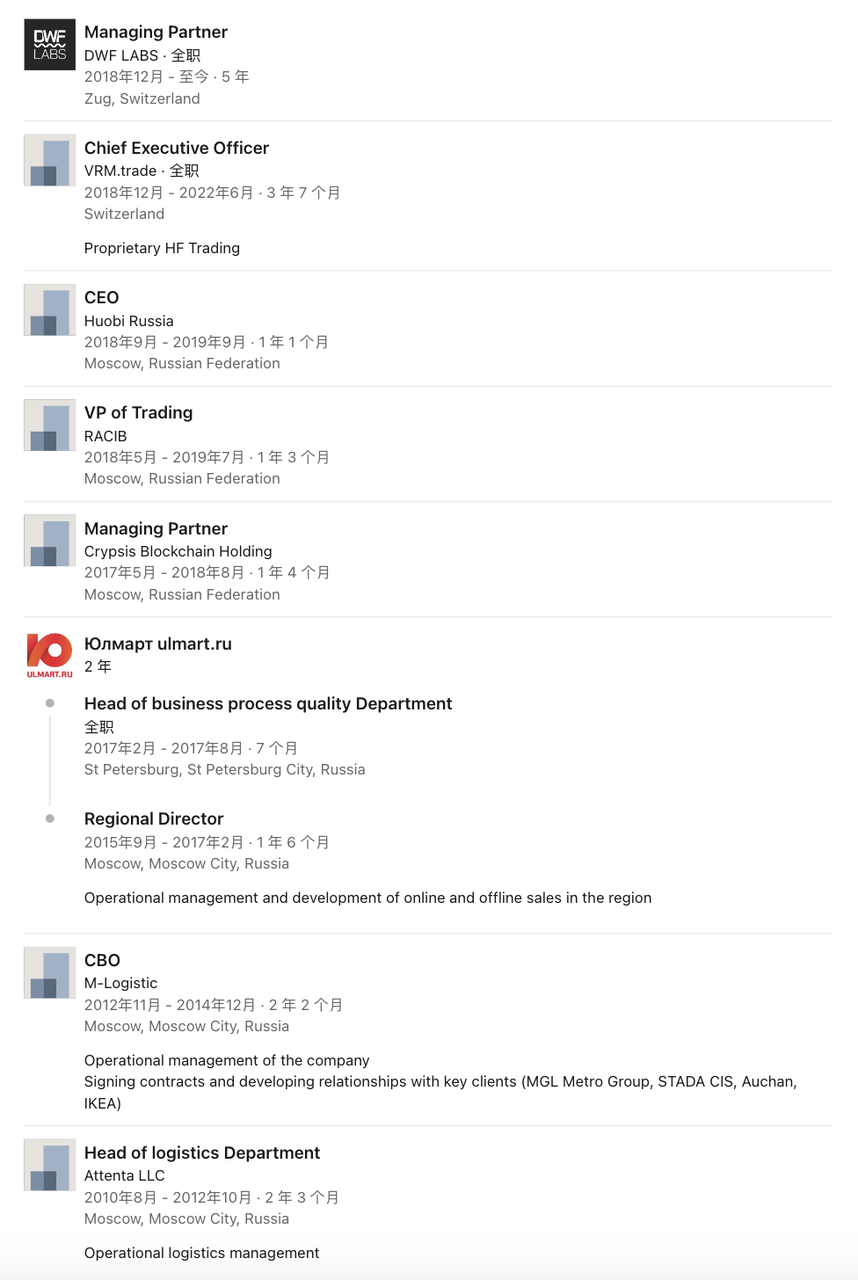
Andrei Grachev worked in logistics from August 2010 until starting trading in traditional markets around 2014, marking the beginning of his trading career. In 2016, Grachev seemingly bought his first ETH, which allowed him to reap huge profits during the 2017 bull run. Experiences founding a crypto trading company and serving as CEO of Huobi Russia accelerated his growth.
Foresight News: How did you transition from logistics into the crypto space? Any key turning points or interesting stories you’d like to share? And how have those experiences influenced your current ventures?
Andrei Grachev: I entered the logistics industry at 18 and spent eight years there before transitioning to trading in traditional markets around 2014. Later, I moved into e-commerce, which gave me more time to study financial markets. Actually, my experience in logistics and e-commerce didn’t significantly impact my cryptocurrency trading, but they did shape my management skills and work style. Since 2010, I’ve always worked remotely with large distributed teams. Both industries helped me develop a big-picture mindset.
In 2016, a London friend introduced me to Ethereum mining—that was my gateway into crypto. The 2017 bull market was a major turning point, when Ethereum rose from $7 to $350. We sold some ETH and officially launched our crypto journey. At first, I co-founded Crypsis Blockchain Holding with friends to explore the crypto market—a great period to gain experience and learn how things operate. I also joined a community organization called RACIB, though it wasn’t formal employment. It captured part of my interest, but I soon realized it looked self-regulatory but wasn’t truly so, and I wouldn’t work in such organizations again. Back then, I managed funds and offered consulting for friends and family, eventually becoming CEO of Huobi Russia.
Huobi Russia was my most important experience. There, I met partners from Digital Wave Finance (DWF), and we became close friends. As the fastest-growing and largest Huobi Cloud partner, we even received two awards from Huobi Global, helping me build strong connections in China and Southeast Asia. Although I stepped down as CEO in 2019, I continued working there as a partner until 2021, ultimately selling Huobi Russia’s operations back to Huobi for a substantial profit. Before launching DWF Labs, we created VRM.trade, conducting proprietary high-frequency trading on tier-two CEXs, learning many product and technical details along the way.
Foresight News: That’s quite an interesting journey. So why did you decide to establish DWF Labs? How did your team come together? Where are your members based, and how do you coordinate work?
Andrei Grachev: DWF Labs was founded in 2022, although Digital Wave Finance itself dates back to 2018. Initially, I helped Digital Wave Finance collaborate with exchanges to negotiate better fees and terms. During this process, I met my current partners Zac, Eugene, and Heng, who greatly assisted me in the Asian market. While discussing collaboration opportunities with Digital Wave Finance, I proposed launching a market-making business to my Asian friends—that became the starting point for DWF Labs. We’re primarily based in Asia and Switzerland, so remote work has always been our norm. Daily communication mainly happens via Telegram, Zoom, and Google Meet.
Foresight News: Can you explain DWF Labs’ departmental setup and organizational structure? What’s the relationship between OTC, DWF Ventures, and market making as shown on your website? How is the team divided?
Andrei Grachev: We have multiple departments offering various products, including OTC trading. Here, we provide seamless transactions for individuals or entities meeting our KYB, KYC, and AML requirements, settling their tokens. Typically, token settlement is straightforward—we simply offer the option to sell tokens, simplifying decision-making. Currently, a few people handle this operation, and we’re enhancing settlement capabilities to allow more users to access real-time pricing across multiple clearing engines.
For projects initially engaging in OTC, our goal is to transition them to other offerings such as market making or DWF Ventures. Additionally, we’ve built a DWF ecosystem to facilitate interaction among different projects and entrepreneurs, enabling them to explore and participate in new investment opportunities and increase trading activity.
However, these three directions are distinct. The market-making unit operates independently as a technical trading department, completely separate from the sales team—even located in different countries—with a focus on proprietary technical trading strategies using dedicated tokens. We also engage in project incubation and nurturing. Currently, about 60 companies in the DWF Ventures portfolio have received our support at the angel or seed stage. These projects haven’t yet listed on exchanges, but we firmly believe that once conditions mature, most will succeed on exchanges. DWF Ventures works closely with the OTC team—their functions overlap somewhat, requiring effective communication to ensure successful transactions.
2. Is All the Money Just Blown by the Wind?
Perhaps the 2017 and 2022 bull runs filled Grachev’s pockets, but is all the money really just blown in by the wind? And if the wind brings it, it can blow it away too. Let’s examine Grachev’s philosophy on earning and managing risk.
Foresight News: Your frequent and sizable investments over an extended period have been astonishing. Many people, myself included, are curious—what is DWF Labs’ source of funding? Have you ever raised capital?
Andrei Grachev: We’ve never participated in fundraising, nor do we currently have any plans to. DWF has always maintained solid financial health, especially profiting significantly during the 2020–2022 bull market phase. While continuously generating profits, we’ve reinvested these funds. Though I can’t disclose exact figures, I assure you we possess the financial capacity to easily invest tens of millions of dollars monthly into startups. Our primary goal isn’t to invest $10 million to earn $200,000; we’d rather invest $10 million, exercise patience, and aim to make $50 million.
Foresight News: Then how do you manage token holdings and control risk?
Andrei Grachev: We distribute tokens through CEXs while adhering strictly to risk protocols. Our standards for risk management are very high—and there’s good reason. Earning money is one thing; protecting those gains is equally critical. Exchanges get hacked, protocols get exploited, market makers get attacked—we don’t want to become victims. Therefore, we need risk-mitigation solutions.
According to our risk strategy, part of our funds are held on CEXs, and we use custody services like Fireblocks, which we assess as providing robust protection. We also maintain multi-signature wallets on-chain and use them when necessary. For BTC, most remains in cold storage since BTC doesn’t require frequent transfers to exchanges.
3. The “Nokia Era” of Market Makers Is Fading Away
DWF Labs has chosen an independent path—so long as it’s compliant, let criticism fade away. “DWF Labs is a one-stop solution meeting all needs”—this is how Andrei Grachev defines DWF Labs. Over the past 16 months, they’ve delivered these services to roughly 350 Web3 projects within the top 1,000 by CoinMarketCap valuation. They aim to compete with the “iPhone,” not the “Nokia.” As Grachev puts it, DWF Labs supports portfolio companies in South Korea’s tightly regulated market—an area many find difficult—but they manage it compliantly. “Be creative, not biased.”
Currently, DWF Labs has invested in 470 projects—70% in DeFi, decentralized derivatives, GameFi, and SocialFi, with the remainder including higher-market-share coins and memecoins.
Foresight News: This year, your hybrid model combining “investment + market making” has kept you at the center of public debate. Since March, traditional crypto market makers like Wintermute have dismissed your investment approach, arguing you’re merely “trading,” not “investing.” What kind of relationship do you maintain with these traditional market makers now? Do you cooperate commercially?
Andrei Grachev: I don’t think there are many avenues for cooperation with them. Perhaps the only possibility would be hiring some of their talent for DWF. But in the business world, imagine you’re a media pioneer, and another outlet starts complaining your interview style isn’t traditional enough—would you care? Probably not. You might actually be pleased, because innovation attracts attention.
For us, legality is paramount. As long as we operate correctly and legally, if a method proves effective, we’ll adopt it—regardless of others’ opinions and unafraid of competitors’ criticism or complaints.
Foresight News: The secondary market also accuses you of market manipulation. Data firms and media outlets report on your on-chain fund flows, and your movements have become a directional signal for institutional and retail investors assessing the market. What’s your take on this?
Andrei Grachev: I frequently encounter such discussions. In terms of trading volume, we handle billions of dollars daily. However, relative to overall market volume, our share is relatively small. Crucially, we don’t engage in wash trading. While media and people may speculate and comment, we indeed create influence. When others observe our actions, they may choose to buy or sell—but those are their own decisions, beyond our control. We play the long game, not the short one.
Trading and investing in crypto inherently involve depositing and withdrawing assets from exchanges—it’s a core part of our business. We don’t engage in trades conditioned on market manipulation; our approach remains distinct.
Market manipulation holds no appeal for us. As the industry evolves toward greater regulation and legitimacy, our focus lies in long-term strategy, not short-term gains. Whether others follow or oppose our moves depends on individual choice, but our principle remains strategic long-term positioning amid changing market dynamics.
Foresight News: I noticed you responded on Twitter to Coin98 Analytics, stating that the 174 projects they tracked represent 40% of DWF Labs’ total portfolio, implying a total of about 435 projects. What types of projects do you typically invest in, and what different strategies do you apply to different projects?
Andrei Grachev: Around 70% of our portfolio focuses on long-term narratives. This includes our emphasis on DeFi, decentralized derivatives (such as perpetual options or options), and significant investments in emerging areas like GameFi and SocialFi.
The remaining portion of our portfolio allocates to specific cryptocurrencies—either those with larger market shares or ones that people favor. We also reserve a small allocation for short-term narratives, such as certain memecoins. The allure of memecoins isn’t groundbreaking technology, but the culture they embody. They represent a cultural phenomenon, and riding this trend can be profitable. When timing aligns, these memecoins may surge dramatically—that’s precisely why we invest in this cultural movement.
Foresight News: You've mentioned in several instances that investing via direct token purchases helps projects in “distress,” suggesting these projects are already relatively mature. Does that mean you don’t trust founding teams? After all, seed rounds mostly involve ideas, often without even a product.
Andrei Grachev: Of course, we believe in startups. When it comes to investing, there’s a clear distinction between startups and the secondary market. The secondary market offers data insights, traction, and signals of user or trader interest, allowing for risk assessment and potential hedging. For startups, however, it’s entirely different. It’s not about trust, but risk management—considering long-term market narratives like DeFi or GameFi. If a startup has an excellent team, a solid product, and aligns with long-term market narratives, it becomes suitable for investment. While success isn’t guaranteed, you can still play the game—weigh possibilities, then decide how much capital to allocate from your portfolio. If 90% of your portfolio consists of startups, the risk is enormous; but if it’s 5% to 10%, there’s no issue. You can make selective investments—losing won’t jeopardize your entire portfolio, but winning could yield massive returns.
That’s exactly our approach—always trusting startups, otherwise we wouldn’t collaborate with them. We manage risk based on calculated probabilities and optimize investment decisions accordingly.
4. More Than Capital—Bear Markets Need Confidence
Andrei Grachev emphasizes that DWF Labs’ investments go beyond mere capital injections—they also provide further support through DWF Ventures and technical teams. To him, building confidence in the industry during bear markets is crucial.
Foresight News: How do you currently make decisions and operate your OTC and secondary market token purchases? Beyond buying tokens, what other support do you offer to your invested projects?
Andrei Grachev: Our focus extends far beyond just providing capital—that’s secondary. Anyone with cash can invest. In crypto and venture capital, money is usually not the bottleneck; good projects often secure sufficient funding. Our differentiation lies in value-added services.
We have our own incubation arm that assists with market strategy, market research, and partnerships with KOLs, media entities, and local businesses. Additionally, our HR department provides solutions, helping portfolio companies recruit talent for their teams.
Moreover, we offer technical assistance through an internal team of about ten developers. Though currently managed under us, we plan to spin them out soon. They provide consulting, computation, and other technical expertise to our projects. Finally, we also deliver support services such as exchange listings and market making.
Foresight News: In 2022, the crypto market suffered consecutive collapses of Three Arrows Capital, Celsius, Voyager, and FTX, causing immeasurable damage to the industry. Amid freezing crypto winters, cooling financial markets, and increasingly conservative global economies, DWF Labs went against the tide—for example, supporting Binance’s Industry Recovery Fund, TON Foundation’s “rescue fund,” and notably accelerating overall investment pace. What considerations and decision-making drove this?
Andrei Grachev: Looking back to early this year, right after FTX collapsed, it was prime time to deploy capital. When everyone else is selling, you buy—that’s golden rule of investing. Acting proactively amid market fear often means fewer competitors.
Binance’s Industry Recovery Initiative post-FTX collapse had far-reaching impact, and our collaboration with Binance made positive contributions to the industry. For us, it’s not just about profit, but about restoring confidence. During turbulent times, having someone say, “Hey, keep building—we’ll support you,” is incredibly important. I’d say we’ve made multiple investments, provided vital support to projects, and generated substantial returns in return.
Regarding the TON Foundation, it’s no secret we’ve committed significant capital to TON. This is a long-term commitment with low capitalization, but we firmly believe in its potential, hence investing tens of millions of dollars. When TON launched its initiative, we naturally offered support. Whether aiding market makers or facilitating OTC deals, we support our partners across multiple domains.
5. What Happens When the Bull Market Returns? “We Are Highly Adaptable”
Andrei says DWF Labs is highly adaptable—having bear-market investment logic while preparing for the bull market through other forms of support and investment. Meanwhile, due to a significant portion of its own funds being frozen on FTX, DWF Labs also plans to acquire a local FTX exchange.
Foresight News: Will this current pattern of “high-frequency” large-scale investments continue much longer? Right now it’s a bear market—you’re investing via OTC into projects facing “distress.” But in a bull market, project funding will be abundant, and your current strategy may no longer work. What plans do you have for investment and market strategy in the next bull cycle?
Andrei Grachev: First, we don’t only invest in distressed projects. We made a major investment in Fetch.ai, which isn’t a “distressed” project, yet it’s performing exceptionally well. It’s a highly profitable investment, and we’ll continue supporting it.
Our efforts go beyond injecting capital into companies—we’re building an ecosystem. Today, we’re selling not just our capital, but comprehensive support, which has proven effective in closing more deals.
Last July, marking 12 months since DWF Labs began operations, I tweeted: “During this period, our portfolio reached 250 projects.” Since then, our portfolio has grown to about 470 projects. This means we found it easy to close deals during the first 12 months of market hardship, and also succeeded during the following four months of improving market conditions. This demonstrates our adaptability across various market environments—we’re capable of operating effectively even as market sentiment turns optimistic. One could say our current momentum and achievements have surpassed where we were just six months ago.
Foresight News: You previously mentioned considering acquiring FTX assets. Recently, calls to acquire FTX and relaunch FTX 2.0 have grown louder, and FTT token prices have surged. Have you communicated with FTX? Are you advancing this plan?
Andrei Grachev: Our lawyers are currently in contact with the FTX liquidator regarding asset matters, and everything is progressing smoothly. Regarding FTX 2.0, a local FTX exchange has approached us seeking our participation as a market maker. I can’t disclose which one yet, but I expect we’ll get involved. Since a large portion of our funds remain frozen on FTX, we need to execute transactions to recover them. However, we’re still unclear how this process will unfold. I have no objection to FTX 2.0.
Foresight News: I once wrote a brief history of LocalBitcoins, once the world’s largest Bitcoin OTC platform. It operated for ten years before announcing shutdown this year. Its peak stemmed from factors like bull markets, underdeveloped payment infrastructure in developing nations, and varying political, economic, and regulatory environments across countries. Ultimately, it failed because LocalBitcoins complied with regulations, implemented KYC, lost its original P2P anonymous privacy features, and faced competition from superior platforms like Binance P2P, which offered better functionality and user experience, capturing markets worldwide. So I’m curious—how does DWF Labs’ OTC mechanism operate? Which regions’ users do you serve? How do you handle compliance? Also, could you introduce your upcoming institutional-grade OTC/RFQ platform, DWF Liquid Markets?
Andrei Grachev: I haven’t thought too deeply about specifics yet, as we’ll formally announce details when the time is right. But I’ll say this—it’s different from LocalBitcoins, closer to Binance P2P, but with unique innovations of our own. We’ll reveal more when the moment is appropriate.
Foresight News: You previously mentioned DWF Labs obtained a license from Dubai Multi Commodities Centre (DMCC) and became a financial partner in its ecosystem. What business activities will you pursue in Dubai?
Andrei Grachev: We’ve recently applied for multiple licenses to expand operations into the Middle East. To ensure full compliance, we’re undergoing audits by one of the Big Four audit firms.
Just yesterday, DWF Labs co-hosted a hackathon in DMCC Dubai alongside DMCC, Bybit, and other partners, providing funding and consulting services to startups headquartered in DMCC UAE. That’s what we’re doing here. These initiatives have already yielded positive results—not widely reported, but effective.
6. All-In on the East, Embracing the Mystical Force
"I have five Chinese tattoos," Andrei Grachev said with immense pride and excitement. There’s something Eastern about him—perhaps his trading nature aligns with Asian crypto characteristics, fueling his deep attachment and confidence in the East.
Foresight News: You have offices in Asia—Singapore, South Korea, and Hong Kong—plus the British Virgin Islands and Dubai. Most of your team members are of Asian descent. It seems you’ve long maintained close ties with the Chinese market. How do you view the Asian market? The U.S. domestic market remains vast, yet you appear to prioritize non-U.S. markets?
Andrei Grachev: The Asian market is the global leader in cryptocurrency. Nearly all leading exchanges originate from Asia—Binance, OKX, Bybit. Only Coinbase and Bitfinex aren’t Asian-based, but in trading volume, I believe Coinbase doesn’t even match some Asian exchanges like Gate.io.
In terms of regulation and compliance, the global regulatory and financial landscape appears to be splitting into Eastern and Western blocs. You must choose, because you cannot simultaneously achieve compliance and risk-free operations in both markets. Thus, we’ve decided to center on the East—that’s why we have so many Asian colleagues. I love Asian culture—I even got five tattoos in China. I’ve been working with Chinese counterparts since 2018. This is our target market, and we enjoy operating here. The Middle East, Asia, and China—all are our target markets.
For the entire industry, I’d say development—including market making and regular trading—is being shaped by the firewall between the U.S. and the rest of the world. We trade on Coinbase International Exchange, an offshore perpetual futures platform, but we avoid trading on Coinbase’s spot market, as the SEC might classify us as market makers. From a risk-to-return perspective, it makes no sense.
Now the world talks about Bitcoin ETFs. Though the news may originate from U.S. ETF approvals, the driving force and momentum for success are expected to come from Asian and Middle Eastern markets, further boosting adoption and growth.
Foresight News: Final question—recently CZ was forced to step down from Binance. What impact do you think this will have on the crypto market?
Andrei Grachev: It’s bad news because Binance is undoubtedly the industry leader, but I don’t think the crypto landscape will change drastically because of it. In fact, U.S. regulators have scored a major victory—they now have access to all of Binance’s data and insight into every user action. I believe this might push users toward DeFi, as people seek more decentralized and less regulated alternatives. Exchanges unrelated to the U.S. may benefit from this shift in user behavior.
Nevertheless, I don’t think this will significantly impact Binance’s business either. Binance has already cemented its dominant position in crypto. While regulatory scrutiny may drive some users to other platforms, it’s unlikely to substantially weaken Binance’s market leadership.
Bienvenue dans la communauté officielle TechFlow
Groupe Telegram :https://t.me/TechFlowDaily
Compte Twitter officiel :https://x.com/TechFlowPost
Compte Twitter anglais :https://x.com/BlockFlow_News
 Foresight News