Entretien avec Raullen Chai, PDG d'IoTeX : les cryptomonnaies ne deviendront réellement mainstream que lorsqu'elles seront connectées au monde réel
TechFlow SélectionTechFlow Sélection
Entretien avec Raullen Chai, PDG d'IoTeX : les cryptomonnaies ne deviendront réellement mainstream que lorsqu'elles seront connectées au monde réel
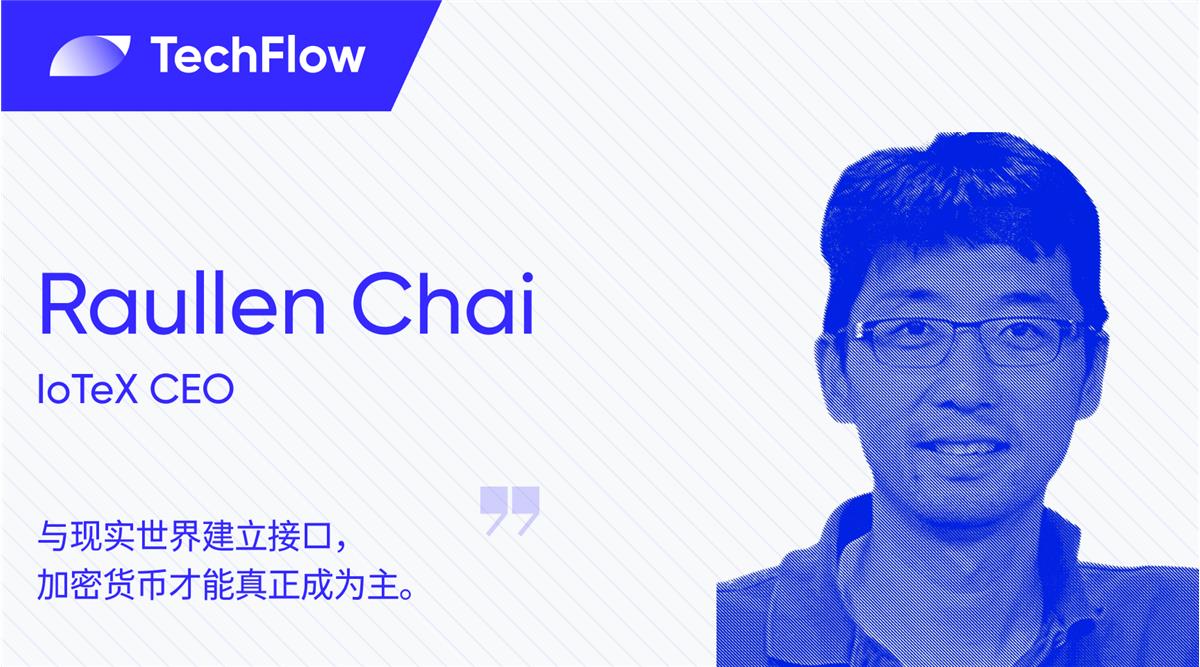
Si la cryptomonnaie veut devenir une technologie véritablement grand public, elle doit établir une interface avec le monde réel. IoTeX vise à construire cette interface afin de permettre une connexion fluide entre les cryptomonnaies et le monde réel.
 Dédié à des analyses Web3 approfondies
Interview : Sunny
Editing : Min
Introduction
Since the crypto research firm Messari released an industry report on DePIN in January this year, the debate over whether DePIN is merely a bear market narrative has intensified. According to the report, decentralized physical infrastructure networks (DePIN) refer to using token incentives to crowdsource and build real-world physical infrastructure networks.
To gain deeper insights into DePIN’s evolution and value since 2017, we invited Raullen, a veteran figure in this field, for an in-depth discussion.
Raullen is the founder and CEO of IoTeX. Prior to founding IoTeX, he led Uber's cryptography R&D division, served as Tech Lead for software engineering at Google headquarters, and worked as an engineer at Oracle. As early as 2012, Raullen began exploring the field of IoT cryptography, serving as a researcher in cryptography, IoT privacy, and security at the University of Waterloo in Canada.
During our conversation, Raullen shared IoTeX’s journey of trial and error in developing its strategy and its collaborative efforts with other industry leaders to shape the direction of this emerging sector. As a bridge between the crypto world and the physical world, IoTeX has effectively shaped the entire industry—terms like DePIN have evolved directly from its innovations.
Key Highlights
-
If cryptocurrency is to become truly mainstream, it must interface with the real world. IoTeX aims to build that interface, enabling seamless connectivity between crypto and physical reality.
-
DePIN has far higher entry barriers than DeFi. With DePIN, you can’t simply fork an open-source DeFi protocol—you need to develop hardware, communication systems, blockchain integration, mobile apps, and more. These layers are highly complex. Unless you can raise significant capital and assemble a capable team, launching a compelling project is extremely difficult.
-
Ultimately, DePIN may end up embedded deep within the technology stack. For most users, there will be several abstraction layers they don't even need to perceive.
-
My personal philosophy is that we should focus more on building infrastructure and lowering the barrier for developers, enabling more innovators to experiment across different domains—out of which truly disruptive ideas may eventually emerge.
-
For upgrading Web2.5 products to Web3, we can ensure transparency, reliability, and decentralization in the intermediate computation process, helping project teams solve this challenge so their logic can be better applied.
-
We want to make the world better: DePIN and distributed technologies could be a powerful starting point.
The Evolution of DePIN Through the Lens of IoTeX
TechFlow: Could you walk us through IoTeX’s journey—the past, present, and future trajectory?
Raullen: IoTeX is actually quite an old project. At the end of 2017, three co-founders—myself, Jing, and Qevan from Facebook—founded IoTeX. Our primary goal was technical: to build a blockchain for IoT, but more importantly, to find better ways to connect cryptocurrency to the real world. We realized that if crypto is to become truly mainstream, it needs an interface with the physical world. That’s why we’re dedicated to building that interface for seamless integration.
In early 2018, IoTeX successfully raised $30 million from top-tier venture capital firms. We then assembled a team, wrote our whitepaper and vision, and started building our Layer 1 blockchain.
At the time, the intersection of IoT and blockchain had many uncertainties, so we decided to start from the foundational layer. We chose Layer 1 because it was relatively mature and seen as the bedrock of the blockchain ecosystem.
Over the next three years—from 2017 to 2019—we focused on developing our Layer 1, a POS-based EVM public chain. Once completed, it hosted around 200 DeFi and NFT projects.
In 2020, we began seriously exploring how to integrate blockchain with the Internet of Things (IoT). IOTA had previously introduced this idea but faced challenges with micropayments. So we re-evaluated the fusion of IoT and blockchain, conducting two vertical experiments to identify better approaches.
The first experiment focused on combining IoT and blockchain for privacy. We believed data generated by devices could be owned by users via decentralized identities (DID) on-chain, enabling future data monetization. We launched Ucam, a smart home camera fully integrated with our blockchain, giving users full ownership of captured footage.
However, market feedback was lukewarm.
We discovered that regular users cared more about cost. To them, the difference between spending 40 or 50 yuan on a camera was significant. Thus, we learned that privacy protection wasn’t a strong enough selling point. For example, if a camera costs 40 yuan, few would pay 50 yuan just for enhanced privacy.
Although we sold tens of thousands of units, this wasn’t our core business. The experiment showed us that, at least currently, privacy isn’t a major priority for IoT users.
Next came our second experiment: the "Pebble Tracker," a small open-source hardware GPS tracker equipped with sensors measuring speed, orientation, air quality, humidity, light, and more.
We promised users could use it for DePIN and token mining, then launched it on CrowdSupply, the largest U.S. hardware crowdfunding platform.
Within two weeks, we sold 2,000 units and earned $200,000. While revenue wasn’t our main concern, the insight was valuable. We realized what users truly cared about: buying a device, contributing data, and earning passive mining rewards.
The concept of passive income is highly appealing to users.
At the time, Helium was also thriving, selling devices to build LoRaWAN networks. Other companies like Borderless’ Hi-Fi and Multicoin’s Proof of Physical Work had similar concepts.
We believed this concept should be called "MachineFi"—where "Machine" provides utility, combined with DeFi mechanisms. What’s now known as DePIN originated from this idea.
This insight defined our path forward for the coming years.
TechFlow: At that time, what was the most critical missing piece in DePIN?
Raullen: After visiting many DePIN projects, we identified several pain points—DePIN is very different from DeFi.
DeFi is relatively simple. Even junior developers can fork a contract like Compound or Uniswap, tweak it slightly, add a frontend, and launch a project quickly. This ease fueled innovation in DeFi.
But DePIN is much harder. You need hardware, communications tech, blockchain integration, and mobile apps—all complex components. Without substantial funding and a solid team, success is unlikely.
So we identified the key missing component: a system where data enters, undergoes computation, generates a proof, which is then sent to a smart contract to trigger actions like issuing tokens or NFTs.
This layer was missing. So we decided to build this infrastructure (Infra) to empower DePIN developers. If they succeed, we succeed too—that was my mindset.
Starting in 2021, we began developing W3bStream.
Today, W3bStream is already collaborating with or supporting over a dozen DePIN projects, providing the infrastructure they need to scale and succeed. This defines IoTeX’s past, present, and future.
Looking ahead, we aim for W3bStream to become the industry standard.
Currently, there are only about twenty to fifty DePIN projects globally. But if we do our job well, I hope to see hundreds emerge in the future.
DePIN: Vision, Reality, and User Acquisition
TechFlow: Many readers, especially in China, may not understand DePIN. Without extraordinary returns, few bother to learn what IoTeX actually does.
So I’d like to know—why did you choose to become a DePIN founder despite its high barriers? Why take on the tough journey of building IoTeX? As an early pioneer, were there hardships along the way?
Raullen: My two co-founders and I wanted to build something transformative—something that improves the world. DePIN and distributed technologies offer a great entry point.
Imagine truly decentralized versions of Uber or Airbnb, or a distributed 5G network—machine networks that improve people’s lives. For example, ride-hailing costs could drop by 50%, or phone rentals on Airbnb could become half as expensive.
My experience at Uber taught me why such companies have high overheads—most costs go toward optimizing driver-passenger matching, route planning, and risk control.
Take telecom companies—they deploy 5G base stations and send technicians for maintenance, both costly. But these costs could be distributed among individuals.
If individuals could operate and maintain a 5G station, they’d be highly motivated—because all earnings go directly to them. This low-cost, high-efficiency model better allocates resources, reduces waste, and gives consumers cheaper services.
If DePIN succeeds, it could profoundly impact human society.
From a public perspective, DePIN is like Sharing Economy 2.0—a deeper, more radical reform of existing sharing models.
TechFlow: From vision to reality—how many DePIN hardware manufacturers are actively pushing this forward today?
Raullen:
The market structure of the DePIN industry looks like this:
(1) First, there's a demand—e.g., 5G, energy storage, solar panels.
(2) A DePIN project steps in, using tokens or other mechanisms to match supply and demand. For example, if you own solar panels and generate power, and I need electricity (say, for air conditioning), the system connects us.
(3) Then third-party suppliers join—companies producing solar panels may partner with or manufacture for the project.
(4) Sometimes a fourth party emerges—specializing in hardware sales.
This is a common pattern we observe.
TechFlow: On the demand side, challenges remain significant. Many people haven’t engaged with crypto yet, and current crypto infrastructure—like smart wallets—isn’t very user-friendly.
Raullen:
I don’t think this is a major concern. Let me use an analogy: crypto is like lithium in a lithium-ion battery. When you drive a Tesla, you don’t care how the battery works—you just drive. When it runs low, you charge it. That’s it.
Similarly, DePIN will likely be buried deep within the tech stack. Most users won’t need to perceive the layers in between.
Take my earlier electricity example: as a regular user, I might not understand crypto. But when I pay my monthly bill, I’ll notice my electricity is cheaper.
That’s all I need to know. I don’t need to understand how tokens work or who issues them—these details are irrelevant to everyday users.
This design helps promote and popularize DePIN by simplifying user interaction, making the experience friendlier and easier to use.
TechFlow: Currently, what’s the most mature area in decentralized IT infrastructure?
Raullen:
In the DePIN space, IoTeX and Helium are among the front-runners, though our focuses differ. Helium specializes in verticals—specifically LoRaWAN, a wireless network with wide coverage (one base station can cover over ten kilometers). But it’s slow—too slow for smartphones.
It has niche uses in agriculture and industry where sensor data volume is small. They’ve deployed hundreds of thousands of devices, mainly in the U.S. and some in China. But their demand side remains underdeveloped. End-users lack sufficient need for the network, so they’ve struggled here.
Later, they pivoted to 5G. Since everyone uses mobile phones, demand isn’t an issue. But supply remains challenging—installing a 5G base station isn’t as simple as placing a device at home; it requires rooftop installation and high-speed internet access.
Our approach differs from Helium’s. They focus deeply on wireless connectivity.
My philosophy is to prioritize infrastructure development and lower the barrier for developers, enabling more innovators to explore diverse paths—out of which groundbreaking innovations may emerge.
We can’t predict future innovations. Like smart contracts—we couldn’t foresee their use in DeFi or prediction markets before they existed.
I believe innovation emerges organically. Our role is to dramatically lower the innovation threshold. DeFi exemplifies this—tens of thousands of applications exist, serious and trivial alike. But with large numbers, a few standouts inevitably appear.
The problem with DePIN is the small base—only seventy to eighty projects, fewer than 100—making breakthrough success unlikely. Our mission is to grow the ecosystem so innovation can flourish.
TechFlow: What’s the ideal collaboration model for IoTeX?
Raullen:
Our Infra is now at version one—fairly complete. Now we engage more with developers, founders, and builders in the DePIN space.
We ask: What do you think of our Infra? What features do you need? What pain points do you face? How can we help? Should we add more functions?
These interactions help us better understand their needs and enable them to use our Infra more effectively, ensuring their projects run smoothly.
Through ongoing dialogue, we continuously refine our Infra. We also hope to inspire more developers to join, accelerating DePIN’s growth.
Our goal is to provide a robust platform so developers can build and advance their projects with ease—fueling the entire DePIN ecosystem.
TechFlow: As mentioned, we need a “Tipping Point” moment to bring DePIN into the mainstream. So what decentralized hardware products available today allow users to earn passive income?
Raullen:
There are now several projects across various sectors, including traditional server storage networks and GPU networks.
There are also sensor networks—for instance, localized weather data collection, where users place devices in backyards to gather hyperlocal weather data and monetize it.
Projects like DIMO collect vehicle data for monetization. Others handle sensitive data, like dashcams mapping street views and selling geospatial data—a valid use case.
Some focus on wireless connectivity—Helium Wifi Maps and a company offering GPS correction services.
GPS correction serves a niche but meaningful market. It addresses inaccuracies in GPS signals due to atmospheric conditions or signal reflection. By installing correction base stations on rooftops, these companies deliver refined signals to smartphones, improving location precision—an interesting application.
TechFlow: From a project builder’s perspective, how can IoTeX help transition a Web 2.5 product into Web3? Many projects still rely on centralized servers, and Web3 VCs often question how they plan to decentralize.
Raullen: That’s a great observation—we hear this often from project teams.
This middleware layer plays a crucial role—it connects devices or data streams and performs computation. Since raw data can’t go directly on-chain, it must be processed off-chain to produce results—like Helium’s Proof of Coverage or DIMO’s driving routes—then posted on-chain to trigger token or NFT issuance.
Initially, a simple centralized middleware may suffice—to validate the concept and build a prototype. But when scaling to investors, token holders, and broader users, this middleware becomes a bottleneck. No one fully trusts the results computed centrally.
You’re right—why should they trust the result? Is there bias? At this stage, transparency, decentralization, and reliability become essential.
That’s where we believe W3bStream can play a vital role. We ensure the computational process is transparent, reliable, and decentralized, solving this trust gap and enabling project teams to better implement their logic.
The Role of ZK in DePIN
TechFlow: Are ZK techniques used in DePIN? What’s your view on ZK’s role?
Raullen: Performing off-chain computation isn’t hard—you can write programs for that. The real challenge lies in generating a zero-knowledge proof (ZK proof), then submitting both the result and the proof to a smart contract. The contract must verify that the result matches the claimed computation—a complex but essential process.
The key is ensuring computational transparency and verifiability. In blockchain, trust stems from verifiability. Only when a smart contract can confirm correctness and rule out cheating or tampering will investors, token holders, and users trust the system.
Thus, ensuring verifiability for specialized off-chain computations is critical—and exactly what our W3bStream project aims to solve. We’re building a trusted middleware layer to make off-chain computation transparent, secure, and reliable, empowering project teams to apply their logic more broadly.
TechFlow: Regarding privacy in lower-layer DePIN applications, what’s your view on ZK’s role?
Raullen:
Recently, Vitalik wrote about Ethereum’s three strategic directions: account abstraction (AA), privacy, and technological advancement. Each has distinct goals.
AA aims to attract more users, especially institutions, whose authentication methods differ greatly from typical consumer logins. Institutions have complex identity systems, and AA seeks to accommodate them.
Privacy, on the other hand, focuses on protecting asset confidentiality on-chain—like not wanting everyone to see your bank balance if you hold large sums.
I believe privacy faces short-term hurdles, especially under regulatory pressure, but holds long-term holistic value. Yet implementation remains challenging—some projects even require custom ZK-friendly smart contract languages.
The third direction—Layer 2—focuses on how to use funds, e.g., DePIN, DeFi, or gaming on L2. Ethereum’s roadmap seems guided by TVL (Total Value Locked) in these areas.
Limitations of DePIN Use Cases
TechFlow: For Web3 and AI founders, startup efficiency is paramount. But decentralized storage experiences are still poor. How can decentralization and centralization combine to improve application efficiency?
Raullen:
There’s a small sub-sector in DePIN focused on decentralized computing—decentralized GPU networks, decentralized storage, etc.
For AI, especially during model training or inference, inference requires less compute, but training is extremely intensive.
Model training—especially pre-training—demands massive GPU resources, high bandwidth, and fast inter-GPU communication.
Building such a decentralized network is extremely difficult. Imagine you have a GPU at home and I have one—communication between them would be painfully slow. However, certain applications are feasible—like fine-tuning large models or deploying smaller models after pre-training.
TechFlow: So DePIN isn’t suitable for building large models independently?
Raullen: Currently, it’s very difficult. Building a ChatGPT-level model using decentralized GPUs is nearly impossible—and cost-wise, it may not beat AWS by much.
Data: DePIN’s Gateway to Serving AI
TechFlow: What role can DePIN play in the convergence of AI and Crypto?
Raullen:
There are several key intersections.
Data, computing power, and energy are all areas where DePIN can serve AI, while AI can also enhance DePIN.
But for DePIN serving AI, data—not compute—is likely the best entry point. Crypto and Web3 excel at crowdsourcing—whether data or funding.
If your AI model needs specific data—say, engine RPM from a particular car model—this need can be fulfilled via a DePIN network, then fed back into the model for training.
Decentralized computing, by contrast, remains far more complex.
TechFlow: Is there any key message about IoTeX you’d especially like the audience to understand from this interview?
Raullen:
Yes. Take IoTeX as an example: as a long-standing project, we recognize that in crypto, attention often goes to new projects, while valuable legacy projects may be overlooked.
But I want people to know that IoTeX has been consistently enhancing our token utility and advancing our project—steadily exploring new frontiers atop a solid DePIN foundation.
We’ve become a leading force in DePIN, and more DePIN projects will join IoTeX, especially in infrastructure development.
We plan to closely collaborate with all DePIN builders, investors, and media to drive this sector forward. Our goal is to foster DePIN’s growth and make the world better.
Bienvenue dans la communauté officielle TechFlow
Groupe Telegram :https://t.me/TechFlowDaily
Compte Twitter officiel :https://x.com/TechFlowPost
Compte Twitter anglais :https://x.com/BlockFlow_News
 深潮TechFlow