A Comprehensive Analysis of How STEPN Ignited the Blockchain Gaming Market
TechFlow Selected TechFlow Selected
A Comprehensive Analysis of How STEPN Ignited the Blockchain Gaming Market
"STEPN" does not rely on recruiting new users through downlines; instead, it has developed diversified fitness gameplay and designed various token use cases, ultimately achieving a dynamic balance between token minting and burning.
 Navigating Web3 tides with focused insights
Author: Qin Xiaofeng
Editor: Hao Fangzhou
Over the past few months, the hottest game in the GameFi market has undoubtedly been STEPN. Built on the Solana blockchain, it claims to be the world’s first Move-to-Earn (M2E) NFT game—“earn while you move.”
In January this year, STEPN announced a $5 million seed funding round led by Sequoia Capital India and Folius Ventures, instantly gaining widespread attention. Recently, Binance Launchpad announced that it will soon list STEPN’s governance token GMT, reigniting enthusiasm among blockchain gaming enthusiasts.
Amid all the praise, STEPN has also faced skepticism, with some accusing it of being a “rebranded Qubool.” However, a deeper analysis of their economic models and gameplay reveals fundamental differences.
Qubool operated primarily as a Ponzi scheme based on recruiting new members for commission payouts. Its token continuously inflated without any built-in consumption mechanisms, leading to a price collapse and eventual exit scam. In contrast, STEPN does not rely on user referrals or multi-level recruitment. Instead, it offers diversified physical activities and has designed multiple utility scenarios for its tokens, achieving a dynamic balance between token minting and burning.
"STEPN's goal is to motivate millions of people to adopt healthier lifestyles, bring them into the Web3 world, and make positive contributions to carbon neutrality," stated the official STEPN team.
Is the innovative "Move-to-Earn" model truly sustainable? Can STEPN, the rising star in the blockchain gaming space, achieve breakout success like Axie Infinity and bring new users into the crypto ecosystem? Odaily Planet Daily personally tested the game and provides an in-depth analysis of its economic model and future prospects below.
(1) The Web3 Game STEPN Takes Off Internationally
"I'm thrilled to witness the origin of 'Move to Earn.' I believe more people will become obsessed with STEPN in 2022," Scott Dunlap, Vice President at Adidas and CEO of Runtastic, recently posted on social media. This isn't the first time Dunlap has praised STEPN—he previously tweeted multiple times promoting the project, calling it "the dark horse of 2022."
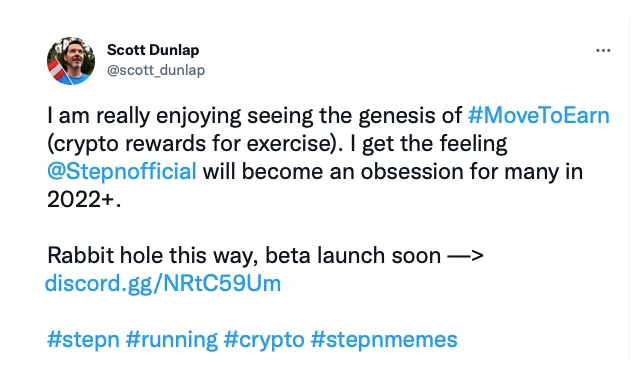
Dunlap is far from alone in his optimism. Over recent months, numerous fund managers and crypto KOLs have voluntarily promoted STEPN to both crypto-native and mainstream audiences—some through public endorsements, others via detailed analyses of gameplay and economics:
"It's such a simple design. People equip NFT sneakers and earn tokens simply by walking or running. The game features a built-in decentralized wallet with swap functionality, cross-chain conversion, and robust anti-cheating mechanisms to prevent exploitation," said Mike Dudas, former Google Wallet executive and partner at 6th Man Ventures.
"STEPN is the first of its kind—a true pioneer blending gamification with mobile earning mechanics. Soon, every runner will earn tokens and collect NFTs while tracking their progress. This convergence of crypto incentives, NFT collecting, and real-world utility offers a glimpse into how the physical and digital worlds may merge in the future," said Dan Patterson, partner at Sfermion.
STEPN is a Move-to-Earn (M2E) NFT game built on the Solana blockchain. It previously ranked fourth in the Solana Hackathon's gaming category and received an official grant.
Move-to-Earn games represent a new form of GameFi where players use real-world movement data as input to earn tokens and NFTs as rewards.
"We came up with the idea for STEPN back in early August last year. While we weren’t the first to propose M2E, we were the fastest to execute—delivering the product within just 120 days," said the STEPN team.
According to its official website, STEPN launched a test version in November last year, inviting over 1,000 players from 43 countries. It achieved a weekly retention rate exceeding 70%. The public beta launched in December and within a month, STEPN surpassed Nike in download rankings on Japan’s app stores, sparking discussions across international forums. Currently, STEPN boasts over 30,000 daily active users and is hailed as the next Axie Infinity.
(1) Diversified Gameplay Breaks Homogeneity in Blockchain Games
The core gameplay of STEPN is straightforward: players equip NFT sneakers in the app and earn tokens by running or walking in real life. These earnings can be used to upgrade or repair shoes to increase earning efficiency, or sold directly.
Here’s how to get started: first, download the STEPN mobile app from the official website and register using an email address. After logging in, players can create or import an existing Solana wallet and transfer SOL to it for purchasing NFT sneakers and receiving in-game rewards.
Within the marketplace, there are four types of NFT sneakers: Walker (walking), Jogger (jogging), Runner (running), and Trainer (training). Each type imposes speed limits—for example, Walkers must stay between 1–6 km/h; going outside this range stops token generation. The Trainer has the broadest range (1–20 km/h) and is typically the most expensive.
Each sneaker type comes in five tiers: Common (gray), Uncommon (green), Rare (blue), Epic (purple), and Legendary (orange). Higher-tier sneakers have better attributes and generate more tokens.
After acquiring NFT sneakers, players can begin playing. Key gameplay modes include:
· Solo Mode: Tap “Start” to begin running and earn tokens. With identical sneakers, longer activity duration yields more tokens. However, daily earning capacity (“energy”) is capped—once depleted, no further tokens are earned. This will be further explained in the economic model section.
· Mint New Shoes: Players can combine two level-5 sneakers to mint a new one. Each sneaker allows up to seven mints. The result is a mystery box that can either be sold directly on the NFT market or opened to reveal the new shoe for personal use or further upgrades.
Interestingly, minting can produce “mutations”—even two common sneakers might yield a higher-tier or different-type shoe. One community member reported crafting an Uncommon sneaker from two Commons and selling it for over $1,000.
· Rent Sneakers: Players with multiple sneakers can rent out those that have reached level 10. No deposit is required, but the NFT cannot be transferred during rental. Revenue is split 70% to the renter and 30% to the owner, with STEPN taking an 8% fee. This feature enables collaboration with future gold-farming studios, offering substantial passive income opportunities.
Beyond these three modes, STEPN plans to introduce marathon events where participants earn rewards based on rankings. Additionally, a background mode will allow players to earn GST even when the app isn’t open, by pulling step data directly from device health apps. (For detailed rules and gameplay, refer to linked articles.)
(2) Challenges and Areas for Improvement
"The game design is great, but it’s a bit hard on the hands. Sometimes if I don’t swing my arms while walking with the phone in my pocket, the data gets skewed and I earn fewer tokens," Player A told Odaily Planet Daily.
This issue stems from STEPN’s anti-cheating mechanism. To prevent fake movement, STEPN uses motion sensors to detect actual human gait patterns—different movements produce distinct waveform signatures to verify authenticity.
However, this system occasionally misclassifies legitimate activity. For instance, in colder regions, users may keep phones in pockets, causing the system to flag them as inactive. The team acknowledges this and aims to refine algorithms for greater accuracy.
Other users report inaccurate step counts or failures to record steps in underground tunnels or office buildings. STEPN attributes this to unstable GPS signals. While no perfect solution exists yet, the team has developed a new algorithm—beta tests show a 70x improvement in GPS precision compared to traditional fitness apps and devices.
Players must transfer SOL from their wallets to an in-game Spending Account to purchase sneakers and receive rewards. However, transfers sometimes take too long, and managing two separate accounts is inconvenient. Internal wallet transactions occasionally fail, and the current NFT marketplace interface is disorganized with no access to transaction history. In response, the team has announced upcoming updates merging the spending account with the main wallet and upgrading the NFT marketplace for smoother trading.
Lastly, some users note that the floor price for NFT sneakers has risen from 1–2 SOL to 8–10 SOL, and GST token prices have increased, raising entry costs and extending payback periods for new players. While this reflects growing popularity, it’s a common challenge during the growth phase of most blockchain games, and currently difficult to resolve effectively.
(2) Is STEPN Just a Copycat of Qubool?
For fitness enthusiasts, the Move-to-Earn model offers tangible financial benefits. This propelled STEPN to instant fame, making it a darling of the blockchain gaming scene.
However, some users interpret STEPN’s model as “exercise-as-mining,” inevitably drawing comparisons to the once-popular Chinese app Qubool. Critics argue STEPN is merely a rebranded version destined to collapse like its predecessor. But is that really the case? Will STEPN suffer the same fate?
STEPN argues that projects like Qubool failed because they lacked a balanced mechanism for token minting and burning. GameFi, however, offers a solution. To this end, STEPN has developed a more sophisticated dual-token economic model.
Let’s examine Qubool’s model: users invested in “scrolls” to generate “candy” tokens based on activity levels. Referring new users boosted activity and thus rewards. Ultimately, the game devolved into a referral pyramid scheme, betraying its original fitness purpose. Moreover, candy tokens were infinitely inflated with no consumption mechanisms, causing prices to plummet and eventually triggering a mass exodus. Within two years, Qubool reportedly amassed 120 million victims and was investigated by authorities in multiple regions for suspected传销 (pyramid schemes), illegal fundraising, and financial fraud.
The fundamental difference between STEPN and Qubool lies in the absence of referral incentives. STEPN avoids multi-level marketing entirely. Instead, through a dual-token system, it introduces multiple token utilities to increase consumption while implementing constraints to limit supply—achieving dynamic equilibrium between inflation and deflation.
Specifically, STEPN has two tokens: GST and GMT. They share some overlapping functions but also serve distinct roles. GST has infinite supply and is primarily earned by moving in Solo or Background Mode. GMT has a fixed cap of 6 billion tokens and is awarded once sneakers reach max level (Level 30).
On the supply side, STEPN imposes daily earning caps. Initially, players can earn up to 5 GST per day, increasing to a maximum of 150 GST/day after upgrading sneakers. The daily cap for GMT is 5 tokens.
Key use cases for GST and GMT include:
1. Upgrading Shoe Levels. Players burn GST to upgrade sneakers from Level 1 to 28. The required amount increases exponentially with each level. Upgrading from Level 28 to 30 requires burning both GST and GMT. Token costs per upgrade stage are shown below:
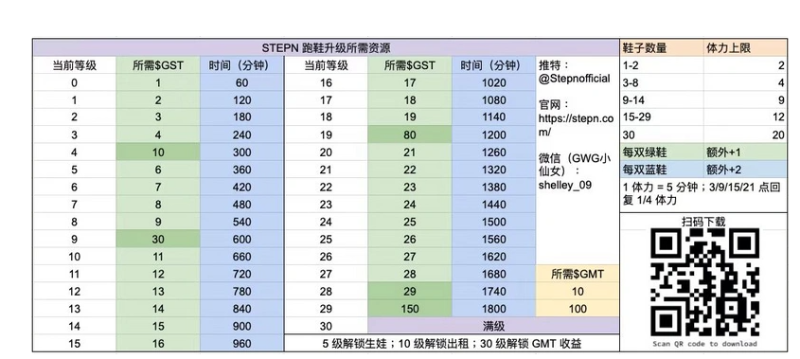
(Data compiled by community members)
2. Accelerating Upgrade Time. Each upgrade takes time—e.g., Level 29 to 30 requires 30 hours. Players can pay GST to accelerate, with costs increasing exponentially per level.
3. Shoe Repair. Every run causes wear (starting at 100, decreasing over time). Once wear exceeds 50%, earning efficiency drops sharply. Regular maintenance is essential, and GST serves as the primary repair token—creating strong, consistent demand.
4. Minting New Shoes (Mint). Minting Common, Uncommon, and Rare shoes consumes GST; Epic and Legendary shoes require GMT. The required token amount increases linearly with each mint. For example, minting two zero-mint Common shoes for the first time costs 200 GST (~$700 at current rates). Detailed figures shown below:
Beyond these, GST can also unlock gem slots (gems add skill points to shoe attributes), upgrade gems, and respec shoes.
GMT is used for premium in-game actions such as renaming shoes and advanced upgrades. More importantly, GMT enables governance. Profits are distributed via DAO voting, with GMT holders deciding how much revenue goes toward carbon offset initiatives. Additionally, locking GMT in the profit pool grants higher voting power.
Many compare STEPN’s GST and GMT to Axie Infinity’s SLP and AXS, but there are crucial differences.
SLP is uniformly minted with limited destruction—only burned in specific cases (like breeding Axies). This leads to faster issuance than burning, causing inflation. Excessive developer intervention further distorts market expectations, rendering future interventions ineffective. STEPN builds upon these lessons by designing numerous “token utility scenarios” that encourage high-spending players to burn tokens aggressively. It also accommodates non-NFT holders via the rental system, lowering the entry barrier.
"By carefully analyzing Axie Infinity’s SLP tokenomics, we understood the core challenge—how to balance supply and demand when token supply is uncapped. We studied everything from Keynes to Hayek, from token circulation to network effects," said the STEPN team. "We realized that uniform token minting must be counterbalanced by systematic burning—through voluntary, mandatory, or structural mechanisms. Temporary token issuance must be offset by consumption that creates value beyond mere currency."
As intended, GST has maintained price stability since launch, avoiding extreme volatility. Recently, due to market sentiment, some new users began hoarding GST, briefly pushing its price to $3.5.
In summary, STEPN employs a dual-token model: it creates diverse utility scenarios for GST and GMT to enhance usability, while simultaneously controlling issuance to reduce sell pressure. Simple “mine-and-dump” strategies are discouraged, and returns are implicitly constrained and diversified. This approach addresses longstanding issues in blockchain gaming, helping avoid death spirals during bear markets—the biggest risk facing most GameFi projects.
(3) Paradigm Shift: From P2E to M2E
In 2021, Axie Infinity took Southeast Asia by storm, expanding “Play-to-Earn” (P2E) beyond crypto circles and introducing GameFi to the masses. Now, STEPN is driving another shift in the industry: the transition from P2E to Move-to-Earn (M2E).
From a gameplay perspective, traditional blockchain games often require significant skill and learning. Some gold-farming studios even train players professionally. In contrast, STEPN embraces a more accessible M2E concept with broad appeal and low barriers to entry—players simply tap “Start” and begin moving.
Blockchain already has a steep learning curve for outsiders. Adding complex mechanics only deters mainstream adoption. In this regard, STEPN is clearly more welcoming to non-crypto users.
STEPN sees vast potential in the M2E market. Citing survey data, its website notes that in 2017 alone, 55.9 million Americans ran regularly and 111 million walked for fitness. Online fitness grew 33% year-over-year in 2021. Expanding into this space could bring millions into Web3. To promote the concept, STEPN has already sponsored two charity runs in Australia.
Moreover, focusing on health and fitness enhances STEPN’s social value. Traditional games require prolonged screen time and manual interaction. STEPN frees players’ hands and eyes—rewarding physical activity with both health benefits and economic gains.
"Unlike traditional Play-to-Earn games, Move-to-Earn creates a tighter link between the on-chain and real worlds. It’s no longer just slapping a game skin over DeFi, nor forcing players to mindlessly click near-identical interfaces for rewards. Instead, it actively motivates physical activity, delivering passive income alongside improved health," said the STEPN team.
More importantly, guided by values of low-carbon living and wellness, STEPN contributes to global carbon neutrality efforts.
Per official plans, GMT holders will vote on how STEPN allocates treasury revenues to purchase on-chain Carbon Removal Credits, supporting climate action transparently. Users can also voluntarily donate GST—converted into USDC/fiat to buy carbon credits or permanently burned.
(4) Conclusion
Every game has a lifecycle, and sustaining long-term engagement is extremely difficult. Most games combat decline by constantly adding new features to retain users—but each update raises the learning curve for newcomers.
STEPN learns from this pitfall, sticking to simple, intuitive gameplay that allows non-crypto users to easily enter the blockchain gaming world through healthy physical activity. At the same time, its dual-token economic model balances token creation and destruction, reducing the risk of a bear-market death spiral.
STEPN’s vision has attracted strong investor support. In January, it secured $5 million in seed funding led by Sequoia Capital India and Folius Ventures, with participation from Solana Ventures, Alameda Research, 6th Man Ventures, Sfermion, Santiago Santos (former ParaFi Capital partner), and Zhen Cao (Republic Asia partner).
The M2E paradigm is reshaping the future of blockchain gaming.
Join TechFlow official community to stay tuned
Telegram:https://t.me/TechFlowDaily
X (Twitter):https://x.com/TechFlowPost
X (Twitter) EN:https://x.com/BlockFlow_News
 Odaily