








Interviewing Major Crypto Leaders: What Are They Watching in 2022?
TechFlow Selected TechFlow Selected
Interviewing Major Crypto Leaders: What Are They Watching in 2022?
The narrative that "software is eating the world" continues to unfold on a large scale in web2.
 Navigating Web3 tides with focused insights
Written by: Mario Gabriele
Translated by: Block unicorn
Here are the most exciting crypto trends that investors, operators, and founders should know about in 2022:
1) Sovereign data could transform the internet. Projects like Ceramic allow users to carry their data across the internet. Two contributors highlighted this open-source protocol, describing how it changes the way we build and interact with on-chain applications.
2) Music NFTs are poised for a breakthrough. If 2021 saw an explosion of profile picture (PFP) NFTs, 2022 may elevate music NFTs. Musicians, fans, and vertical NFT marketplaces like Catalog all stand to benefit significantly.
3) DAOs can solve real problems. DAOs can do more than just bid on the U.S. Constitution—they might become a vehicle for developing life-saving drugs. VitaDAO, focused on longevity research, could prove to be a pioneer in the nascent "DeSci" movement.
4) Infrastructure development is accelerating. Existing infrastructure has struggled to keep up with growing crypto adoption. Better rails are needed to unlock the next phase of growth. In this regard, Pocket Network could prove essential. The multi-chain protocol enables decentralized cloud computing worldwide.
5) Wallets go beyond transactions. Current crypto wallets (like MetaMask) were built to handle and track transactions. However, wallets are increasingly becoming places to track digital goods and experiences—extending into identity, which could benefit newcomers like Genesis.
What is DeSci? Decentralized Science (DeSci) makes the entire process—from publishing to funding—more open, visible, and frictionless.
I first heard the word “Solana” in February 2021—I don’t recall if it was from a conversation or a skimming article. If I’d looked deeper, I might have learned what Solana was, why it was interesting, and even how much a token cost. I might have discovered it was a new Layer 1 protocol designed for massive scale, backed by some of the smartest builders and investors, trading at around $6.50.
The second time I heard about Solana was in late May, when David Rosenthal from Acquired shared what he’d learned during a walk in San Francisco. It piqued my interest, but not enough to place a bet. At that time, Solana traded at around $27.
In August, I published a trilogy on FTX, the cryptocurrency exchange. As part of that, I spoke with early Solana adopters including Sam Bankman-Fried and Kyle Samani, by which point SOL had reached $33.
Two weeks later, my friend Packy McCormick published his piece on protocols. Finally, I bought my first Solana tokens at $70 and began regular purchases.
I share this anecdote not to show I’m an idiot (though, in this case, perhaps I am). More importantly, it illustrates how many times we can hear about a topic before it truly begins. Even when it comes from people you admire and respect, it can take a long time to cut through the noise.
Today’s article aims to shorten this process for all of us. Instead of waiting for the most exciting crypto projects and trends of the year to unfold, I asked some of the most thoughtful people I know to share what they’re watching—and explain what excites them about their picks, helping us move beyond mere recognition.
While this isn’t investment advice—and if you need proof of the industry’s volatility, just look back at recent pullbacks—I hope by the end of this article you’ll understand what’s worth watching this year.
Matt Shapiro, Partner at Multicoin Capital
Incentivizing Infrastructure Development via Cryptoeconomics
Crypto is beginning to touch the real world in fascinating ways. The technical foundations of crypto have advanced enough that entrepreneurs outside the space—with deep domain expertise—are realizing they can leverage it to disrupt existing industries or rewrite traditional rules. The best example so far is Helium, which disrupted wireless networking by using cryptoeconomic incentives to drive real-world infrastructure deployment.
Render Network is another exciting example, representing the convergence of digital rendering and crypto. 3D objects and realistic graphics in film and video are computationally intensive. With the rise of the metaverse, there will be a need to create and render virtual environments, along with millions of avatars and NFT accessories to populate digital spaces. This will require countless hours of dedicated GPU time to make the metaverse possible.
Cryptoeconomic incentives are ideal for attracting latent assets at near-zero marginal cost and scaling production through new markets. Render Network does exactly this, leveraging a global pool of idle GPUs. Moreover, as Ethereum transitions to a proof-of-stake consensus mechanism, we expect a full GPU market to become available for image and video rendering.
But markets are two-sided. Simply organizing supply won't work without demand. Render Network has a unique advantage due to its relationship with Otoy, which has been at the forefront of rendering software for over a decade. Today, its flagship solution, Octane Render, is widely regarded as the leading GPU rendering tool. It's used by major studios like Disney and tens of thousands of digital artists including Beeple. Otoy provides Render Network with a built-in user base—customers currently doing rendering elsewhere, including on Amazon and NVIDIA.
RNDR, a forgotten 2017 token, is undergoing a major upgrade. The token design is being updated to include staking and governance functions. Render Network is migrating to Solana for greater speed and execution capability and integrating with Metaplex. Other major rendering solutions, such as Redshift, have already joined the network.
For these reasons, Render Network is positioned as a core infrastructure component connecting web3 and the metaverse.
Structured Products
As DeFi evolves, I’ve been watching structured products closely. With new capital entering the space to offset borrowers’ demands, overall DeFi yields have declined. Yet capital inflows haven’t slowed—in fact, they’re increasing as traditional asset managers join, hoping to exploit inefficiencies and arbitrage opportunities.
As more capital flows into yield and derivatives protocols, structured products find themselves in a compelling position. For example, covered call strategies are well-established in traditional finance, but typically too complex for most retail investors to understand and execute quickly. Crypto’s programmability removes this complexity, making it simple (one-click) for long-term holders to generate yield on their assets by writing covered calls.
This segment is rapidly evolving and gaining impressive traction. It includes structured product protocols like Ribbon and StakeDAO on Ethereum, and Katana and Exotic on Solana. Demand for these products also benefits underlying options protocols such as Opyn and Hegic on Ethereum, and Zeta and PsyOptions on Solana. We’re still early, but this is a space to watch in DeFi.
Li Jin, Co-Founder of Variant
Universal Basic Capital via DAOs
Crypto will serve as a testbed for ambitious economic and social experiments—building a fairer internet than what exists in web2.
Income inequality has worsened in most developed countries over recent decades. The concept of Universal Basic Capital (UBC), or universal basic wealth, addresses structural inequality by granting people ownership of appreciating assets. Examples include Alaska’s sovereign wealth fund, which pays dividends from oil revenues, and Singapore’s Central Provident Fund. Compared to simply redistributing income, UBC offers advantages: basic capital acts as a safety net, increases bargaining power, enables risk-taking and entrepreneurship, supports long-term goals, and reduces financial anxiety.
While economists, executives, and political leaders debate how to implement UBC at scale, DAOs are already ready to experiment here. According to DeepDAO, the total assets under management (AUM) of DAO treasuries listed on the platform rose from $400 million in January 2021 to $16 billion by December 2021. A portion of these treasury funds could be allocated to members’ base capital, invested over time to generate returns. Members could then use these accounts for retirement, education, healthcare, or startup funding. Examples include attempts to create forms of basic income or capital via DAOs such as Worldcoin, $UBI, Impact Market, and smaller-scale experiments like FWB’s artist residency grants or SuperHi’s Creative Basic Income.
Crypto gives us the toolkit to build new economies and societies. That brings with it the opportunity to ask how we want these economies to function and what kind of society we can create. I’m excited to see DAOs think beyond short-term user acquisition or engagement when designing tokens and financial strategies—instead treating them as foundations for a new, fairer world.
Aaron Wright, Co-Founder of Tribute Labs and The LAO
The Great Hybridization
In 2021, we saw the emergence of web3, thanks to three overlapping core trends: DeFi, NFTs, and glimmers of social tokens—all stitched together by the cartilage of DAOs.
In 2022, things will start getting weird. These three categories will continue growing and blending. DeFi will enter NFTs through lending and collateralization. NFTs will flirt with DeFi mechanisms. NFTs will morph into membership cards and social communities, with social tokens acting as internal incentives.
DAOs and DAO networks will continue thriving, supporting artists, creators, and novel financial products. They’ll enable more open-source tools, IP pools, and public goods. Tools—especially DAO tools, bridges, zk-tech, messaging, privacy, and storage—will improve and mature, unlocking more ways for people to collaborate in emerging multiplayer modes.
Millions (if not more) will enter crypto via NFTs, opening new collector demographics. NFTs will no longer be limited to PFPs, gaming items, virtual worlds, and digital art. They’ll begin consuming other media forms (with no apparent headwinds), such as fashion and music.
Who knows what prices will do—but if the web3 ecosystem attracts more capital, the wealth generated will increasingly be directed toward solving harder problems, such as decentralized science and climate change.
Annika Lewis, Grants Program Lead at Gitcoin
Ceramic
Data is everything. It's a valuable asset in itself, as evidenced by the rise of companies like Facebook and Google. Both became among the world’s most profitable enterprises by harvesting data from billions of users.
A macro shift in data ownership and value capture is underway. Web3 brings what I call “data de-platforming”—that is, decoupling the application layer from the data layer. These layers have traditionally been fused under single-entity control. Data de-platforming enables user-controlled data storage—a paradigm shift for both users and developers.
No one is better positioned to embrace this transformation than Ceramic. Ceramic is an open-source protocol for decentralized applications building the data rails of web3. For developers, it allows building apps without relying on trusted centralized database servers—the norm until now. Ceramic breaks down data silos for end users, letting them transport data across platforms. In doing so, it puts data control back in users’ hands.
Ceramic is rapidly gaining adoption, with notable projects already built on the protocol. With an incredible team and a vast problem space, Ceramic is one to watch in 2022.
Ken Deeter, Partner at Electric Capital
Multi-chain and 2.0
Last year, the multi-chain narrative shifted dramatically. Ethereum Virtual Machine (EVM) compatibility and high transaction costs on Ethereum mainnet allowed competing chains to attract apps and users. However, much of the activity I've seen has been copy-paste—forks and imitations of successful Ethereum projects, plus aggressive liquidity incentives.
Long-term, successful competitor chains will attract entirely new types of applications priced out of Ethereum and leveraging each chain’s unique architectural advantages. We’re starting to see examples of games and NFT marketplaces built natively outside Ethereum mainnet—but this space is only just beginning.
DeFi Tokenomics Revival
Protocol-owned liquidity, vote-locking, bonds, curve wars—DeFi has seen rapid innovation in the economic design of governance tokens. Best practices are evolving quickly. Thanks to these improved designs and incentives, new protocols can rapidly gain market share. Early DeFi projects are reevaluating and restructuring their core economics based on recent innovations. Communities are being disrupted and reorganized. Over the next year, I believe we'll see a clear divide between protocols adapting to integrate these new mechanisms and those stuck in old ways.
Gaby Goldberg, Investor at TCG Crypto
Wallets as Identity
In 2022, wallets won’t be crypto wallets. They’ll be native web3 wallets—built for identity, navigation, personalization, and media.
To date, all wallets have been built and designed around transactions. Many have existed for over three years, created specifically for buying, trading, and holding tokens. Since then, as the ecosystem has expanded, wallet use cases have evolved. As we enter web3—a more social, open, and interoperable internet—we’re seeing increasing demand for wallets as places to store NFTs (see Rainbow or Coinbase Wallet) and multimedia experiences (see Glass, Sound, and Altered State Machine). In short, wallets are becoming places where people want to spend time. Existing wallets won’t (and frankly, can’t) adapt to this new behavioral preference.
When considering how this ecosystem-wide shift might happen, we can examine factors that drove user adoption of previous mass-market wallets. Take MetaMask: in July 2020, it had 545,000 monthly active users (MAUs). By August 2021, that number surged past 10 million—driven by surging interest in “DeFi Summer,” where yield farming acted as a consumer onboarding funnel. At the time, using MetaMask to access DeFi yields was a clear choice because MetaMask was more accessible (widely supported) than competitors.
We can draw parallels between that example and today’s web3 ecosystem. Supply of NFT projects, new yield farming opportunities, and social web3 platforms are all at historic highs—and rising. Traditional wallets will initially absorb new demand. But as apps, use cases, and behaviors diversify, users (and developers) will need integrated wallets that support leveraging on-chain sources and transferring your digital identity across apps and chains. For these reasons, I’m excited about wallets like Genesis, Bitski, and Sudo.
My brilliant friend and investing partner Jay Drain put it best: “Right now, crypto wallets look very much like stock… In the future, they’ll more clearly represent our digital identities by making them composable across the web.” I recommend checking out his full piece here.
John O'Connell, Investor at True Ventures
Stader Labs
One project I’m excited about is Stader Labs. Stader is building the “Amazon of staking”—letting users easily stake their cryptocurrencies and earn passive income through various strategies based on user preferences.
Stader launched on Terra, allowing users to automatically compound their LUNA staking rewards to maximize returns, while distributing their assets across various validators to encourage further decentralization of the Terra blockchain. Stader also launched LunaX, a liquid staking derivative of LUNA, enabling users to interact with other DeFi applications within the Terra ecosystem.
Today, Stader manages around 6.1 million LUNA across different strategies (worth approximately $490 million at the time of writing). Going forward, Stader plans to launch similar products on other blockchains, including Solana and Ethereum. They’ll also introduce advanced strategies to further enhance their platform’s role within their growing community. (Disclosure: True Ventures is an investor in Stader.)
Altering the State Machine
Another exciting project is Altered State Machine (ASM), building a protocol to add enhanced AI capabilities to NFT projects. ASM recently dropped a project called “Brains.” NFTs are unique artificial intelligences that can be trained and used in different ways.
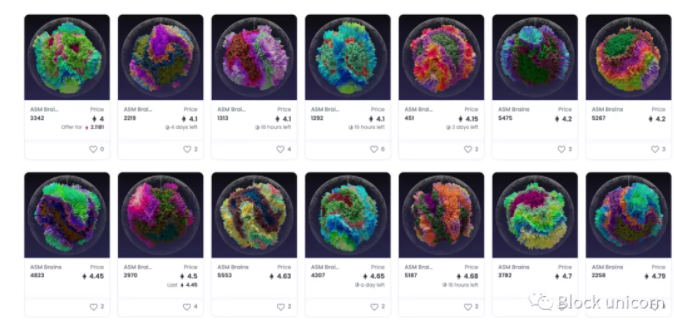
For example, ASM launched the Artificial Intelligence Football Association (AIFA). Holders can use their Brains to play AIFA’s play-to-earn video game with special “All-Star” characters. As Brains are used in games like this, they develop skills and abilities that make them more valuable in the future. Users can also passively train them using ASM’s simulation modeling technology.
Going forward, Brains will be usable in other DeFi, gaming, and crypto contexts. Holders might even combine Brains to mint new NFTs, bringing new participants into the ecosystem. (Disclosure: True Ventures is an investor in ASM.)
Andy Weissman, GP at USV
Digital Fashion
I'm particularly curious about what unfolds in the evolving world of digital fashion. Digital identity clearly matters—4.5 billion social media consumers already use digital identities and avatars. As Dani Loftus, founder of digital studio Draup, wrote:
Avatars forming the foundation of your identity aren’t curated from your physical life, but are fully created digitally, offering you opportunities for self-expression in entirely new ways.
What new forms of self-expression will emerge? What new tools and platforms will be invented for emerging designers? What new ways of wearing, sharing, selling, and distributing will arise? And what happens when you blend these concepts with web3’s core principles—composability and transferability?
I’m keeping an eye on names like: Dani Loftus, UNXD, DressX, The Fabricant, Artisans, Charli Cohen, RED DAO, and XXXXTH. (Note: Some of these outstanding individuals are my friends!)
Jackson Dahl, Resident Entrepreneur at Paradigm
The Rise of Pseudonymity
I’m excited to see more people exploring and building pseudonymous tools, especially within the context of web3. While the past decade of the internet has largely centered on real-name identity, I believe we're entering a new phase where pseudonymity will become commonplace, if not dominant, across many media. Importantly, while there are privacy and security reasons for pseudonymity (which Balaji Srinivasan has discussed extensively), there are other significant implications—including social dynamics, identity expression, culture, and celebrity. Perhaps most importantly, pseudonymity allows identity to be contextual rather than fixed. In this sense, unlike anonymity, pseudonymity opens up a broad and rich design space.
Over the past year, anonymous influencers in gaming and crypto have grown—from famous creators (Dream, Corpse Husband, CodeMiko) to niche but highly engaged thought leaders with NFT-based identities (Gmoney, Punk 6529, 4156). There are also examples in art and fashion. We’ll see more people joining this cohort; people will use multiple identities, and some identities will be composed of multiple people. We’re already seeing widespread pseudonymity on platforms like Reddit, Discord, Tumblr, and even parts of Twitter and Instagram.
This trend doesn’t have a direct link to web3. But NFT identities, on-chain reputation, decentralization, and composability are critical to its development. As we spend more and more of our lives in digital spaces, I hope flexible identities will become as important a factor in shaping our ideal future as digital currency and property rights.
Richard Chen, GP at 1confirmation
Vertical NFT Markets
OpenSea is our portfolio’s biggest winner. While it will remain a generational company and the dominant secondary NFT marketplace, I believe vertical-specific markets will carve out niches with superior UI/UX, search, and discovery features. SuperRare is a successful example of a premium 1/1 crypto art marketplace, but there will be others in categories like photography (Sloika), metaverse (Metahood), and music (Catalog).
I’ll highlight music NFTs in particular—it’s surprising that music NFTs haven’t exploded yet, unlike fine art, collectibles, and gaming. But I feel collector tastes are shifting rapidly. Leading music NFT marketplace Catalog had a breakout month in October, and its volume chart resembles what I saw before the crypto art explosion on SuperRare in early 2020. For music, it’s a matter of when, not if.
Tina He, Co-Founder of 0xStation
The Birth of New “Cities”
In 2022, we’ll rethink the relationships between identity, contribution, and connection online. The most interesting assets are those capable of creating environments that deepen our understanding of ourselves.
Psychological currents have been converging on this point for some time. Both web2 and web3 startups are riding this wave from different directions and vehicles. Both recognize the democratizing power of tools that let everyday consumers participate in economic activities once controlled by a few institutions or corporations.
Reality is becoming increasingly plural and transcendent. The idea that “everyone is an investor” alone has spawned two venture-backed startups; Party Round and Syndicate are two expressions of the same belief. For some newcomers, the identity of “investor” must be earned through “contribution”—whether rising through the ranks of Mirror writing contests to become a thought leader, or discovering tactical niches with knowledge compounding. Those who invest together gather to discuss more investments, cultivating fertile ground for new social interactions built around shared asset ownership.
The “software is eating the world” thesis continues playing out at scale in web2. For most web2 companies, a coherent, seamless, and delightful user experience abstracts away legal plumbing and institutional adjustments achieved through SLAs, laborious digitization, and standardization. For web3 companies, these institutions are being created as entirely new entities and rapidly gaining legitimacy. The former will compete for consumer attention, while the latter will compete for legitimacy guardrails and invite an entirely new working class to help get there.
The most exciting trend in 2022 is witnessing how this story of many cities unfolds—giving birth to new workers, citizens, leaders, and infrastructure classes.
Cooper Turley, Full-Time DAO Contributor
Music NFTs
From independent artists like Daniel Allan and Haleek Maul to Nas and 3LAU, musicians are tokenizing audio files en masse, giving fans a way to collect their favorite songs or albums. Here are some market leaders:
1) Catalog. As the premier 1/1 music NFT marketplace, Catalog was the first major platform to tokenize audio files by building on Zora. It features well-known artists, rising performers, and debut records. Having sold over $2 million in records to date, Catalog has become a cornerstone of the music NFT movement.
2) Sound. Hosting listening parties has never been more satisfying. Sound lets musicians share new music by releasing a numbered set of NFTs, allowing listeners to support their favorite artists. Early versions are considered more valuable than later ones, incentivizing discovery. To date, Sound has hosted twenty-nine sold-out listening sessions, all filling up within the first minute of going live. With a growing secondary market, Sound is one to watch.
3) Royal. Earlier this week, Royal launched its first product, letting fans collect NFTs with direct royalty claims. By enabling credit card payments, Royal appears to have attracted many non-crypto natives—40% of participants used this method to join the drop. For web3 newcomers, Royal offers a promising solution.
Beyond music NFTs, the space includes a growing number of record labels, agencies, and collectives coming together to collect music. Whether you're a fan, degen, or artist, there’s something for everyone.
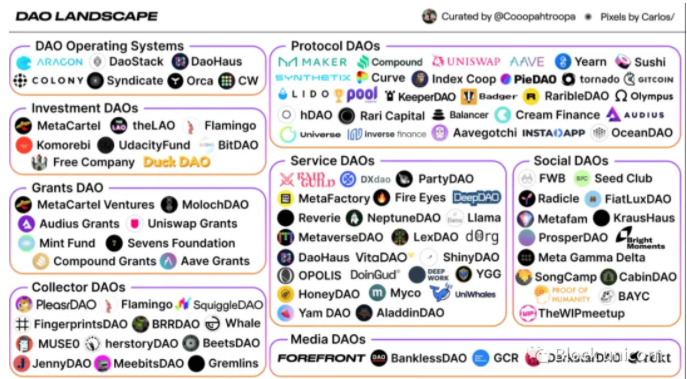
DAO Ecosystem
Hanel Baveja, Investor at USV
The Emergence of DeSci
Reimagining the structures that make drug development opaque and misaligned today may require a completely orthogonal, non-obvious perspective: DeSci.
DeSci makes the entire scientific innovation process—from publishing to funding—more open, visible, and frictionless. It expands who can become stakeholders in new scientific IP and aggregates resources—human and capital—in novel ways through DAOs and other web3 structures to bring more new IP into the world. Perhaps DeSci’s most radical vision is empowering broader stakeholder groups—patients, researchers, and enthusiasts—with positive market incentives, delivering cheaper, better outcomes for all.
There are already several interesting projects in DeSci, including Molecule, VitaDAO, and others. For this emerging category, I have more questions than answers—which only makes me more excited about what’s to come.
Alexis Ohanian, Founder of 776
Bored Ape Yacht Club
As an early ape holder, I’m biased—I’ve converted many people from my former co-founder Garry to my own wife (I bought her as a gift)—but I believe we’ll see even more from BAYC in 2022 that resets our expectations of what NFTs x Culture can achieve.
Maria Shen, Partner at Electric Capital
DAOs as a New Subculture
The internet eliminated geographical boundaries, allowing communities to form around any interest, no matter how niche. Crypto unlocks the ability for anyone to create large-scale coordination systems.
DAOs leverage both the internet and crypto, enabling tribes of strangers to pool resources for common purposes. With DAOs, people can now collectively pool resources and use governance processes to decide how to allocate them. DAO creation is growing exponentially—from a trickle of one or two per day to a flood. The largest DAOs manage treasuries worth billions, issue grants, and hire large teams. In contrast, the smallest DAOs can be a group of friends pooling funds to buy an NFT.
DAOs provide jobs, donate to charities, fund initiatives, contribute to political campaigns, and throw grand parties. In the future, we may have as many DAOs as subreddits—except these organizations will be able to direct resources toward ideals they care about, beyond just forums.
David Phelps, Co-Founder of Ecodao
Ceramic
If you were a scholar in the years before the printing press, you were likely also a traveler—spending much of your time neither reading nor lecturing, but moving between libraries to study and copy books. You moved, but the books didn’t. Of course, the printing press changed all that: now books could move, so you didn’t have to—and centuries of revolution followed. But despite all technological progress, on today’s internet, we’re mostly pre-printing press. We can’t port our follows, preferred media types, reputations, audiences—our data—from one platform to another. Like scholars, we spend time moving between platforms; the media on them doesn’t.
What happens if our data becomes portable? We should expect at least four major social consequences:
1. People can track the impact of creative works as they’re shared, used, and monetized across the far reaches of the internet.
2. People will share more data with platforms to improve performance and recommendations, knowing it enhances their experience across the network.
3. People will be incentivized to contribute to public datasets, generating better analytics and social graphs for platforms to innovate upon. AI can leverage this information to automate many of our daily online tasks.
4. Platforms will compete to let users move their data and audience from one place to another.
In other words, data portability represents a massive social shift of power—from platforms to users. Or more precisely, from platforms to protocols, since users can only manage and transfer their data on standardized, verified, and streamed data rails. Platforms must build atop common data rails to leverage each other’s content and audiences. Still, as Joel Monegro suggested years ago, as users move their tokens, NFTs, content, followers, and reputations from one to another, platforms lose their moats. Meanwhile, data protocols strengthen their moats by enabling users to port data in the first place.
This behavior is realized by Ceramic as it develops blockchain-based data streams, letting us own our data. This means we can monetize our data, set automatic commissions whenever it’s used, and get rewarded by platforms competing for our presence. Furthermore, we can track and prove the impact of creative work: imagine writing a song that not only earns you money when others play it at events, but also automatically routes royalties back to you when someone remixes it without permission—while collecting usage data you can leverage for career opportunities and connecting with others of similar taste. In web3, our ability to manage data will let us manage our entire online lives. NFTs are merely the front-end representation of how we’re seen as data in the metaverse.
If the 2010s were the decade of distributed ledger technology (DLT) enabling sovereign finance, the 2020s will be the decade of providing all forms of sovereign data. We can return to our ancient scholars, wandering between libraries, futilely trying to share and translate each other’s texts so libraries might eventually resemble one another. In the less poetic web3 data stack, Arweave is like the library, hosting books, while protocols like The Graph and Kyve act as librarians, helping index and query the books we need.
But Ceramic is unique—not only because it provides a universal rail for platforms, but because it lets us write books inside the library in the first place. Providing tools to own and manage our data motivates us to collect and create entirely new types of data we haven’t even imagined. That’s the immense potential—not just owning our data individually online, but being rewarded for sharing and collectively reorganizing it into new public social structures we haven’t yet fully conceived.
Chase Chapman, Co-Founder of Decentology
Token-Weighted Voting
As DAOs become de facto structures in web3—holding large treasuries and millions of members—the stakes of getting things right are much higher. All of this makes organizational design failures in DAOs a significant risk.
Token-based governance is a well-documented organizational design failure. Not only can tokens be bought and used to manipulate votes, but token-based voting systems ignore domain expertise. For example, individuals with marketing expertise should have greater influence in marketing decisions. This failure dilutes expert knowledge.
In 2022, I expect to see major governance experiments slowly shifting from token-based voting toward mechanisms that allocate governance power based on merit, context, and required expertise. As tokens’ importance in governance declines, DAOs will be forced to ask what intrinsic value tokens actually hold—potentially driving innovation in new mechanisms that give tokens value beyond governance rights.
Brian Flynn, Co-Founder of Rabbit Hole
0xStation
If we’re playing the great online game, the next level is exchanging “social scores” for “contribution scores.” I believe 0xStation will play a key role in this shift. The project is building infrastructure to connect talent with the right projects in web3, helping members of the new economy work and play. As these individuals grow and engage, their achievements will appear on-chain, creating logs of skills and capabilities. Over time, I expect on-chain reputation to replace social status on sites like Twitter, better reflecting individual value and completed work. 0xStation will be a place to watch.
Julia Lipton, Founder of Awesome People Ventures
Syndicate
I remain bullish on DAOs. It’s still early, but it’s clear DAOs will unlock new types of organizations, projects, and investments previously impossible.
A key player in this space is Syndicate. They make creating investment clubs incredibly easy. Communities form overnight to invest in NFTs, DeFi projects, or even startups. Want to buy 100 CryptoPunks or run a DeFi investment fund? Interested in angel investing with friends? Syndicate might be your best option.
Establishing a traditional investment fund is expensive, time-consuming, and legally complex. Syndicate enables projects, friends, and trustless communities to coordinate capital for investment almost instantly. We’ll continue to see new ways of coordinating labor and capital in 2022, and I’m excited to see what comes next.
Fiona O'Donnell-McCarthy, Investor at True Ventures
JellyFi
I’m excited to highlight two projects led by incredible female co-founders. The first is JellyFi, which provides a simple source of liquidity for other DeFi projects. Unlike the typical over-collateralized loans we see in DeFi today, they offer under-collateralized lending.
Their clients are audited institutional borrowers (DAOs, dApps, and DeFi protocols) who use liquidity like a revolving credit line. This structure allows lenders to earn higher returns than those offered by over-collateralized DeFi lending platforms.
This excites me because it introduces a lighter, more efficient form of credit to the ecosystem. This will become increasingly important as high-potential DeFi projects navigate growing pains or temporary setbacks.
JellyFi was founded by four ConsenSys alumni, including Charlotte Eli, who worked on decentralized derivatives trading platforms at ConsenSys. (Disclosure: True Ventures is an investor in JellyFi.)
Dematerialized
While crypto remains male-dominated today, many women-led projects are capturing our attention and imagination. Dematerialized, a Net-a-Porter for the metaverse, is one of them. They collaborate with existing fashion brands and web3 artists to curate and launch digital and “phygital” fashion. In 2021, I bought my first phygital garment from The Dematerialized—a boot with a 3D NFT. The boots are definitely cooler than me.
Beyond the extraordinary products, two key aspects of this project stand out: its mission to address waste in the fashion industry by shifting consumption to digital platforms, and its commitment to attracting and onboarding new users to crypto through familiar UX.
DAOs Focused on Gender Diversity
Blockchain promises decentralization and dismantling traditional power structures, yet we still see significant gender disparities in the web3 world. HER DAO is a collective of female, transgender, and non-binary developers. Their mission is to increase representation in the field and ensure diverse perspectives are included when building revolutionary web3 products. One of HER DAO’s many initiatives includes scholarships for self-identified women to attend major conferences like ETH Denver.
Boys Club focuses on supporting women and non-binary individuals at every stage—from crypto-curious to fully degenerate—as they transition from club to DAO. I’m impressed by their ability to draw people into the space and encourage advanced web2 talent to consider web3 careers. I strongly recommend joining their Discord or following them on social media (Instagram and TikTok).
Join TechFlow official community to stay tuned
Telegram:https://t.me/TechFlowDaily
X (Twitter):https://x.com/TechFlowPost
X (Twitter) EN:https://x.com/BlockFlow_News






