After laying off 30,000 employees, Oracle hired a CFO with experience managing power plants.
TechFlow Selected TechFlow Selected
After laying off 30,000 employees, Oracle hired a CFO with experience managing power plants.
Sometimes, to understand where a company is headed, all you need to do is look at who it has hired.
 Navigating Web3 tides with focused insights
Author: Kuli, TechFlow
The most heated layoff news in the tech world recently centers on Oracle—the world’s largest enterprise database company—whose software runs the back-end systems of most banks and airlines globally.
According to CNBC, the company laid off approximately 30,000 employees. Just days later, it appointed a new CFO whose total compensation package amounts to $29.7 million.
Thirty thousand people out; one person in.
The departing employees each received severance packages equivalent to just a few months’ salary, while the newly hired CFO’s single contract equals the annual salaries of one thousand employees combined.
This move has sparked intense discussion on Reddit, where over 6,000 comments have accumulated—most expressing outrage at the stark disparity between executive pay and that of rank-and-file workers, criticizing the new CFO’s compensation as excessive.
It’s not the first time executives’ salaries—often several or even dozens of times higher than those of regular employees at major tech firms—have drawn scrutiny. But beyond the compensation itself, what interests me more is the new CFO’s professional background.
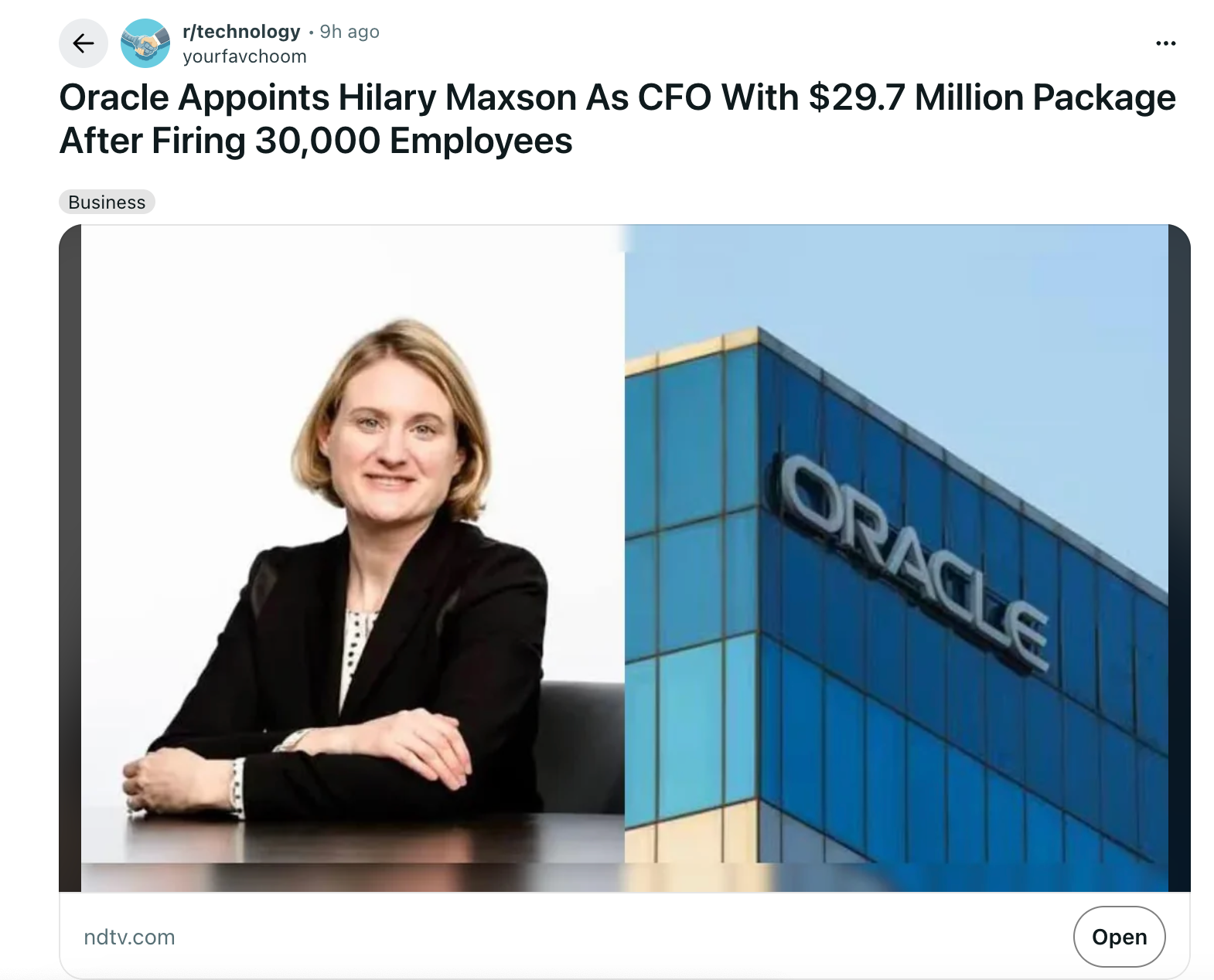
The new CFO is Hilary Maxson.
Prior to joining Oracle, she served nearly a decade as Group CFO at Schneider Electric—the world’s leading energy management company, specializing in power supply solutions for data centers and power grids, with annual revenue exceeding $45 billion.
Before that, she spent 12 years at AES Corporation, a long-established U.S. power company focused on building and operating power plants and managing electricity grids.
In other words, Oracle paid $29.7 million to hire someone whose entire career has revolved around electricity—managing power plants, overseeing grid operations, and leading companies that power data centers—only to appoint her as CFO of a company that has sold database software for 47 years?
There’s another lesser-known fact embedded in this decision.
For the past 12 years, Oracle has had no standalone CFO—the finance function was directly overseen by former CEO Safra Catz. According to CNBC, when Catz transitioned to Executive Chairman at the end of 2025, an interim financial leader filled the role for six months.
Now, Oracle has formally established the CFO position—and specifically recruited from the energy sector. That act itself carries far greater significance than the headline compensation figure.

Analysts at Bloomberg Intelligence interpret this appointment as a clear signal: selecting a CFO from an industrial company reflects Oracle’s strategic pivot—from database and enterprise software toward cloud infrastructure.
The numbers tell the same story.
According to Oracle’s latest earnings report, its cloud infrastructure revenue surged 84% year-on-year. Its capital expenditure budget for this year stands at approximately $50 billion—nearly all earmarked for AI data center construction, more than double last year’s amount. To fund this expansion, Oracle plans to raise $50 billion through debt and equity financing. Its total backlog of signed but unfulfilled contracts has soared to $553 billion—public disclosures indicate that one single agreement with OpenAI alone exceeds $300 billion.
A company lays off 30,000 employees who maintained legacy businesses—and then entrusts its finances and resources to someone drawn from the power industry. Read in context, Oracle’s leadership clearly no longer views the company as purely a software firm.
Yet capital markets remain unconvinced—for now. Oracle’s stock has declined roughly 24% this year.
Investors’ concerns are concrete. Historically, Oracle generated high-margin revenue selling database software and enterprise applications, where personnel were its largest cost. But AI is rewriting the economics of this business: large language models can now automatically generate SQL queries and manage databases—eroding Oracle’s 47-year-old technical moat, bit by bit.
Oracle’s response? A full-scale strategic shift.
Rather than selling only software, it’s now building data centers for AI companies. Public disclosures confirm Oracle signed a multi-billion-dollar infrastructure agreement with OpenAI—part of the “Stargate” data center initiative—and similar deals with Meta and xAI. Its total backlog of unfulfilled contracts has reached $553 billion.
This year’s capital expenditure budget—roughly $50 billion—is almost entirely dedicated to data center construction.
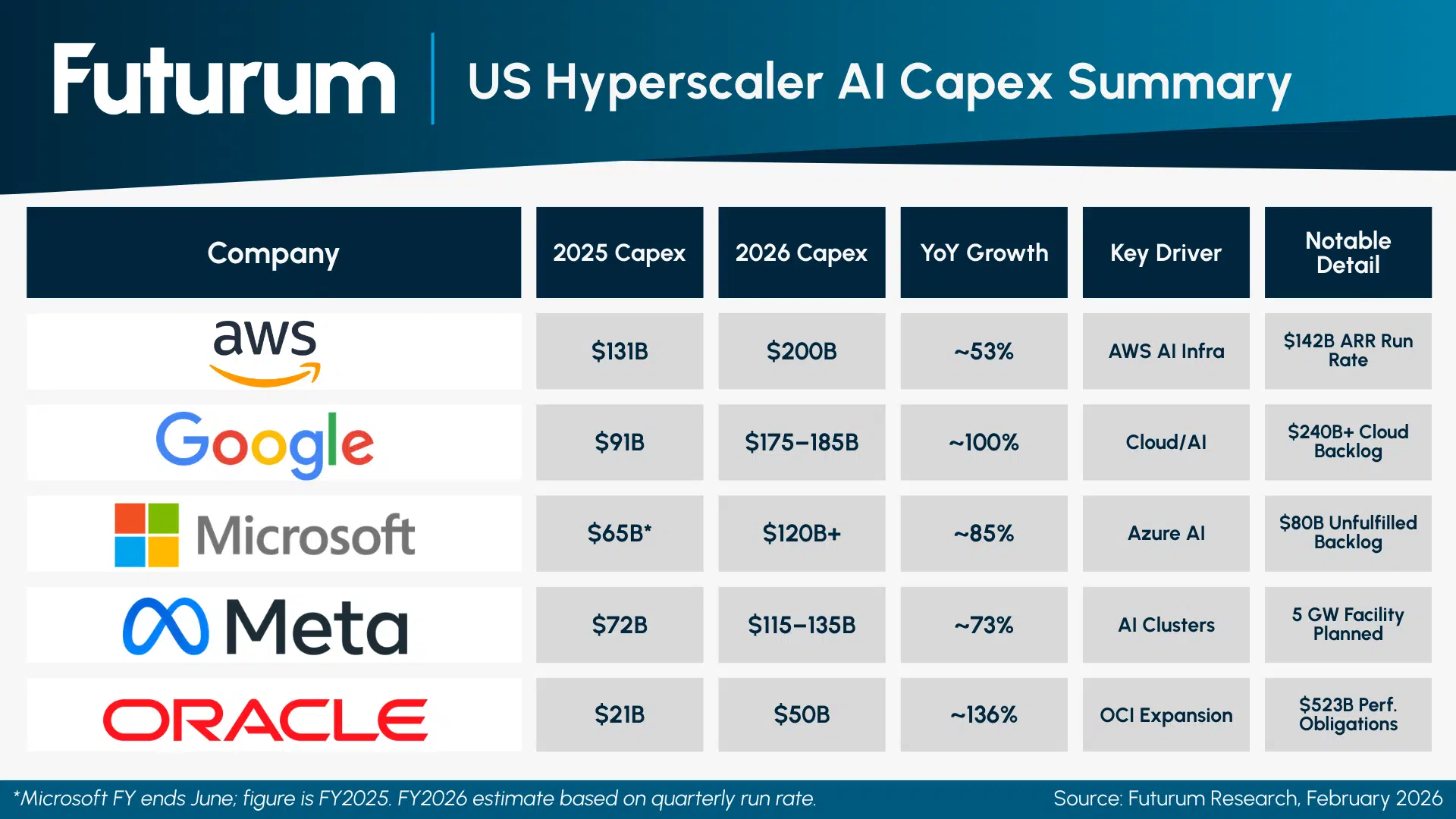
The two largest expenses in data center development are chips and electricity—cooling requires power, GPU computation demands power, and the annual electricity bill for a large AI data center can run into hundreds of millions of dollars.
Oracle is now constructing “gigawatt-scale” data center clusters. What does “gigawatt” mean? Roughly equivalent to the output capacity of a nuclear power plant.
That explains why Oracle went straight to the power industry to recruit its new CFO.
She previously managed power plants, oversaw electrical grids, and led companies that supply power to data centers. What Oracle needs now isn’t a finance leader versed in software profit margins—but someone who knows how to spend tens of billions of dollars building power infrastructure, and how to ensure those massive investments ultimately deliver returns.
Wall Street analysts, meanwhile, remain optimistic: of the 27 analysts covering Oracle, 27 have issued “Buy” ratings, with an average target price of $245—implying roughly 70% upside. Yet between a 25% stock decline and analysts’ bullish $245 target lies the same fundamental question: Can Oracle truly transform from a software company into an energy infrastructure company?
At least, in terms of personnel structure, it has taken its first step: out go the engineers who wrote code for decades; in comes the executive who managed electricity for twenty years.
Sometimes, to understand where a company is headed, you don’t need to read its strategy deck. You just need to look at whom it hires.
Join TechFlow official community to stay tuned
Telegram:https://t.me/TechFlowDaily
X (Twitter):https://x.com/TechFlowPost
X (Twitter) EN:https://x.com/BlockFlow_News
 深潮TechFlow